

10 Cars That Depreciate Faster Than The Honda Civic
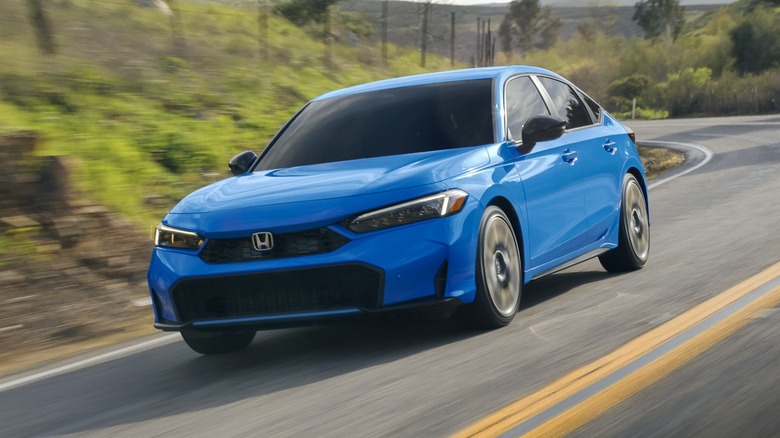
The Honda Civic is nothing short of an automotive icon. Currently in its eleventh generation as of 2026, the Civic is one of the best-selling cars of all time, with well over 27 million units sold since the very first Civic debuted in 1973. There is, truly, a lot to like about almost every generation of the car, and newer versions like the 2026 Civic Hybrid Hatchback offer a sensible blend of everyday usability, affordable pricing, and strong fuel economy.
One of the most compelling things about the Civic is that it holds its value very well. CarEdge expects a Civic to lose 29% of its value, while iSeeCars estimates a much more wallet-friendly 22.7%. While the exact percentages will vary depending on many factors, including who you ask, the bottom line is that Civic owners should be happy with the price they get when it comes time to sell.
That, of course, is not a luxury that every sedan owner will have. While most mainstream sedans perform decently here, not all do quite as well as the Civic. If you're curious about which cars depreciate more quickly than Honda's long-lived compact car, this is the list for you.
Subaru WRX
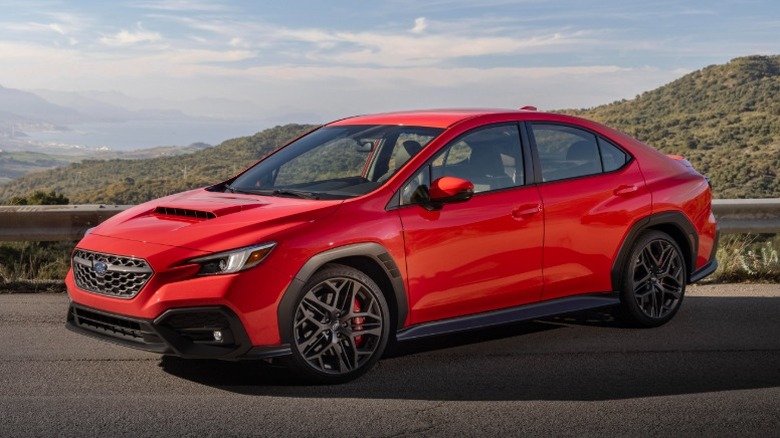
Buyers seeking performance-minded, four-door motoring for around $30,000 or so don't have that many options, but the ones they do have are quite compelling. One could, of course, go for the excellent Civic Si, which offers some of the Civic Type R's thrills at a significantly lower cost. But, depending on their preferences, they may well look elsewhere and end up with a rival performance sedan like the Subaru WRX.
The WRX, which is very closely related to the modern Subaru Impreza, has quite a few advantages over the Civic Si. Four-wheel drive is, of course, a given, as the Subaru WRX uses the automaker's signature Symmetrical All-Wheel Drive system. But the WRX also has the upper hand when it comes to power. While both use turbo four-pots, the turbocharged boxer engine in the WRX makes 271 hp and 258 lb-ft of torque, a significant chunk more than the 200 hp and 192 lb-ft that the Civic Si's turbo inline-4 offers.
Power isn't everything, of course, but you do get a very compelling package with the WRX, especially if you're willing to pony up Type R money for the WRX tS and its trick electronically-controlled dampers. One thing you don't get, though, is better value retention. According to iSeeCars, a WRX will depreciate 29.8% over five years, while CarEdge pegs it at 33%. Very close to the Civic, sure, but no cigar.
Toyota Corolla
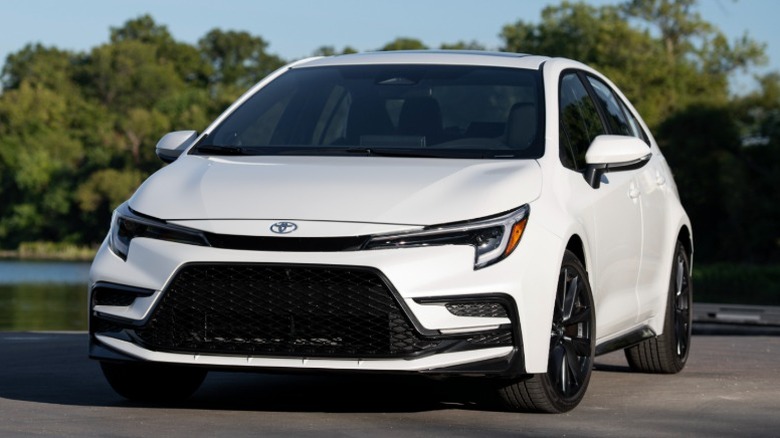
Honda isn't the only Japanese automaker to have a long-lived compact car in its lineup, of course. The Toyota Corolla is every bit as recognizable a compact car as the Civic, and it even predates it by about six years, having debuted in 1966. Even though many decades and Toyota Corolla generations have passed since then, the two nameplates are still fierce rivals, vying for drivers' hard-earned cash the world over.
While one can debate the merits of each car until the cows come home and probably never come to an iron-clad conclusion, one thing's for sure: in terms of resale value, the Civic takes the cake. But, as you might expect given how closely matched these cars are, the Corolla only trails its Honda rival by the slimmest of margins.
According to CarEdge, a Toyota Corolla should lose 33% of its value within five years, compared to 29% for the Civic. Edmunds' True Cost to Own estimates align quite well with CarEdge's figures, too, as the outlet expects an entry-level Corolla LE to lose around 36% of its value over the same period. That's really not bad overall, and shouldn't stop you from buying one if the Corolla's charms strike your fancy.
Honda Accord
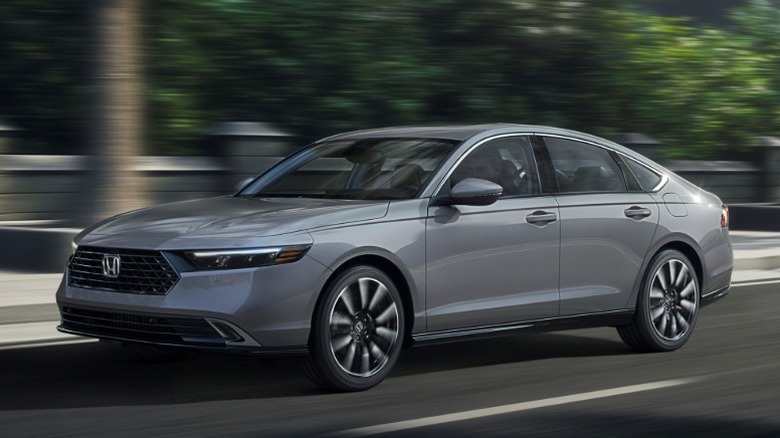
The Civic is reliable and has sold bucketloads since its debut, but it's not the only dependable and nigh-on ubiquitous four-door in Honda's lineup. Its bigger brother, the Honda Accord, lives up to both descriptors as well, with well-publicized million-mile examples and well over 12 million units sold since 1976.
Both cars share a lot of the basic Honda DNA, but the Accord is the larger of the two vehicles, with better interior amenities such as rear-seat USB-C ports, hotspot capability on all trims, and a larger 12.3-inch touchscreen on Sport Hybrid trims and higher. The Civic, in contrast, maxes out at a 9-inch touchscreen, doesn't have rear USB ports, and only gets a hotspot on the Sport Hybrid trim. Expectedly, the Accord also costs more, with every version being pricier than the equivalent Civic Sedan. Of course, if you happen to need the space that the Accord provides, then that higher cost is something you'll have to live with.
More features and a bigger price tag don't equate to better value retention, though, at least if we're talking percentages. According to Edmunds, a 2025 Accord SE will lose around 32% to 35% of its value, depending on local conditions, which tracks nicely with CarEdge's 36% depreciation estimate.
Volkswagen Jetta
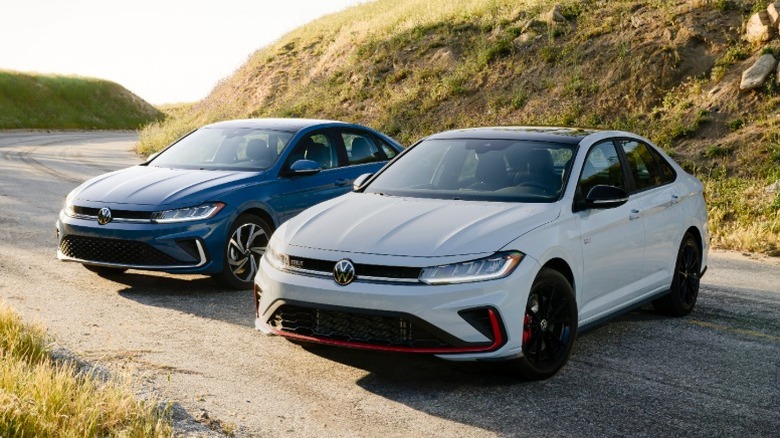
Volkswagen's Jetta, in standard and turbocharged GLI form, is the only sedan that the German automaker offers to U.S. buyers as of mid-2026. That may change if (or when) the ID.7 sedan it unveiled in 2023, comes to these shores, but for now, the Jetta is the sole option for those who happen to want an affordable German sedan.
The Jetta's sub-$30,000 starting price should tell you that it's patently not a luxury offering in the mold of BMW or Audi. Consider, for example, that even the $33,745 (plus $1,245 destination) Jetta GLI is still cheaper than Audi's most affordable U.S.-market offering, the $40,000 A3 sedan. Of course, it doesn't quite have the same cultural cachet (or luxury) as an Audi or a Mercedes-Benz, but hey, not everyone wants — or can afford — to pay for that sort of prestige.
One upshot, however, is that the Jetta doesn't depreciate quite as badly as those brands' luxury sedans — although it still loses out to the ever-sensible Civic. According to iSeeCars' data, a Jetta will lose 35.9% of its sticker price in five years. Kelley Blue Book has similar numbers, at least if going by its Fair Purchase Price estimates: a 2021 Jetta SE, for example, has lost 36% of its value in 2026 based on that metric, rising to 39% for the top-tier SEL trims.
Mazda3
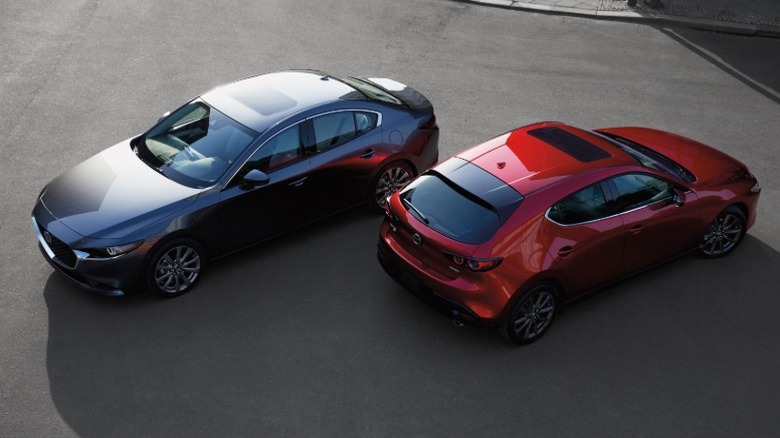
Mazda's U.S.-market lineup, at least as of mid-2026, is decidedly SUV-flavored, but the automaker hasn't quite forgotten its compact car roots. The Miata is still available — with the 2026 model being as brilliant as ever — but the Mazda offering that most directly competes with the Honda Civic is the Mazda3.
Like the Civic, the Mazda3 is available in sedan and hatchback body styles, with the Mazda3 Sedan being the cheapest model in Mazda's current lineup — again, echoing the Civic, whose sedan body style is cheaper than the hatchback. The Mazda3 Sedan's affordable pricing and the fact that it debuted for the 2019 model year mean that you will miss out on some of the modern tech we take for granted in our cars, although some may consider that a good thing. The Mazda3's reliance on old-school physical switches (for now, at least) dovetails nicely with Mazda's classic driver-focused ethos — doubly so if one opts for the pricier turbo model.
Mazda's fun compact also echoes Honda's offering by retaining its value decently, if not quite as strongly as the Civic. ISeeCars suggests a 34% drop in price after five years for the Mazda3 Sedan, with the hatchback version performing every so slightly worse at 35.3%. CarEdge's numbers are slightly worse at 38% for the sedan and 41% for the hatchback, which may admittedly sting a bit more if they come to pass for you.
Nissan Versa
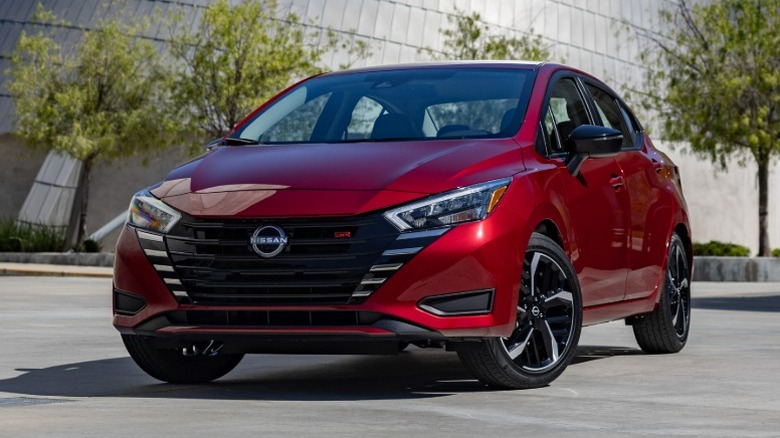
Nissan's Versa, which the automaker discontinued at the end of 2025, was the last of a dying breed: the subcompact sedan. It was an ultra-affordable, tiny vehicle that asked for little but delivered quite a lot, as we found out when we spent time with a 2023 Versa. But while the Versa definitely punched above its weight class, one area where it doesn't quite do so well is resale value.
According to CarEdge, a Versa depreciates by up to 38% over five years. Based on the outlet's numbers, that works out to an $8,090 loss, presuming a $21,036 price when new. It's a smaller loss in terms of raw dollar amounts than most other cars here, which, of course, is entirely because the Versa is cheaper than even the cheapest Civic or Mazda3 Sedan. It's a similar story for iSeeCars, which predicts a 34.5% drop for the Versa after five years.
Of course, there is one benefit to these relatively poor percentages — remarkably low used prices. While buying a new Nissan Versa is now off the cards, five-year price drops of around 35% or so mean that the budget-constrained will be able to scoop up a five-year-old Versa subcompact for around $10,000 or so.
Toyota Camry
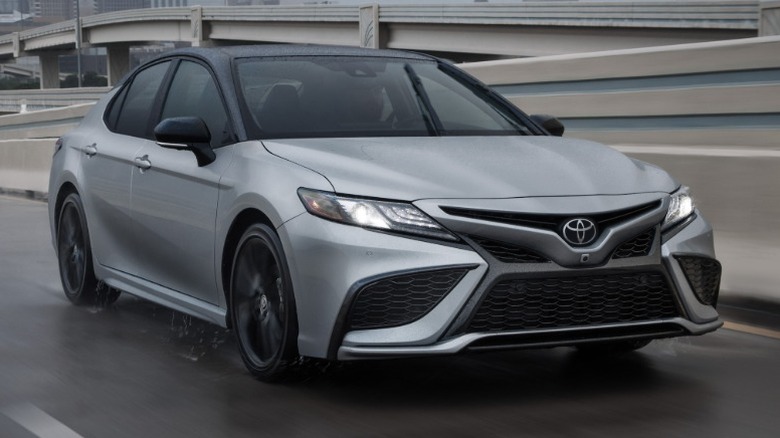
Just as Honda has a larger, mid-sized sibling to the Civic in the form of the Honda Accord, Toyota has a mid-sized sedan for buyers who find its Civic rival, the Corolla, a bit too small for their needs. The modern-day Camry is a great example of Toyota's new all-hybrid approach, which brings serious benefits to models like the Camry XLE AWD we reviewed in 2025 — chief of which is fuel economy, with the most frugal versions managing 51 mpg combined in the EPA's testing.
The extra grunt off the line that the electric motor offers is a boon, too. It's not enough to convince anyone that they're driving a performance sedan, but every little bit of added propulsion is a boon in the stop-start city traffic that many Camrys are likely to see. The Camry's hybrid drivetrain and extra size make it a pricier vehicle than the Civic, though, with many trim levels costing more than even the $32,000 Civic Si — which will probably be a lot more fun to drive.
The Civic also edges out the Camry when it comes to depreciation, although Toyota's mid-sized sedan is no slouch either here. Expect a roughly 35% drop in value over five years: Edmunds' numbers work out to around 36% depreciation for a Camry SE, while iSeeCars has 34.3%. "Worse depreciation than the Civic" isn't necessarily a ruinous thing, as it turns out.
Nissan Sentra
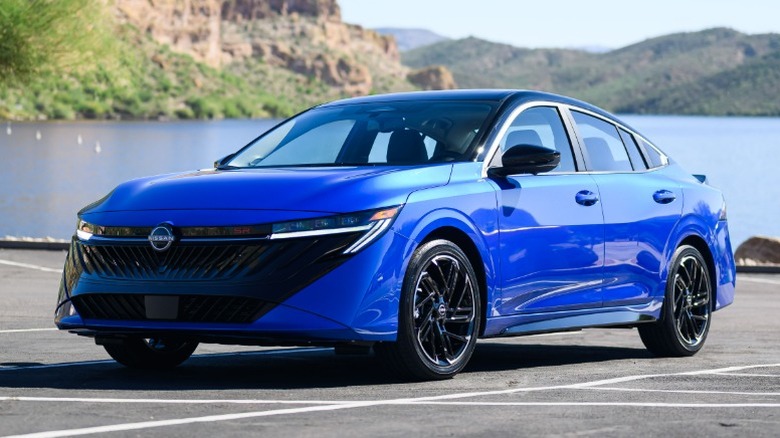
The Nissan Sentra is one of the cheapest cars you can buy in 2026, with the entry-level Sentra S starting at $22,600 and the top-tier Sentra SL available for still-reasonable $27,990 (prices plus $1,245 destination). It belies its cheap pricing with great styling that's a world apart from older Nissan econoboxes like the Sunny, although, as our review of a 2026 Sentra discovered, those good looks don't extend to good performance — while it's comfortable and nice to drive, it's also slow.
Is that a particularly big sin? No, not really, especially not for a car designed to appeal to budget-conscious or first-time car buyers who need a straightforward way to get from A to B. Unsurprisingly, this no-frills, appliance-style approach to car design doesn't help the Sentra's resale value on the secondhand market compared to the Civic: Edmunds, for example, expects 2025 Sentra SV prices to drop by around 40% in five years, give or take a couple of percentage points.
Edmunds' estimate is a bit worse than others, though: Kelley Blue Book's Fair Purchase Price for the 2021 Sentra, for example, showcases around a 31% drop in value across trim levels — better than Edmunds, but still not quite as good as Honda's compact darling. Of course, Sentra buyers probably aren't the type to be overly concerned about depreciation, so this probably isn't a major issue in the grand scheme of things.
Hyundai Elantra
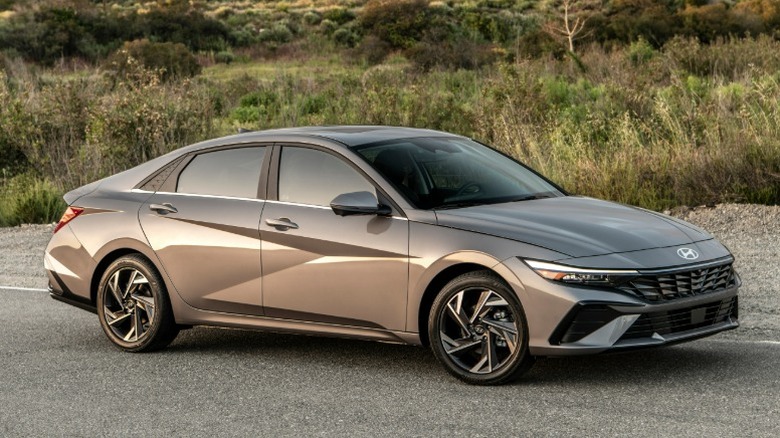
The Honda Civic is a great car that holds its value very well, but those two don't always go together. Take the Hyundai Elantra, for example. Available in several guises, including the very entertaining (and turbocharged) Hyundai Elantra N and a great-value hybrid, the Elantra looks like it has all the ingredients to take the fight to Honda's ever-popular compact.
While it is, by most accounts, a solid car that gives a good account of itself on the road, one area where it falls flat is in how it retains value over the years — or, rather, in how it doesn't do so. Of course, we're not talking the 60% or more drops of the worst-depreciating cars in 2025, but the Elantra performs quite badly for a mainstream vehicle, especially when you put it up against the Honda Civic.
Edmunds' True Cost to Own calculator estimates that Elantra owners will cost owners $9,500 or more in depreciation over five years, with percentages sitting at around the 40% mark depending on location. ISeeCars is more optimistic, but its 37.1% estimate is still significantly worse than the Civic. We like the Elantra a lot, but these numbers don't lie; if depreciation matters greatly to you, it's probably not the best choice. Or, at least, not as good a choice as a Japanese compact.
Hyundai Sonata
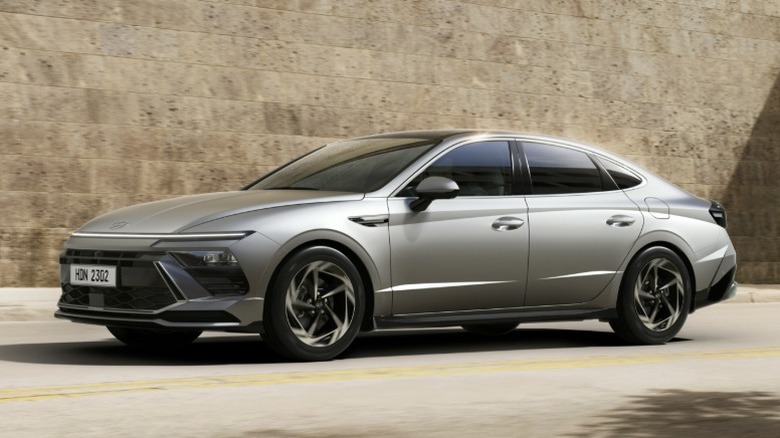
There's a lot to like about the Hyundai Sonata, whether it's the Sonata Hybrid that we tested at the start of 2025 or the Sonata N Line and its perky, turbocharged 2.5-liter four-pot. The former offers impressive fuel economy, while the latter is a genuinely fun performance sedan that's also great to live with daily. And no matter which version you go for, you get a smart exterior, a nice cabin, and a lot of safety equipment as standard.
Hyundai got a lot right with the modern-day Sonata, then, and we wouldn't criticize anyone for choosing it over a comparable Toyota or Honda. However, while it can make great cars, the Korean automaker seemingly struggles to make cars that retain their value as well as those from Japanese rivals, as shown by its relatively poor depreciation compared to other major car brands.
While their specific percentages differ, the usual sources agree that the Sonata will lose more than 40% of its sticker price after five years. ISeeCars expects a 42.4% drop, while CarEdge's numbers are slightly worse at 45%. Lest you think both of these outlets are being a bit harsh on good old Hyundai, Kelley Blue Book's Fair Purchase Price numbers for all 2021 Sonata trims translate to drops of between 39% to 43%.
Our methodology

Depreciation might be guaranteed, but the amount of depreciation isn't; various factors can affect how quickly a vehicle's value drops, not least the mileage and condition of the specific vehicle. Thus, you shouldn't treat these numbers as a guarantee, only as a general guideline and an indicator of how these vehicles perform relative to the Honda Civic. That said, we made sure to source our depreciation percentages from multiple reliable sources to offer a more rounded picture of how quickly each of these vehicles depreciates and to make sure that all of them deserve a place on this list.