

5 Four-Cylinder Engines That Pump Out More Power Than Most V8s
There's no replacement for displacement — or is there? While V8s have always been associated with big horsepower (and still are, at least when we're talking about the most powerful V8s ever), humble four-cylinder engines have proven over the years that it is entirely possible to make big power with half the number of cylinders you'd find in a big, burly V8.
Now, to be clear, none of these can hang with ultra-high-performance eight-cylinders powering hypercars like the Koenigsegg Jesko Absolut, so don't go expecting four-figure horsepower numbers here. If you want that, you'll have to turn to heavily modified modern drag racing engines. However, these four-bangers will give more mundane V8s, like the 490-hp 6.2-liter power plant in the 2025 Chevrolet Corvette Stingray, a run for their money and then some, with power numbers starting at the 350-hp mark and climbing ever upward.
From the four-cylinder boxer engine powering the most recent Porsche 718 Boxster S to a couple of boosted inline-fours from the glory days of Group B rallying, here are a handful of four-cylinders that make V8 levels of power. And, just to add a bit of spice, we're sticking to gasoline engines here, not taking any electric motors into account.
Porsche turbocharged 2.5-liter flat-four – 350 hp
In 2024, Porsche announced that it was discontinuing the gasoline-powered Cayman and Boxster by mid-2025, setting its sights on an electrified future for its relatively budget-friendly, attainable sports cars. But it looks as if Porsche's EV future has been put on hold, at least for its junior sports cars: The 2025 718 Boxster range remains all-gasoline, and reports indicate that the German automaker is reworking its next-gen 718 platform, previously all-electric, to support EV and gasoline powertrains.
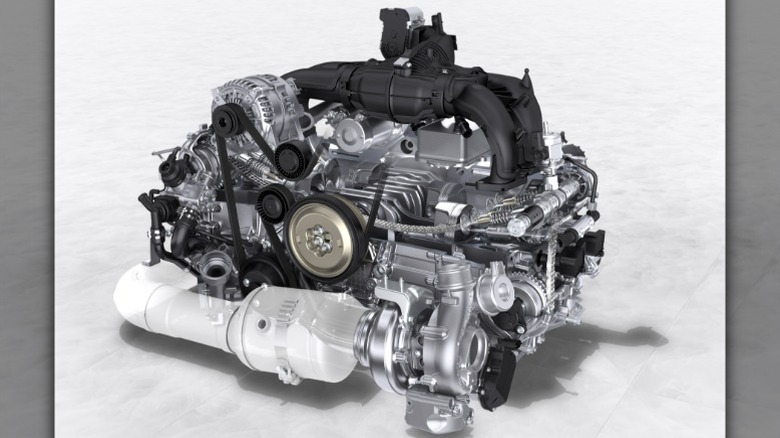
That, however, is a discussion for the future. In the here and now, Porsche's latest take on the Boxster and Cayman comes with a selection of flat-four and flat-six engines, one of which earns the company a place on this list. The 2025 718 Boxster S and Cayman S sport a turbocharged 2.5-liter boxer engine that makes a healthy 350 hp and 309 lb-ft of torque. That gives it an impressive specific output of 140 hp per liter, significantly better than V8s like the Cadillac CT5-V Blackwing's 668 hp, 6.2-liter V8 (which, for the record, comes in at around 107.7 hp/liter).
The 718's 350-hp engine is enough to take both versions of the 718 to 60 mph in 4.2 seconds with the standard seven-speed PDK transmission, dropping to 4.0 seconds with the $2,610 Sport Chrono package (presumably thanks to the included launch control feature). Now, is it quite as brilliant as the six-cylinder that powers the Porsche 718 Cayman GTS 4.0 we reviewed? No, probably not, but it's plenty capable all the same.
Mitsubishi 4B11T – 440 hp
Japan is arguably the home of legendary four-cylinder engines. There's Honda's line of K-series engines, for one, which is still going strong in the 315-hp 2025 Civic Type R. Subaru, similarly, had the ultra-reliable EJ20 and EJ22 flat-fours that powered many of its vehicles. And then there's the Mitsubishi 4G63T, a special JDM engine that powered rally cars like the Lancer Evo III that gave Tommi Mäkinen his first-ever WRC title.
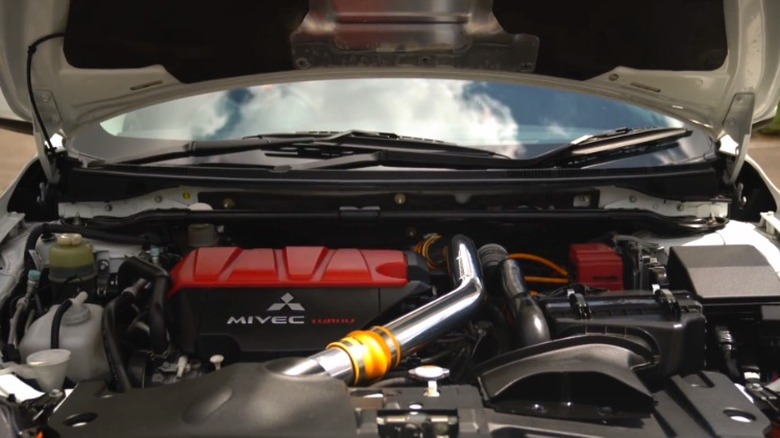
But while the 4G63T is perhaps Mitsubishi's most-recognized inline-four engine, it's not the crowning achievement of the Japanese automaker's efforts (at least, as far as horsepower goes). For that, we have to turn to the engine's successor, the 4B11T, which debuted alongside the Lancer Evolution X in 2007. Even then, though, we can't just talk about any 4B11T, oh no; There was a very special version of the 2.0-liter four-banger that powered the limited-to-40 Lancer Evo X FQ-440 MR.
The Evo X FQ-440 MR was a U.K.-only model that was both a celebration of 40 years of Mitsubishi's U.K. operations and effectively a sendoff for the Evo, which Mitsubishi discontinued after 2015. The FQ-440 had the same basic 4B11T engine, but with a range of modifications that included an HKS turbo, beefier injectors, a freer-flowing intake, and a trick Janspeed exhaust. The result? 440 hp from a tiny 2.0-liter engine, making for more horsepower per liter than a Bugatti Chiron.
Mercedes-AMG M 139 – 469 hp
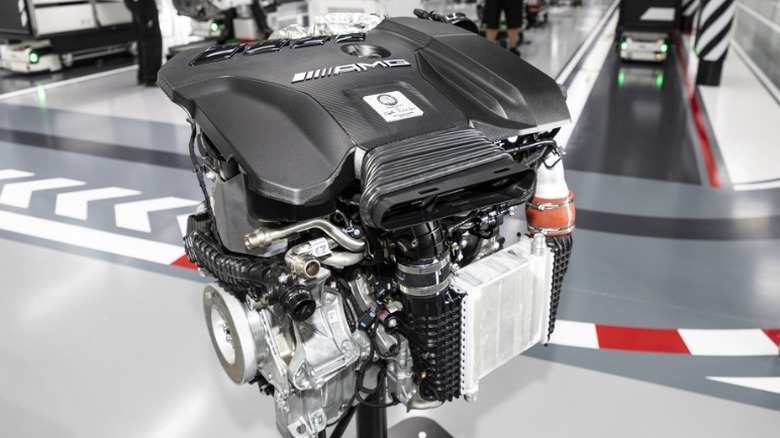
As far as modern, big-power four-cylinder engines go, there's little that compares to the Mercedes-AMG M139. First debuting in 2019 as a 416-hp powerplant that the company claimed was the most powerful in series production, the M139 would go on to power a range of vehicles from the German automaker and even see use (in slightly downtuned form) in the Lotus Emira 2.0 Turbo.
When it first came on the scene, the 2.0-liter M139 paired its healthy horsepower output with an equally impressive 369 lb-ft of torque. Mercedes-AMG achieved these numbers, of course, with the aid of a twin scroll supercharger — par for the course, really, for high power four-pots. Hand-built in Germany, the M 139 also boasted other notable features, including a racing-derived closed-deck engine block, high-strength chill-cast aluminum crankcase, and a quite complex cooling system featuring a secondary wheel-arch-mounted radiator and an air-to-water intercooler.
Mercedes first unleashed the M 139 in compact vehicles like the Mercedes-AMG A45 S, but the engine's peak form would come a little later. The Mercedes-AMG C63 S E Performance, which debuted in 2023, ramped power up to a dizzying 469 hp, thanks to changes such as a Formula 1-inspired electric turbocharger. Coupled with an electric motor, the Mercedes-AMG sedan dishes out 671 hp in total — a lot of power, but not necessarily for the best, as we found out when we got behind the wheel of a C63 S E Performance.
Fiat 233ATR18S – 500+ hp
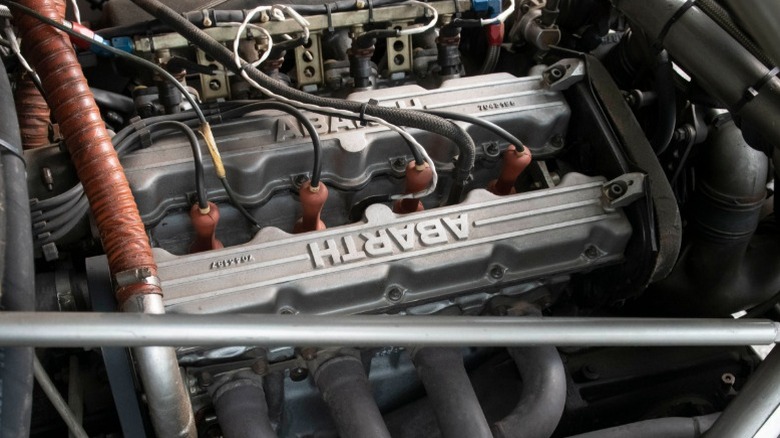
Production four-bangers can certainly be very impressive, but we have to turn to the realm of motorsports for the really big-power inline-fours. More specifically, the world of Group B rallying, home of some of the fastest rally cars of all time, including the infamous Fiat 233 ATR 18S-powered Lancia Delta S4.
The S4 debuted at the end of the 1985 season and featured a novel solution to the turbo lag issues that Lancia's Group B rivals faced with their turbocharged engines: twin-charging. Thus, the S4's 1.8-liter inline-four relied on a supercharger up to about 3,000 rpm, at which point a bypass valve dumped the supercharger's output and let the turbo take over. The result was around 500 hp, with figures ranging from 510 to 550 hp. It delivered power via a four-wheel-drive system that sent the majority of its power to the rear wheels, making it a bit of a handful.
Fiat's twin-charged 1.8-liter also saw road-going use, since Group B regulations required manufacturers to release 200 street-legal examples of their cars for homologation purposes. The S4 Stradale, as it was known, replaced the racing engine's Bosch electronics for a Weber Marelli system, keeping power down to about 250 hp or so. Sadly, the world didn't get to see much of this four-cylinder, as the FIA cancelled Group B in 1986 after the deaths of S4 driver Henri Toivonen and co-driver Sergio Cresto, who crashed while leading that year's Tour de Corse. Despite that, the S4's place in rally history is undeniable. Just ask the person who paid a cool £1,636,250 for a genuine, Toivonen-driven example at a 2022 RM Sotheby's auction.
Cosworth BDT-E – 600 hp
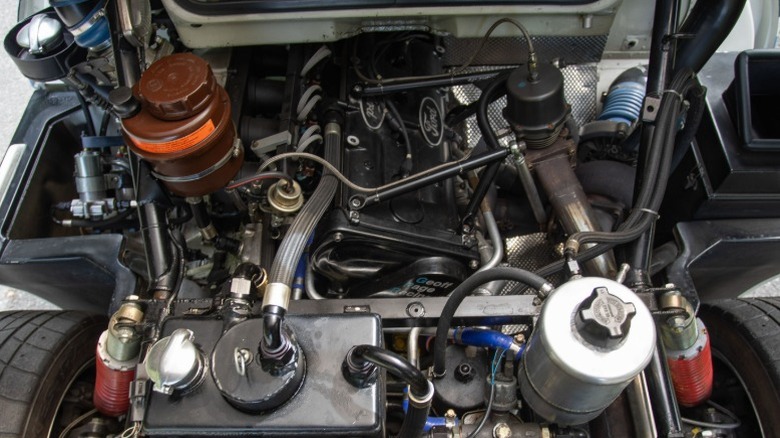
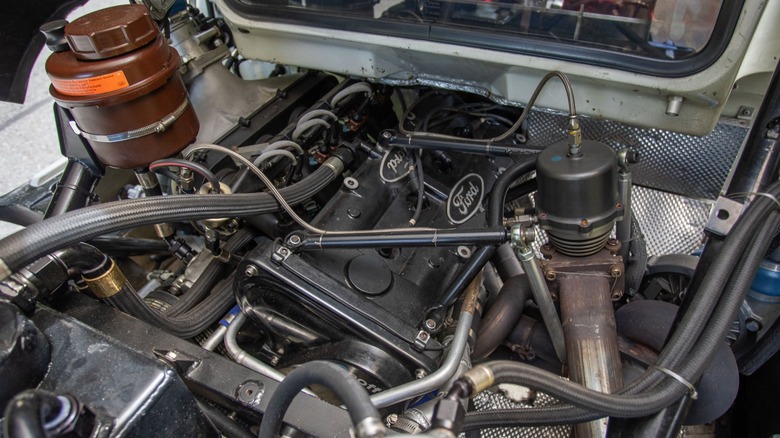
There have been plenty of iconic rally cars to carry the Ford badge, but none, for our money at least, equal the Group B Ford RS200. But it wasn't Ford's first attempt to compete in the new class: The automaker had first developed the RS1700T, but the emergence of Audi's revolutionary Quattro four-wheel-drive system meant that Ford had to go back to the drawing board. Thus, the RS200 took many of its predecessor's features — such as the Cosworth BDT 1.8-liter turbocharged inline-four and the transaxle gears — and reconfigured them for a four-wheel-drive world.
The RS200's 1.8-liter engine made about 250 hp in road-going form, which climbed to 450 hp when in full racing configuration. That alone would be enough to secure it a place in the pantheon of V8-rivaling inline-four engines, but that wasn't the end of Ford's Group B experiments. The RS200's Group B debut was delayed by homologation issues, but Ford engineers pressed on, developing an even crazier version called the RS200 Evolution for the 1987 season.
Group B's demise meant that the RS200 Evolution never competed in that particular rally series, but it would likely have dominated if given the chance: It was powered by a revamped 2.1-liter version of the standard RS200 engine, called the Cosworth BDT-E. The BDT-E sported an aluminum engine block and an uprated turbo; combined with the increased displacement, it made around 600 hp (a crazy 285 hp/liter), enough grunt to take the RS200 Evolution to 60 mph in 3.07 seconds. Ford made just 24 RS200 Evolutions, and they predictably fetch a pretty penny these days — one sold for $615,000 at RM Sotheby's Monterey 2023 auction.