

10 Pickup Trucks With Faster 0-60 Times Than A Mazda MX-5 Miata
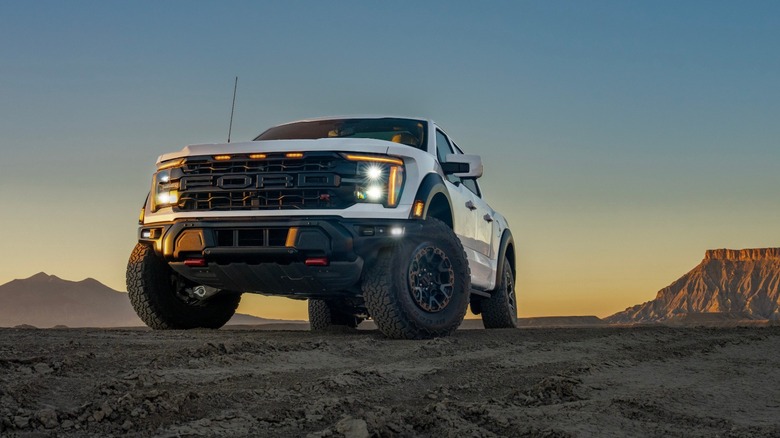
The Mazda MX-5 Miata is nothing short of an automotive icon. First debuting in 1989, the Miata has offered buyers nimble and lightweight roadster fun for nearly four decades, earning itself the title of the world's best-selling roadster in the process. But while the Miata is undoubtedly a brilliant car, it isn't the quickest sports car out there.
Now, that doesn't mean it's slow, not in the least. The 181 horsepower and 151 lb-ft of torque it gets from its inline-4 is plenty in a car that weighs about 2,500 pounds, as proven by the admirable 5.5-second 0 to 60 mph time Car and Driver recorded. In reality, the Miata is as quick as the average driver needs a sports car to be, really. But that doesn't mean you can't do better.
There are plenty of vehicles that'll beat the Miata in a straight line and hit the 60-mph mark long before Mazda's roadster, but that's hardly surprising in a world populated by 600-plus-horsepower super sedans. What's you might not expect is that there are also a lot of pickup trucks that'll outgun the Miata in a straight line — and not all of them are crazy triple- or quad-motor EVs, either.
GMC Syclone
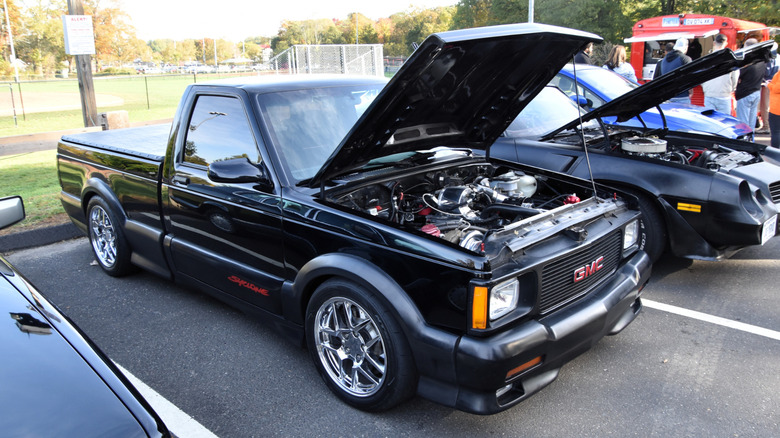
There have been quite a few classic American muscle trucks over the years, but few are remembered quite as fondly as the GMC Syclone. The Syclone was a hopped-up version of the 1990s GMC Sonoma that was absolutely useless for typical truck tasks — it could only tow 2,000 pounds and carry 500 — but more than made up for it with the V6 in the engine bay.
That V6 wasn't just any six-cylinder motor, either. The 4.3-liter Vortec V6 was turbocharged, intercooled, and fuel injected, giving a Syclone owner 280 horsepower and 350 lb-ft of torque to use as they pleased. It sent that power through a four-speed auto gearbox, the 4L60, then to all four wheels via a full-time all-wheel-drive system borrowed from the GMC Safari, with two-thirds of the power going to the rear. Other changes from the Sonoma included a lowered suspension, a body kit, 16-inch wheels, but the engine was really the star of the show here.
How much of a star, exactly? Well, good enough to outrun a Ferrari 348ts in a legendary Car and Driver test from 1991. The magazine recorded a 5.3-second 0 to 60 mph time for the Syclone, a hair faster than the current Mazda Miata and a whole 0.7 seconds faster than the 348ts. Sadly, the Syclone was short-lived: GM built just under 3,000 for the 1991 model year before poor sales prompted the brand to axe it in 1992.
Dodge Ram SRT-10
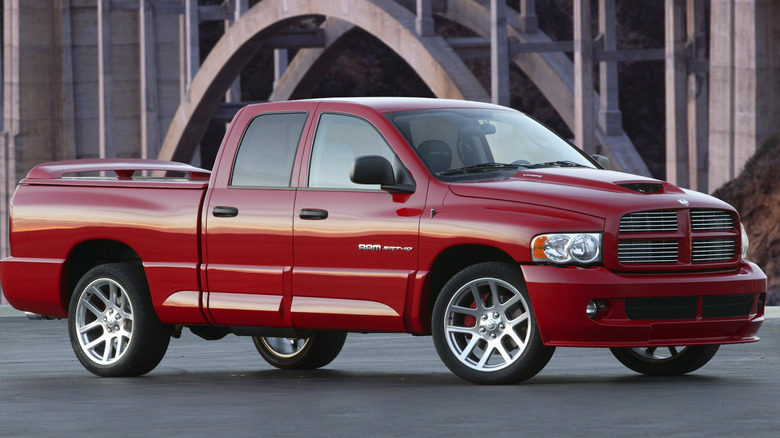
These days, the most ludicrous pickup trucks are EVs with three or more motors that make over 1,000 horsepower — of which there are quite a few on the market. But in the mid-2000s, the king of truck-based silliness was the Dodge Ram SRT-10, a Viper-engined pickup that anticipated the design of the Hellcat decades before Dodge came up with the concept.
The SRT-10 was not, by any stretch of the imagination, a reasonable vehicle. It was horribly inefficient, quite expensive for the time, and didn't handle particularly well, but the Viper's 500-horsepower engine gave the SRT-10 genuine grunt and a 0 to 60 mph time of around five seconds, give or take a few tenths depending on who you ask. Motor Trend recorded a 5.2-second time, while Car and Driver managed to get the 5,000-pound truck to 60 mph in 4.9 seconds — very quick for the time, especially for a truck, and impressive even now.
While many reviewers were generally quite positive about the SRT-10, it was far from a bestseller. Dodge made around 10,000 or so from 2004 to 2006, in regular- and Quad-Cab configurations. That isn't bad compared to some other muscle trucks, sure, but a drop in the ocean compared to the 400,000-plus Ram trucks sold in 2005 alone.
Toyota Tundra TRD Supercharged
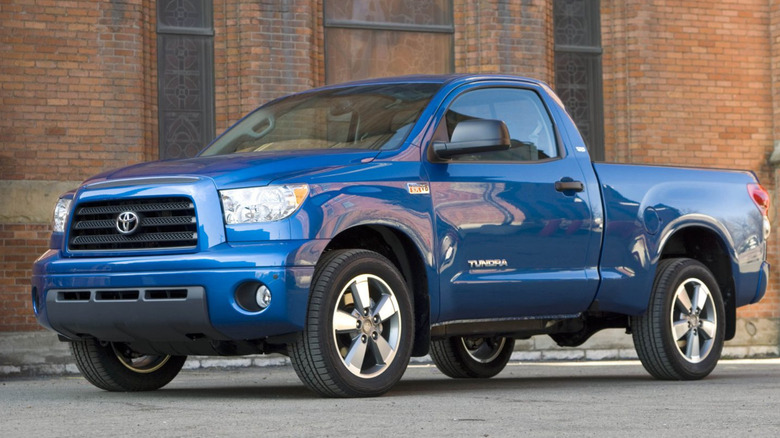
When you think of the Toyota Tundra, the first word that comes to mind is probably reliability — the troubled third-gen Tundra notwithstanding. It's probably not 'performance'. But for a brief period in the late 2000s, Toyota offered a fire-breathing, fully warrantied version of the second-gen Tundra through its dealers. It boasted sportscar-beating performance, courtesy of a supercharged version of the pickup's 5.7-liter V8.
Starting in 2008, buyers could spec a range of TRD parts for their Tundra, with the star attractions being an Eaton supercharger that, paired with a dual exhaust system, lifted the V8's power from an already-decent 371 horsepower to a tire-shredding 504, with an equally impressive 550 lb-ft of torque on tap. Other TRD specials available included an uprated brake system, revamped suspension setup, and large 22-inch wheels, although not all of these changes were as beneficial as the uprated engine. A Motor Trend review of the time found the brakes somewhat ineffective and the large wheels a hindrance on rough asphalt, although the outlet's model lacked the TRD suspension mods that may have helped.
None of these parts were cheap, of course. The supercharger alone was nearly $6,000, while the exhaust added another $1,000 on top of that. But the results spoke for themselves: Motor Trend recorded a 0-60 time of just 4.4 seconds, which is genuinely rapid even now, let alone in 2008. For context, that's quicker than the 2008 iterations of the Ford Mustang GT, Dodge Challenger SRT8, and Audi S5 — not bad for a Toyota.
Fifth-gen Ram 1500
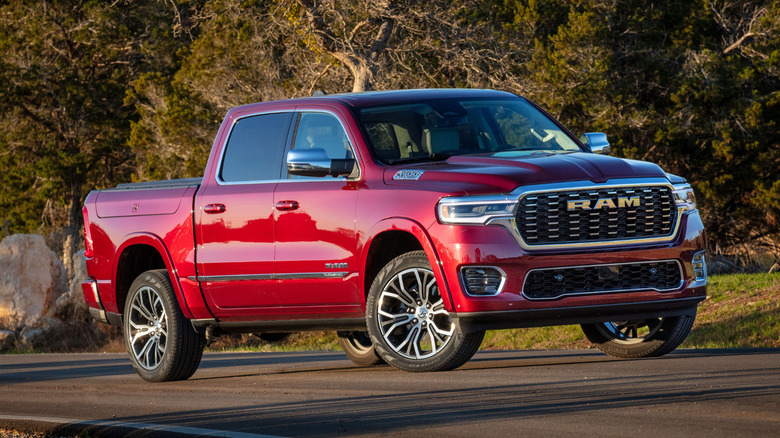
When Ram debuted the fifth-gen Ram 1500 in 2025, it broke with tradition by ditching the HEMI V8 in favor of its Hurricane inline-6 in standard and High Output guises. While these engines were more efficient and beefier than the V8 they replaced — the High Output version in particular, which had 540 horsepower and 521 lb-ft of torque — Ram eventually bowed to customer demand and reintroduced the 5.7 HEMI to the engine bay after just a year.
The decision paid off for Ram, pushing the 1500 to new heights in terms of sales, but we won't mince words here: As evocative and iconic as the HEMI V8 is, it's far from the best engine you can get in the Ram 1500. If you want power and Miata-beating acceleration, it's the High Output Hurricane engine you really want. Car and Driver managed an impressive 4.2-second 0-60 run with the 540-hp inline-6 in a 2026 Ram 1500 Limited Crew Cab, while the less powerful (but still capable) standard Hurricane took a Ram 1500 Rebel to 60 in 4.9 seconds. Motor Trend's numbers were similar, with the H.O. Hurricane in a Ram 1500 Tungsten hitting 60 in 4.4 seconds.
For context, the old HEMI-powered Ram 1500 Limited Crew Cab took a positively glacial 6.4 seconds to hit that same milestone when Car and Driver tested one in 2022. That's not too surprising, of course, given the V8's relatively predestrian 395 horsepower and 410 lb-ft of torque; even the standard Hurricane inline-6 makes 420 and 469, respectively.
Ford F-150 Lightning
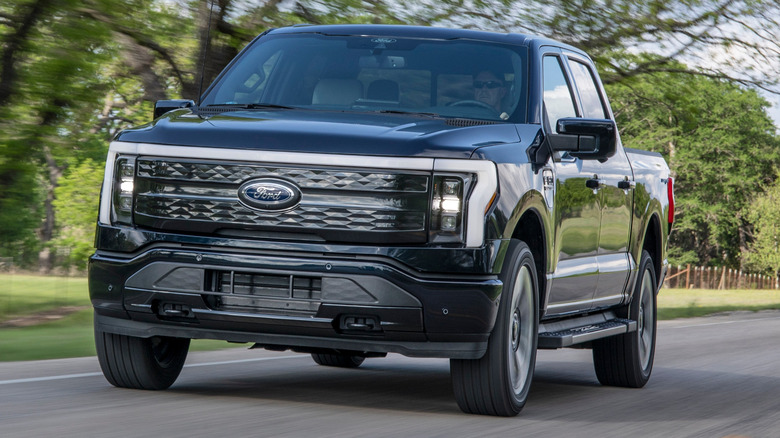
The Ford F-150 Lightning won't be remembered as one of Ford Motor Company's triumphs. Unveiled to much fanfare in 2021, not least thanks to a proposed sub-$40,000 starting price, the F-150 Lightning never quite reached the heights Ford had in mind. Ford only sold around 100,000 units between 2022 and 2026, eventually canceling the EV truck due to low demand.
While it wasn't necessarily a sales success for Ford, the F-150 Lightning was a genuinely good truck. We really liked the 2025 F-150 Lightning Pro, and we weren't alone: The EV pickup won accolades such as Motor Trend's Truck of the Year and the North American Car, Truck and Utility Vehicle of the Year awards, both in 2023. The motoring press appreciated how the Lightning retained all that was good about the F-150 with an all-electric powertrain that didn't require buyers sacrifice too much to get the benefits of EV propulsion.
One of those benefits was, of course, acceleration. Motor Trend clocked a 0-60 mph time of just 3.8 seconds, with Car and Driver's 4.0-second time not too far behind. The fact that the F-150 Lightning was handily beating the Miata's 60-mph time while weighing nearly 7,000 pounds is a testament to just how capable electric motors are when it comes to acceleration.
Ram 1500 TRX
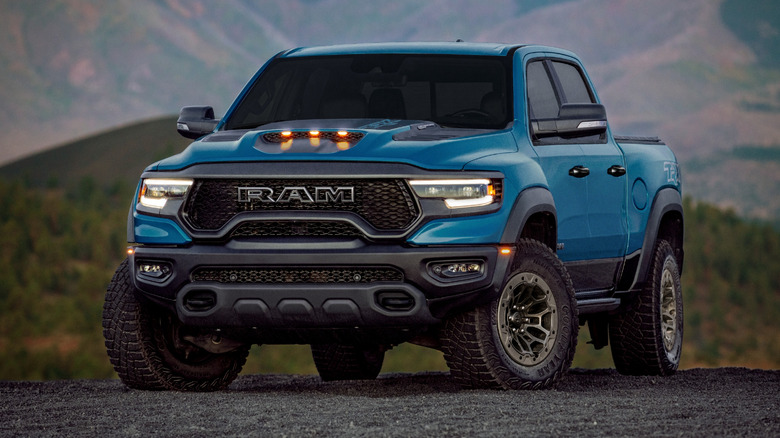
The Ram 1500 TRX sits alongside the Ford F-150 Raptor R at the pinnacle of the gasoline pickup world, sporting 700-plus horsepower when it first hit dealer forecourts for the 2021 model year. The TRX had 702 horsepower and 650 lb-ft, courtesy of a 6.2-liter supercharged Hellcat HEMI V8 under the hood.
Stellantis claimed a 0-60 mph time of 4.5 seconds, but that proved to be a conservative estimate: Independent testing by Car and Driver showed that the TRX could hit 60 mph in as little as 3.7 seconds, coming within a hair of its Ford rival and easily besting not just the Miata, but a swathe of more illustrious high-performance exotics from years past. Motor Trend only managed a slower 4.1 seconds to 60, but that's still more than a second quicker than the Miata.
The Ram 1500 TRX was discontinued in 2024, but returned for the 2027 model year with a vengeance, ramping power up to 777 horsepower and 680 lb-ft of torque. The power boost doesn't come cheap, with the 2027 Ram TRX SRT (its proper name) starting at over $100,000, but it's a brilliant truck, as we found out in our review. Stellantis claims that it'll hit 60 mph in 3.5 seconds, but we've yet to see any third-party tests to back that figure up. We wouldn't be surprised if the 2027 TRX lived up to Stellantis' claims, though.
Ford F-150 Raptor R
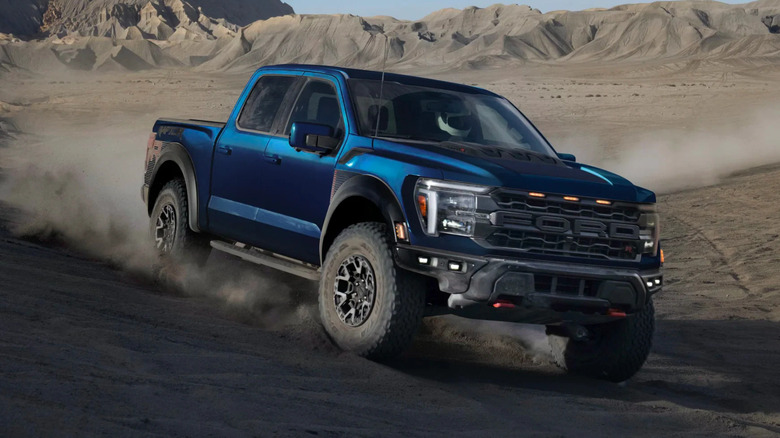
The 2023 Ford F-150 Raptor R hit dealer forecourts in 2023 with 700 horsepower and 640 lb-ft of torque, courtesy of its supercharged 5.7-liter V8, before a 2024 update added another 20 horses on top. That was enough to make it the top dog in the pickup world until the 2027 Ram 1500 TRX reclaimed that throne, bumping Ford's flagship F-150 down to second place. But, really, what's 50-odd horsepower between friends?
Either way, the F-150 Raptor R is a quick pickup. Sure, it weighs a not-insignificant 6,090 pounds (or around 2.4 times the Miata), but the V8 has enough grunt to take it to 60 mph in 3.6 seconds, per Motor Trend testing. That's admittedly not a patch on any of the latest crop of hyper-EVs, but it's only a few tenths slower than the legendary McLaren F1's 0-60 mph time. That's properly mind-boggling stuff, if you consider the sheer gulf in price, weight, and motorsport heritage between the two vehicles.
Of course, the Raptor R isn't necessarily built to go fast in a straight line. All that power is meant to make it an off-road monster, capable of handling anything a trail or a bunch of sand dunes might throw at it. And, while it's not necessarily the greatest towing machine out there, it's reasonably capable there, too: Ford rates it to tow 8,700 pounds, with a max payload of 1,410 pounds.
GMC Hummer EV
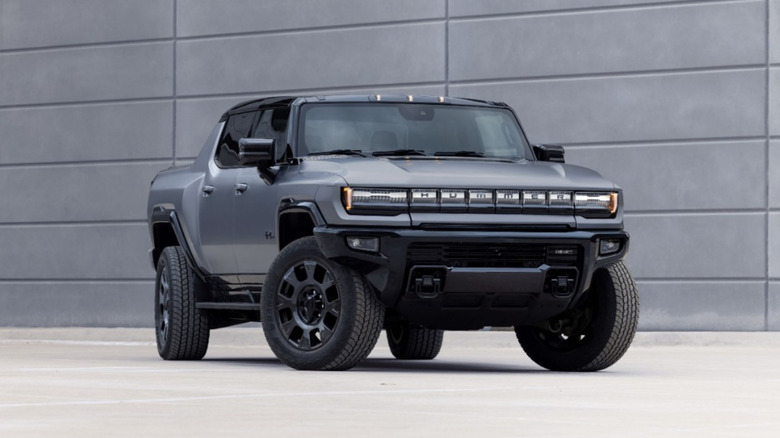
There are, and have been, many quick gas-powered pickup trucks over the years. But if you want supercar-beating acceleration, then EV pickups are the way to go — specifically those with three or more motors. Case in point: the GMC Hummer EV, which can hit 60 mph in 3.1 seconds in tri-motor 3X trim, per Motor Trend.
What makes that number more impressive is the fact that the Hummer EV is heavy even by pickup truck standards. Quick, high-performance trucks like the Ford F-150 Raptor R and Ram 1500 TRX weigh between 5,000 and 7,000 pounds, and even the battery-laden F-150 Lightning came in at around the latter number. The Hummer dwarfs all of them, though, tipping the scales at around 9,000 pounds or more, depending on configuration. That's all down to the three motors, of course, which make more than enough power to overcome the weight penalty.
GMC states the 2027 model makes up to 1,160 horsepower and 13,000 lb-ft of torque, but bear in mind that the latter is at the wheels, not at the crankshaft. In reality, it's closer to 1,000 lb-ft, which is still impressive, but not quite as crazy a figure. It also claims a 0-60 mph time of 2.8 seconds, although we'd wait for third-party tests instead of taking the automaker at its word there. Even if it can't quite live up to that number, though, the Hummer EV is an undeniably quick vehicle — our Alex Hevesy called the SUV version a "land missile" in his test — that, while ridiculous and undeniably massive, might also be a bit brilliant.
Tesla Cybertruck
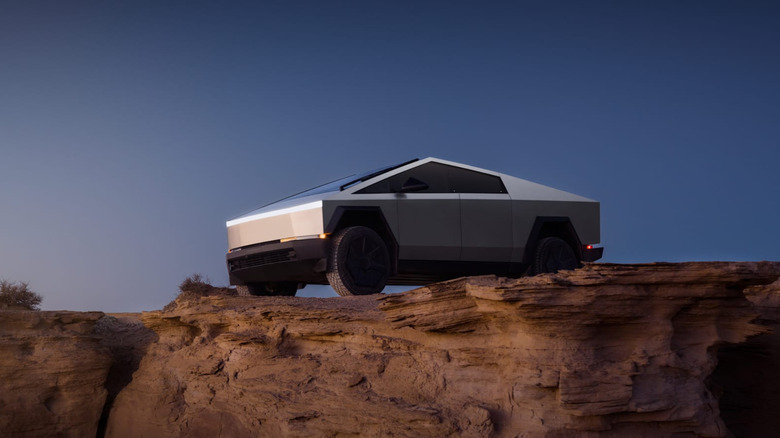
Ah, the Tesla Cybertruck. On the one hand, it's a genuinely rapid and pretty capable truck, an impressive feat of engineering that looks like nothing else on the road. On the other hand, a combination of a divisive (to say the least) company owner, broken promises, and a love-it-or-hate-it design — among others — have combined to make the Cybertruck a genuine flop, with cratering sales bolstered only by SpaceX purchasing nearly 1,300 examples in 2025.
There's no point in arguing for or against the Cybertruck here; If you're reading this, you've likely already made your mind about it, and there's not much that will change your mind. But there's no way of denying the fact that Tesla's EV pickup is properly quick. The tri-motor Cyberbeast version has 845 horsepower and 864 lb-ft of torque on tap, good for a claimed 2.6-second 0-60 mph time — a time that Car and Driver equaled when it tested a 2024 model.
One wouldn't need the top-of-the-line Cyberbeast to reach 60 mph quicker than a Mazda Miata, though. Tesla says the dual-motor version reaches that mark in 4.1 seconds, and Motor Trend did a bit better than that, recording a 3.7-second 0-60 time when it tested a Foundation Series launch unit in 2024. So, yes. It's quick. Is that enough to make it a great truck? We'll let you be the judge of that.
Rivian R1T
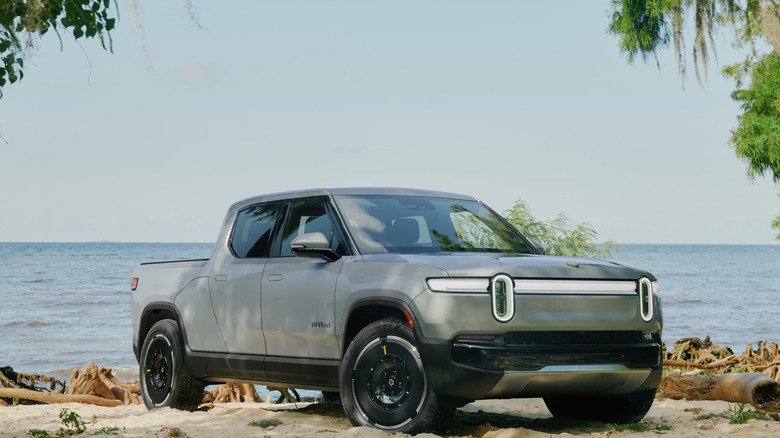
What's better than three motors? Four, of course. That's exactly what Rivian offers on its top-of-the-line R1T Quad. The $115,000 EV pickup makes a combined 1,025 horsepower from its motors. It's this power, combined with significant weight savings on the second-gen model, that allows it to hit 60 mph in 2.5 seconds, according to Motor Trend and Rivian. Car and Driver didn't quite manage to equal Rivian's number, but 2.6 seconds is still blindingly quick.
We tested the quad-motor versions of the R1T and R1S and, like other reviewers, found them extremely quick. We took the R1S to 60 mph in 3.15 seconds on a poor surface and without any tire prep — which, while not nearly as quick as other reviewers, is arguably more representative of real-world conditions than most acceleration tests. These second-gen models are about more than just brutal performance, with exquisite interiors, genuine off-road chops, and customizable the power, steering, and suspension behavior via RAD Tuner. All this combines to make the R1T (and R1S) genuinely compelling EVs for those who have the cash to splash.
As with Tesla's Cybertruck, the more affordable versions of the R1T are also quick enough to beat the Mazda Miata to 60 mph. The dual-motor R1T Premium can hit 60 in 3.4 seconds according to Rivian (and Car and Driver), while the tri-motor R1T Performance cuts that to a manufacturer-claimed 2.9 seconds.