

12 Cars That Scream 'Mid-Life Crisis'
There comes a time in many peoples' lives, when they take an automotive decision that their family will never let them forget. It could be the slightly balding father-of-four finally getting that two-seater sports car instead of a land-yacht car meant for hauling families. It could be the homemaking mother choosing a pink JDM car after years of driving a Volvo, or the corporate woman rocking up in a lifted 2025 Ford F-150 Hybrid — there are too many examples to name. At the end of the day, a "midlife crisis" car tends to be something unexpected, flashy, and out-of-character for the person driving it.
When you realize that the past twenty years have been dominated with the practical choices — the three-row SUV, the minivan, the economical sedan — and your youth is slipping away, the purchase becomes that much more justified. There's also a (very) thin line to be drawn between what makes a car a niche vehicle versus a midlife crisis ride. Buying a Porsche 911 because you've always appreciated engineering and the German pursuit of excellence is fine. Getting one because your youngest left for university and the GMC Yukon is taking up too much space in your garage is an entirely different conversation. None of this is inherently wrong by the way; life is short, depreciation is real, and no one wished they had bought a more sensible estate car on their deathbed. Here are 12 cars that are so beloved that they've become midlife crisis icons.
Any Porsche 911
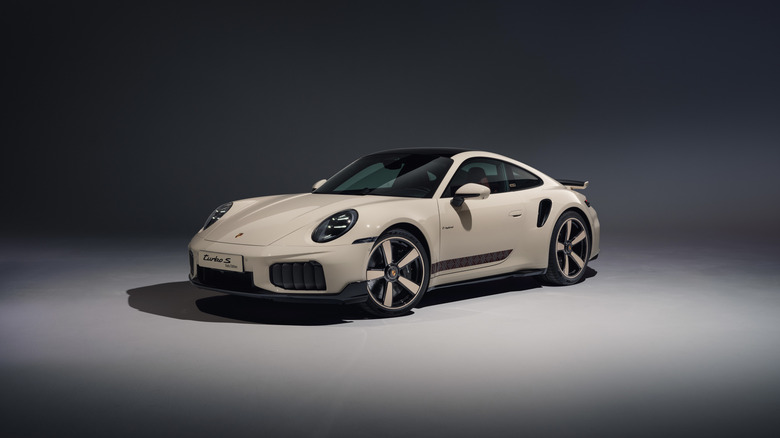
Since we mentioned the Porsche 911 in the intro, let's start with that one, as it also holds its value well. Ever since the original model was released in 1963, it has been a favorite in the sports car community for its performance, handling, and driving dynamics. Several types of 911 – better classified as submodels, and not trims — have been sold through the years. In ascending order of performance, the major ones are the base 911 Carrera, the Turbo, the GT3, GT3 RS, and GT2 RS.
An "S" behind any Porsche model usually indicates more horsepower, and having a "4" suffix usually means all-wheel drive. Open-top convertible models are known as the "cabriolets," while "targa" is a specific type of rigid-body convertible where the roof is removed manually.
The GT line is more focused on racing, but remains street legal, while some special versions of the GT2 RS are not street legal and are pure-bred motorsport machines. 911s can be either a two-seater or can be had in a 2+2 layout too. Given the range available, and the number of units that have been produced, pricing varies greatly for the 911. A new base-model 911 will run buyers $135,500 as MSRP in addition to $2,350 as destination charges, while used models from 2010 are available for about $50,000. The 2026 generation base model is powered by a 3-liter, six-cylinder engine making 388 hp and 332 lb-ft of torque.
Porsche Boxster
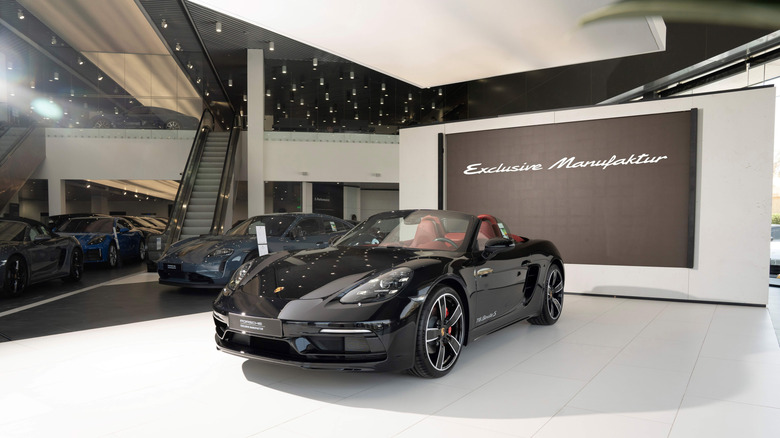
The Boxster has long been the open-top version of Porsche's baby sports car, the Cayman. In 2016, Porsche combined the Boxster and Cayman under one model line, known as the 718 — which has since been discontinued. According to owners, the 718-series cars were actually more fun and engaging to drive than the company's flagship 911 lineup, at least according to some. For the latest models, the base Boxster got a two-liter motor that spreads its displacement across four inline cylinders.
This engine produced the respectable sum of 296 hp, along with 280 lb-ft of torque, and shipped with a glorious six-speed manual transmission as standard — which could explain why it was such a favorite among enthusiasts. For those that weren't keen on manually changing their gears, an upgrade to an eight-speed automatic was also on offer for an extra cost.
It's also worth mentioning that there were three higher-performance variants of the Boxster available, which included the "S" model, with a 2.5-liter, four-cylinder making 345 hp, and the "GTS" model, which added two cylinders, pushing the displacement to four liters, and the power to 395 hp in total. There was also the frankly ludicrous 718 Spyder RS, which came with a 4-liter six-cylinder engine making the massive sum of 493 hp — and weighing just 3,000-ish pounds. On the used market, Boxsters in decent condition from around 2016 are going for between $40,000 and $45,000 depending on the trim level and options — which could be a pretty sweet deal.
Chevrolet Camaro Convertible
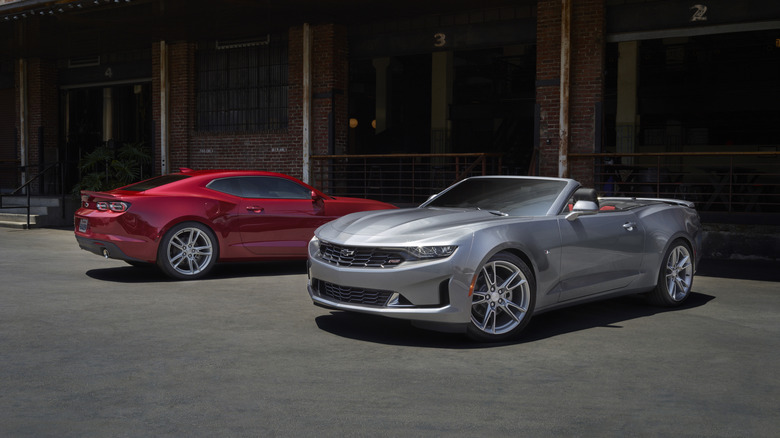
Keeping with the convertible car theme, pulling up in a Chevrolet Camaro after age 40 will virtually guarantee side-eyes, but with a 3.6-liter V6 engine making 335 hp under the bonnet in even the base models from 2024, you likely won't care. With space for four passengers across its twin rows of seating and 9.1 cubic feet of space in the boot, the Camaro was never meant to be a practical car — it was meant to be fun.
And you could greatly multiply that fun if you sprung for a slightly more expensive version that shipped with the V8 that pushed out the grand total of 455 hp and 455 lb-ft of torque; able to rocket the car from standing to 60 mph in just 3.9 seconds. That V8 engine could also give the 2024 Camaro a standing quarter-mile time of 12.2 seconds, at the end of which the speedometer would read 118 mph, and also gave the car a respectable top speed of about 180 mph.
In addition to being available as a convertible, the Camaro was also available in the traditional two-door coupe body style. Sadly, both versions have now been axed, as the Camaro was discontinued altogether in 2024. However with Ford really leaning into the Mustang's performance variants, and the Corvette's prices creeping up, Chevrolet has committed to bringing it back by 2027 as a 2028 model.
Mustang GT Convertible
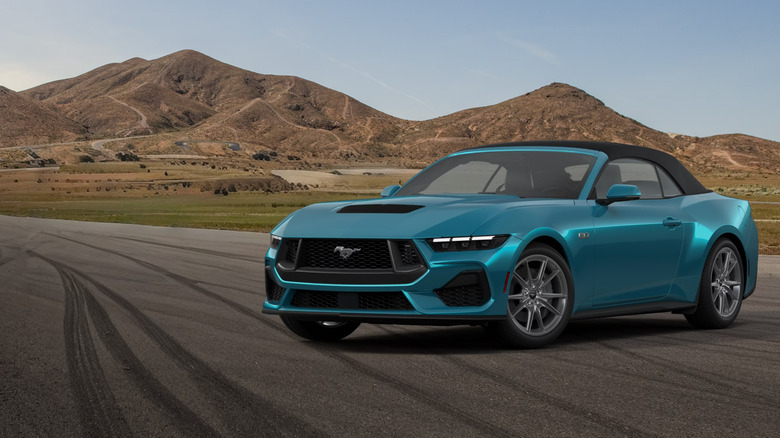
For those who want a taste of Americana and the feel of the wind in their hair, the choices are not exactly plentiful. Beyond the Camaro we discussed above, your other main option is its main competitor, the Ford Mustang GT Convertible. And unlike the Camaro, the Mustang GT Convertible — along with its coupe variant — continues to be available today as a 2026 model.
For this model year, the car comes with a 5-liter, eight-cylinder engine that churns out 480 hp and 416 lb-ft of torque. On both the convertible and coupe Mustang GT, a six-speed manual transmission is what you get from the factory, though a 10-speed SelectShift automatic box is an optional upgrade. One interesting difference that we wanted to point out was the rear axle, which, on the coupe is a 3.15 ratio, while an upgrade to a limited-slip axle with a 3.55 ratio is an optional upgrade. However, the convertible version gets the 3.55 limited-slip rear axle as standard, likely to give the car a slight boost in acceleration. As of writing, a 2026 Ford Mustang GT Convertible would cost you $51,731 as base MSRP, which is exclusive of a $1,995 destination charge.
Any old SL Mercedes
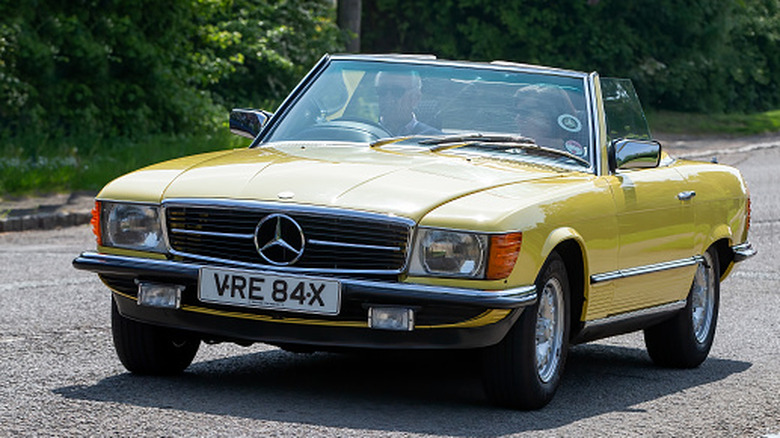
When cars such as the R107 SL from Mercedes were released back in the 70s, it was on every child's bedroom wall as a poster. Many of those children grew up only seeing these vehicles in magazines and on the television, and are now old enough to consider buying one for themselves. Factoring in depreciation, SL-series Mercs now go for anywhere between $10,000 for project cars to $50,000-plus for concours-level examples, which means that several budget ranges can be catered to.
If you're a parent whose kids have flown the nest, and there is now space for another car in the driveway, that old SL Mercedes might not be such a bad idea. After all, they won't be around for much longer unless you get your hands on one soon, since many are now approaching the 50-year-old mark. Also, there is now a plethora of information available on common issues, maintenance hacks, and problem workarounds that simply wouldn't have been available at the beginning of the 2000s, for example. There are also many people who believe that Mercedes genuinely peaked with these SL-series cars, and it was around this time that the Stuttgart-based company was still known for its reliable vehicles.
Dodge Challenger Hellcat
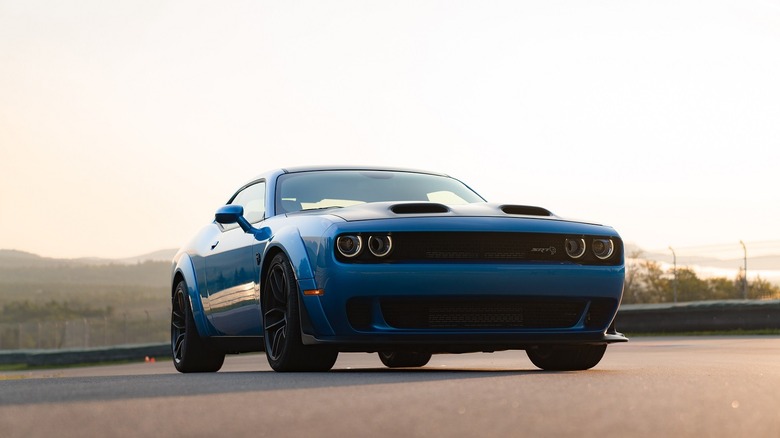
Some cars are known to suit those on the younger side, and a Dodge Challenger Hellcat is certainly one of them. You wouldn't see a middle-aged corporate executive pull up to the office in one of these, and if you did, chances are that people would be staring. That's because the Challenger Hellcat is a car that will make you grin from ear to ear when you press the gas pedal — models from 2023 came with a 6.2-liter, V8 unit that churned out a massive 717 hp, and Redeye models could make 797 horses from factory.
The sound made by the exhaust would definitely be a dopamine-inducing one, and your neighbors would hate you when you cold started the car. Sadly though, as with all great things, the Challenger Hellcat was discontinued in 2023, and is no longer on sale. As a matter of fact, Dodge now only sells two SUVs and one EV, which is called the Charger, but looks like the Challenger. So, the next time you see someone blasting down the freeway in a good old-fashioned ICE Challenger Hellcat, cut that person some slack, knowing they might very well be going though a midlife crisis. At the time of writing in mid-2026, Challenger Hellcats from 2015 or thereabouts are listing for around $35,000 on the used market.
Dodge Viper
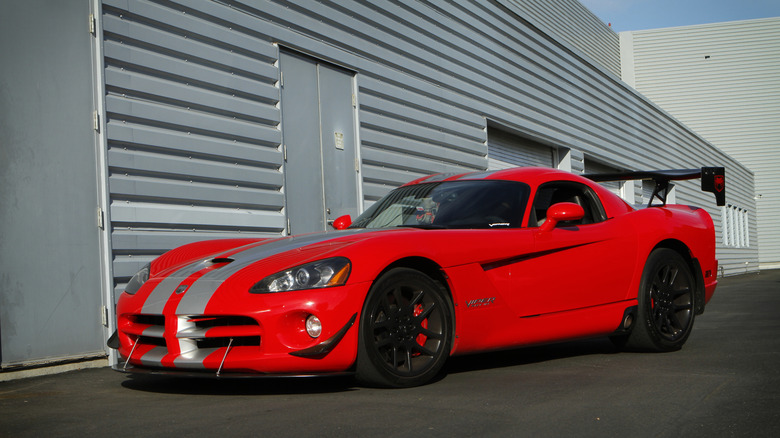
Before the 911 became accessible to the masses here in the U.S., we had the Dodge Viper's legendary speed. This car turned heads wherever it went with its incredible design and great performance figures — you could hear a Viper coming a mile away. Under that long, sloping hood rested a 10-cylinder engine that displaced a massive 8 liters in total, a displacement it reached via a bore of 102 millimeters and a stroke of 99 millimeters.
Now, the V10 is undeniably the most legendary part of the Viper, but a little-known fact, admitted by one of the engineers on the project, is that it almost shipped with the 426 Hemi V8 engine — we're so glad it didn't. Another fun tidbit was that Dodge had invited maybe around 100 volunteers to work on the Viper project, but over three times that number apparently showed up to initial meetings, which is a real testament to the love that went into making this car.
Anyway, the V10 engine that did end up going inside the Viper actually had its roots in Lamborghinis of the era, as the Chrysler group used to own Lamborghini at the time. It's a shame that now, Vipers are treated as investment vehicles or showboats. If you see someone out riding in one, you can be sure they're trying to relive the glory days.
Any kind of squatted truck
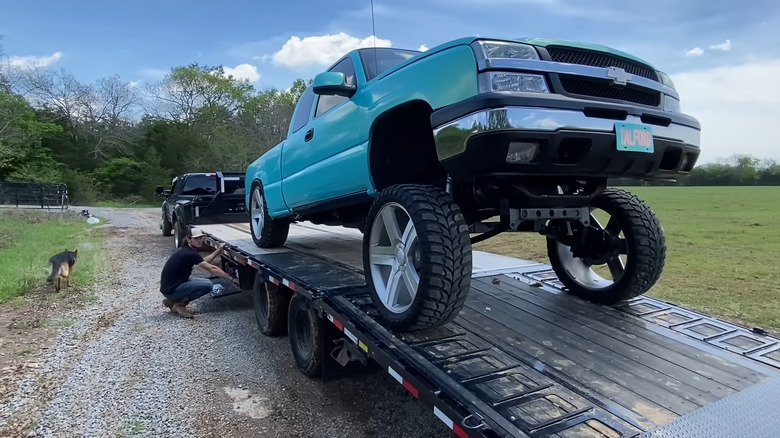
Sometimes, the itch of wanting to drive something loud, flashy, and unmistakably you simply cannot be scratched with stock, from-factory vehicles. Some owners might wrap their vehicle, paint it, tune the engine for more performance, or add an exhaust kit — the possibilities for car modding are endless. When someone chooses to forgo all of that and opt instead for a squatted truck, it's probably a clear sign of a midlife crisis, hitting hard. You see, squatted trucks are actually less utilitarian than their regular counterparts, owing to a number of factors.
First off, this squat — known as the "Cali lean" or "Carolina squat" in some areas — severely reduces the visibility out the front windshield, because it's now significantly more elevated than it should be. Next, the towbar can become borderline unusable for towing, depending on the degree that the truck is squatted to. The headlights (which are usually pointed downwards) can also become blinding oncoming drivers in certain cases, and the front wheels lose traction because of the weight balance. If the squat or lean angle is too great, then oil also won't reach the places it's supposed to go, which can lead to a catastrophic repair bill. So, while these trucks are undoubtedly cool to look at, it's probably best not to daily drive them.
Non-car exotics

For some, the itch to stand out can't be scratched with a car at all, which is why you'll sometimes see middle-aged dads rocking up in something that barely qualifies as a vehicle. The four prime examples we have of this are the Caterham Seven, Vanderhall Venice, Morgan Super 3, and the Polaris Slingshot. Each is vastly different in some way from the last, but the last three are three-wheeled, open-top vehicles that offer a completely different kind of driving thrill than a car can. In other words, they're just what people considering a weekend toy would want.
Readers should note that the Caterham Seven is not street legal off the bat — it must be registered as a kit car after the owner buys the chassis from Caterham and an engine from somewhere else. The other three vehicles are street-legal and classified as autocycles, because they have only three wheels, so you can ride them with a standard motorcycle license. Furthermore, if none of them are your style, you could also opt for something like the Polaris Rzr, which, with a few modifications, can become road legal in certain states.
Lexus LC500
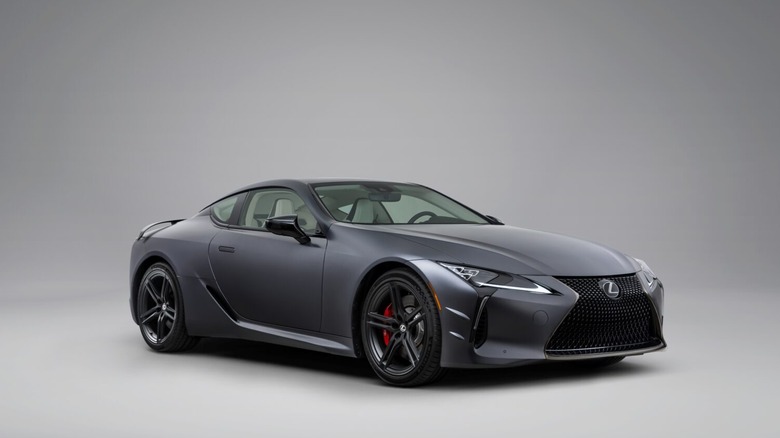
Potentially the most expensive car on this list, aside from some show-condition Dodge Vipers will be the LC500 from Lexus, the luxury arm of Toyota. Seen as the little sibling to the legendary Lexus LFA, the LC500 is a beautiful vehicle that first went on sale in 2017, and has since been discontinued. The closest thing to a brand-new LC500 would be Gazoo Racing's GR GT, which was unveiled late in 2025.
Back to the LC500 though, it shipped with a 5-liter eight-cylinder engine mated to a 10-speed transmission, that ended up pushing out 471 hp, along with 398 lb-ft of torque. We also need to take into account the gorgeous styling of the LC500, which is absolutely stunning. The car is a decade old, but would look right at home in a sci-fi futurama film.
The LC500 was offered by Lexus as both a convertible, as well as a coupe — though differences between the two styles were minimal, and there was only one engine option available to consumers. As of mid-2026, Lexus LC500s in the U.S. are listed in the range of $65,000 to $100,000.
Aston Martin Vantage
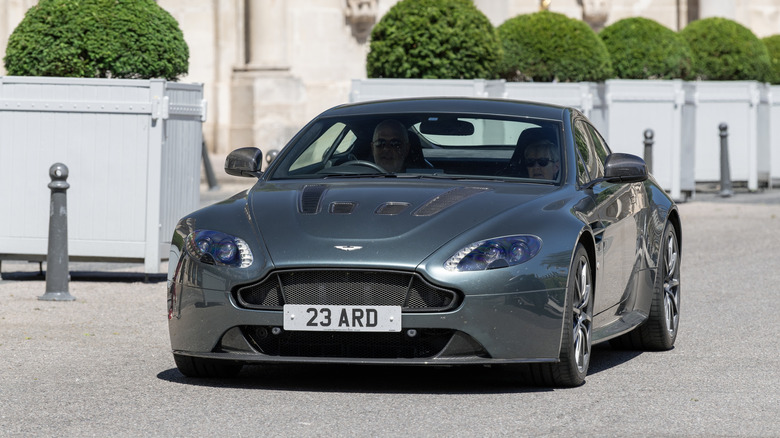
Be honest, if you saw an Aston Martin Vantage (or any Aston, really) parked at the end of your suburban cul-de-sac, you'd stop and look. Who wouldn't? That's exactly what people are aiming for with these midlife crisis cars — the feeling of being youthful, admired, envied, and, most importantly, cool. Getting a British sporty grand touring vehicle will most definitely achieve that effect, and it's easy to see why. Though the Vantage nameplate has been used on Aston Martin cars for over five decades, we're specifically referring the DB7 Vantage models that launched around 1999, and what came after.
These cars aren't inaccessible either; Vantage units from around 2008 continue to be widely available in the used market for about $40,000, and offer pretty decent value for money (supercar maintenance costs and reliability issues aside). For that price, you'd get the 4.3-liter, eight-cylinder engine that generation came with, making 380 hp and 302 lb-ft of torque, which are figures for the 2006 model year. For those who have the cash to splash, a 2026 Aston Martin Vantage will run buyers the pricey sum of $194,500 as base MSRP, and an undisclosed amount as destination, which buys you a four-liter V8 engine making 670 hp and 590 lb-ft of torque.
Chevrolet Corvette
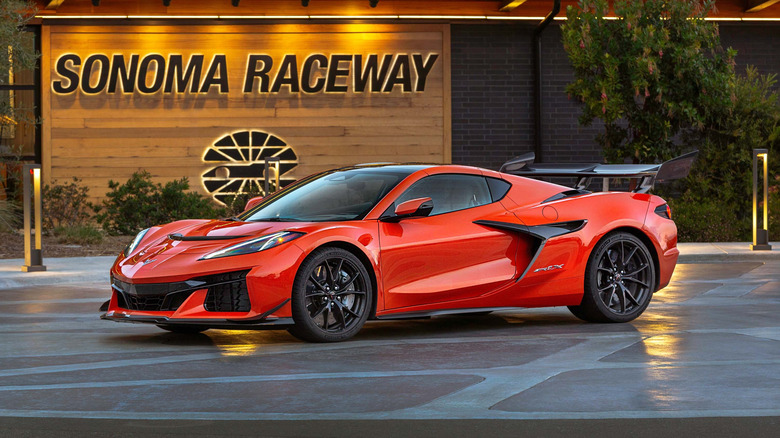
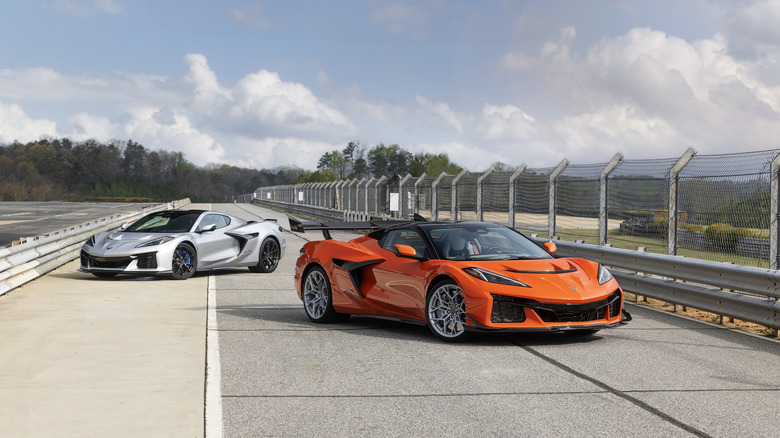
Lastly, we have the final boss of midlife crisis vehicles: the Chevrolet Corvette. In our experience, Corvette owners fall into one of two camps — those that baby their cars, and those that thrash them about every single time they exit the parking lot. Either way, if anyone on the other side of 45 is seen driving a Corvette, and hasn't owned that thing since it was new, we'll think they've fallen victim to a midlife crisis, whether they know it or not.
There's a lot to love about the Corvette, starting with the current-generation's 6.2-liter, V8 engine that pushes out 490 hp and 465 lb-ft of torque at a screaming 6,150 RPM. However, since the line has been around for so many decades, there are also many Corvette options available that are also downright slow, such as some variants of the C5, famously (at least it'll still be eye candy).
For those people who want the best that money can offer, there's the Corvette ZR1, which is officially the most powerful corvette Chevy has ever made, and the one that absolutely dominated Nürburgring lap times in early 2026. All in all, remember that the only opinion that matters when it comes to what you drive is your own, so go out and get that car, because one day, it'll be too late.