

6 Large SUVs That Depreciate The Fastest (And 6 That Hold Their Value)
Recent studies have found that an increased demand for used cars is helping to keep resale values higher than in previous years. However, new car buyers can still expect their purchases to lose a significant portion of their value over time.
Across every segment, some cars hold their value better than others. Even in traditionally high-depreciation segments like the large luxury SUV segment, the differences in value retention between rival cars can be stark. More affordable large SUVs also exhibit significant variation, with used buyers often willing to pay more for models with greater practicality and better perceived reliability.
If you're looking for a new large SUV and want to claw back as much of your original investment as possible when you upgrade, a few models stick out as particularly good choices and a few are particularly risky. We've used data from CarEdge and KBB to put together a roundup of the best and worst large SUVs for value retention, to help you see what's worth considering and what's worth staying away from.
Loses value: Land Rover Range Rover
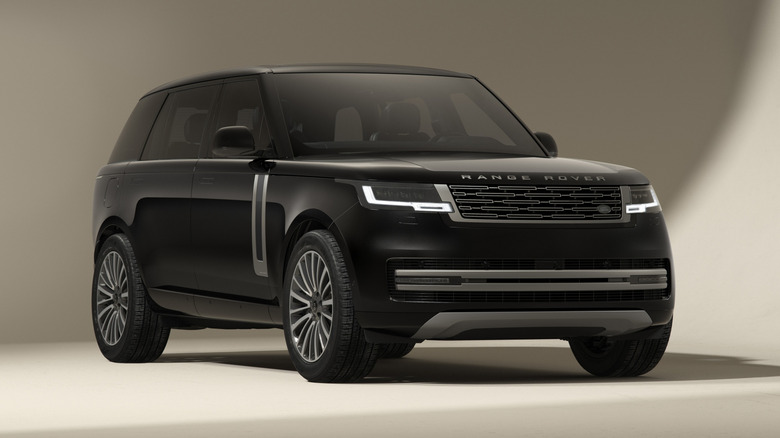
At the very top of the Range Rover lineup is the flagship Range Rover, which blends cosseting luxury mixed with impressive all-terrain capability in a way that few other SUVs can manage. It's available in a variety of trims and configurations, with entry-level versions starting just north of $110,000 and top-spec trims costing more than $250,000. It's not unusual for luxury SUVs to depreciate fast, but the Range Rover sheds its value even quicker than many of its rivals, plummeting in value over its first few years on the road.
Like all the cars here, exactly how much value it loses can vary based on the trim, mileage, and condition of any given example. According to CarEdge, the average new Range Rover will lose 74% of its original value after its first five years on the road, while KBB pegs its depreciation at 68%. The latter outlet says that Range Rover owners can expect to spend $155,057 in total ownership costs over that time, once things like insurance, maintenance, and fuel have been factored in.
Those numbers might seem eye-wateringly large to most drivers, but Range Rover buyers aren't likely to be put off by running costs. They're also unlikely to be swayed by the model's mixed reputation for dependability, since Land Rover's warranty will cover any issues that arise during their first few years of ownership. For used car buyers, those issues are not so easily dismissed, which is primarily why used buyers are willing to pay so much less than the original owners.
Holds value: Mercedes-Benz G-Class
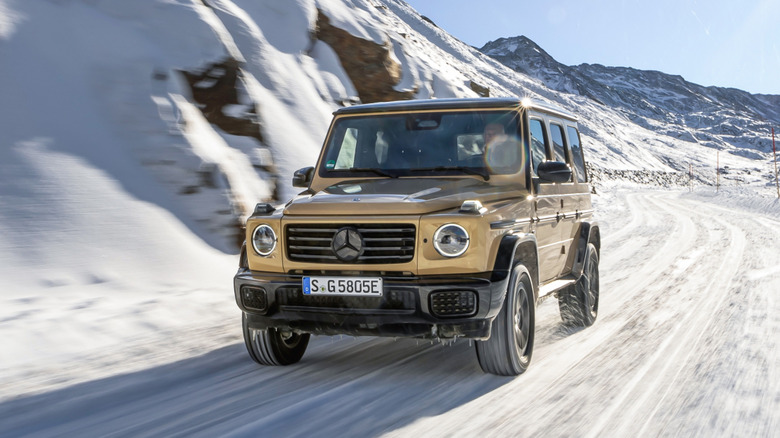
Range Rover owners can expect to lose most of their original investment if they resell their car after five years, and they're not alone. Plenty of other luxury SUVs suffer from high depreciation, though there are a few exceptions. One of those exceptions is the Mercedes-Benz G-Class, which will lose less than half of its value after five years. That puts its depreciation levels on par with many economy cars in percentage terms, even if its high asking price means that buyers will still be losing a lot in dollar terms.
Data from CarEdge suggests that a G-Class will lose 48% of its value after half a decade, while KBB predicts that the car will lose just 40% of its sticker price. There isn't one single reason driving the G-Class' higher value retention, although it's likely that its reputation for being more reliable than most other luxury SUVs plays a part. So too does its status as an in-demand fashion symbol, and the fact that older versions of the car look so similar to newer versions surely can't hurt resale values either.
Loses value: Nissan Armada
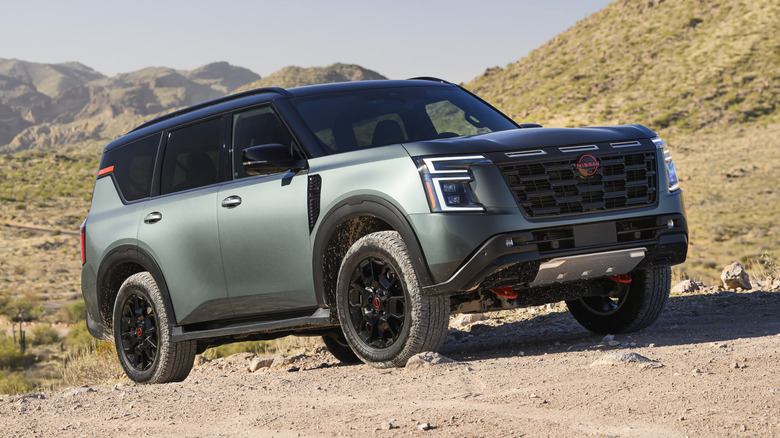
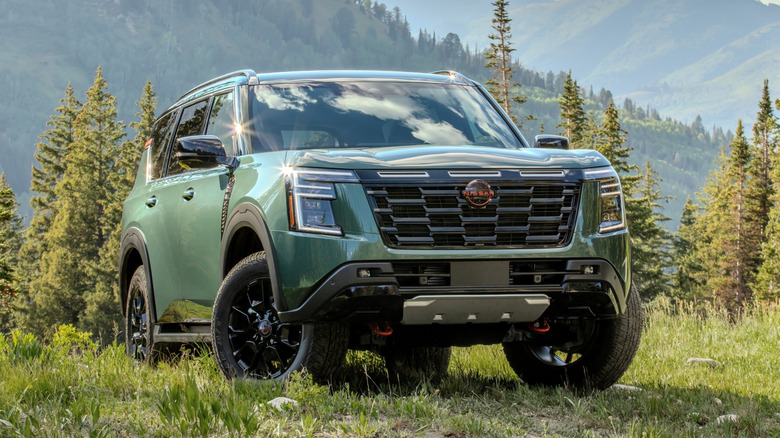
Although our reviewer thought the latest generation of the Nissan Armada felt less forgettable than previous generations, it seems that the full-size SUV still doesn't spring to mind as a good choice for many used car buyers. Its depreciation levels are closer to those of luxury brands than they are to many of the Armada's rivals, with CarEdge predicting a 66% drop in value after five years and KBB estimating a depreciation rate of 57%.
That's despite the Armada's core appeal being very similar to its rivals. There's a powerful V6 engine under the hood, a competitive amount of interior space for passengers and cargo, and a list of premium extras included in top trims. In Pro-4X guise, the Armada also promises additional off-road capability, bringing it closer in line with rivals from Ford and Toyota. None of that has been enough to convince used buyers to pay a premium for Nissan's biggest SUV, and that dents its appeal in a segment that isn't short of SUVs with far better value retention.
Holds value: Lexus LX
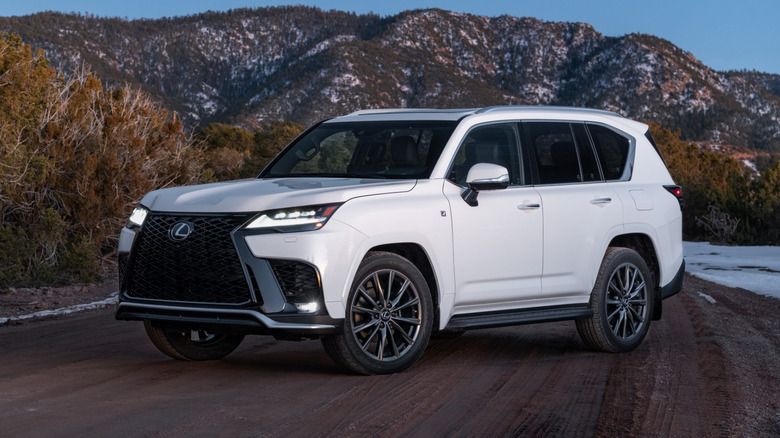
Estimating depreciation levels isn't an exact science, and sometimes differing datasets and methodology can produce significantly different results. The Lexus LX is a good example, with CarEdge suggesting it will depreciate only 33% after five years on the road and KBB estimating a 51% drop in its value over the same period. Even if you take KBB's figure at face value, the Lexus still remains one of the best luxury SUVs for value retention on the market.
Buyers of all used luxury SUVs will be aware of their potentially wallet-draining repair costs should something go wrong, so it's safe to assume that Lexus' brand-wide reputation for reliability helps reassure LX buyers. The latest generation is also available as a hybrid, but the electrification doesn't pay off at the fuel pump. We saw an average of 15 mpg during our time with the car, significantly less than the LX's EPA-estimated 20 mpg combined.
The hybrid is slightly more brisk off the line than its non-electrified counterpart, though, which makes a noticeable difference to the overall driving experience given the SUV's overall heft. The cabin is also a very welcoming place to spend time, regardless of whether you're a passenger or the driver. If you're a second-row passenger, you can get reclining captain's chairs too.
Loses value: Lincoln Navigator
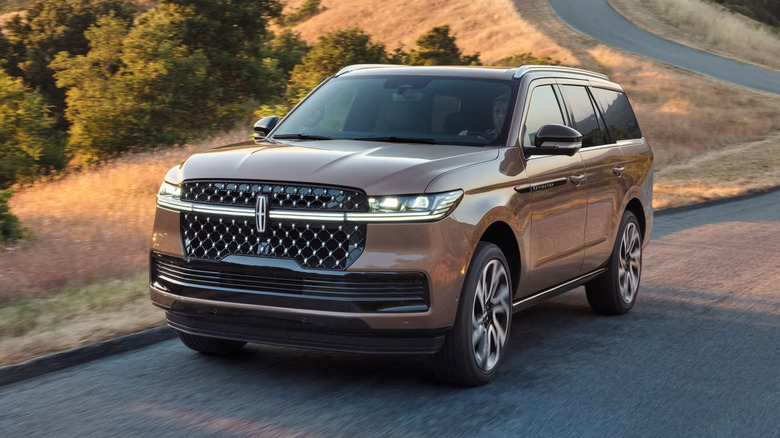
Some luxury large SUVs buck the trend and hold their value well, but most don't. The Lincoln Navigator sits in the second camp, and buyers should be prepared to lose the majority of their investment if they sell after five years. CarEdge puts the Navigator's five-year depreciation rate at 60%, while KBB suggests a 63% loss in value. This isn't quite as much of a loss as some other large luxury SUVs, with the Range Rover in particular losing a much higher percentage of its value, but it's still enough to put the Lincoln behind most of its rivals in value retention terms.
It might not be a financially shrewd investment, but during our time behind the wheel, we found it easy to see the appeal for buyers with enough cash to burn. The SUV was pleasingly easy to drive and supremely comfortable, and its interior infotainment tech felt high-end without being as intrusive as some rivals. The horsepower boost compared to the Ford Expedition was also a welcome addition.
Holds value: Toyota Sequoia
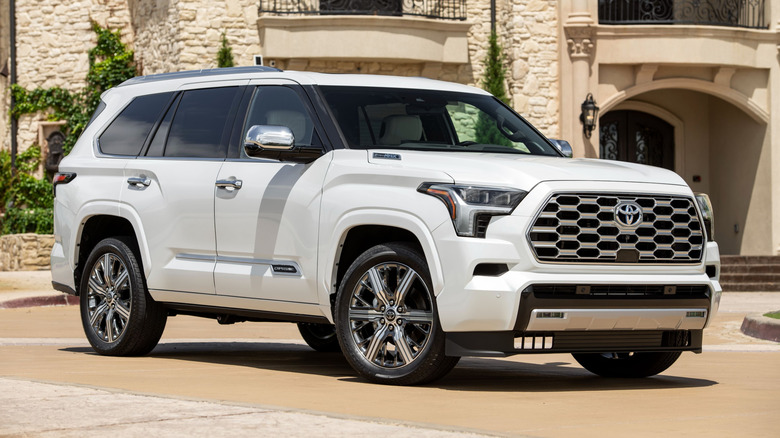
As well as being capable and roomy, the Toyota Sequoia has a reputation as being one of the longest-lasting SUVs on the market. It's one of many Toyotas that should comfortably be able to last for over 250,000 miles, assuming it's serviced correctly, and that longevity helps bolster its resale value. Estimates on how much the latest Sequoia will depreciate can differ though, with CarEdge predicting a 37% depreciation rate and KBB forecasting 51%.
We spent time with the current generation Toyota Sequoia in 2024 and found it to be a very capable machine, albeit with a more truck-like road manner than some rivals. The trade-off for that lack of refinement is increased off-road capability, with the beefy tires and hybrid V6 powertrain of our TRD Off-Road tester making it even more capable than a base-trim Sequoia.
Much like Lexus' similarly capacious hybrid LX, the electrification offers a performance boost but not an efficiency boost, and we recorded 17 mpg during our testing. What it lacks in frugality it makes up for in low depreciation, making the Sequoia a smart pick for those who need an SUV of its size.
Loses value: BMW X7
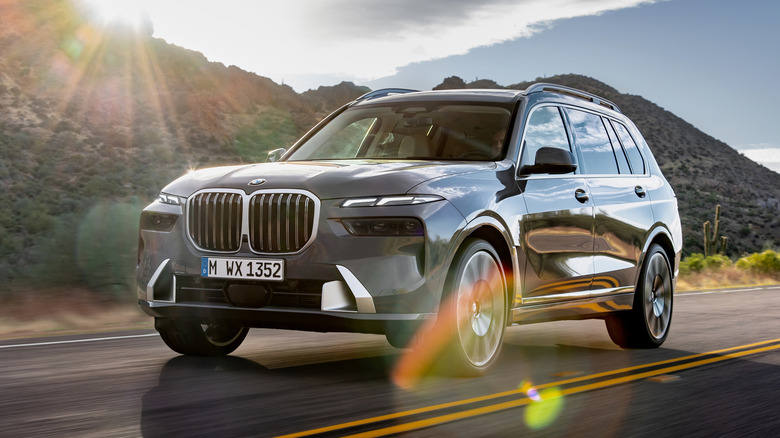
It might not depreciate as quickly as some of its competition, but the BMW X7 still loses a larger share of its original sticker price over five years than many other large SUVs. According to CarEdge, it can be expected to lose 63% of its value, while KBB suggests a 57% drop. The latest generation of BMW's large luxury SUV has been on sale for several years now, but it'll still cast a striking figure in a row of similarly sized competitors in any country club or upscale hotel parking lot.
The brand's oversized kidney grilles continue to be divisive, but they're definitely memorable, while the 23-inch wheels were the largest of any production BMW when the current generation launched. Inside, the X7 shares much of its design with other high-end BMWs, with a large dual-screen curved display handling both infotainment duties and the digital dash. With a starting price just under $90,000 for the 2026 model year, the base X7 isn't quite as pricey as other range-topping luxury SUVs like the Lincoln Navigator or Range Rover. However, buyers who pick the 523 horsepower X7 M60i can see their final bill stretch past $130,000 with enough options ticked.
Holds value: Lexus TX
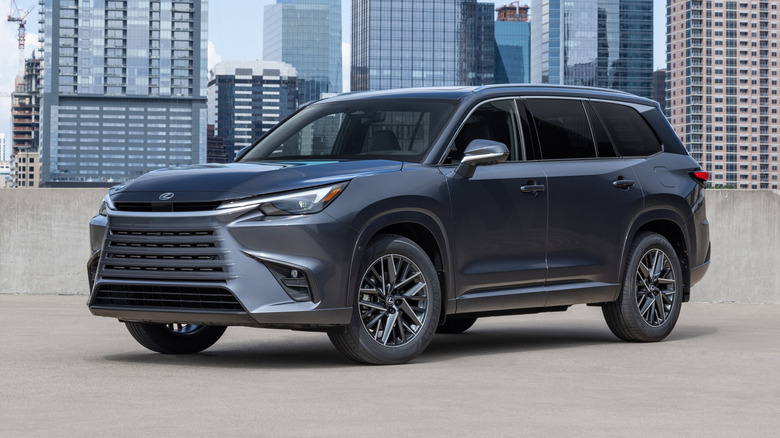
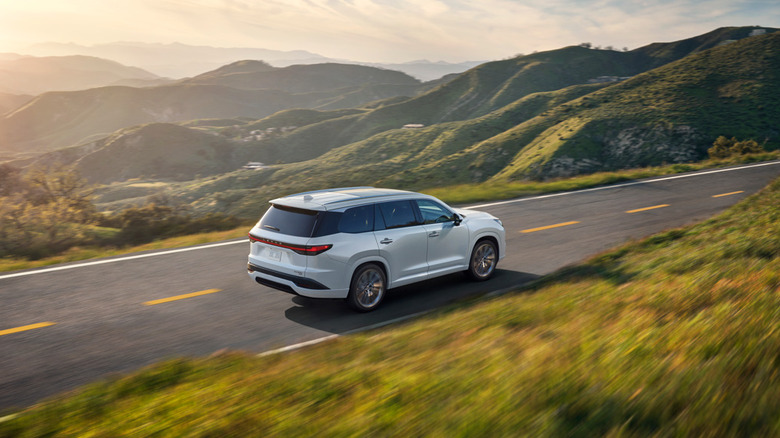
The 2024 Lexus TX, a new launch for Lexus at the time, replaced the little-loved RX-L. It shares a platform with another relatively fresh launch, the Toyota Grand Highlander. While it's still early days and so expected depreciation figures vary, the initial predictions suggest that the TX should hold its value well compared to other luxury SUVs in its price bracket. CarEdge is very positive about the TX's predicted values, suggesting it will depreciate just 41% after five years, while KBB is slightly less bullish about its prospects, estimating a 53% fall in value.
Like all good three-row SUVs, the TX provides ample space for passengers in the first and second rows, and its third row could also fit smaller adults without much trouble. That's an improvement over the old RX-L, which had much less generous legroom and headroom in the back row. In most other aspects, the TX is a typical Lexus SUV: comfortable to drive and adequately powerful, with competitive levels of onboard tech and a high level of fit and finish. It doesn't do anything particularly unique, but it's still a very capable upmarket family hauler.
Loses value: Cadillac Escalade ESV
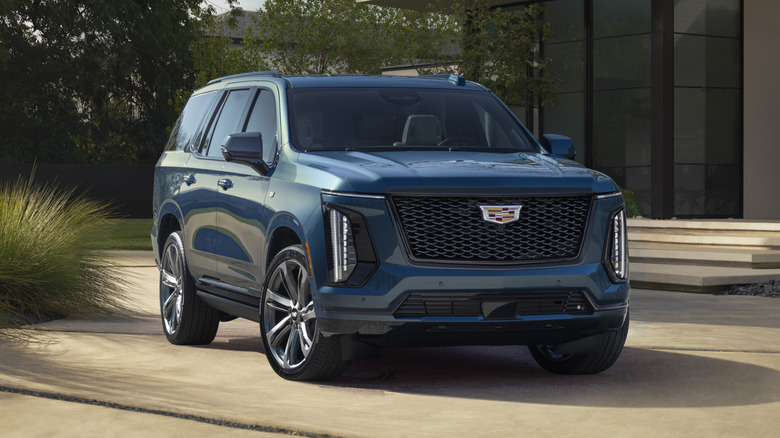
The standard Cadillac Escalade is already very, very large, but the ESV is even larger. It will also depreciate faster by CarEdge's estimates, with the regular Escalade losing 58% of its value after five years but the Escalade ESV losing 64% in the same time frame. KBB predicts an even larger drop in value for the ESV, calculating a 66% loss over half a decade.
It's safe to assume that many Escalade ESV buyers won't have a reason to justify purchasing such a large car. It's an SUV that you purchase in spite of its impractical size, hefty running costs, and speedy depreciation. If anything, its inefficiency is a key part of its appeal. The trouble is that same inefficiency becomes less appealing as the SUV ages, and, in turn, that makes it one of the fastest-depreciating luxury SUVs on the market.
Holds value: Hyundai Palisade
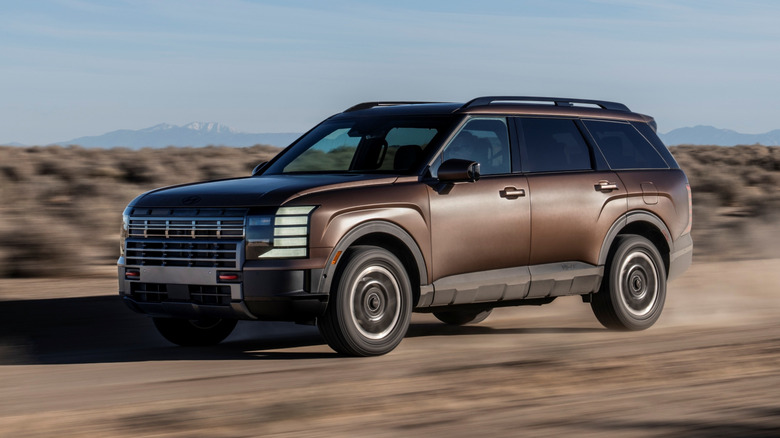
In addition to looking more premium than its price tag suggests, the 2026 Hyundai Palisade is also packed with plenty of useful tech. Its list of driver assistance, safety, and infotainment tech is comparable to the equipment you'll find in SUVs from some traditional luxury brands, but the Palisade undercuts almost all of those luxury-brand rivals in price. In base-spec form, it starts from $41,035 (including a $1,600 destination fee), but even the range-topping Calligraphy trim can be had for as little as $56,160. Buyers get a lot of carrying capacity for their cash too, with three rows of seats and available captain's chairs for the second row.
Hyundai's large SUVs don't hold their value quite as well as rivals from the likes of Toyota, but the Palisade is still one of the better performers in its class. According to CarEdge's estimates, it should depreciate 49% after five years, while KBB predicts that it will lose 51% of its value. Considering its low asking price, the Palisade's depreciation in dollar terms is among the lowest of any of the picks here.
Loses value: Infiniti QX80
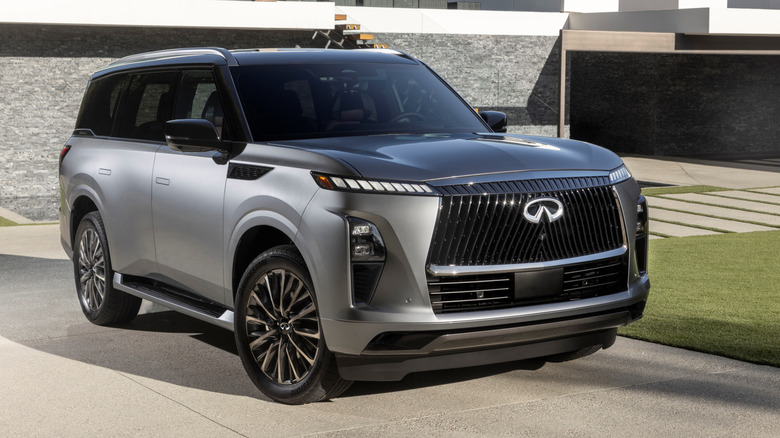
The Nissan Armada is one of the fastest depreciating SUVs in its segment, and its upscale sibling, the Infiniti QX80, is no different. In fact, it depreciates even faster than the Nissan, losing 69% of its value after five years on the road, according to CarEdge, and 60% according to KBB.
We thought the latest generation of the QX80 was a notable improvement over its predecessor, but its handling still can't match up to the best in class. Its efficiency figures trail the class leaders too, so owners will need to account for high running costs as well as high depreciation costs.
There's still plenty to like about the QX80, from its unusual-looking Klipsch audio system to the heated, ventilated, and massaging seats, both of which are available in top-spec trims. The biggest issue is the number of appealing rivals the QX80 is up against, most of which also hold their value better over time.
Holds value: Toyota Grand Highlander
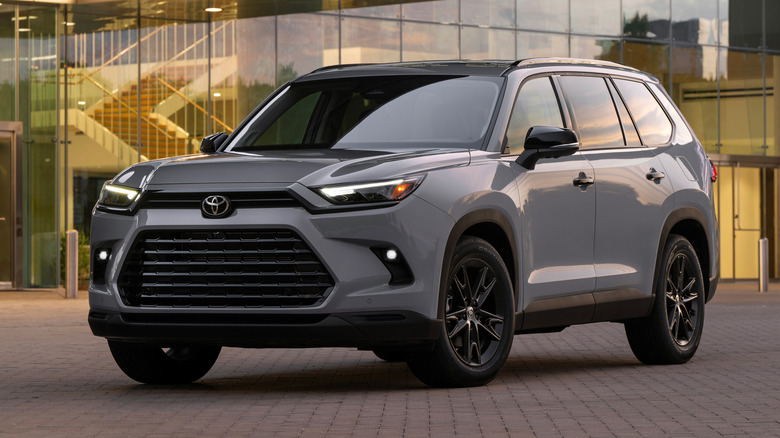
The Toyota Grand Highlander occupies a distinct space in the market between the largest full-size SUVs and the traditional three-row mid-size SUVs, being cheaper than a Sequoia but roomier than a Highlander. Just like the related Lexus TX, the Grand Highlander has only been on sale for a couple of years, and, combined with its relative lack of rivals, that makes predicting its depreciation far from simple.
While CarEdge suggests that a five-year-old Grand Highlander can be expected to lose only 30% of its value, KBB claims that the average example will have dropped 48% in the same period. Regardless of which estimate turns out to be closer to the truth, that puts the Grand Highlander towards the top of the class among its admittedly small field of rivals.
While the Grand Highlander is designed to fit underneath the Lexus TX in both price and plushness, it's not short on luxuries in its highest trims. It isn't short on power either, with Toyota's Hybrid MAX powertrain under the hood of costlier variants. An output of 243 horsepower might not sound impressive by modern standards, but we found it to be plenty to tackle both highway driving and mountain roads.
Our selection methodology
We used data from CarEdge and KBB to calculate average depreciation rates for large SUVs, with each of our value-holding picks depreciating 50% or less according to the mean estimate from both outlets. Each fast-depreciating pick loses 60% or more of its initial value over the same period, according to the mean estimate from both outlets.