

6 Hemi Engines That Weren't Built By Chrysler
"HEMI" and "Chrysler" go together like a horse and carriage. Whether it's the early, first-generation FirePower HEMI that debuted in the 1951 Chrysler New Yorker, the iconic 426 Street HEMI that powered iconic '60s and '70s muscle cars like the Dodge Charger R/T, or the late-model Gen III HEMIs that survive to this day, the American automaker is indelibly associated with hemi engines.
The thing is, though, the technology is far from exclusive to Chrysler. The HEMI name, after all, only truly denotes that an engine has hemispherical combustion chambers, nothing else. And, as you might expect given the simplicity of the concept, those kinds of heads were in use long before the first HEMI ever rolled off a Chrysler production line. Sure, Chrysler may have trademarked the HEMI (all caps) name, but it's not the only one to have built and used hemi engines in its vehicles.
We've covered non-Chrysler hemi engines and the cars they've powered before, including the Jaguar XK inline-6 and the Alfa Romeo Busso V6. But the world of Hemi engines not built by Chrysler extends far beyond these offerings and includes some attempts from Chrysler's U.S. rivals, too.
Chevrolet Hemi 302 Crossram
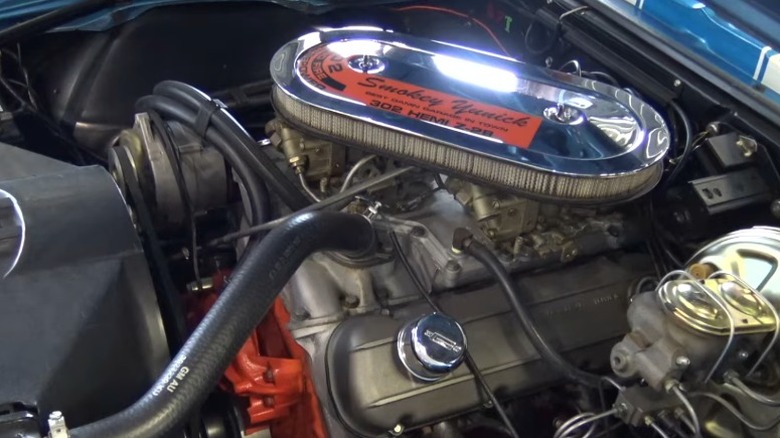
The idea of a GM hemi engine may seem like blasphemy, but that's precisely what happened in the late 1960s, when Chevy hooked up with legendary NASCAR engineer Smokey Yunick. At the time, Chevy was racing in the SCCA Trans-Am racing series and wanted to better compete against Ford's Boss 302 engine. The solution was to slap some hemispherical heads on the engine it was already using in the series: the iconic 302-CI V8 that powered the '67 to '69 Camaro Z/28.
Chevy's ultra-rare hemi engine was a small-block like the base engine, but featured plenty of upgrades over the original. These prototype mods included larger pistons, aluminum hemi heads, magnesium valve covers, and a new camshaft that had enough lift to move the new, bigger, valves. The block was also modified to fit said larger valves, and the whole package was topped off with twin Holley carburetors complete with Yunick-built intake trumpets for maximum airflow.
As it turns out, Ford's 302 wasn't quite as dominant as Chevy expected it would be, and that seems to have been enough for GM to shy away from pursuing the small-block hemi 302 concept. The engine thus never left the prototype stage, and the world never got to see what a hemi-head small-block 302 could do. As of 2021, there were only three GM 302 Hemi engines known to exist, including one in a blue '68 Camaro Z/28 and another in a silver '69 model.
Ford 427 Cammer
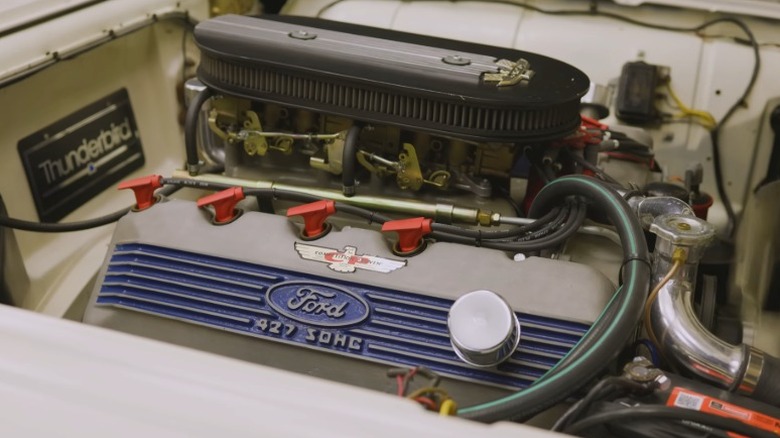
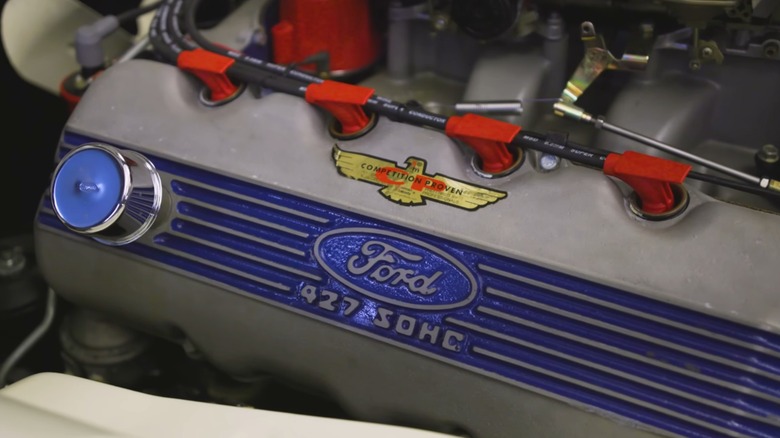
The Big Three of the U.S. automotive industry all tried their hand at hemi engines, although Chrysler was the only one to bring the technology to mass production. One of a handful of prototype and racing-only hemi engines is Ford's legendary SOHC 427 hemi, also known as the "Cammer."
Ford's "Cammer" V8 was based on its 427 FE engine, which many consider one of the greatest V8s Ford ever built. The standard FE was already a mighty impressive racing engine, but the "Cammer" took things to the next level. Hemi heads were of course present, alongside necessary upgrades such as new aluminum pistons and improved engine block lubrication. But these hemi heads weren't just any old heads: these were dual-valve, single-overhead-cam cylinder heads with machined combustion chambers, large intakes, and a complex drive system that necessitated a 6-foot-long timing chain. The result? 616 hp at a relatively high 7,000 rpm and 515 lb-ft of torque.
The 427 "Cammer" was designed to rival the 426 HEMI in NASCAR, but the racing series banned non-production engines like the HEMI and the "Cammer" in 1964. Thus, Ford took the engine to the drag strip instead. The engine had a good run, powering championship-winning campaigns in the mid-to-late 1960s and early 1970s. However, the "Cammer" was eventually displaced by its Chrysler rival as parts and factory support began drying up. Ford never put the "Cammer" into a production car, and it's estimated that it only ever built a maximum of 1,500 crate engines during its run.
Daimler SP250 V8
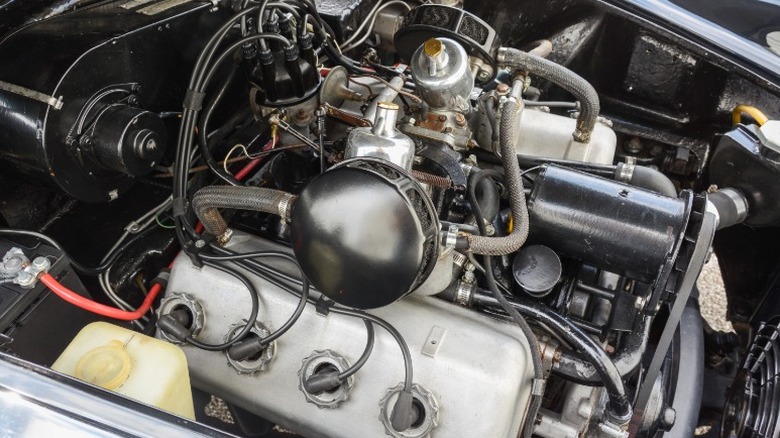
The Jaguar XK inline-6 and Alfa Romeo's Busso V6 are among the best European hemi engines, but while both are great engines, they're far from the only examples of the breed. British marque Daimler — which had no relation to Gottlieb Daimler — also built a hemi engine, and it had two more cylinders than the Jaguar and Alfa hemis.
Daimler's hemi V8 powered its SP250 sports car, which debuted (as the Daimler Dart) at the New York Auto Show in 1959. The fiberglass-bodied 2+2 drop-top was not particularly attractive, nor was it all that good, but that's neither here nor there for us — what's important is what was under the hood. In the Daimler's case, it was a 2.5-liter pushrod V8 with hemispherical heads that made 140 bhp and 155 lb-ft of torque. Not all that impressive when compared to other hemi V8s, of course, but the SP250's svelte 2,260-pound curb weight meant that the V8 was good enough to give it a 0-60 mph time of around nine seconds and a top speed of 120 mph or so.
The SP250 had a brief run, with Daimler stopping production in 1964. The automaker refined the car significantly over those five years, especially after it was taken over by Jaguar in 1960, but it was, by most accounts, a failure. Only 2,654 were ever built, with nearly half of them being left-hand drive. Despite its rarity, the SP250 isn't quite as pricey as other low-run classics, if the $50,600 going price for a black 1961 model at an RM Sotheby's auction in 2020 is anything to go by.
Tatra V8
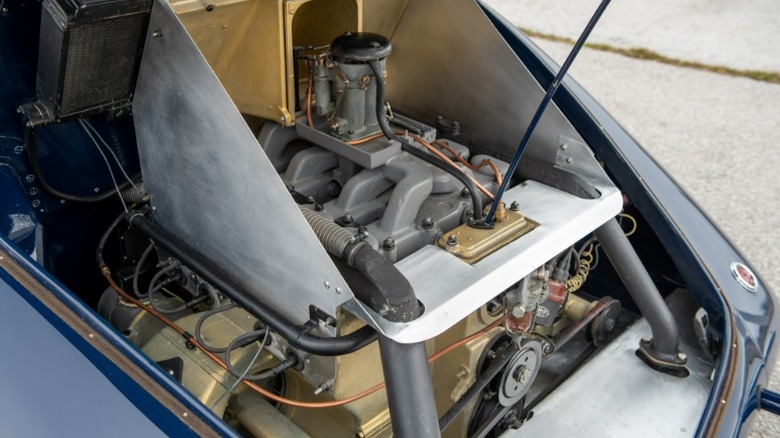
There are strange cars, and then there are really strange cars. The Tatra T77, which debuted in 1934, is arguably one of the latter. Hand-built in limited numbers by Czechoslovakian company Tatra, the T77 was developed and designed with the aid of former Zeppelin designer Paul Jaray, whose influence likely gave the T77 its sweeping lines and ultra-aerodynamic shape.
But the Tatra T77 is notable for more than just being one of the first mass-produced aero road cars ever. It also had quite an interesting engine, namely a magnesium-alloy 3.0-liter air-cooled V8 with hemispherical heads and a dry sump oiling system — pretty trick for the 1930s. And it was all mounted in the rear, Porsche-style, which explains the presence of rear louvers instead of a rear window. Tatra's V8 was woefully weak by modern standards, only managing 60 hp, but the T77's sleek body made up for the lack of raw power. The Tatra's slippery shape gave it an impressive-for-the-time top speed of 87 mph.
Tatra only built the T77 until 1936, making it an extremely rare car, which explains why someone paid $390,000 for one at an RM Sotheby's auction in 2023. The T77's successor, the T77a, had a bigger 3.4-liter engine that made more power — 75 hp — and bumped its top speed to 93 mph, but retained the air-cooled hemi design of the T77's V8. That wasn't the hemi's final form, though, and Tatra rejigged the V8 once again in 1936. This version, which powered the T87, reduced displacement back down to 3.0 liters but added an overhead camshaft that kept power at 75 hp.
Ford Boss 429
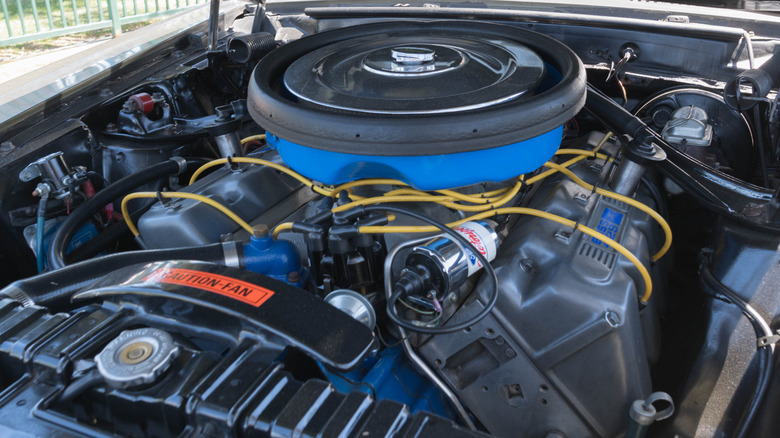
Now, let's be clear: Ford's Boss 429 isn't a "true" hemi engine; instead, it's a semi-hemi with angled valves, which earned it the nickname of the "Twisted Hemi." However, Chrysler's modern HEMIs aren't true HEMIs either, so we think this engine is a perfectly valid one to discuss in a list of hemi engines.
The Boss 429 engine was unveiled in late 1968 as a higher-performance, NASCAR-oriented version of the 429-CI engine that was part of the then-new 385 engine series. To that end, the Boss 429 received several notable upgrades, such as a 1,000-cfm Holley carburetor, aluminum cylinder heads with better-flowing semi-hemi combustion chambers, a strengthened engine block, and uprated bottom-end components. The result? A potent engine that garnered quite a few successes on track, including a 1969 NASCAR championship and a chunk of Grand National wins. Was it a 426 HEMI beater? No, not quite, but it did give a good account of itself in general.
Ford's Boss 429 made it to the street, too, as NASCAR required automakers to build 500 street-legal versions of their products to race them on track. The road-going Boss 429, which Ford offered in the Mustang, was sadly not quite the same as its racing cousin, with a more restrictive carburetor and compromised valvetrain that hobbled its high-rpm capabilities. Ford rated the Boss 429 Mustang at 375 hp, a mere 15 hp over the standard 429 in the 1969 Thunderbird, although both of those numbers are likely significantly underrated. The Boss 429 Mustang was unfortunately not a huge success, with only 1,358 cars leaving the factory during its short production run.
Mickey Thompson Ford FE Hemi
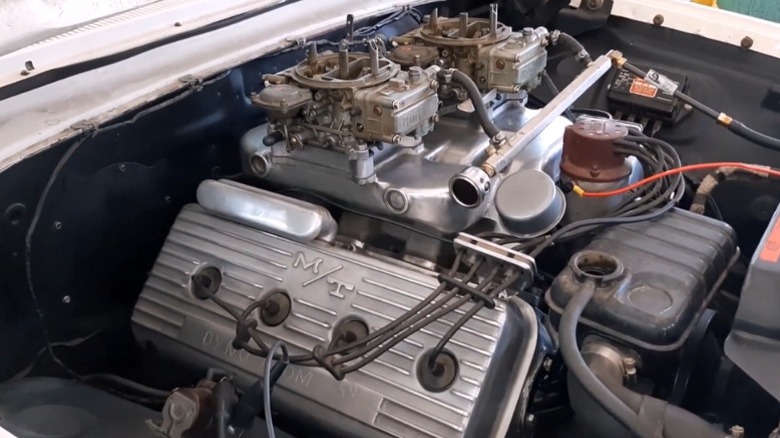
The Blue Oval built two in-house hemi engines in the mid-to-late 1960s as it attempted to compete against Chrysler's immensely successful 426 HEMI, in the form of the 427 "Cammer" and Boss 429. But Ford engineers weren't the first people to try and make hemi heads work on a Ford block: legendary drag racer and top speed record-holder Mickey Thompson also gave it a go, giving rise to a unique take on the Ford 427 FE engine.
Thompson's involvement with Ford began in 1964, soon after his GM deal ended the year before. He had already developed hemi heads for GM's Pontiac V8s, and he retained the concept once he had jumped ship to GM's Detroit rival. His efforts were helped by similarities in the engine blocks of Ford, Chrysler, and Pontiac's V8s, which allowed him to develop hemi heads for Ford's FE engines. Thompson allegedly made four sets of these heads, and they were the main difference; as far as we can tell, the engine blocks themselves didn't see any changes.
As you might expect, getting hemi heads on a Ford FE engine wasn't entirely straightforward and relied on one very interesting innovation: segmented, articulating pushrods. The Mickey Thompson heads had three-piece pushrods that were welded into the lifters themselves, making for quite a unique valvetrain setup. Thompson's Ford hemi experiment was short-lived, though, and he quickly switched over to Ford's 427 "Cammer" (which didn't need such a convoluted pushrod setup) once it was available.