

12 Of The Most Powerful Japanese Sports Motorcycles, Ranked By Horsepower
Japanese sports bikes have been a fixture in the world of high-performance motorcycles since the '90s. Bikes like the extremely influential Yamaha YZF-R1 and Suzuki's Hayabusa, for example, can stake claims to be considered some of the most iconic bikes of all time, while rivals from Kawasaki and Honda are similarly legendary and well-loved by members of the two-wheeling community.
Many of these bikes are also known for making quite a bit of power, with current iterations of the Suzuki GSX-R1000R, Honda Fireblade, and Kawasaki ZX-10R coming close or even exceeding the vaunted 200 hp threshold. Even 600cc and 700cc bikes are quite powerful these days, with well above 100 hp on tap from some models. But how do all of these Japanese sports motorcycles compare, though? Let's go through the numbers of their most recent iterations and find out.
A few notes on who we selected these bikes before we begin: First, we're treating "sports motorcycles" as a catch-all category that encompasses sub-liter sports bikes and high-performance superbikes. Second, not all manufacturers reveal horsepower numbers, especially for the U.S. market; Thus, we had to diversify our sources and look at European-market numbers and EPA testing data. We then chose the highest number available to determine a bike's ranking on this list.
Suzuki GSX-R600 - 119 hp
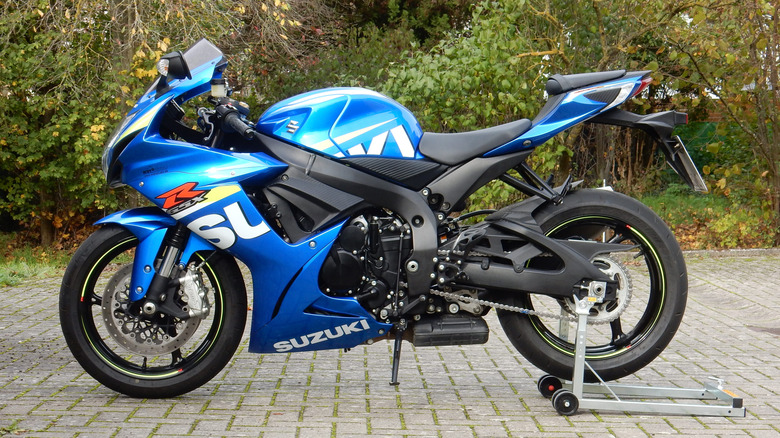
Suzuki's GSX-R600 has been a fixture in the company's lineup since 1997, when Suzuki launched it to compete in a new 600cc racing circuit called the Supersport World Series. The GSX-R600 hit the ground running, with its racetrack-focused design winning reviewers over and translating to success on the track, resulting in World Series championship wins in 1998 and 1999.
Nearly 20 years on from its debut, the GSX-R600 continues to fly the flag for middleweight, inline-four fun, with its racy geometry and high-revving engine encouraging riders to really get stuck in and work the bike hard to make use of its relatively limited (at least, compared to other bikes on this list) power. The engine's numbers reflect that, with EPA test data indicating a maximum output of 119 hp at 12,400 rpm.
Suzuki has updated the GSX-R600 several times over the years, but it has remained relatively unchanged since its last major update in 2011. Thus, it's a delightfully old-school bike in many ways, including a surprising lack of rider aids. It has a drive mode selector that lets riders choose between road or track-focused engine maps, but that's about it. You don't even get traction control, so be glad it only has 119 hp.
Kawasaki Ninja ZX-6R - 127 hp
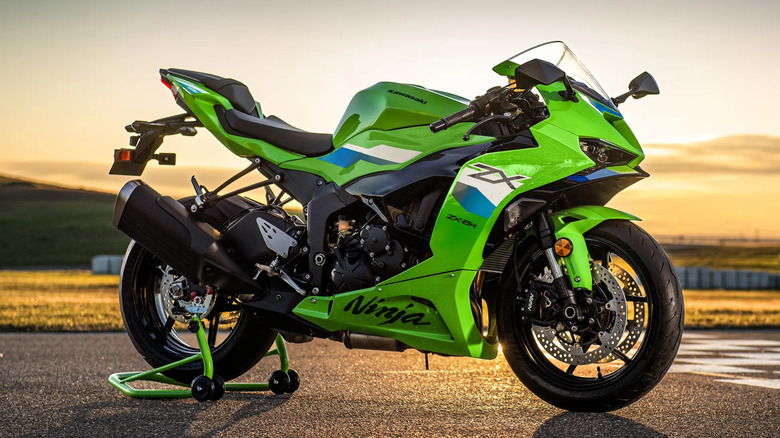
Kawasaki's Ninja ZX-6R made a splash when it debuted in 1995, with Cycle World hailing it as "the lightest, quickest, fastest, most powerful" 600cc bike that had released up to that point. It was the first 600cc bike to post a 10-second quarter-mile time in the magazine's testing and managed to hit an impressive 154 mph during its top speed run — not bad for a 599cc engine.
The modern ZX-6R carries on the heritage of its 20-year-old forebear, with its 127 hp and 52.1 lb-ft of torque (generated at 13,000 and 10,800 rpm, respectively), higher than any 600cc Japanese sports bike still in production. Of course, Kawasaki is cheating a bit: The ZX-6R has a 636cc engine and has had one since the 2003 model year. Its closest rival, the Suzuki GSX-R600, has a 599cc engine, as does the much less powerful Honda CBR600RR.
While the 636cc engine's numbers might indicate a very peaky engine, the ZX-6R is anything but a top-end merchant: We tested a 2025 Kawasaki Ninja ZX-6R and found that the inline-four was capable throughout the rev range, with good grunt between 6,000 and 9,000 rpm. Combine that with its responsiveness, engaging dynamics, and good handling, and the Ninja ZX-6R might just be the middleweight sports bike to beat.
Suzuki GSX-R750 - 147 hp
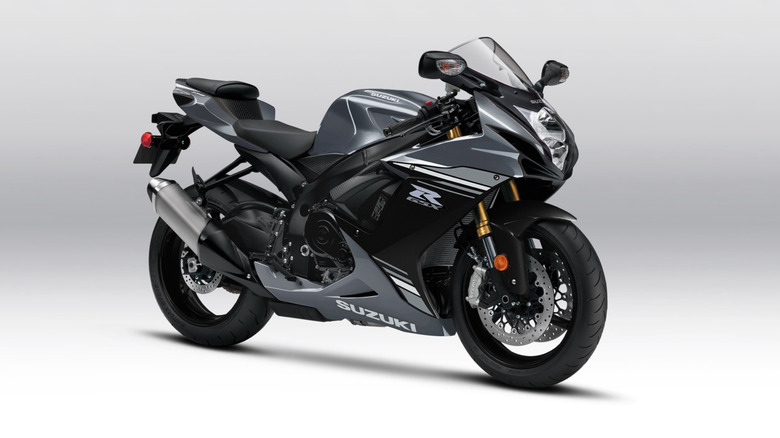
Suzuki's GSX-R750 has been around for longer than most sports bikes: The 750cc icon debuted in 1985 as a race-oriented, ultra-lightweight bike powered by a 76-hp inline-four and weighing under 400 pounds dry. It changed the landscape of sports bikes and had rivals playing catch-up, cementing its place as one of the best motorcycles Suzuki ever made.
In the years since, the GSX-R750's power has nearly doubled to 147 hp, which it makes at 12,200 rpm, according to EPA data. Its curb weight is still light, though, at 419 pounds. Much like its smaller brother, the GSX-R600, the GSX-R750's svelte weight is down to its simplicity. It doesn't have any of the usual rider aids — not even traction control — nor does it have features like a quick shifter or much in the way of fancy electronics. You'll even have to make do with an analog tachometer with only a few concessions to dashboard modernity, such as a lap timer and programmable shift indicators.
The result, then, is a bike that offers up old-school thrills and requires riders to keep their wits about them to stay upright. Of course, that's not without reason: The GSX-R750 has essentially been unchanged since 2011, which comes with downsides such as outdated factory tires. Despite that, the GSX-R750 remains a compelling sport bike for enthusiasts.
Honda CBR1000RR - 169 hp
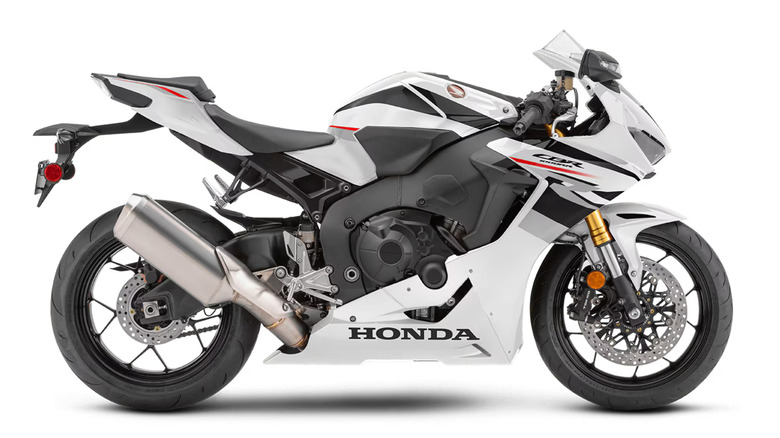
Unlike most of its Japanese rivals, Honda has two big-power liter bikes in its current American-market lineup. The fire-breathing CBR1000RR-R Fireblade SP is the king of the hill, but those who want some of that prestige without the massive power (or price tag) can go for the slightly more approachable CBR1000RR.
The CBR1000RR's 998cc inline four makes a healthy 169 hp at 10,400 rpm based on EPA data, and revs up to a maximum of 13,000 rpm. It has a dual-stage fuel injection and makes use of materials like magnesium for the oil pan and ignition cover, as well as a diamond-like carbon coating on the piston rings. It sends power to the rear wheel via a six-speed box with a slipper clutch and sports Honda Selectable Torque Control. This allows riders to select from one of several levels of engine power curves and torque control, plus a few types of engine braking and wheelie control behaviors.
Honda's combination of a beefy engine with rider-friendly features and electronic assists makes the CBR1000RR a liter bike that could conceivably find use for daily riding, as we found out when we took a 2025 CBR1000RR for a spin. It might not be quite as wild as the CBR1000RR-R, but 169 hp in a 432-pound bike should be plenty for most.
Yamaha YZF-R1 (and R1M) - 184 hp
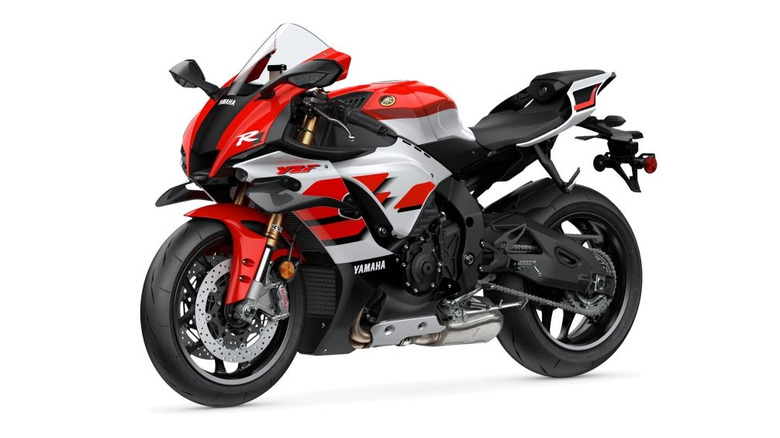
The current-day Yamaha YZF-R1 (and R1M) are the latest and greatest bikes in Yamaha's long line of memorable R-series bikes. These top-tier liter bikes are known for many things, but one of the key features has to be the engine. While the R1 and R1M differ in several areas, both have the same 998cc inline-four engine — and what an engine it is.
The CP4 engine, to give it its proper name, runs a crossplane crankshaft directly inspired by Yamaha's MotoGP bike. It has titanium connecting rods and intake valves, with a matching titanium muffler and heat shield. There's also Yamaha's computer-controlled intake setup, which alters intake funnel length depending on engine speed. This switches between a longer intake funnel (for more torque) at lower revs before shortening it for top-end power past 10,000 rpm or so.
In its last road-legal European guise, the R1 made 197 hp at 13,500 rpm and 83.5 lb-ft of torque at 11,500 rpm. Yamaha no longer sells a road-going version of the R1 in Europe due to emissions regulations. The YZF-R1 and R1M currently available in the U.S. make less power: The EPA database lists the R1 and R1M's power output as 184 hp at 11,500 rpm. Given that we're unsure whether the EU model would make 197 hp if it were still available, we'll stick to the lower number here.
Suzuki Hayabusa - 187 hp
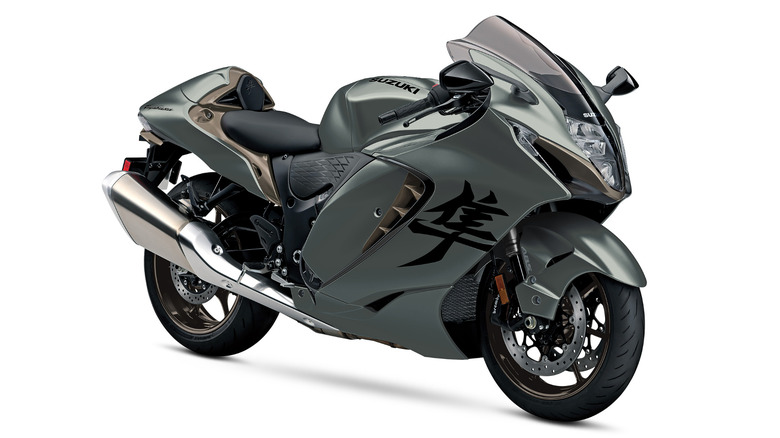
The Suzuki Hayabusa is an undisputed icon of the supersport class. This 1,340cc monster is the fastest bike Suzuki has ever made, capable of hitting 194 mph in the heady days before Japanese manufacturers began limiting their bikes to 186 mph, as part of the no longer active Gentlemen's Agreement.
Just like how the modern Hayabusa isn't quite as fast as its forebears, the latest iteration of the bike also isn't the most powerful that Suzuki has ever produced. The second-generation Hayabusa, which Suzuki built from 2007 to 2018, made 194 hp. The 2021 model dropped the output to 187 hp, and it's remained at that level since, according to the automaker's U.K. website. Like some of its rivals, the American-market Hayabusa produces less power, with EPA data stating that it has 185 hp at 9,700 rpm.
The 1,340cc engine has a handful of notable features that help it make that much power. These include two Suzuki Ram Air Direct (SRAD) intake ducts to channel cool air and increase power at higher speeds, special oil passages for the crankcase and crankshaft, titanium valves, and a four-plus-four injector setup that has four main units with four auxiliary ones that engage at lower engine speeds.
Suzuki GSX-R1000R - 192 hp
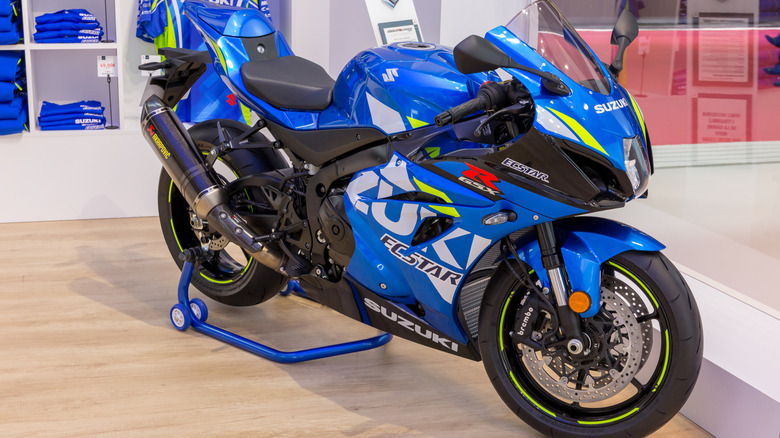
The Hayabusa may be Suzuki's most recognizable supersport bike, but it's its smaller brother that takes the horsepower crown. Suzuki's U.K. website lists the 40th anniversary version of the GSX-R1000R as making an impressive 192 hp and 81.1 lb-ft from its 1,000cc inline-four. Suzuki, like most of its contemporaries, neglects to offer a horsepower number for the U.S. market, but data from the EPA shows that it's slightly down on power, with 185 hp at 11,000 rpm.
This discrepancy lays in the fact that Suzuki has always downtuned its flagship liter bike for Americans, shipping it with a different engine map that curtails its power output beyond 11,000 rpm. Even the unrestricted 2026 GSX-R1000R, which is returning to the European market after being discontinued in 2022 due to emission regulations, isn't as powerful as it used to be. Its current numbers are a slight drop from its peak of 199 hp and 86.7 lb-ft of torque.
While the 2026 GSX-R1000R uses essentially the same engine, Suzuki has made a range of updates to ensure that it won't run afoul of current EU regulations. These include new internal components (including the crankshaft and pistons), larger exhaust valves and throttle bodies, and a bigger catalytic converter.
Kawasaki ZX-14R - 197 hp
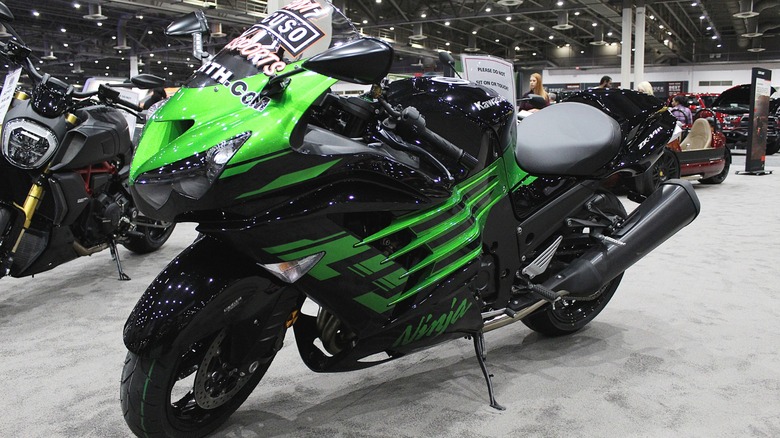
Kawasaki's ZX-14R has one of the largest (if not the largest) inline-four engine Kawasaki has ever built, and certainly one of its most powerful. First debuting as the ZX-14 for 2006, the first-gen model's 1,352-cc engine was impressive from the get-go. Its big power allowed the non-R model to record an impressive 2.5-second 0-60 mph time and a 9.8-second quarter-mile time in the hands of Cycle World's intrepid testers.
The world would have to wait a few more years for the ZX-14 to reach its final form, though. Kawasaki unleashed the ZX-14R on the biking world for the 2012 model year, with the most notable upgrade being a longer stroke that increased displacement to 1,441cc. Kawasaki didn't reveal power numbers back then, but tests at the time put the bike's rear-wheel horsepower at or above the 190-hp mark. This allowed the ZX-14R to handily beat its predecessor's quarter-mile time, with Cycle World managing a 9.47-second run.
Kawasaki doesn't seem to have made many changes since then, with the ZX-14R surviving broadly unchanged through the 2010s and into the 2020s (minor but useful upgrades such as ABS aside, of course). The company discontinued the European variant, known as the ZZR1400, after 2020, but American riders have continued to enjoy access to the 1,441cc bike. In its current form, the ZX-14R makes 197 hp at 10,000 rpm and 116.5 lb-ft of torque at a very streetable 7,500 rpm.
Kawasaki Ninja ZX-10RR - 204 hp
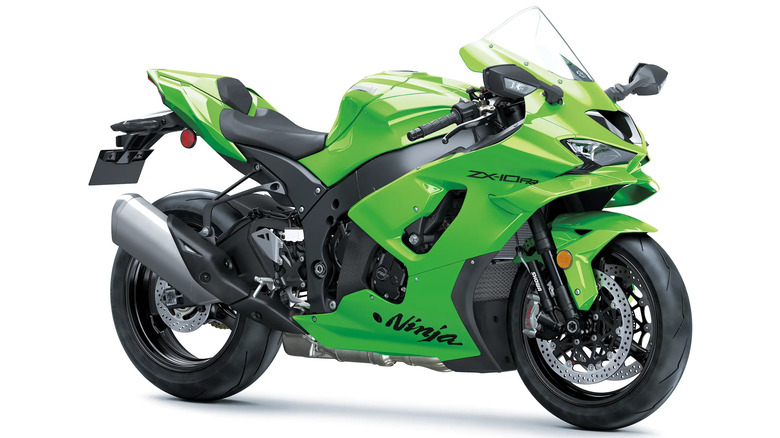
Yes, we know: The ZX-10RR isn't that much more powerful than the ZX-10R. The RR's European-market numbers are 204 hp at 13,200 rpm and 81 lb-ft of torque at 11,400 rpm versus the 10R's near-identical 202.7 hp, both with ram air. But it's still more powerful, even if you likely won't feel the difference in real life, so the 10RR earns its place over the 10R.
The Ninja ZX-10RR debuted in 2017 as a limited-edition homologation special version of the 10R with several racing-oriented upgrades, including a new cylinder head designed to take advantage of new racier cams that Kawasaki sold separately as part of a race kit. This race kit also included other hardware, such as a racing ECU, which buyers also needed to purchase to switch the 10RR into full race mode.
This state of affairs has continued to the present day, with some upgrades released in the intervening years, such as lightweight Pankl pistons, to maximize the engine's potential. Kawasaki continues to sell a wide range of race kit parts for the modern ZX-10RR, and recent models require the race ECU to activate features like the engine's variable intake system, at the cost of removing its road-legal status. We imagine a fully race-spec'd ZX-10RR will make significantly more power than the 10R, but your guess is as good as ours when it comes to how much more exactly.
Honda CBR-1000RR-R Fireblade SP - 214 hp
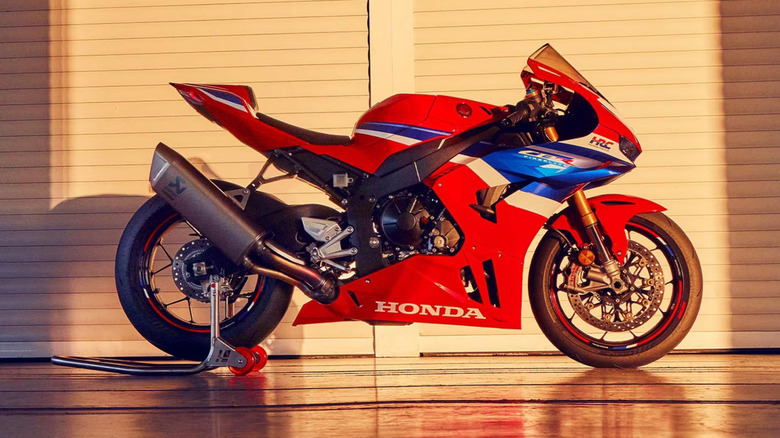
Honda's Fireblade has long been synonymous with high performance, but the storied Japanese manufacturer outdid itself when it launched the all-new CBR-1000RR-R Fireblade SP for the 2021 model year. Drawing heavily on its MotoGP knowledge and experience, the CBR-1000RR-R was essentially a race bike for the road, with aggressive geometry, semi-active suspension, and an all-new, over-square engine inspired by the ultra-rare RC213V-S MotoGP replica Honda released in 2015.
The result was a bike that made more than 200 hp in its most potent, European-market form, which reviewers hailed as a massive improvement over its predecessor and the zenith of Honda's road-going two-wheelers. We were similarly impressed when we tested a 2023 CBR-1000RR-R, with our reviewer loving the engine's power delivery and the bike's thoroughly modern electronics — including three customizable ride modes — but finding some issue with the Honda's somewhat cramped ergonomics.
Honda's most recent numbers for the European-market CBR-1000RR-R (which it released for the 2024 model year) claim that it makes a very healthy 214.5 hp at 14,000 rpm and 83 lb-ft of torque at 12,000 rpm. As with some of its rivals, the American version has a different engine map that reduces the engine's maximum power and rev range to meet U.S. regulations. Thus, American riders can expect a peak of 189 hp at 12,000 rpm.
Kawasaki Ninja H2 - 240 hp
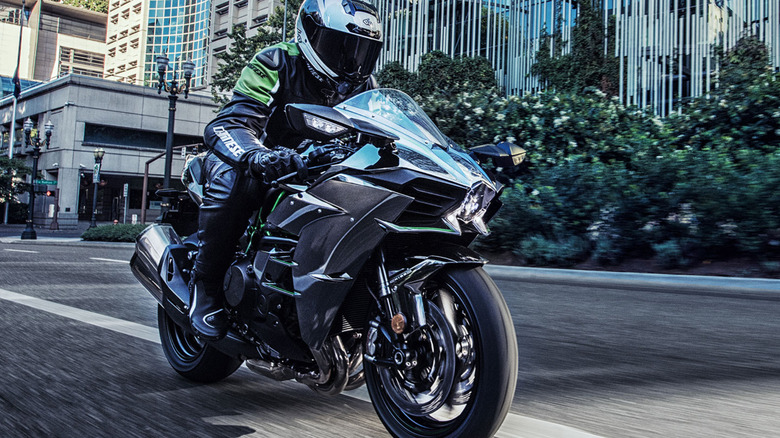
As far as mass-production, street-legal bikes go, few can match what Kawasaki achieved with the Ninja H2. First unveiled in 2014 before making its way to owners and gobsmacked motoring journalists in 2015, the Ninja H2's four-cylinder, 998cc engine ranks as one of the most powerful bike engines in production. It has even more power than monsters like the Ducati Panigale V4 and Aprilia RSV4, and that's all thanks to its supercharger.
Kawasaki took advantage of parent company Kawasaki Heavy Industries' turbine know-how to design a blower that could fit on a motorcycle and didn't require an intercooler or fancy race gas. The H2 (and its bigger sibling, the H2R) were the first bikes to use this new supercharged 998cc engine, which has made its way to more bikes like the Kawasaki Z H2 in the years since — albeit in more approachable, lower-power configurations.
No such concessions for the H2, though: You get the most powerful street-legal version of the engine, with no detuning or tweaks to make it easier to ride. Sure, you get rider aids like traction control and an anti-lock braking system to help keep you on the road, but there's no denying that the H2's 240 hp (at 11,500 rpm) and 104.9 lb-ft of torque (at 11,000 rpm) will be a handful for all but the most experienced riders.
Kawasaki Ninja H2R - 322 hp
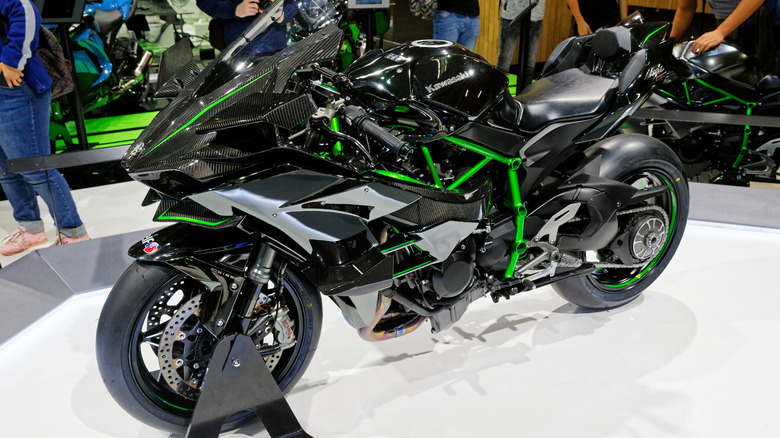
The one-of-a-kind Kawasaki Ninja H2R is the big daddy of all Japanese sports bikes, and deserves a place in history for several reasons — one of which is its impressive power output. The H2R uses the same supercharged 998cc engine present in Kawasaki's other H2 bikes, just turned up to 11 via a handful of tweaks that push power past the 300-hp mark.
These changes include racier camshafts, a new head gasket, a dual intake system, and a remapped ECU to take advantage of all of these changes. It also runs slightly lower compression than the H2, with 8.3:1 instead of the H2's 8.5:1. Not a huge difference, but it's there all the same. Either way, the result is a frankly ridiculous peak of 322 hp at 14,000 rpm and an equally impressive 121.5 lb-ft of torque at 12,500 rpm. As you might expect, the H2R is a track-only bike, which is perfectly fine, really: Who needs 320 hp on the streets?
Kawasaki launched the H2R in 2015 with a somewhat understated claim of a top speed above 186 mph. It took a year for the world to learn just how much faster it could go: Turkish rider Kenan Sofuoğlu piloted his H2R to an astounding 248 mph in 2016, making the H2R officially one of the fastest motorcycles ever built. Crazy top speed aside, the bike also made a strong impression on the motoring world, with journalists deeply impressed by the race bike's power and overall capabilities on track.