

10 Motorcycles With Better Power-To-Weight Ratios Than The Honda CBR 1000RR
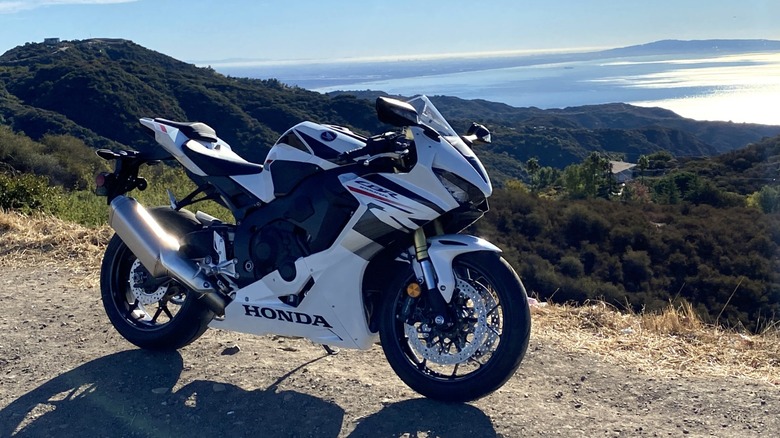
Power isn't everything. While a bike's horsepower undoubtedly plays a big part how it performs, the relationship between that power and the motorcycle's weight — the power-to-weight ratio — arguably says more about the bike. There's no way to tell how a bike rides based on the specs, of course, but a higher ratio can reflect how good a bike is at all those seemingly mundane tasks that riders have to do regularly: speeding up with traffic, slowing down, taking corners, avoiding obstacles, and weaving through traffic.
All bikes benefit from a good power-to-weight ratio, of course, but it arguably matters most for performance-oriented bikes intended to be ridden hard. Think sportbikes, of course, and the occasional ridiculously overpowered hypernaked bike (think Ducati and MV Agusta). And in the realm of sportbikes, there are likely few names as evocative as Honda's CBR1000RR. The model debuted in 2004 as a successor to bikes like the CBR900RR and is still at the top of its game more than 20 years on. But while it's a great bike, it's not the craziest performer out there.
Of course, 171 horsepower (according to EPA testing data) and a 432-pound curb weight means it's more than rapid enough for most riders, which works out to about 0.396 horsepower per pound. But if you're playing sport- or superbike top trumps, there are quite a few motorcycles out there that'll beat the Honda's numbers.
Suzuki GSX-R1000R - 0.43 hp/lb
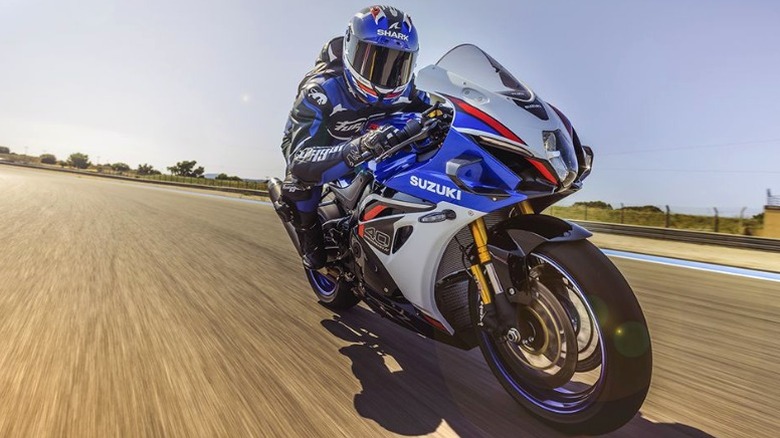
The Suzuki GSX-R1000R sits at the top of Suzuki's sportbike hierarchy, with only the legendary Hayabusa ahead of it in the pecking order. The GSX-R1000R received a host of updates for its 40th anniversary in 2026, including a heavily upgraded inline-4 engine that featured, among others, revamped pistons, an improved crankshaft and new camshafts, all piped out through a spiffy new exhaust system.
These changes weren't about making more power, though: The new engine was all about keeping performance up while meeting Euro5+ emissions standards and, as such, its 192 horsepower in U.K. spec, is down from the 199 horsepower peak of the 2017 to 2025 model. That's still a lot more than the Honda, though, and its 448-pound curb weight means it has a much more impressive power-to-weight ratio of 0.43 hp/lb despite costing about the same as the Honda in the U.S.
Of course, there's a catch here: U.S. models don't make nearly as much power as international-market versions. They weigh the same, but Suzuki has always downtuned its liter bike for American buyers; the result then is 126 kW per the EPA, or around 169 horsepower. That means the American GSX-R1000R has a worse power-to-weight ratio than the Honda, at 0.38 hp/lb rounded up. But we're going by the biggest number available for all of these bikes, regardless of territory, so 0.43 hp/lb it is.
Yamaha YZF-R1 - 0.44 hp/lb
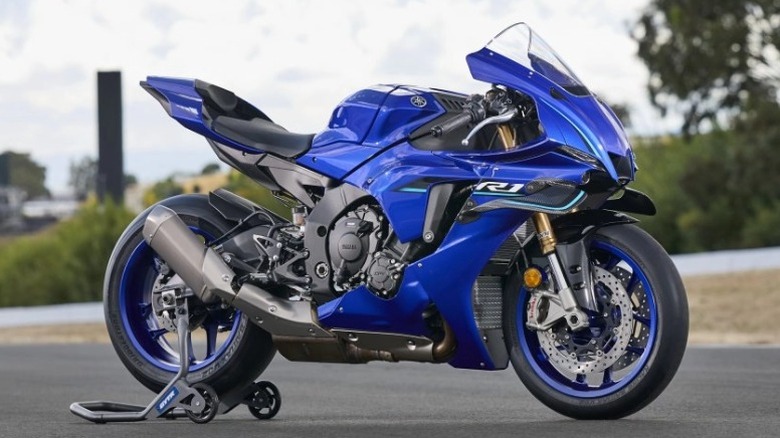
Few bikes have been as revolutionary as the Yamaha YZF-R1. The Japanese manufacturer's liter bike changed sports bikes forever after it debuted in 1998, its combination of powerful engine and lightweight design, plus some technological innovations, giving birth to a new leader of the 1,000cc class. Yamaha stopped selling the R1 in Europe in 2025 due to emissions regulations, but American and Japanese buyers can still get their hands on one, although power, as is usual with many sport motorcycles, differs between the two markets.
Yamaha doesn't provide an official power number on its American website, but numbers from EPA testing show that it makes 135.4 kW, or around 184 horsepower. Combined with its 448-pound curb weight, the U.S.-market YZF-R1 has the power-to-weight ratio edge over the CBR1000RR at 0.41 hp/lb, earning it a spot on this list even in downtuned form. But we can do better.
The Japanese R1 is more powerful, with Yamaha claiming 147 kW, or almost exactly 200 horsepower, on its domestic-market spec sheet, all while weighing in at the same 448 pounds. Doing the math with those numbers, then, gives us a much more impressive 0.44 hp/lb, good enough to put it ahead of Honda's CBR1000RR and Suzuki's GSX-R1000R.
MV Agusta Brutale 1000 RR Assen - 0.46 hp/lb
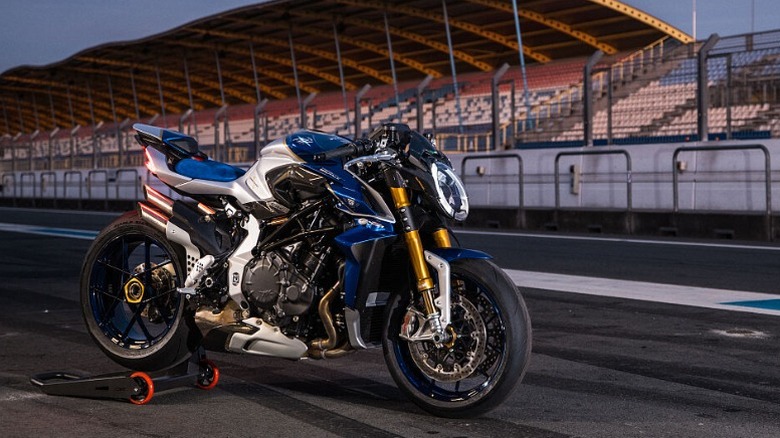
Let's not mince words: The MV Agusta Brutale 1000, whether you're talking about the ever-so-slightly more approachable Brutale 1000 RS version we tested in 2024 or the hardcore Brutale 1000 RR, is something of a beast. Marrying an ultra-aggressive hypernaked design with a 998cc engine making 208 peak horsepower, the Brutale 1000 is loud, brash, and attention grabbing — the least you'd want for a $33,000-plus outlay.
The 1000 RR isn't the craziest member of the family, though: that honor belongs to the Brutale 1000 RR Assen, a limited-edition version of the bike designed in collaboration with the legendary racing circuit. It gets a revised gearbox, lightweight components, and access to a kit that boosts output to 212 horsepower. MV Agusta claims a curb weight of 436.52 pounds at its lightest, but there's a catch: That's without fuel, even though almost all other manufacturers quote curb weight with a 90 percent full tank. Thus, we'll have to do some calculations to get a more accurate number.
With a 4.23-gallon fuel tank, and following JD Power's estimation of 6.27 pounds per gallon of premium fuel, we get a total curb weight, with fuel, of 460.4 pounds. That's a lot heavier than the Honda, but the Brutale 1000 RR Assen's 212 horses means that it beats the CBR1000RR's 0.39 hp/lb with a ratio of 0.46 hp/lb. And lest you think we're being unfair here, the standard Brutale 1000 RR bests the Honda, too, with 0.44 hp/lb.
Honda CBR1000RR-R Fireblade SP - 0.49 hp/lb
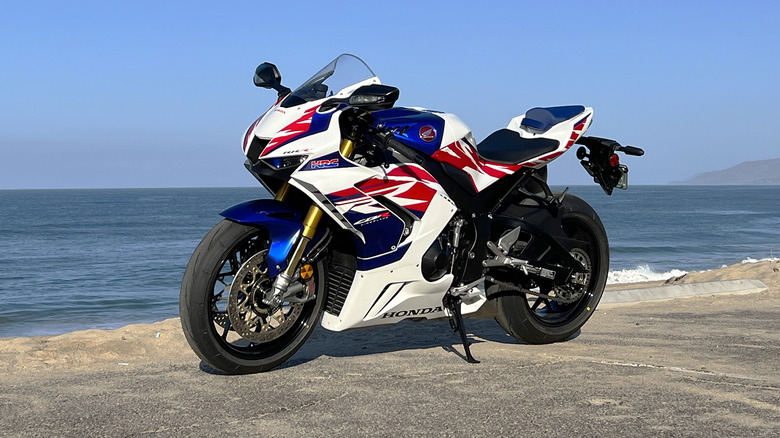
The CBR1000RR is a brilliant bike, but it's nowhere near the peak of what Honda can do with two wheels and a 1,000cc engine. That, instead, is the Honda CBR1000RR-R Fireblade SP. This nigh-on $30,000 superbike is essentially the CBR1000RR on steroids, with a MotoGP-derived engine, electronically-controlled Öhlins suspension, titanium Akrapovič muffler, and Brembo brakes setting it apart from its supersport sibling. For 2027, the Fireblade SP gets chassis and engine upgrades, including a new aluminum frame, a variable-length intake, and lighter wheels, widening the gap even further.
That MotoGP-inspired engine makes 214.5 hp, although, as you're probably able to guess by now, it doesn't make nearly that much power Stateside. The difference is much bigger than some other bikes on this list, though; Honda doesn't offer a horsepower figure on its U.S. website, but EPA data shows that the 2027 Fireblade SP makes 141 kW, or around 189.1 hp. More than most riders will ever need, sure, but it's still quite a loss.
But let's not dwell on that, because, either way, the Fireblade SP is still well ahead of the CBR1000RR. At its worst — as in the U.S. trim — the 445-pound curb weight makes for a power-to-weight ratio of 0.43 hp/lb, while U.K. models with the full 214.5 horses and a slightly lower curb weight of 438.7 pounds post an 0.49 hp/lb figure.
Ducati Streetfighter V4 SP - 0.49 hp/lb
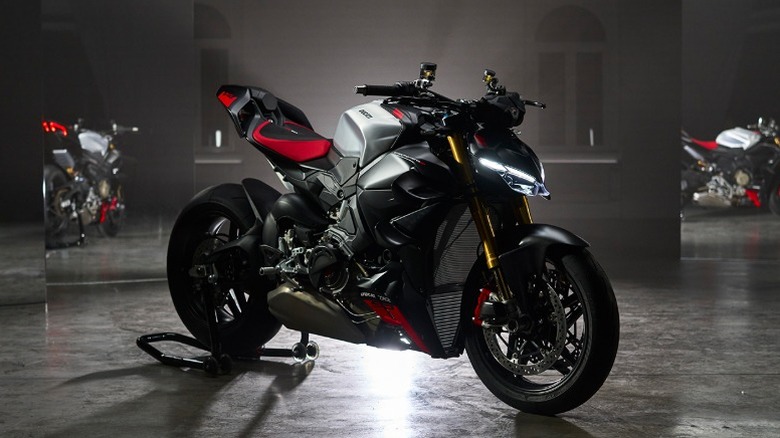
The Ducati Streetfighter V4 is, in many ways, the naked version of the Italian marque's Panigale V4 superbike. It uses the 1,103cc Desmodici Stradale engine as the Panigale, for one, and also draws on the Panigale for its chassis and electronics. There are, of course, obvious points of distinction, including the bodywork and riding position differences that inherently divide naked and sport bikes, and they also extend to power: The international-market Panigale V4 makes 218 horsepower, but all versions of the Streetfighter V4, including the SP, have to make do with 214 instead. For the U.S., the split is 209 and 205 horsepower, respectively.
Sitting at the head of the Streetfighter V4 family is the V4 SP, a limited-edition, track-focused version of the already pretty racy Streetfighter V4 that cuts a few pounds from the base Streetfighter's 417 pound curb weight (which, as is traditional with Ducati, is a wet weight without fuel). It achieves this courtesy of carbon-fiber wings and wheels, the latter of which allegedly weigh 2.1 pounds less than the standard model's aluminum wheels.
The result is a bike that comes in at 414 pounds by Ducati's measure — not a massive weight reduction, but every little bit counts. Adding a 90 percent-full tank to that, at 6.27 pounds per gallon for premium fuel, gets us to 437.7 pounds, which works out to a power-to-weight ratio of 0.49 hp/lb once we round up.
Aprilia RSV4 1100 - 0.49 hp/lb
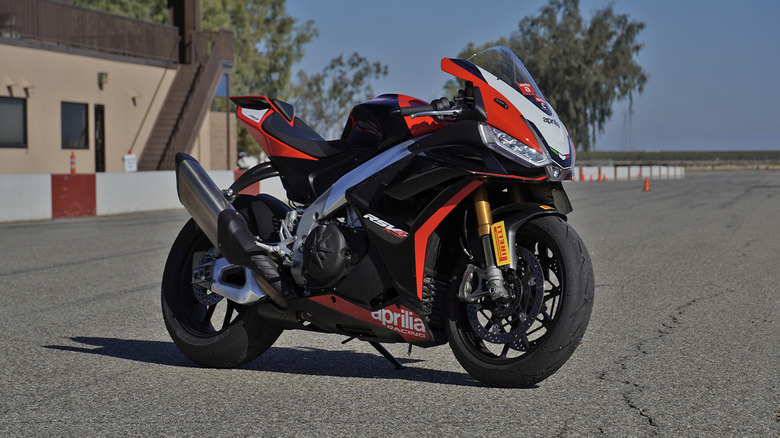
Aprilia perhaps doesn't have the same American presence as some other brands on this list, but the Italian manufacturer has a strong following in Europe, driven primarily by nimble, medium-displacement sport bikes like the RS 457 and RS 660 — a model that we absolutely loved back in 2023. Great as those are, though, they're not nearly powerful enough to bother the Honda CBR1000RR in the power-to-weight stakes, let alone beat it. But Aprilia has one model that'll do the latter quite handily: the RSV4 1100.
SlashGear's Michael Teo Van Runkle called the 2025 RSV4 Factory he rode in 2024 "undoubtedly one of the best bikes ever," and, given the relatively minor changes in the succeeding years, should still be very much deserving of that title now. Power is slightly up, too, although 220 horsepower isn't necessarily a massive increase, considering it already had 217 in 2025. What's quite interesting, however, is that U.S. buyers aren't missing out here, with the same 220 horses available on tap no matter where you buy the motorcycle.
The RSV4 1100 tips the scales at 449.7 pounds wet — with fuel, this time, unlike fellow Italian brands Ducati and MV Agusta — which gives it a power-to-weight ratio of 0.49 hp/lb. That fittingly puts it within spitting distance of its closest Italian rival, the Ducati Panigale.
Ducati Panigale V4 R - 0.50 hp/lb
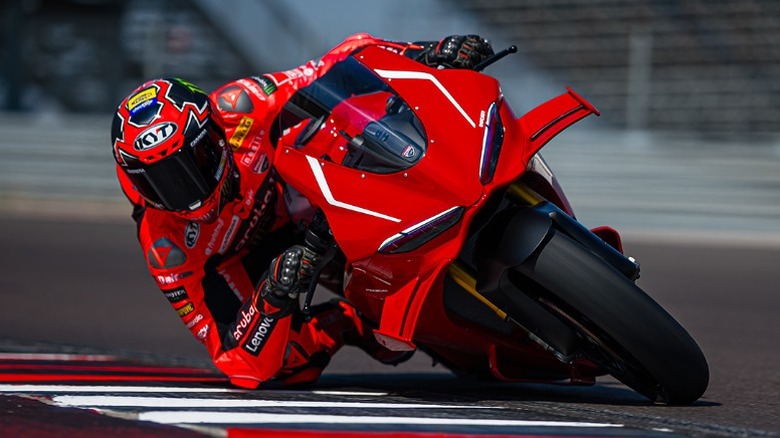
Ducati's Panigale V4 R is, essentially, the zenith of Ducati's race-bred, high-performance efforts, taking the already impressively fast Panigale V4 and kicking it up a notch with a racing-centric 998cc engine (in place of the 1,103cc power plant in the non-R), MotoGP-inspired side pods, and the first use of Ducati's Racing Gearbox on a production bike. Since the 2025 model year, that means a bike that puts out 218 hp at a wild 15,750 rpm and weighs just 411 pounds wet that, thanks to its array of rider aids that includes cornering ABS and what Ducati calls Race Brake Control, remains surprisingly usable on track by non-MotoGP riders.
If you're doing the math in your head and wondering why we've put the Panigale V4 R down as having 0.50 hp/lb instead of the 0.53 hp/lb the specs suggest, it's simple: Ducati lists its bikes' wet weight without fuel. Add the standard 90 percent full fuel tank to the equation and we get a wet weight of about 436.4 pounds, which equates to 0.499 hp/lb — good enough to round up to 0.50 hp/lb, in our books.
There is, of course, another caveat: American riders aren't getting the Desmosedici Stradale R's full 218 hp output. Instead of 218 hp at 15,750 rpm, the U.S. V4 R makes a relatively pedestrian 208.4 hp at 13,250 rpm, for a power-to-weight ratio of 0.48 hp/lb once rounded up. That said, while it's worse on paper, we suspect most riders really won't care that much.
BMW M 1000 RR - 0.51 hp/lb
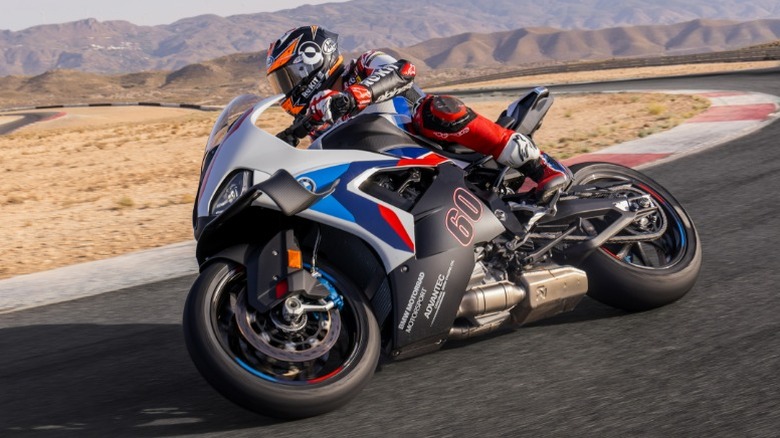
BMW Motorrad has had a good time in the 2020s, selling over 200,000 bikes globally for four years in a row up to 2025, despite operating primarily in the premium end of the market. Sure, it offers relatively affordable fare like the $7,000 F 450 GS, which is set to hit U.S. retailers in early 2027, but it's the pricier, larger-capacity bikes are the ones that likely set fans' hearts racing. And there's really no better example of what BMW Motorrad can achieve in that market segment than the M 1000 RR.
One of the fastest BMW bikes ever built, the M 1000 RR is a homologation special that sits at the top of the company's liter bike range. Its 218 hp (205 hp in the U.S.), 999cc inline-4 engine is good enough for a claimed top speed of 189 mph, while its 428-pound curb weight helps it break past the 0.50 hp/lb threshold, posting a 0.51 hp/lb power-to-weight ratio once rounded up and putting it in rarefied company. That U.S.-market number is predictably down, the drop in power making for "just" 0.48 hp/lb, but that still puts it in the upper echelon Stateside, so it's not all bad.
As you might expect for a bike with those sorts of numbers, the BMW M 1000 RR is a beast on track, aided by its oodles of downforce and very nimble chassis. While it's undoubtedly a hardcore superbike, though, it's not without concessions to regular Joes (or Janes), including a very effective array of rider assists and a surprisingly ergonomic riding position that accommodates taller riders reasonably well.
Ducati Superleggera V4 Centenario - 0.63 hp/lb
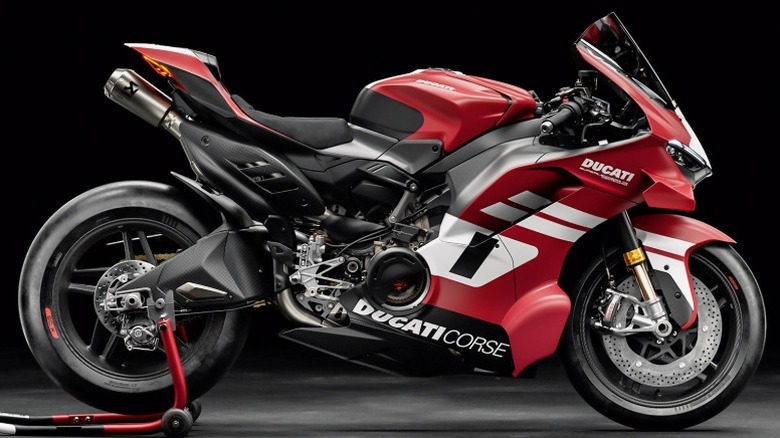
Ducati has always pushed the envelope with its Panigale-based Superleggera bikes. The name has graced cutting-edge (and ultra-expensive) offerings as the nearly-all-magnesium 1199 Superleggera from 2013 and 2018's 1299 Superleggera, the latter being the first-ever production bike to ship with carbon fiber wheels, chassis, swingarm, and subframe. The V4 Centenario is the latest member of that family, released to celebrate Ducati's 100th anniversary, and it continues in much the same vein as its predecessors.
This time, the world's-first are the brake discs, which Ducati claims are the first carbon-ceramic discs approved for road use. It retains the carbon fiber chassis of the 1299 Superleggera, resulting in significant weight savings compared to its Panigale V4 origins: Ducati claims a wet (no fuel) weight of just 368 pounds in the V4 Centenario's hottest race configuration, rising to 381 pounds in its standard road setup. Aiding this weight loss is a new Desmodici Stradale 1100 R engine that makes 228 horsepower in road form and a crazy 247 horses with a racing Akrapovič exhaust and Ducati's race engine oil.
Even adding the estimated weight of 4.05 gallons of fuel (90 percent of the Superleggera's 4.5-gallon fuel tank) isn't enough to hobble the Ducati's power-to-weight ratio all that much, no matter the config. At its worst (228 horsepower and 406.4 pounds in road trim), we're looking at 0.56 hp/lb. In race config with 247 horses and a 393.4-pound curb weight with fuel, we get 0.627 hp/lb, which we'll round up to 0.63 hp/lb. A fittingly impressive number for an impressive bike.
Kawasaki Ninja H2R - 0.67 hp/lb
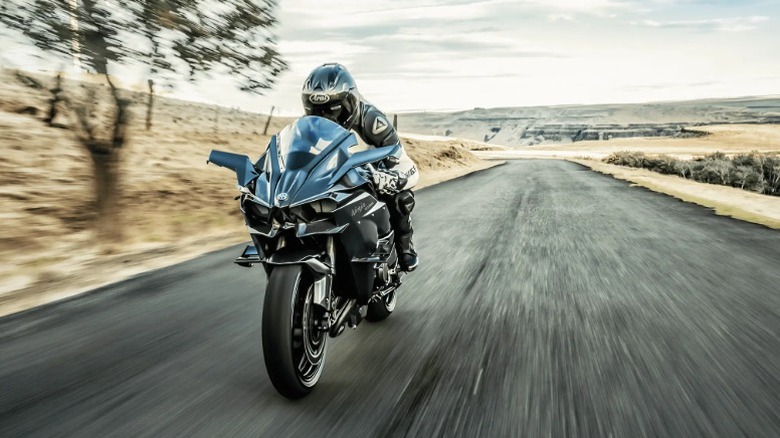
Kawasaki's Ninja H2R is a one-of-a-kind bike that is so far ahead of its competition, power- and performance-wise, that it's almost a bit of a joke. Sporting more power — 322 horsepower — than your average commuter car but weighing only 476.3 pounds, the Ninja H2R has a class-leading power-to-weight ratio of 0.67 hp/lb, a number we don't expect to see beaten — by a production bike, at least — any time soon.
The secret to the Ninja H2R's power is the Kawasaki Heavy Industries-developed supercharger bolted onto the 998cc inline-4 engine. It shares this engine with Kawasaki's other supercharged H2 bikes, albeit with a range of upgrades to push power past the 300-horsepower barrier. In prior years, these included an uprated intake, higher-performance camshaft, remapped ECU, new head gasket, and a beefier clutch. Kawasaki introduced an essentially all-new 998cc engine for the 2027 model year with higher compression (11.2:1 instead of 8.5:1), revised supercharger impeller, updated aluminum intake, and redesigned intake and exhaust ports, among others.
While these changes mean that the 2027 H2 drops from 240 horsepower to just 206, the track-only H2R has not suffered the same fate. That's likely because it's not beholden to the emissions regulations that have robbed its street-going stablemate of 34 horses.