

11 Tips & Tricks To Maximize Your Air Conditioner's Efficiency
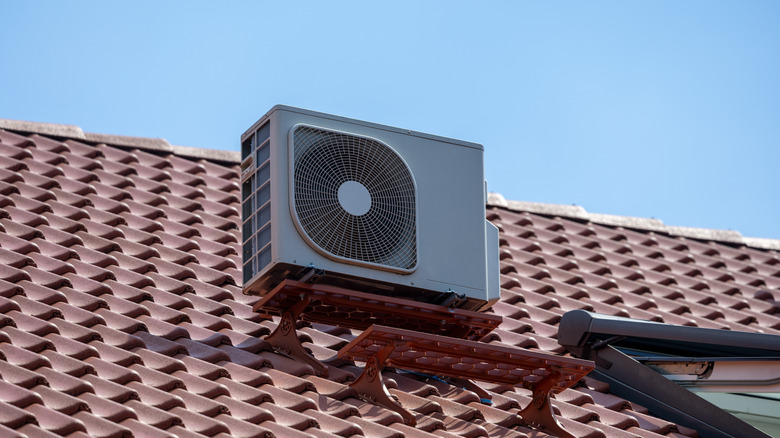
Summer temperatures in the United States may just be the hottest they have ever been. After looking at the data, the National Centers for Environmental Information, part of the National Oceanic and Atmospheric Administration, determined that July 2026 was the warmest month on record in the past 132 years. Whether you're dealing with sweltering heat in Wyoming, oppressive humidity and high temperatures in Florida, or something in between, there's nothing better than ice-cold AC when you go indoors.
But bearable indoor temperatures come with at least one pitfall: cost. According to the U.S. Energy Information Administration, cooling could make up nearly 20% of your electricity bill. Considering everything else you need to power — from lighting to your washer and dryer to the water heater and more — that could amount to a significant expense.
On the positive side, maximizing your air conditioner's efficiency could save you money. By reducing your AC unit's energy draw, you may see your bill drop. At the very least, you should feel a bit more comfortable while the air conditioner is doing its very best, most efficient job. There's no single tip or trick to cut your cooling costs, but there are plenty of strategies for maximizing efficiency. From pre-purchasing tips to after-the-fact fixes, here are some ways to increase your air conditioner's efficiency.
Size your AC properly
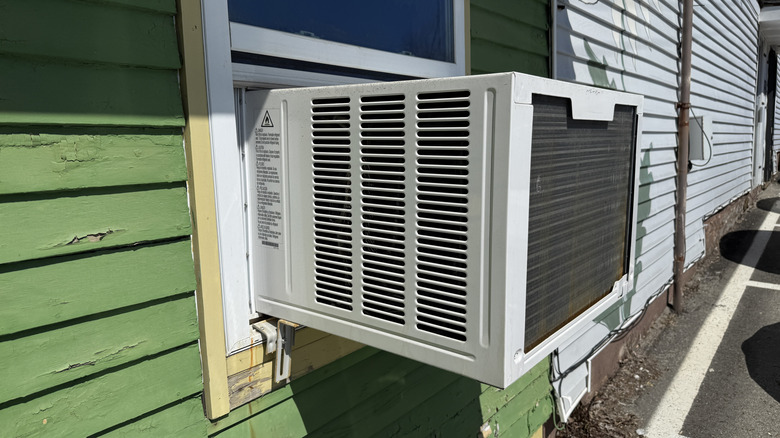
Size matters when it comes to selecting an AC unit. While you might think buying the biggest, beefiest unit will turn your home into an Arctic paradise in mid-August, that's not the most efficient way to choose an air conditioning unit. Buying a too-big AC means you're spending more up front and wasting energy whenever it runs. Energy Star also suggests that a bigger AC isn't better for cooling, either.
To determine the right air conditioner size for your space, you'll need the room measurements. A simple perimeter calculation (well, simple if your room is a square or rectangle) will help you figure out how many BTUs per hour you need. For example, Energy Star recommends a unit with a 10,000 BTU capacity for spaces between 400 and 450 square feet. Keep in mind that ceiling height can impact the calculation, however. Energy Star notes that its suggestions are based on 8-foot ceilings, so if yours are higher, you may need to scale up.
Choosing the right AC unit means you're not over- or under-powering, which should help with energy usage and, therefore, your electric bill. The right-sized AC could also mean you hit closer to the expected lifespan of your AC unit. Obviously, a too-small air conditioner will have to work harder (and constantly) to cool a larger room. Thus, proper sizing can help avoid wasting energy and overworking your unit.
Select variable speed tech
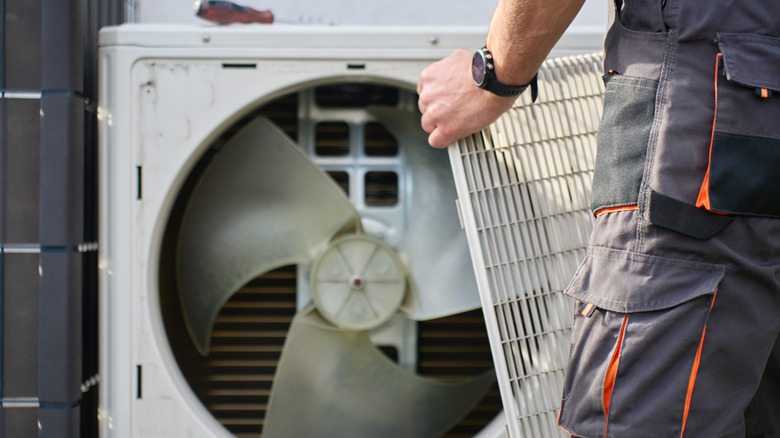
You might suspect that turning your air conditioner off when you're not using it is the only real way to be efficient. However, binary on-off switches may be wasting energy rather than conserving it. After all, if you shut off the AC and it gets hot again, your unit may be working harder to get the temperature back down. According to Energy Star, a variable speed air conditioner offers greater efficiency when it comes to energy usage, and it goes a little deeper than thermostat controls.
Instead of going full blast and then cutting off completely, variable speed technology allows your unit to adapt to changing conditions in your space. Even my older window AC unit has this technology, with a thermostat option to set the desired room temperature. Then, it powers off and on according to the environmental conditions. The same way there's a difference between setting HVAC to on or auto, most AC units have a similar function. While that's better than a unit you have to manually adjust, there's actually an even better way, according to Energy Star.
Energy Star goes a step further and recommends variable-speed compressor AC units with more advanced technology. Instead of switching on and off, variable-speed air conditioners change their internal compressor motor speed. Not only is this kind of function more efficient, but it's also quieter than alternatives.
Look for Energy Star efficiency

It might go without saying that you should look for the most efficient air conditioner possible if you're looking to buy a new unit. The simplest way to set yourself up for long-term savings is by choosing a unit with an Energy Star label. Most labels I see at my local Lowe's include a chart that shows predicted energy savings over the course of a year, and usually an associated cost, too. What does Energy Star certification actually mean, though?
According to Energy Star itself, certification is a confirmation of both performance and environmental friendliness. You'll probably find that a lot of major air conditioner brands have Energy Star certified options, specifically to remain competitive. Any manufacturer seeking Energy Star certification has to agree to EPA (Environmental Protection Agency) regulations. The manufacturer also has to source third-party testing and certification, confirming that the product or products meet industry requirements for performance.
When it comes to air conditioners, specifically, Energy Star also means higher quality materials. The instructions should also be much clearer than for air conditioners that don't seek Energy Star certification. You may also find ACs that are labeled Energy Star Most Efficient, a title that speaks for itself. Whether you're choosing a window AC versus a mini-split or looking for budget options, Energy Star labeling is one benchmark to check.
Plant shade trees
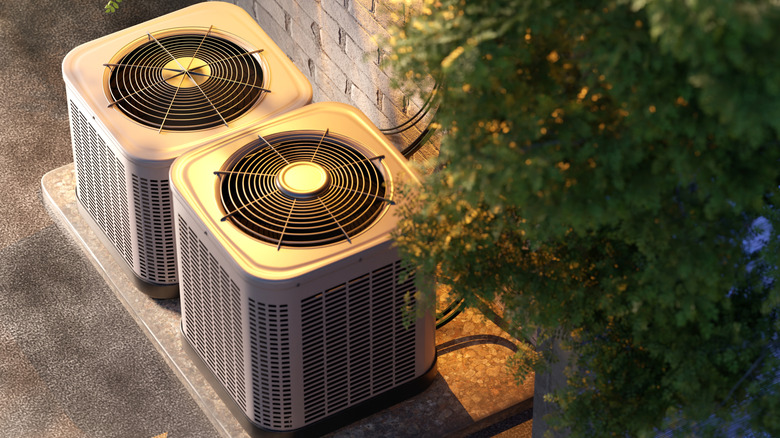
Shade could make a significant difference in your air conditioner's efficiency, but it may not be in the exact way you would expect. It might seem intuitive to make sure your AC unit has shade over it, especially if you're using an evaporative cooler, such as a swamp cooler. After all, direct sunlight can lead to more evaporation than you might want. Yet there are some precautions when deciding whether you should shade your AC unit, including considering whether the shade structure may block hot air from escaping.
In terms of increasing energy efficiency, it seems that the research on shade over air conditioners may be inconclusive. For example, one study by researchers at the Kuwait Institute for Scientific Research noted that the efficiency increase gained from shading an AC unit will likely be under 1%. In our research, we were unable to find a definitive source that confirms significant energy savings from shade over the outdoor AC unit.
However, shade could still be a net positive if trees and greenery block the sun from hitting your home. The U.S. Department of Energy suggests that shade helps reduce air conditioner usage, going so far as to recommend that you plant both shrubs and shade trees to reduce AC costs. Blocking sunlight and heat is one strategy for keeping your AC running in a heat wave, and even on those cooler days, too.
Clean or replace filters

It's not surprising that some of the most common problems with air conditioners center around physical blockages like dirt. After all, how can an air conditioner blow cool air into your home if its filters are clogged? It's such a common issue that consumer pamphlets from sources like the U.S. Department of Energy include multiple reminders not only to check your AC filters regularly, but also to investigate whether the filter is the cause of operating problems.
Various types of air conditioners may have filters, from swamp coolers to central air systems to window AC units. Some units may even have washable filters, which can help stretch filter usage longer than you may expect. Whether you're buying a new air conditioner or are cleaning up an existing one, check what type of filter the unit may require, and then stock up.
Curious about how much a dirty filter can impact your air conditioner's efficiency? The U.S. Department of Energy claims that the number one way to cut your cooling energy usage is by cleaning or replacing the unit's filter. The U.S. Department of Energy gives a range, but you could reduce your unit's energy consumption by up to 15%. Although the lower end of that savings range is 5%, taking multiple steps to maximize your AC's efficiency can add up to a significant amount.
Check seals
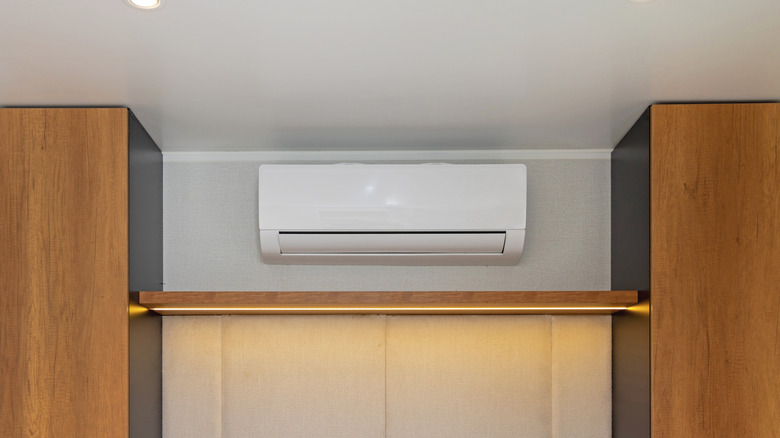
When it comes to cooling (or heating) your home, one of the most significant factors is how and where air enters and exits the house. Whether you have a window unit that you carefully place and insulate, or your home has ductwork throughout, poor seals could result in a lot of energy loss. A lack of seals around doors and windows could mean the unit is working harder to keep cool air circulating, because it's actually escaping.
In its guide on home cooling and energy savings, the U.S. Department of Energy describes different types of AC units and cautions users against allowing cool air to escape. With a central air conditioner, for example, consumers should check their ductwork not only for holes and gaps, but also for any spots where the ducts bend or sag. A room air conditioner, says the Department of Energy, is most efficient when you skip the accordion-like panel that comes in the package and instead use rigid material to block airflow.
Some exceptions do apply when it comes to sealing up your home for the summer. For example, the types of portable air conditioners that require vents actually need a way to vent warm air out of a window. While you'll still want to make sure the connection is airtight, ventilation is important. Similarly, more passive cooling methods — like inviting a cross-breeze between windows or doors — rely on air moving through the building.
Keep it clean
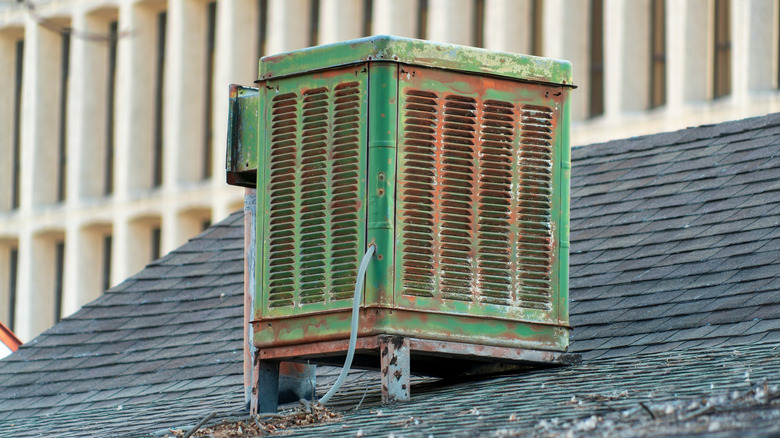
Cleaning your air conditioner is one of the less glamorous aspects of enjoying frigid indoor temperatures during summer heatwaves. Yet maintenance like cleaning drains and removing leaves and other debris is important for peak performance and energy efficiency. Different types of air conditioners involve varying cleaning requirements, but in general, central air conditioners, mini-split compressors, and evaporative coolers may need more cleaning and upkeep, according to a guide from the U.S. Department of Energy.
Of course, other AC types can also involve cleaning; one of the downsides of portable AC units is the fact that they need regular draining so as not to flood your home. You'll need to determine how often to service your AC unit and whether you can DIY or if the equipment requires a professional. You may find that accumulated debris impacts how your unit works, especially if it's a central unit or a swamp cooler.
Whether it's a toddler dropping random objects into your HVAC system or frogs climbing into your swamp cooler (things that you can hopefully manage to avoid), a visual inspection and cleaning can go a long way toward reducing your suffering in summer temperatures. With some AC units, refrigerant may need a top-off, or you might find that the evaporator coil is bent, and while the Department of Energy says you can DIY the latter, it's up to you whether you want to.
Add a fan
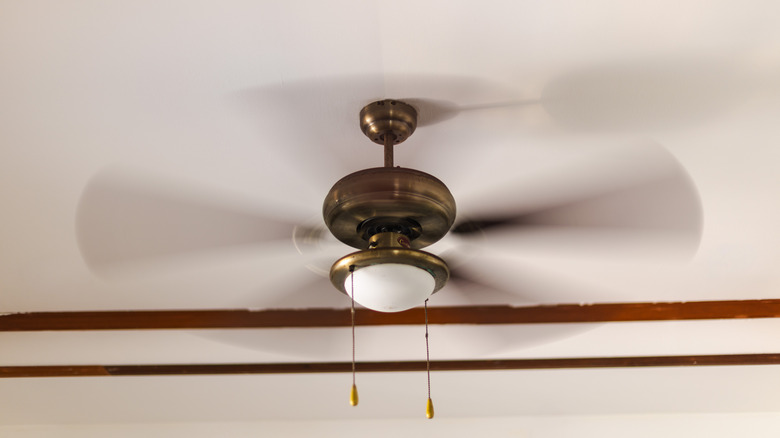
One of the simplest yet probably overlooked ways to maximize your air conditioner's efficiency is by giving it a boost with a fan. A fan doesn't necessarily make it cooler in your home, but it can contribute to better efficiency in the sense that you may not need your AC cranked up as high if the cool air is kept circulating.
As the U.S. Department of Energy explains, fans create a wind chill effect as they circulate air. Various types of fans can help achieve that cooling effect, but ceiling fans, in particular, are recommended for efficiency. In effect, a fan can reduce the strain on your AC unit because it can be set to a lower temperature thanks to the wind chill. You'll still feel comfortable, but the thermostat won't have to be set any lower.
One thing to keep in mind about fans is that they cool people, not spaces. Fans work because they help evaporate our sweat. Thus, if you're leaving a room (or the house), turning off the fans will help conserve energy and probably not make much of a difference in terms of overall cooling. Yet there are drawbacks to using fans, particularly in the mid-90s Fahrenheit. The Environmental Protection Agency (EPA) cautions against using fans for cooling at higher temperatures, because they cannot prevent heat-related illnesses at those temperatures.
Invest in insulation
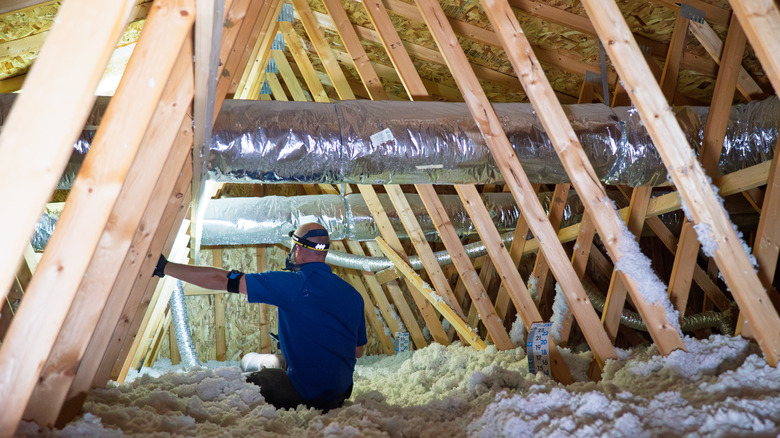
Sealing your home is one smart step toward keeping you cool in the most efficient way possible. However, there's an almost invisible factor that can also impact how efficiently your air conditioner runs, and that's insulation. While you can't see inside your walls, crawl spaces, or attic, you'll want to investigate whether there's sufficient insulation to help maintain comfortable temperatures, according to the U.S. Department of Energy.
Insulation recommendations vary based on what climate zone you live in and whether your home already has insulation. Insulation is measured in R-Values, where the higher numbers mean better thermal performance, per Energy Star. For example, in a hot, dry climate, Energy Star recommends R49 for an uninsulated attic. A very cold climate is better served by R60 insulation.
If your attic already has insulation, but it's around 3 to 4 inches deep, Energy Star recommends adding more, though at a lower R value than if it was uninsulated to begin with. Insulation isn't only for your attic, either. Energy Star also recommends insulation under the floor and under siding. Though you should check local regulations and probably get an expert opinion, overhauling your home's insulation could significantly improve both cooling and heating efficiency.
Check the vent settings
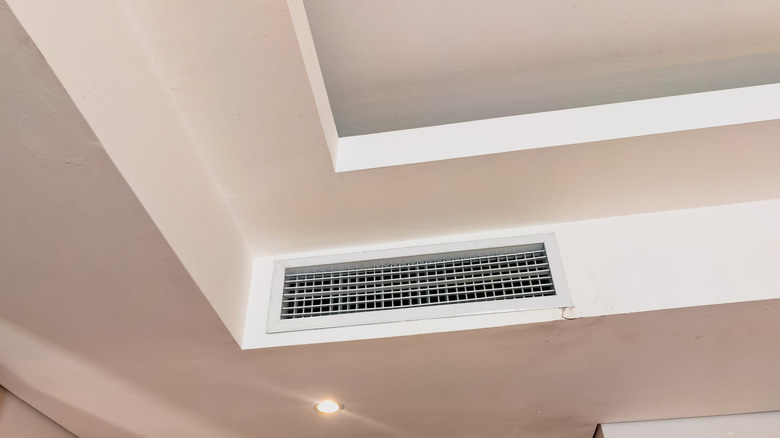
Adjusting your air conditioner's vent settings is another basic step toward better efficiency. Depending on what type of AC unit you have, you may need to take a tour of your home's vents. Or, it could be as simple as tweaking the direction of the vent on your window AC unit. As far as what direction your AC vents should go, that will depend on what type of system you have and where the vents are located.
If your vents are high up, either on the wall or ceiling, you will probably want to point them downward. Doubling down on a previous tip, using your ceiling fan on the right summer setting can also help circulate that cool air as it descends. In the summer, ceiling fans should turn counterclockwise to continue pushing air down and circulating it around the room.
Especially at the change of seasons, when temperatures first begin to rise, it makes sense to check all the vents and fans in your home to make sure everything is operating properly. After all, if one vent is closed, that could mean one room is warmer than the rest, and that's an unfortunate thing to discover in the middle of a heatwave.
Minimize manual adjustments
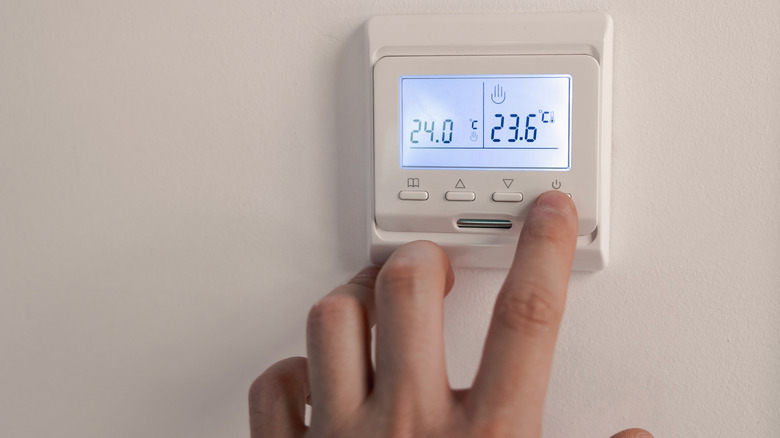
Although the ability to adjust your home's thermostat to suit your comfort level is nice, humans are not always the best judge of efficiency. For one thing, each type of air conditioner has its own operating guidelines. As the U.S. Department of Energy covers in its guide to home cooling, some units can simply stop working due to a clogged filter or a thermostat failure. In short, most air conditioner systems are pretty smart, especially when they're clean, in good repair, and Energy Star certified.
There's even a specific 3-minute rule for air conditioners, which governs how often an AC unit comes on. Turning on and off too often can overwork an air conditioner, so the rule helps keep it as efficient as possible. Thus, manual overrides can reduce efficiency, as research from the National Bureau of Economic Research (NBER) confirms.
In a working paper on how humans affect smart-technology efficiency, the NBER found that households regularly override their thermostat settings. Unfortunately for humans who may think their smart thermostat is helping them save energy, the overrides were less efficient than what the system was already doing. In its abstract, the NBER specifically notes, "we find that user behavior dampens energy savings," an unfortunate yet helpful finding for smart thermostat users, in particular.