

11 Browsers That Still Support Ad Blocking (Now That Google Chrome Doesn't)
The day we dreaded would come is now here: Google Chrome is tightening the final screws on ad blocking. We shouldn't be surprised. Google is an ad company, Chrome its browser — the world's most popular browser by a huge margin — so obviously it calls the shots. Google's been chipping away at ad blocking on YouTube, and Manifest V3 has been the writing on the wall for some time already. We've been saying for years that you should stop using Google Chrome, and now you have one more reason: ad blocking remains alive and well on many other browsers.
It's important to understand that ad blockers aren't just about getting rid of annoying ads; they're a shield protecting you against some of the worst the internet has to offer. So we've made a list of browsers that still support ad blocking. When we say "still support," we mean that either ad blocking is built directly into the browser or you can install ad-blocking extensions. These thirteen browsers — for now — are solid alternatives to Chrome that keep your browsing safe, clean, and fast.
Firefox
It would be sacrilege not to include Firefox in this article, because in the view of many, it is the allegorical savior of the browser world. One reason Firefox continues to support ad blocking (for the foreseeable future) is that it uses an entirely different browser engine that Google has no control over: Gecko. Add the fact that Firefox's maker, the Mozilla Foundation, is a non-profit focused on privacy, and we have grounds to believe Firefox will remain so.
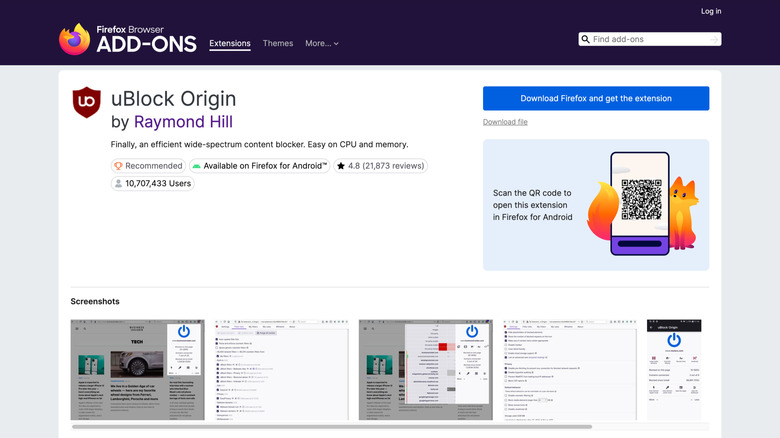
Firefox doesn't have a built-in ad blocker, but it does support protection settings that block trackers — which can in turn block tracking ads sort of like Privacy Badger by EFF. Firefox can also block third-party cookie trackers, pages that hijack your browser for cryptomining, and fingerprinting efforts. Firefox is very open about its support for ad blockers and recommends a few free ones you can download from the Firefox Add-ons store. uBlock Origin is our number one recommendation, with AdGuard AdBlocker as a solid second.
Ad blocking aside, Firefox is an easy recommendation for a daily browser, too. I've used it on and off for years and found it to have all the features the average user could want and more. Plus, we've tested Firefox and found it to be significantly more resource-efficient than Chromium-based browsers. One of the big reasons to not use Firefox is that you may run into compatibility issues, since devs are making their websites for Chrome first, other browsers second. You can download Firefox here.
Vivaldi
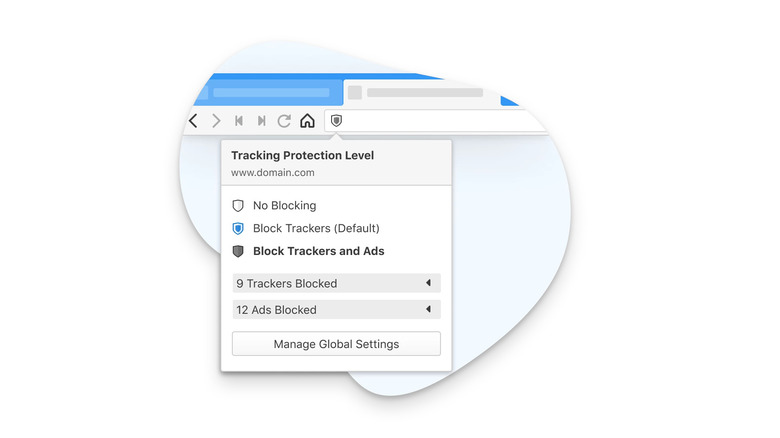
Vivaldi is the name of an amazing composer, and also an amazing browser. Vivaldi is a Chromium browser, i.e., it uses the same engine as Chrome. However, thanks to a built-in ad blocker, Vivaldi can (and seemingly will) continue to block ads regardless of which direction Chromium goes. It works almost identically to ad blockers. You can block trackers and ads, block trackers exclusively, or disable blocking on a per-website basis. You can also control your ad blocking sources. Users are free to install an ad blocker extension and disable Vivaldi's built-in ad blocker if it doesn't suit their needs.
We like how Vivaldi takes a more nuanced approach to ad blocking than just "block all ads." It suggests that you disable the ad blocker on websites you regularly use to support them, or only disable tracking ads. Vivaldi argues that we can't have a free internet if user-respecting websites can't generate ad revenue to cover their operating costs.
So how good is Vivaldi's ad blocker? We haven't been able to find any rigorous, conclusive side-by-side comparisons, but based on my personal experience, it almost never fails. I'd have to think hard to remember the scant few situations where ads somehow slipped the cordon. I do wish Vivaldi's ad blocker would include more features, like uBlock Origin's Element zapper tool, but other than that it's rock-solid. Vivaldi's been my daily driver for years now, and I don't regret making the switch. You can download Vivaldi here.
Opera
I like to think of Opera as Vivaldi's fraternal twin, a Chromium browser made in good ol' Scandinavia with a heavy focus on privacy and user customization. Both have a staggering amount of features, like free VPNs. Opera likewise includes an ad blocker out of the box.
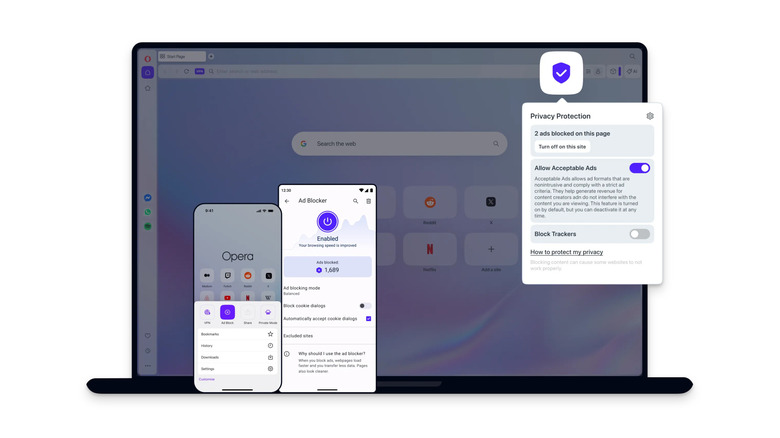
Opera says the ad blocker is "built on powerful uBlock-compatible technology," with one of the big selling points of uBlock Origin being its efficiency compared to other blockers. Same as Vivaldi, Opera's ad blocker is a core feature unaffected by changes to Chromium. Opera's implementation has quite a few more options than Vivaldi's does, such as allowing you to choose the blocking mode, eliminating those annoying cookie dialogs, and allowing "acceptable" ads.
Opera has directly addressed the concerns that the ad blocker will be affected by Manifest V3. In this blog post, it states, "Opera users will always have native ad blocking." When you consider the entire package — a privacy-focused browser that is teeming with great features — it's a compelling reason to switch even if you don't need or want ad blocking. You can download Opera's main browser here.
Zen
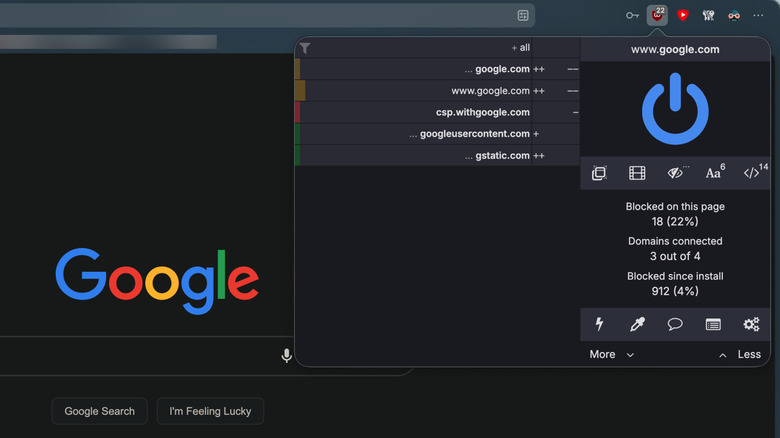
Firefox is not the unimpeachable silver bullet to Chromium dominance that it's sometimes touted as. It's been quite turbulent behind the scenes for years now as market share has shriveled. Some — myself included — feel that Firefox has fallen behind, but luckily, Firefox code is open source. A whole bunch of Firefox-based browsers have sprung up over the years to fill the gaps. Zen is my personal favorite.
Since Zen is basically just a Firefox browser with its own visual flair, any add-ons in the Firefox Add-On Store work. Ad blockers are no exception. When you click on the "Add to Firefox" button, it will install the extension normally. Further, all of your Firefox data — bookmarks, passwords, anything in Firefox Sync — will have cloud backups in case you choose to leave Zen for another Firefox-based browser.
Ad blocking is the focus here, but again, Zen is an incredible browser from top to bottom. It looks beautiful, with a forward-thinking UI focused on distraction-free productivity and very reminiscent of the late Arc browser. Once you clear the learning curve, it's a breath of fresh air compared to other browsers that just seem to be slightly different versions of the same thing. You can download Zen here for Windows, macOS, and Linux only. Bear in mind, it's still in beta, though it's incredibly stable, usable, and reliable already based on my own personal experience. This tends to be the case for Firefox-based browsers in general, including others we'll mention on this list.
Waterfox
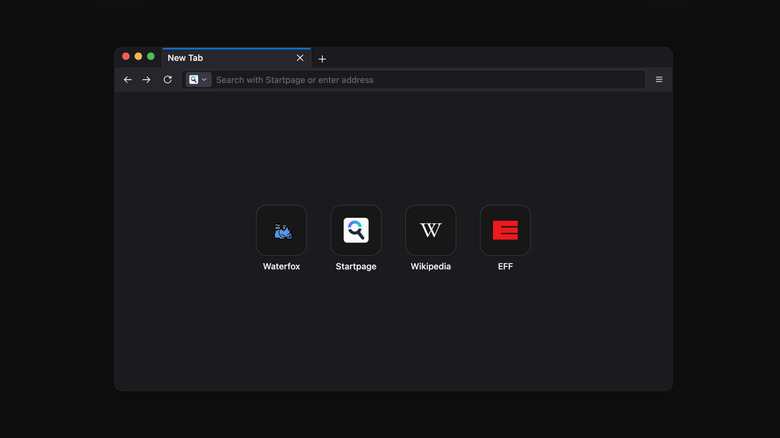
If there's a Firefox, there might as well be a Waterfox. Waterfox is spearheaded by Alex Kontos, who started the project when he was only 16 years old in 2011. Since it's yet another Firefox-based browser, you can install add-ons directly from the Firefox Store, including your ad blocker of choice. There are also murmurs that Waterfox is working on its own ad blocker, coming in 2026.
It's a shame Waterfox isn't as well known as some of the other options on this list, because it packs some great features. A large raft of them are privacy-focused, like a private DNS relay, automatic cookie banner rejection, and the removal of all sorts of telemetry and analytics. There's more tab customization, including the option to use vertical tabs, and you get the meta-search Waterfox Private Search as your default search engine. It's certainly a more power-user-oriented browser, though for someone who wants a bit more features than Firefox (and to whom privacy matters a lot), Waterfox is a top choice. You can download Waterfox here for Windows, macOS, Linux, and Android.
LibreWolf
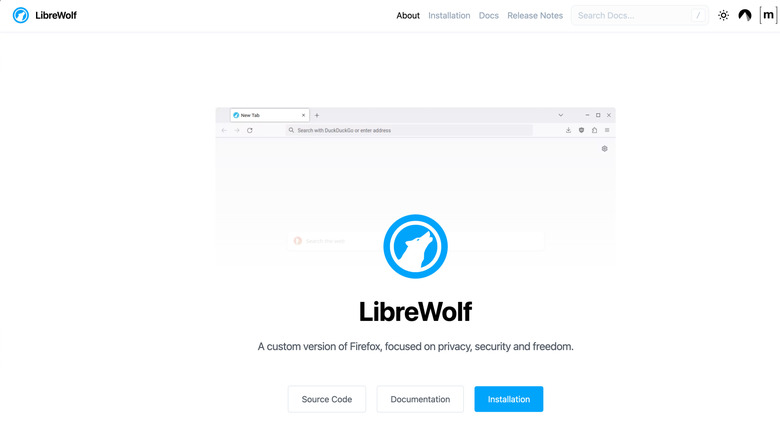
Tired of Firefox-based browsers yet? Well, here's one more, but we promise it's worth taking a look at. LibreWolf is a browser that's all about freedom (hence the name), namely privacy and security. It strips out Firefox's telemetry, supports only private search engines like DuckDuckGo, and installs uBlock Origin in the browser from day one. So if you want a Firefox-based browser that is ready to block ads the second you open it, look no further.
We recommend this browser with some caveats. Number one, the more aggressive privacy protections are going to break websites more often — at least in my experience. Further, things like Google's Safe Browsing are disabled, a feature we recommend to protect you online. So is DRM, meaning you may not be able to watch content on streaming websites. So is the password manager, and features like DNS-over-HTTPS are not encouraged.
Long story short, LibreWolf is a very opinionated browser. If you just need a browser that works without requiring any technical knowledge or tinkering, this may not be for you. But if you are especially paranoid about privacy, you'll be right at home. You can install LibreWolf on Windows and macOS, as well as several Linux distributions.
Safari
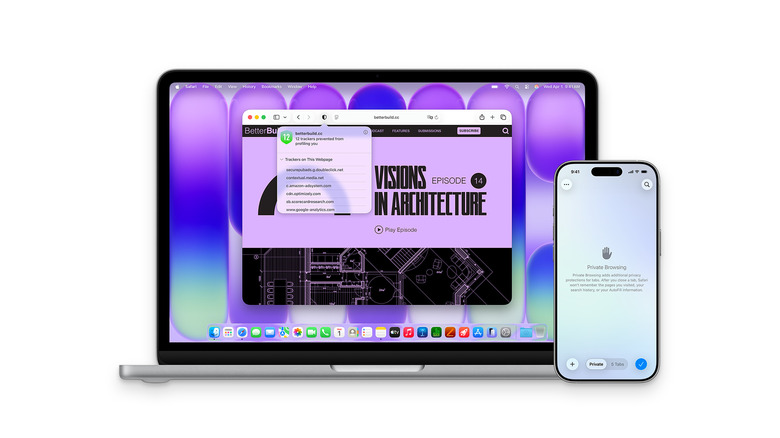
If you've been operating under the assumption that Safari is a "bad" browser, we'd like to disabuse you of that notion. Safari has improved significantly in recent years and may be preferable to Google Chrome. Some user testing has shown that, if nothing else, it's the most power-efficient browser in the Apple ecosystem. In any case, there's at least one reason to use it. Safari fully supports ad-blocking extensions.
Safari supports uBlock Origin Lite on macOS, iOS, and iPadOS, which you can download directly from the App Store. Another option is AdGuard, and there are some Apple-exclusive ad blockers like 1Blocker and Wipr 2. I've used all of these in the past with Safari and had few complaints.
It's worth noting that Safari already has strong privacy protections by default. It uses anti-fingerprinting tech, blocks third-party cookie trackers, stops web extensions from spying on you, and strips tracking elements from URLs in private browsing mode. It's also the only way to use iCloud Private Relay, a unique VPN-like solution to privacy. It's doubtful Apple will ever add an ad blocker to Safari, but if you're on an Apple device, you ought to use this instead of Chrome — ad blocking being only one reason.
Orion
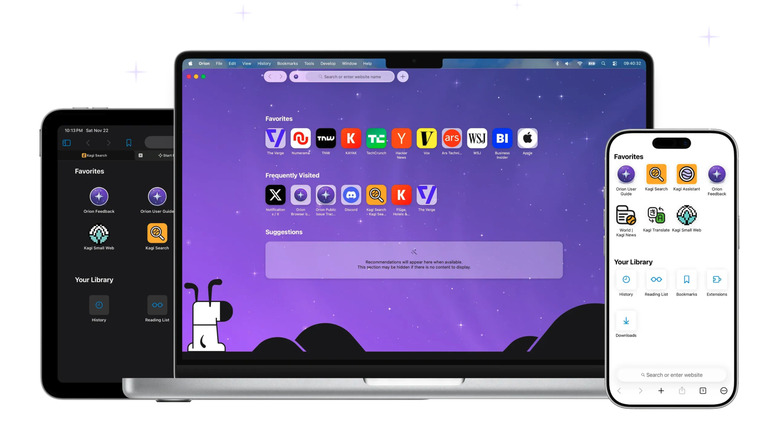
Safari can be a great browser for a lot of people, but it definitely falls behind the pack in terms of features. That's where Orion steps in. Orion is almost like a user-made Safari clone (it uses the Safari WebKit engine), albeit far more feature-rich. One of those features is a built-in ad blocker. If that ad blocker isn't cutting it for you, though, you can install an ad blocker from the Firefox or Safari extension stores; it's one of the few browsers out there that allows for this cross-platform extension installation, so even if for some inexplicable reason WebKit disallows ad blocking in the future, you'll be safe.
Orion's feature set includes tab containers, focus mode, overflow menus, pop-up link previews, vertical tabs, one-click Internet Archive retrieval, and so much more. Based on that same user testing we mentioned earlier, Orion is very close to Safari in power efficiency, ideal if you really want to stretch your MacBook's battery life. Orion's best for Apple users, but it's in beta on Linux and a very early alpha-beta on Windows.
Mullvad Browser
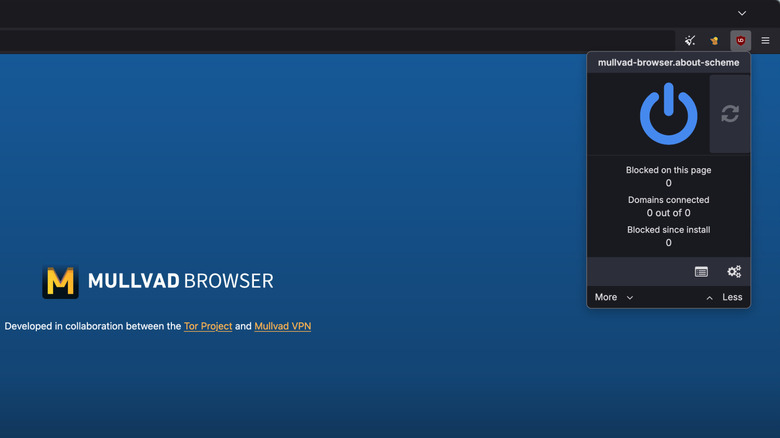
One of the top VPN services we recommend is Mullvad VPN, a one-of-a-kind service that makes privacy the priority from the very first step; it uses an ingenious account number system that lets you sign up without revealing any personal information. True to form, Mullvad teamed up with the Tor Project to build its own in-house browser, and thus Mullvad Browser was born. It ships with the uBlock Origin ad blocker pre-installed.
This is another one of those browsers that we recommend with a huge asterisk. There is a heavy emphasis on privacy. Mullvad takes a page from the Tor Browser's book by matching your browser's fingerprinting indicators to all other users, making it difficult for websites to track your online behavior. Doing so necessarily reduces the convenience of browsing. For example, you will browse in a perpetual letterboxed window mode, i.e., all websites will not take up the whole screen as they normally would. Mullvad also defaults to the most extreme tracking protection mode.
It's difficult to recommend this browser to most people as a daily driver. Rather, we'd look at this as a super-paranoid private browsing mode in browser form, and a less extreme alternative to Tor Browser for casual users. Naturally, Mullvad wants you to use this with a VPN, though do be aware that a VPN doesn't really make you anonymous.
Midori Browser
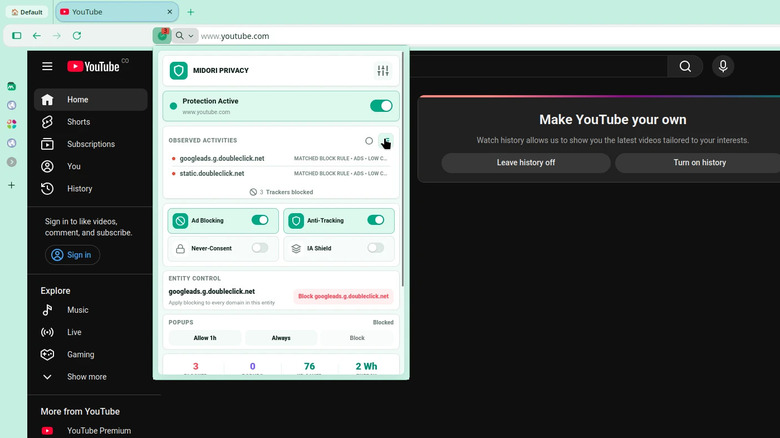
Never heard of Midori? You're not alone. Midori (Japanese for "green") is a browser that's been around since 2007, though mostly only on Linux and staying niche even then. In recent years, it shifted from its old WebKit engine to Firefox's Gecko, and one of the reasons to use it is for its excellent ad blocker. Here, we see another integrated ad blocker that doesn't require installing an extension or doing any special configuration. Unlike some of the more stripped-down ad blockers, Midori's ad blocker will tell you which domains are running in the background and which it has decided to block, along with specific toggles for ads and trackers, pop-ups, ad stats, and more.
Overall, Midori is yet another great choice for the privacy-conscious. It's free, promises no telemetry, is open to audits, and doesn't require you to sign in to use it. Everything's open source. This is all part of the Astian ecosystem, which includes the AstionGO search engine (the default in Midori), Astian VPN, and Astian Cloud. You can download Midori here for Windows, Linux, and Android.
In the interest of full disclosure, Astian is also an ad company. It promotes itself as a "Private Advertising" brand, so presumably it is not selling user data, as has become the norm. Although the code is fully open source, users should be aware of this before deciding to use Midori.
DuckDuckGo
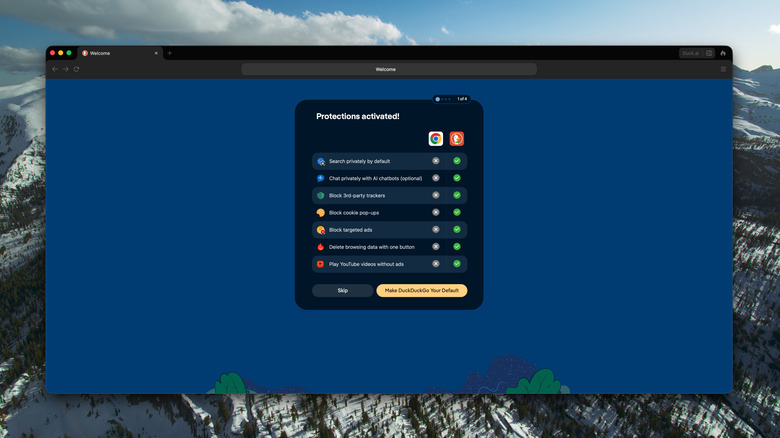
One of the best private search engine alternatives to Google is DuckDuckGo, and it also makes its own privacy browser — a viable choice as an everyday browser that can block ads. Just know that DuckDuckGo doesn't support complete ad blocking; it is very careful with its language, saying it blocks "most ads," e.g., targeted ads, email trackers, third-party trackers, and YouTube ads. Since DuckDuckGo, as a company, relies on ad revenue (the privacy-respecting kind) and makes DuckDuckGo search the default, this makes sense. Seems like a fair exchange for a free browser that has DuckDuckGo's reputation.
Having said that, you cannot install an ad-blocking extension if you want to block all ads; one of the benefits of an ad blocker is not just blocking ads, it's saving on data, resources, and battery. Since DuckDuckGo is a custom job using WebView2 and the Blink rendering engine, Chrome and Firefox extensions do not work. That also means you cannot use your favorite non-ad-blocking extensions.
Putting that fact aside, DuckDuckGo's Privacy Browser is surprisingly well polished despite its relative obscurity. Many of the features you would expect to find are there, and it adds more thoughtful touches we wish we'd see in other browsers; you can have the browser hide AI search results or AI-generated images; you can "incinerate" all your browsing data and start a fresh session, without removing the cookies for "fireproofed" websites. Download the DuckDuckGo browser for all platforms, minus Linux, here.