

Mercedes Transformed The CLA-Class From A Cheap Luxury Sedan Into A Stellar EV
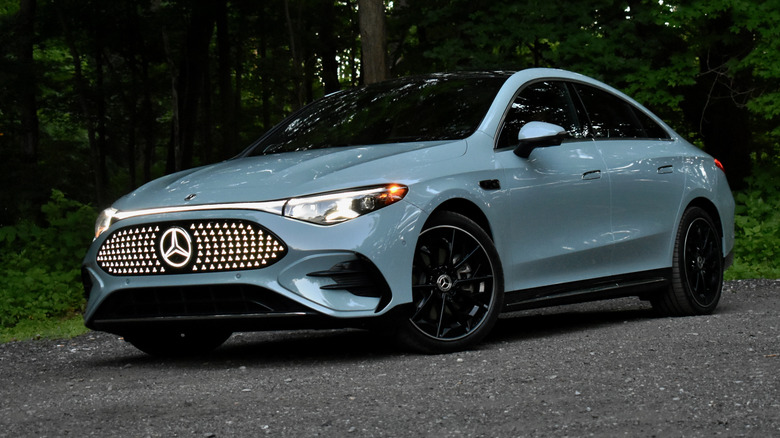
If they're not getting killed off in a frenzy of cost cutting, most cars get a redesign every few years. This almost always includes new styling, generally includes new tech, and may include a new powertrain or underlying architecture. The 2026 Mercedes-Benz CLA-Class goes a bit farther than that.
For its third generation, Mercedes transformed the CLA-Class from a Nordstrom Rack luxury sedan into a cutting-edge EV. A hybrid version is available, but the new CLA was designed around all-electric powertrains. It incorporates Mercedes' latest motor and battery tech, as well as lessons learned from the sensational Vision EQXX prototype, with a new infotainment operating system to boot.
So while it's still positioned as an entry-level model, the CLA is also a technological leader for Mercedes, a role normally filled by flagship models like the S-Class. That makes the new CLA a more credible recipient of the three-pointed star than the two previous generations, which is good, because Mercedes didn't limit itself to just one. But it also reorients this compact four-door toward dedicated EV shoppers, rather than those simply looking for a Mercedes on a Honda budget.
Star-crossed styling
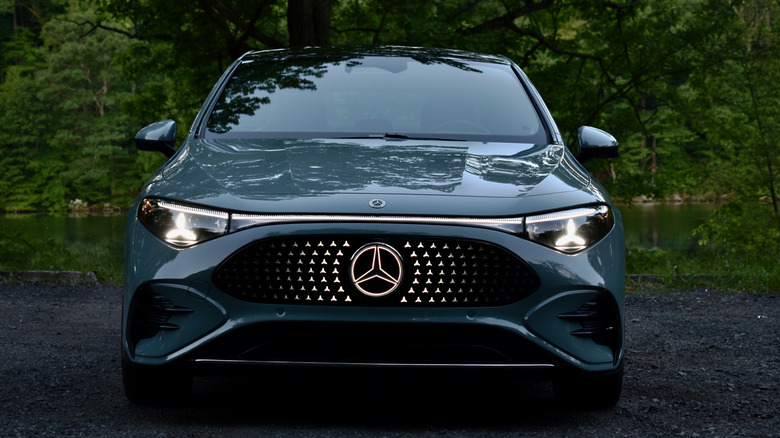
The styling is best described as "challenging," but in a way that's a return to form. The first-generation CLA was the first of Mercedes' small front-wheel drive cars to reach the U.S. The second generation blended in a bit more, but that's not the case here.
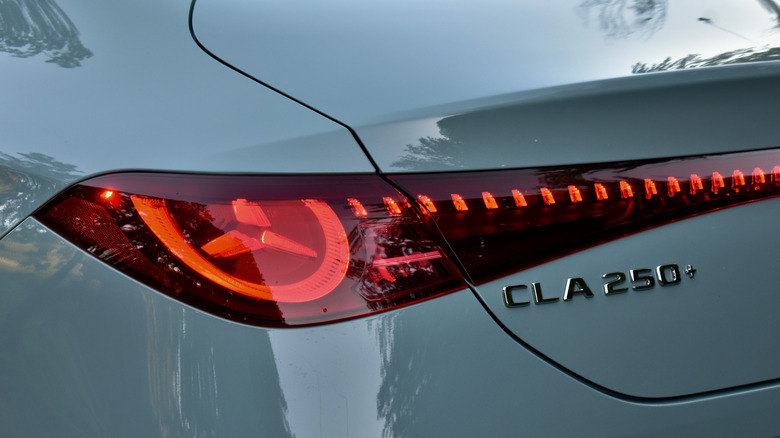
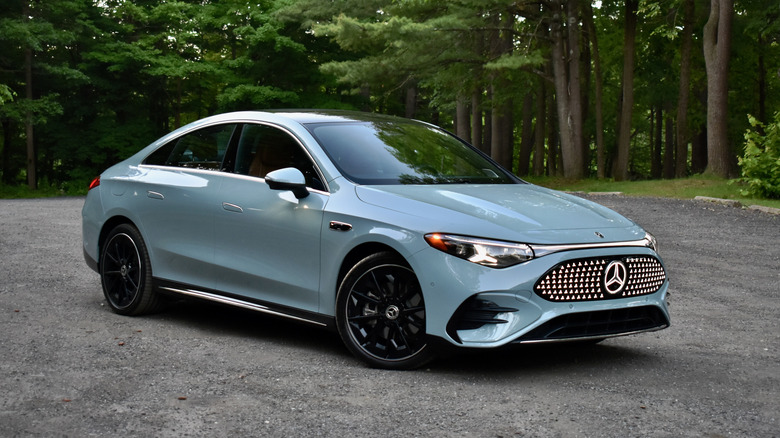
No longer needed for cooling, the grille is now a fashion statement. Bringing to mind a catfish's mouth, it serves as the background for a giant Mercedes logo and 142 three-pointed stars. Illumination is optional, allowing you to bring the stars with you even on a cloudy night. Droopy headlights contain their own three-pointed star elements, as do the taillights.
This gaudiness wouldn't be as much of a problem if the rest of the car wasn't so ungainly. This generation was stretched and puffed up to make room for a battery pack. It's 1.3 inches longer, 0.8 inch wider, and 1.1 inches taller than the previous generation, with a 2.4-inch longer wheelbase. And while it does have a more pronounced hood, the third-generation CLA also takes on some of the lozenge-like shape of the controversial EQS and EQE sedans.
Engineers would likely point to the work that went into fitting both batteries and people with the CLA's footprint, and the very impressive 0.21 drag coefficient. But the added visual bulk doesn't do the CLA any favors when it comes to appearance, and a light-up grille doesn't make up for that.
Quick enough in base form
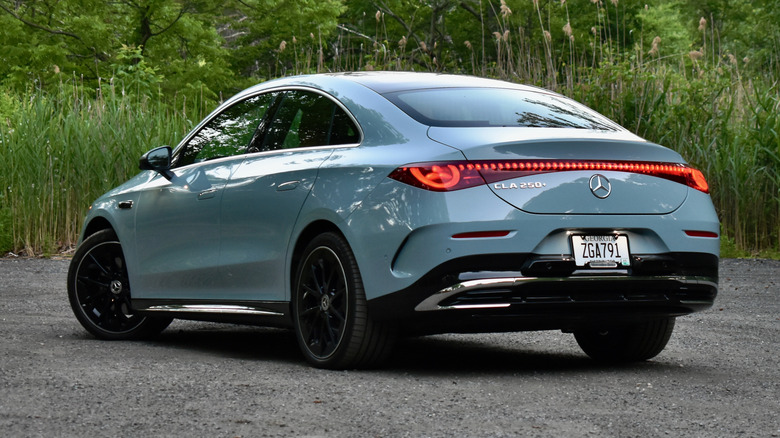
Underneath that questionable styling is the Mercedes Modular Architecture (MMA), a new platform designed for batteries first and internal-combustion second. Among other things, that brings the option of rear-wheel drive to the CLA for the first time.
The CLA 250+ with EQ Technology (Mercedes is thankfully replacing "with EQ Technology" with "Electric" for 2027) has a single motor spinning the back axle with 268 horsepower and 247 pound-feet of torque through a two-speed transmission (a first for Mercedes) to balance efficiency and acceleration across a wider range of speeds.
The single-motor CLA felt quicker than the 6.6-second zero to 60 mph time quoted by Mercedes, and quite impressive for a car that weighs 4,553 pounds in base form, even if it is a few tenths slower the outgoing gasoline CLA 250. However, despite the extra gear, it felt less energetic at higher speeds. I could also do without the artificial sounds that accompany brisk acceleration, which sounded like an uncopyrighted version of the submarine sound effects from The Hunt for Red October (they can, at least, be turned off).
A dual-motor CLA 350 4Matic is also available, with 349 hp and 380 lb-ft of torque. According to Mercedes, it does zero to 60 mph in 4.8 seconds—the same as the previous-generation AMG CLA 35 gasoline model. Finally, the front-wheel drive hybrid extracts 208 hp and 280 lb-ft from a 1.5-liter turbocharged four-cylinder engine and a small electric motor, getting to 60 mph in 7.1 seconds.
The baby Mercedes grows up
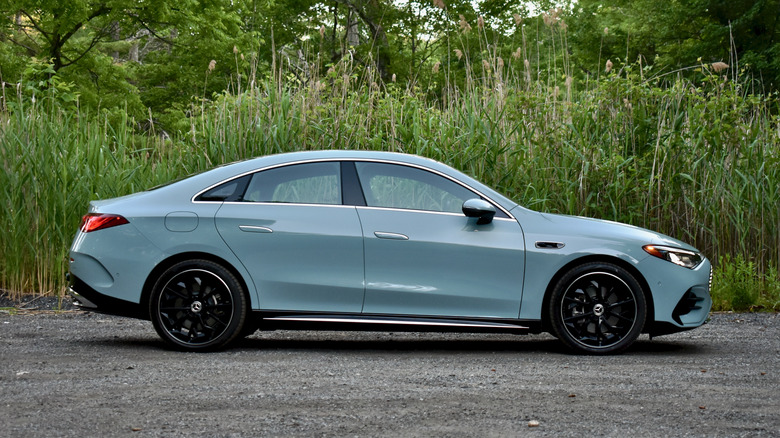
Just as switching from a gasoline engine to an electric motor completely changes the experience of acceleration, the bigger body gives the ride and handling a completely different character. But it's a character that's very appropriate for a Mercedes.
It may not feel as nimble as before, but the extra heft and wheelbase stretch give the CLA 250+ a more grown-up quality. From behind the wheel, it no longer seems like an entry-level model. Even with the optional 19-inch wheels, bumps are controlled with poise and confidence, and it's easy to make smooth control inputs that allow the CLA to glide through corners like a proper luxury car. You won't be able to get the back end out in corners, but rear-wheel drive reduces understeer, giving the steering an additional level of precision, if not feel.
This ability to hustle without losing composure earns the CLA its many Mercedes stars. So does the quiet cabin, although the levels of tire noise on the larger optional wheels were hard to ignore. The lack of a combustion engine tends to expose those noises in EVs, though.
Mercedes has also made big improvements in regenerative braking. You can now choose multiple levels via steering wheel paddles; "Normal" and "Strong" are sequential so you can mimic engine braking via downshifting in a combustion car. And there's no phantom pedal movement, as in early EQS models.
Big upgrades in range and charging over previous Mercedes EVs
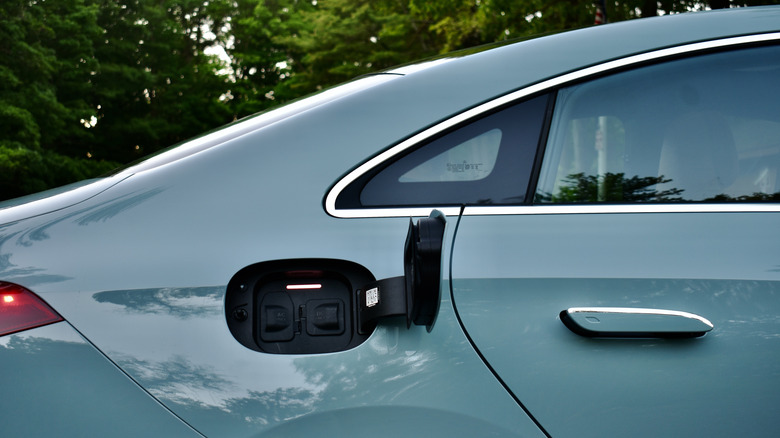
The CLA also succeeds as an EV. As with other Mercedes EVs, the "+" in CLA 250+ signifies that it has the most range, in this case an EPA-rated 347 miles in base form or 317 miles with bigger wheels and optional equipment. The all-wheel drive CLA 350 4Matic is rated at 312 miles. And that's all achieved with a reasonably-sized 85-kilowatt-hour battery pack.
Observed average efficiency of 4.3 miles per kWh over the entirety of this loan indicates those EPA numbers should be achievable in the real world. According to the car's trip computer, the CLA maintained that level of efficiency on a 90-degree day with the air conditioning blasting.
The MMA platform also brings an 800-volt electrical architecture to a Mercedes for the first time, as well as a NACS port and Tesla Supercharger connectivity. You'll need to use a CCS adapter to take full advantage of the CLA's 320 kilowatts of maximum DC fast charging power, which can add 202 miles in 10 minutes or complete a 10%-80% charge in 22 minutes, according to Mercedes. With a cold battery, the car still pulled 202 kW from a 350-kW Electrify America station, getting from 50% to 80% in 10 minutes.
For home charging, the CLA's ability to Level 2 AC charge at up to 9.6 kW should make overnight recharges possible with plenty of cushion.
The interior needs a similar upgrade
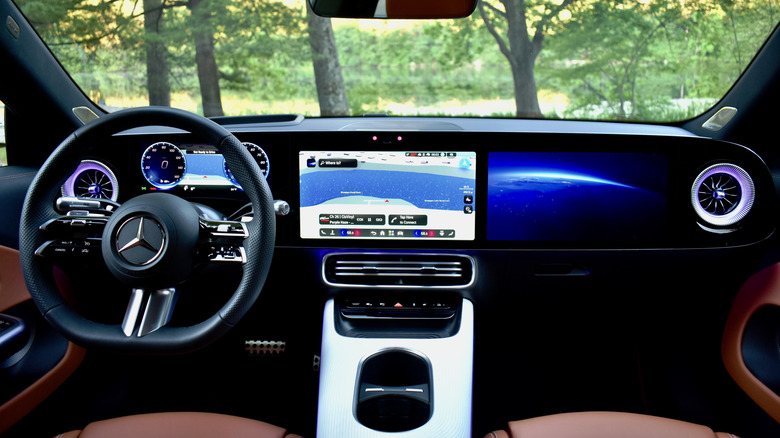
The interior is where the CLA's low-budget side starts to reassert itself. Things start well enough. You enter using the same overengineered retractable door handles that debuted on the S-Class just a few years ago. Both they and the doors themselves go about their business with the reassuring ker-thunk of quality Mercedes is known for.
Inside, it's a different story. Mercedes ported over some of the design elements from its high-end models—including elaborate ambient lighting, circular air vents, and speaker grilles for the available Burmester audio system that could double as cheese graters. But most of the material is chintzy plastic. The seat controls in particular look and feel like a bad copy of what you get in a more expensive Mercedes. Leather upholstery was a $1,450 option on this test car, and while the $200 "natural fiber" trim on the center console was an interesting alternative to wood, it's not exactly a luxury-car material.
Even with an as-tested price of about $60,000, the test car also lacked a power-adjustable steering column and ventilated and massaging front seats. Heated seats were included, along with a kinetic function that moves the seats to avoid stiffness on long drives. That was disappointing, but headroom and legroom weren't. This CLA felt more akin to a C-Class inside—another win for this car's embiggening.
Excessive tech
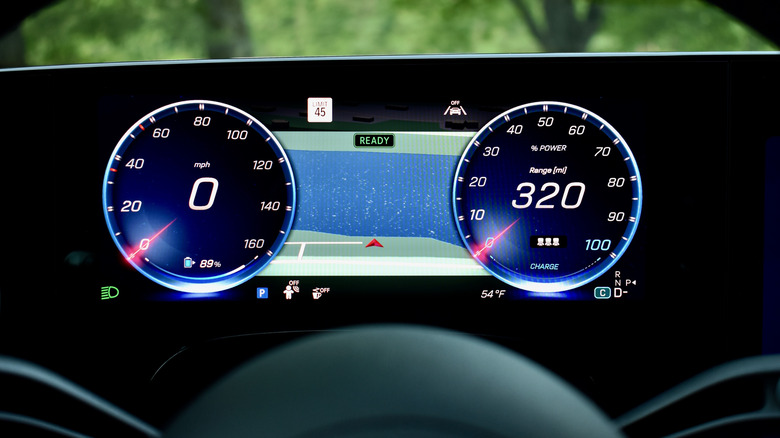
The CLA's next-generation infotainment system should have made a bigger impression than the cheapness of the rest of the interior. Mercedes has thrown out all subtlety by turning the dashboard into a completely flat surface tailor made for screens. Embedded within it are a 10.25-inch digital instrument cluster and 14-inch central touchscreen. The optional Superscreen setup adds another 14-inch touchscreen for the front passenger.
Behind the screens is the new MB.OS operating system, designed to provide the flexibility to juggle a growing number of software-based features. In addition to wireless Apple CarPlay and Android Auto, MB.OS incorporates Google Gemini and ChatGPT. These are undeniably the apps of the moment, but Mercedes' existing voice recognition was already so good that they don't have much to offer. AI is supposed to respond in a more natural way, but I never had trouble understanding or being understood by the voice recognition in the old CLA. Gemini and ChatGPT are meant primarily to find destinations and answer general-knowledge questions, respectively, but neither is exactly an everyday use case.
The screens' graphics were impressive, particularly the sharp-and-detailed map that serves as the background for tiles that take you to menus for things like audio and phone connectivity. It's a good layout, although having to rely on the screen for climate controls is still awkward. And with a big screen just to their left and a phone in hand, the front passenger doesn't really need a dedicated display.
Driver-assist features you'll want to use
The CLA launches with the expected array of driver-assist features, all of which are refreshingly intuitive. It was easy to tell when adaptive cruise control and automated lane centering (combined as MB.Drive Assist) were active and when they needed help, and Mercedes includes automated lane change functionality as well. The car had trouble negotiating some highway curves, though, and was a bit slow to execute a lane change when prompted by pressing the turn-signal stalk.
Mercedes has a more capable system on the way, however. MB.Drive Assist Pro promises door-to-door semi-automated driving on both highways and surface streets, akin to Tesla's so-called "Full Self Driving." Unlike Tesla, Mercedes responsibly classifies this as an SAE Level 2 system requiring an attentive driver, and even designed the software to call the driver to intervene without deactivating the system. It handled the streets of San Francisco just fine in a Mercedes-organized demonstration.
The sensor suite needed to support MB.Drive Assist Pro provides other benefits. The cameras in the front fenders allow for a super-wide angle when backing up. And the automated parking system is one of the best around. It automatically looks for spaces and, when it finds one, overlays an image of the car in said space in the backup camera view. A tap of the touchscreen initiates parking which, when backing in at least, is done quick enough to actually make this feature usable in real life and genuinely improve on the average human driver.
2026 Mercedes-Benz CLA-Class verdict
With starting prices of $48,500 for the single-motor CLA 250+ and $51,050 for the dual-motor CLA 350 4Matic (2027 model year pricing will be slightly higher), the 2026 CLA-Class with EQ Technology effectively leaves its aspirational origins behind. It's $4,500 more expensive than a base gasoline CLA and $5,050 than a 4Matic version. And the CLA 350+ provided for this review had an as-tested price of $64,030 thanks to options like leather upholstery, Burmester audio, and upgraded driver aids.
Customers are mostly paying for good engineering. The CLA's efficiency and charging performance impressed more than its interior, and the styling is an acquired taste. Mercedes will at least undercut the upcoming BMW i3, which is expected to start north of $60,000, but BMW is promising at least 400 miles of range. And as a small luxury EV, the CLA is more convincing than the Audi Q4 e-tron and Lexus RZ.
Those who don't care about the powertrain type, and just want the cheapest possible car from a luxury brand, will be better served by the Audi A3 or, if the lease deals are good, the BMW 2 Series Gran Coupe. But the electric CLA's more mature driving experience and right-sized proportions make it a more credible luxury car than before, even if the interior fittings still fall short. It exposes the lie that you can do true luxury on the cheap, but that shouldn't detract from the positive things it says about Mercedes' EV future.