

7 Simple Gadgets With Surprisingly Complex Engineering
We may receive a commission on purchases made from links.
Isaac Newton is sometimes credited with having said that he could "[see] further than others ... by standing upon the shoulders of giants." What he meant was that he was only as successful as he was because he stood on a foundation made by previous generations' gradual successes over hundreds or even thousands of years — i.e., without those who came before, he'd be starting from zero. Although he was referring to his own field, the saying absolutely applies elsewhere. The only reason we've made science fiction devices real is thanks to scientists, chemists, engineers, and others tirelessly building on what they were given. We really are spoiled by all that progress, which can lead us to forget that some of the simplest, most forgettable, everyday items we use are sometimes the culmination of millions of hours of human sweat and blood.
In this list, we look at a few gadgets that really illustrate this point. Everything on this list looks or seems simple at a glance, often being so affordable and widespread that you could throw one away without anyone even blinking. But unlike some of the more obviously complicated machines ever made, these ones don't get the credit they deserve for their deceptive simplicity.
Drip coffee makers

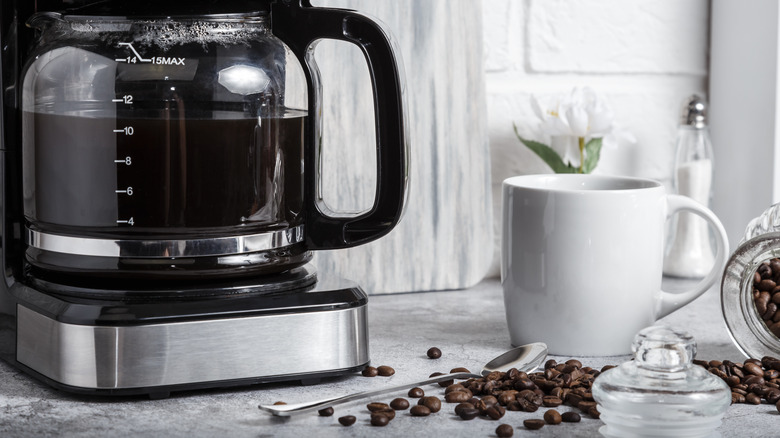
A good coffee maker is an almost foundational piece of technology, at least for those of us addicted to the morning brew. And it may seem as simple as it gets. All you'd need is some mechanism to heat the water and pass it over the grounds. It couldn't be any simpler, right? Bill Hammack from the engineerguy YouTube channel discusses how making a coffee maker runs into significant engineering challenges when trying to keep the product affordable and effective. In the machine demonstrated, a simple one-way valve running through the heating element creates a bubble pump that both heats the water and moves it up the reservoir and over the grounds. So, what's moving the water is a complex mixture of fluid thermodynamics and buoyancy, minus any moving pump.
Some coffee makers also feature a "pause and pour" feature. Thanks to this, you can remove the carafe mid-brew, pour yourself a cup, and put it back without spilling any coffee. The way the coffee maker does this is brilliant and simple; it uses a spring with a valve that, when depressed, allows the drip coffee to flow freely. Removing the carafe, though, lets the spring extend, closing the valve and preventing coffee from spilling. The carafe's lid is also designed so that, when the carafe is seated properly, the valve is depressed, but as you pull it out, the spring snaps out to instantly stop the flow. Simple, cheap, but brilliant.
As proof of the "standing on the shoulders of giants" aspect, the design of cheap coffee makers has actually gotten simpler and cheaper. So next time you're brewing yourself a cuppa, take your hat off to that $10 coffee maker.
Quartz watches
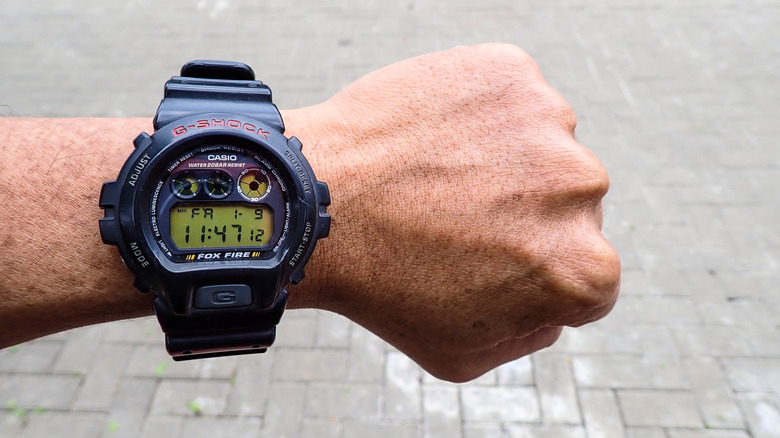
No one needs to be told twice that mechanical watches are exhaustingly complex. Just look at them. The reason a Rolex runs without a battery is thanks to perpetual rotors that charge themselves with the swinging of your arm. However, what about digital watches? That cheap Casio F91W Series watch that you can get for under $30 doesn't turn any heads, despite featuring an almost sci-fi-like technology that many people aren't aware of. Rather than mechanical movements, digital watches like these use quartz movements. Yes, quartz, the crystal.
Quartz crystals can function like tuning forks, emitting a frequency of up to 200kHz. But rather than hitting them to produce vibration, scientists figured out that shocking them (the piezo-electrical effect) makes them oscillate at a high frequency. So how does that tell time? Well, quartz movement watches measure the vibration, convert it to a format digital circuits can understand, and then calculate that to tell you the time. In other words, the quartz in your digital watch is almost like a pendulum, swinging faster than you could physically see to tell you the time. And that's an oversimplified description, as this is a highly complex topic requiring a specific type of quartz, cut in a specific way, and vibrated at a very specific frequency.
How accurate is a quartz watch? More accurate than a mechanical watch, at least. We're talking a couple of seconds lost each month, totaling a couple of minutes lost per year. To get more accurate than that, you'd need something like an atomic clock, some of which might lose a second every 15 billion years. However, those are measuring the resonance of atoms and can get pricey as far as wristwatches are concerned. Quartz is cheap, effective, and deserves recognition.
E-ink readers

E-ink has been around for a minute. It was exciting new technology back in the early 2000s, but now you don't even blink at seeing e-ink on store price tags and e-reader screens. E-ink — particularly in e-readers — has become so affordable that it's the de facto way to read digitally. You can go cheap with the Xteink X4 for $69, or graduate to a more expensive e-reader with a color display. All of this belies the fact that this is one of the most sci-fi-sounding pieces of tech on this list.
Sandwiched within a screen as thin as a human hair are two electrodes, a transparent fluid, and black and white ink capsules. The electrodes push and pull either the black or white pigments — millions of them — to one side, producing the page you're reading. Once set, the e-ink screen can retain that image indefinitely without requiring any more power; I have an old Kindle whose battery died years ago, and it still has the dead battery sign today. Anyone who owns an e-reader knows that it can easily get weeks or months of battery life before needing to be charged. Posy has an excellent video showing how it works under a microscope.
Simple in theory, but mind-bogglingly complex when you think about the science that had to go into creating this and manufacturing it at scale — while still being affordable to the average person. It also reminds us of the explosive science behind how computer chips are made, enabling us to craft billions of transistors on something the size of a postage stamp. So next time you turn the page on your e-reader, know you're basically a magician summoning a Biblical plague of ink dots just to digitally recreate the page of your latest read.
Smartphone gyroscopes and accelerometers
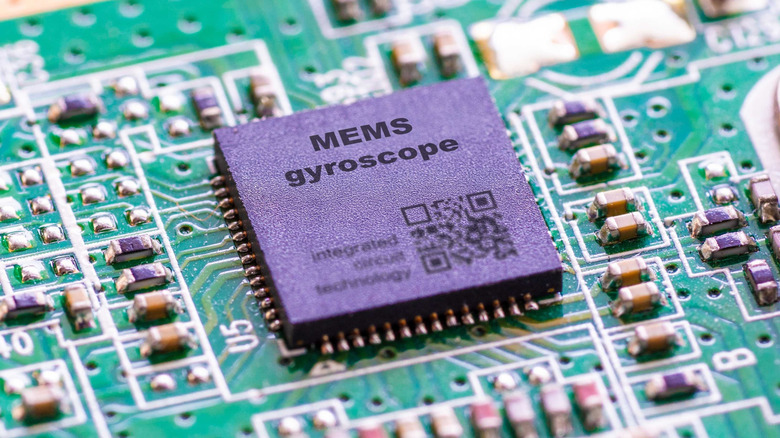
Two of the many sensors in your smartphone are the gyroscope and accelerometer. If you know your Greek, then you know "gyros" means rotation, and accelerometer comes from the same root as "accelerate." Therefore, a gyroscope and accelerometer are how your smartphone knows its position and movement; for example, when you lift your phone and the screen turns on, or when your Switch controllers track your movement. Nerds were raving about this tech back in the late 2000s with the emergence of smartphones, but now it's old hat. It's a shame it has become so unremarkable, because the underlying technology is impossibly small and complex.
A modern smartphone gyroscope/accelerometer uses a MEMS device, short for microelectromechanical system. By micro, that means something measured in micrometers; you need a microscope to appreciate these. According to a paper by InvenSense, gyroscopes and accelerometers are assemblies containing proof masses cut out of silicon, the same silicon used for semiconductors. These proof masses are capable of moving in all directions, despite being a flat construction. The end result is packed in a tiny, hermetically sealed chip installed in your smartphone that tells your phone when to switch from portrait to landscape orientation.
If none of that made sense, then a video explanation will help. Breaking Taps shows what a gyroscope looks like on the microscopic level (it all fits inside a 2mm chip) and then 3D-prints a larger version to demonstrate. The pieces flex in different directions to measure a specific axis. Since these things are so small, they're able to detect even the most minute movements, which is why your smartphone manages such accurate readings. Again, we've skipped over a lot of the finer technical details, but you don't need a PhD to appreciate these MEMS devices and therefore gyroscopes/accelerometers.
Smartwatch heart rate detector
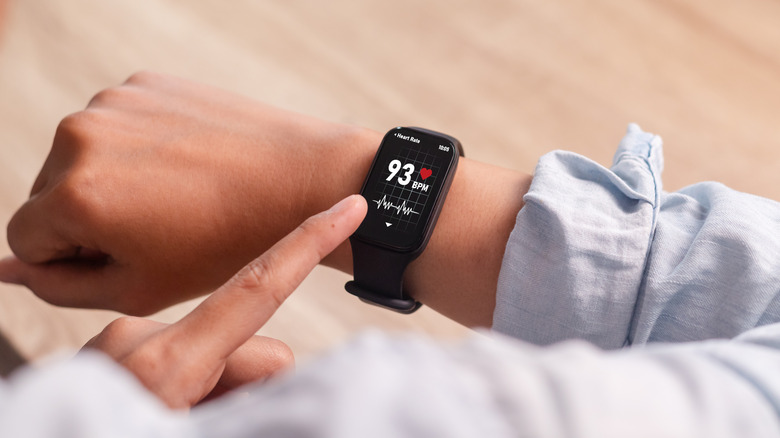
Heart rate detection on smartwatches is yet another feature that gets glossed over because we've come to expect it as the bare, bare minimum. But think about this for a second. How do you measure someone's heart rate just by looking at the surface of their skin? Modern heart rate measuring devices (we'll use the Apple Watch as our example) often use photoplethysmography, or — for something easier on the tongue — PPG. Basically, scientists found out that your circulatory system subtly changes the color of your skin when pumping blood and this can therefore be measured to determine heart rate. This is also, by the way, the technique used for smartwatches that track your blood oxygen level.
Apple describes the Apple Watch as detecting "the amount of blood flowing through your wrist at any given moment," which sounds super metal and sci-fi. But at its core, it's a simple principle. More blood in your wrist means greater green light absorption, and vice versa, so measure that shift and you get an accurate measure of heart rate. If you've ever noticed a flashing green light coming from the optical heart sensor on your wrist, that's your watch taking a heart rate reading; if it's red, it's measuring oxygen.
Steve Mould has an excellent video showing this in action. Though smartwatches use flashing lights to achieve this, you could in theory measure someone's heart rate with just a camera and some software. Steve's friend is able to measure his heart rate with a video of his face, which, when the colors are adjusted, turns from a sickly green to a loud pink, and back again as blood goes back and forth through his system.
Electric toothbrushes

Of all the items on this list, the one you probably think about the least is your electric toothbrush. There are two types of electric toothbrushes: oscillating brushes (the wiggling-head ones) and sonic/ultrasonic toothbrushes (the vibrating ones). In the former, there's a somewhat complex gear and crank mechanism that transforms the electric motor's spinning motion into bristles that only oscillate — not a full, spinning rotation.
See it in action for yourself with this video; two gears move an arm that gives the shaft leading up into the toothbrush head that short-range, oscillating movement. Up inside the brush head, another mechanism turns the movement 90 degrees so the bristles oscillate. Now you have a bit of an idea why replacement toothbrush heads might be so expensive, since each one provides the second half of the mechanism necessary to oscillate the toothbrush.
Then there are sonic and ultrasonic toothbrushes. Patents for these go back to the 1990s, and they operate on similar principles to quartz electric watches, using a piezoelectric crystal to produce high-frequency vibrations up to 66,000 times a minute. An ultrasonic toothbrush works on two principles: first, hydrodynamic flow violently agitates liquid (water and saliva) and makes tiny teeth-cleaning bubbles, known as cavitation; second, it uses literal sound waves to blast away plaque. So are the vibrating brushes more effective? Anecdotally, I think so, as my teeth feel cleaner with my ultrasonic brush compared to the oscillating one I had before it. But Consumer Reports has a fascinating article demonstrating how "nine out of ten dentists recommend" is really just a thinly veiled potential conflict of interest with large toothbrush manufacturers. Our recommendation? Use the one you think works best.
Hall-Effect controllers
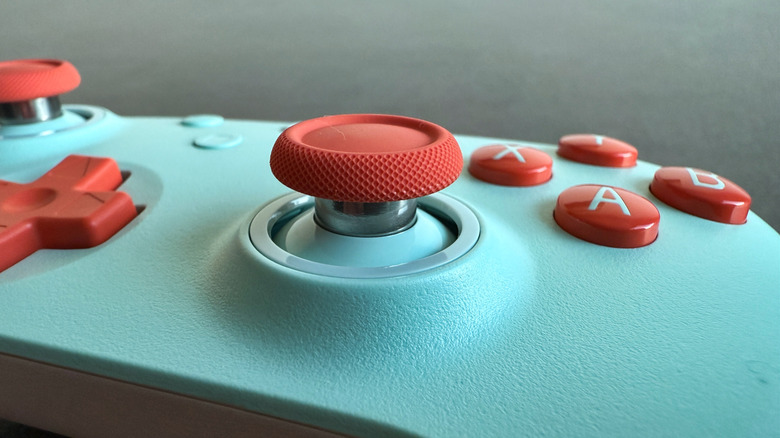
If you have an old PS4, you likely are familiar with controller drift. Long story short, most controllers' thumbsticks use potentiometers that succumb to "stick drift" at some point, i.e., when the in-game movement "drifts" in a direction you didn't intend it to. It's annoying when you play, and annoying that this problem has basically already been solved, and yet your new PS5 controller and Nintendo Switch 2 Joy-Cons will still likely drift someday. So how does Hall-Effect solve this?
Hall-Effect sensors measure the flow of electricity when affected by a magnetic field, without touching mechanical parts. So in theory, Hall-Effect thumbsticks and triggers should last for a long, long time before needing a fix or replacement — if ever. Further, Hall-Effect sensors are more sensitive, making them ideal for gamers frustrated with dead zones and insufficient precision. For the layman, it looks like sci-fi technology controlling your game character by effectively waving a magnet in front of a sensor.
Then there's TMR (tunneling magnetoresistance), which some argue has an edge over Hall-Effect sensors. It employs a similar phenomenon and could be more sensitive while using a fraction of the power that Hall-Effect requires — and, of course, remaining stick drift-free. Then there are emerging capacitive analog sticks, which might be even better than TMR, but we rest our case. We see almost no reason for anyone to buy a controller that has a potentiometer. You can find excellent Hall-Effect and TMR controllers that cost as much or less than the ones from Sony and Microsoft. We recommend something like the 8BitDo Ultimate 2C Wireless Controller. For $30, you can experience the magic of Hall-Effect rather than paying double for something that will break prematurely.