

12 Useful Gadgets That Can Help You Take Better Photos
We may receive a commission on purchases made from links.
As a photographer with nearly two decades of professional experience in the field, much of which has been spent testing and reviewing camera gear, I've encountered all manner of camera-related gadgets. Some turn out to be gimmicks that end up gathering dust on a shelf; others have earned permanent places as part of my daily kit. I'm also always on the lookout for innovative new tech to improve my capabilities beyond what skill and talent alone can accomplish.
It's important to always remember that buying a new thing won't make you better at taking pictures. Much like buying an expensive saw won't make you a skilled carpenter, purchasing a high-end lens won't make you more skilled photographer. However, if you do have the requisite skill, then the right tools serve to open up amazing new creative opportunities.
The following article contains a mix of products from those I've either bought and used myself for years or have been provided to my by various manufacturers for the purposes of testing. Some are new, innovative products which, though I've not yet used myself and are unproven, are nonetheless promising and worthy of consideration.
1. A Tripod
This is one of the first accessories anyone wanting to expand their photography capabilities should invest in. Even if all you use is a smartphone, a tripod opens up a lot of creative possibilities that would otherwise be impossible. Are you interested in capturing a multi-exposure HDR image? A long exposure of a waterfall? Doing any sort of astrophotography? If you answered "yes" to any of these questions, then you'll need a tripod.
It's worth investing in a quality tripod from a name brand. For a budget model, I recommend looking in the $100 price range, where something like Benro Tripster Travel Tripod is a fairly respectable option. I also find that a mini tripod is an indispensable tool in my kit, because quite often I don't want to deal with the weight and bulk of a full size one. I highly recommend the Manfrotto PIXI EVO Mini Tripod, which has served me well for the past six years.
My primary tripod rig, however, is something of a custom setup. I use the Benro Tortoise Columnless Carbon Fiber Tripod with Leveling Base, paired with the Leofoto VH-30R. This setup offers all the convenience and flexibility of a ballhead, but is much more precise and secure. The VH-30R can be a bit difficult to find these days (Ebay is probably your best bet), but the Acratech Panoramic Head is an excellent alternative, though it's much more expensive. All told, this setup will run you between $530 and $780, but it's well worth the investment. It's also relatively modestly priced compared to high-performance carbon fiber gear from the likes of Gitzo.
2. An artificial light source
Whether it be an external flash or an LED, an artificial light source can seriously upgrade your capability to take photos of a more professional caliber. While of course a flash can help in a dark room, it can be equally useful in brightly backlit scenarios or in dappled light. If you're doing macro photography, then a high powered light can make a world of difference when you're fighting the laws of physics at close focusing distances.
Personally I'm not too fond of flashes; I much prefer constant video lights for stills photography. This allows me to compose my shot while being able to see exactly how the image will turn out. I use a bunch of different lights in my setup, but my favorite is by far the Smallrig RC 100C COB LED Video Light Kit. It's relatively compact, and the kit comes with everything you need to get started. It has become a highly valued tool for the purpose of product photography, largely due to how very convenient and versatile its design is. I own a lot of excellent lights which also see regular use, but this one is my favorite.
3. Interchangeable lenses
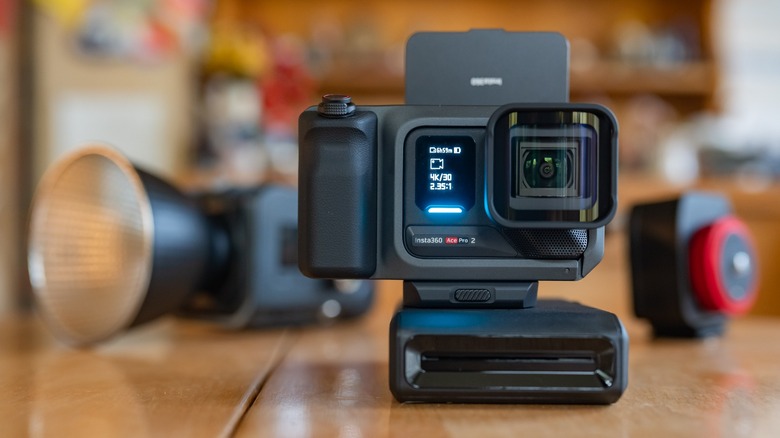
Even if you don't use a mirrorless camera or a DSLR with interchangeable lenses, action cameras and smartphones alike now have access to a number of different high quality lens options. I've used action camera lenses extensively in testing and reviewing the GoPro Hero 13 Black and the DJI Osmo Action 6, and have recently had the opportunity to try out interchangeable lenses for the Insta360 Ace Pro 2. All have proven to be of remarkably good quality, and they serve to significantly expand the capabilities of these cameras. So far, they tend to fall into three different categories: ultra-wide, macro, and cinematic/anamorphic. This serves to help action cameras overcome some of the limitations inherent in their design.
Of course, interchangeable lenses remain primarily the domain of mirrorless cameras and DSLRs, and the range of available options is truly vast. For example, you could use Viltrox's EPIC anamorphic lenses to achieve cinematic effects and create in-camera single-shot panoramas Meanwhile, if you're looking for a compact, portable, and relatively affordable full frame super telephoto lens for wildlife photography, the Sigma 500mm f/5.6 DG DN OS Sport lens is a fantastic option.
If you want to go ultra wide and still retain autofocus capabilities, then the Laowa 10mm f/2.8 Zero-D is an extraordinary optic, while the Sigma 14mm f/1.4 DG DN Art is what you want for capturing wide angle shots of the star-filled night sky. Alternatively, a macro lens such as the Nikon NIKKOR Z MC 105mm f/2.8 VR S also opens up new worlds of photography. Similarly, the Venus Optics Laowa 55mm f/2.8 T/S lens offers the unique creative possibilities of a tilt/shift lens in addition to super close-up photography.
4. Bolt Hunter
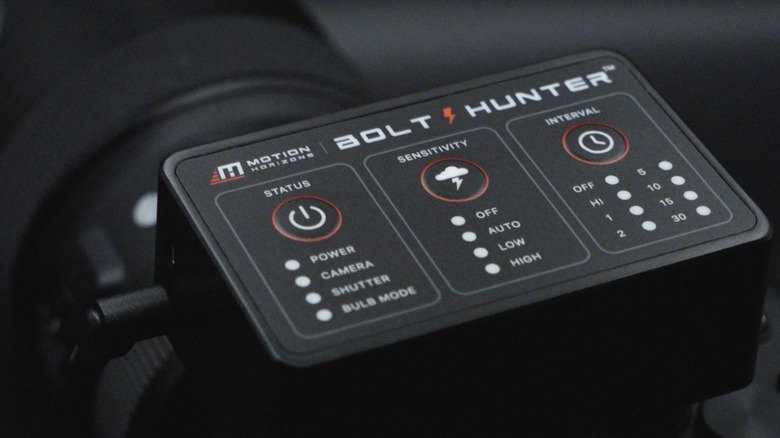
This gadget is specifically designed for capturing photos of lightning strikes, a subject which can be extremely difficult to photograph. The device purports some really impressive capabilities, and is currently available to back on Kickstarter. Devices which aid in the capture of lightning strikes have existed for some time, but the Bolt Hunter is the first to focus entirely on this photographic subject. As a result, it possesses a number of unique features that I find more than a little intriguing.
Rather than rely on rapid changes in brightness as a means of detection, the Bolt Hunter detects intracloud precursor activity, triggering the camera to catch that elusive image more quickly than a typical lightning detector. It's also designed to operate in challenging lighting conditions where other lightning detectors might fail (such as when pointed at the sun), and it's capable of automatically adjusting settings to compensate for changing conditions.
5. Lens mount adapter
An adapter that allows you to use lenses with a mount they're not normally compatible grants you access to more numerous, and potentially more affordable, lens options. Some are very cheap and only mechanically connect the lens to the camera, while others can cost hundreds of dollars and offer electronic connections between both.
With simple mechanical adapters, it's usually fine to simply go with the cheapest option you can find. For example, this Fotga FD to Nikon Z adapter is just $18 on Amazon and allows you to mount vintage Canon lenses onto modern Nikon cameras. There are a vast number of amazing used vintage lenses from numerous different manufacturers to be found for cheap (there might even be some stored away in your own closet), and while they don't typically rival the quality of modern lenses, they all offer a unique look and feel that can deliver some truly stunning images.
Depending on which system you have and which lens you want to adapt, it's also possible to use modern lenses from one brand on the camera body of another. Adapting Sony E-mount lenses onto Nikon Z-mount cameras is a particularly popular route many photographers take, and autofocus capable adapters have come way down in price. The Viltrox E-Z AF Lens Mount Adapter is just $85 at B&H with a coupon at this time of writing. There's a lot more great E-mount lenses available from third parties at relatively affordable prices compared to native Z-mount lenses, so this really opens up your options if you have a Nikon camera.
6. Move Shoot Move Nomad Star Tracker
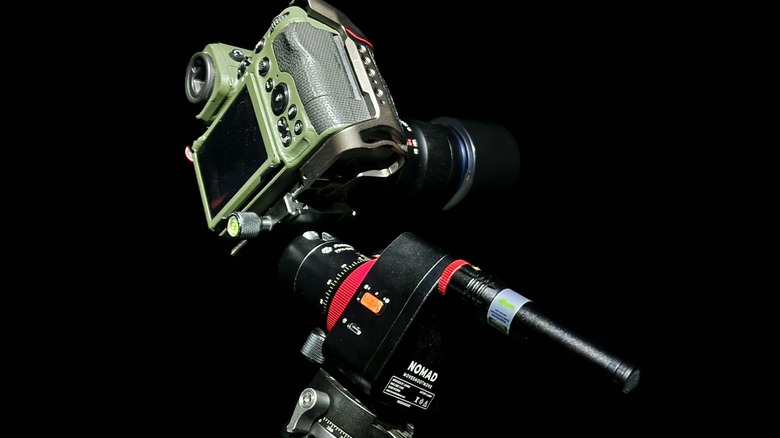
A common limiting factor for amateur astrophotographers is the physical limitations of being able to capture enough light to record photos of the dark night sky without the stars blurring due to the motion of the Earth. That's where a star tracker comes in, allowing you to shoot however long an exposure you might need without the stars turning into streaks. The results, well, speak for themselves:
 Andy Zahn/SlashGear
The Move Shoot Move Nomad Star Tracker is less than $300 in a kit with a couple of essential accessories, and it's actually a potential alternative to investing in an expensive wide angle lens with a bright aperture. In fact, a star tracker can record detail in the night sky that is currently impossible with a single shot from a static camera. By stacking images and combining them with a static exposure of the foreground, you can create images that are truly otherworldly. The Nomad Star Tracker is an easy, compact, and relatively affordable way to get into more serious astrophotography.
7. Xplorer Grip Pro Kit for Insta360 Ace Pro 2
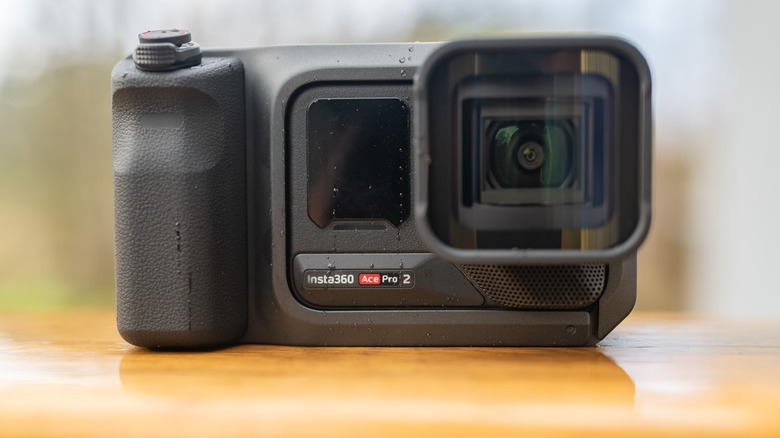
Action cameras aren't typically thought of as a tool for still photography, or indeed for handheld use. They are typically mounted to something like a helmet or an extension pole and then set to record for the duration of an activity. The Xplorer Grip Pro Kit turns the Insta360 Ace Pro 2 into what is essentially a more traditional compact camera, allowing much easier handheld use and enabling the Ace Pro 2 to be more functional for still photography. Paired with Insta360's recently launched lenses and instant printer, the Xplorer Grip Pro turns the Ace Pro 2 into something that's much more than a simple action camera.
At $99 on Insta360's website, the Xplorer Grip Kit is pretty reasonable given all the functions built into it. Not only does it provide a protective cage with a large comfortable grip, but it also has a shutter/record button, zoom rocker, and control dial, as well as a built-in battery with several hours of additional power for the camera (depending on how you use it, of course).
This all serves to make the Ace Pro 2 a much more capable general-purpose camera for still and video capture. An instant printer is also available as an optional add-on, which is a fun idea that I wouldn't have thought to implement on an action camera. Combined with the optional lenses and other accessories, Insta360 has created a really interesting ecosystem of gadgets for their flagship action camera.
8. Smartflex camera
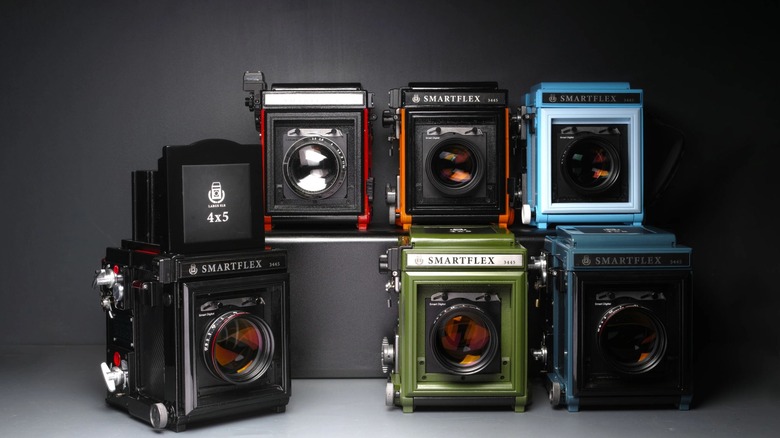
While this may be a 4x5 SLR camera in its own right, the Smartflex Camera can also be paired with a phone as a camera accessory, enabling you to capture digital large format images and video on any smartphone. Yes, at around $3500 on Smartflex's online store, this device costs more than a new full frame digital camera, but that full frame camera isn't capable of producing the kind of images you'll capture with the Smartflex and your smartphone.
How this works is through a smartphone adapter that allows you to slot your phone over the viewfinder hood of the Smartflex before snapping a photo or recording a video. The cool thing about this system is that it's a remarkably easy way to capture large format video, something which otherwise doesn't really exist. Keep in mind, the Smartflex is kind of enormous, though that is as expected given the size of the image it is projecting. Alternatively, it also works with Fuji Instax Wide instant film.
9. Lit Duo 1 Light meter
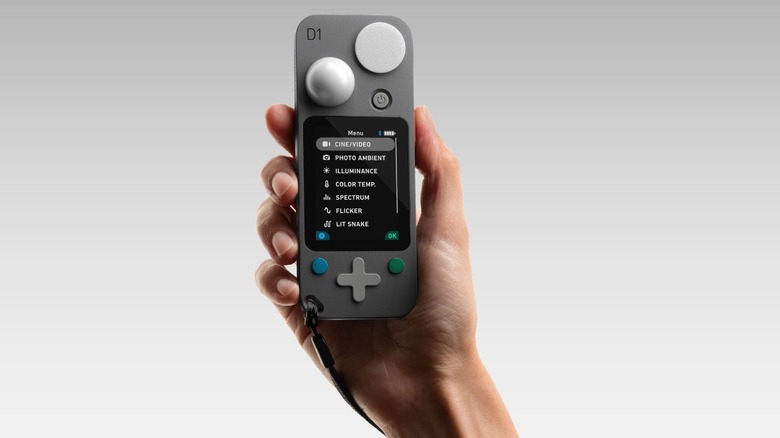
A light meter is an important tool for advanced photographers. Cameras have, of course, been equipped with light meters since the days of mainstream film photography and continue to have advanced light meter functionality to this day. However, there is still value in utilizing a special tool for the task, particularly one with so many different functions as the Lit Duo 1. This light meter offers a wide range of features to aid you in various scenarios; with it, you can monitor color, exposure, illuminance, and spectrum. It also includes a flicker meter.
Getting the correct color for a scene can actually be quite tricky if you're just trusting your eyeballs or the software of your camera. Meanwhile, the Lit Duo 1 can give you a precise Kelvin color temperature rating and green shift, so your image will look true to life every time. If you're shooting with multiple lights, you can use the Lit Duo 1 to measure their output and then correct the color temp of those lights using filters so that they match perfectly. The exposure meter can help you get settings right in-camera, which will save you time in post-processing; meanwhile, you can solve issues when shooting artificial light sources by measuring flickering.
The downside, as with many types of camera equipment, is price. The Lit Duo 1 costs a whopping $701 from Lit System's online store, which is pretty steep for most hobbyist photographers.
10. PolarPro Helix Maglock camera filters
Filters are an essential part of upgrading your photographic capabilities, and there's quite a range to choose from. I particularly enjoy using extremely heavy neutral density filters in order to capture long exposure images, even in bright daylit conditions. If you ever wondered how people capture amazing photos of waterfalls or blurry coastal waves, this is the key. Alternatively, a polarizing filter can help you fight back against glare from reflective surfaces.
I particularly recommend considering the Helix Maglock camera filter system from PolarPro. In the first place, the filters themselves are of top-notch quality, but I particularly like the company's Helix Maglock variants because they are so quick and easy to swap out. Each uses a magnetic/mechanical lock that's so much better than a typical screw mount. They're also one-size-fits all, meaning that you don't need multiple duplicate filters for different lenses. The only downside is that they're significantly more expensive than their screw-mount counterparts, generally running from $150 to $300 on PolarPro's online store.
This company also makes some very unusual filters. Some emulate particular film looks, while others offer effects which can only be described as "trippy". I personally love the results I get from their Warp filter as shown above.
11. An underwater housing
Some cameras can be used underwater straight out of the box, but most need a housing to be submerged below the surface. While an expensive high-end underwater housing may be necessary for scuba diving, more affordable options exist if you're just snorkeling in shallow water.
I can definitely recommend Insta360's $99 housing for their latest X5 360 camera. You typically want a wide angle lens when filming underwater, and it doesn't get any wider than a full 360 degrees. I also regularly use Pelican's Marine Waterproof phone case, which both enables me to do some casual underwater photography with a smartphone and also allows me to take it out in hazardous scenarios such as kayaking. It's just $25 from Pelican's online store.
If you're looking to take a mirrorless camera or DSLR underwater, prices go up fast. If you're actually diving with a camera, expect to spend multiple thousands of dollars; it's not a good idea to try and save money here because cheaping out could easily result in the destruction of your camera if the housing fails deep underwater. However, at shallow depths, you can get away with less expensive kits. The OM-System OM-1 Mk ii is a good candidate camera to use in an underwater housing, given that it's already highly resistant to water, and it's smaller than full frame cameras. That means housings are less expensive — though in this case "less expensive" means $648 for the most affordable housing from Seafrogs.
12. Smallrig camera cage
A cage adds a ton of utility to your camera. Most importantly, it gives you a quick release tripod mount that is more secure and which you never need to remove from your camera. A cage also protects the camera from damage, and that's something I consider an essential tool in my kit.
You can find cages for most modern cameras, and there are a number of respectable manufacturers to choose from. However, I personally have had a great experience with Smallrig's cages on my Nikon cameras. The Smallrig Nighteagle cage has been attached to my Nikon Z8 since shortly after I purchased it, and the same goes for Smallrig's cage designed for the Nikon Zr.
Aside from the greater convenience and security of integrated quick release plates, I love having numerous mounting points, detachable handles, and strap mounts that don't require me to deal with stock ones. These cages have also saved my cameras from hard knocks on numerous occasions.