

5 Downsides Of Boxer Engines
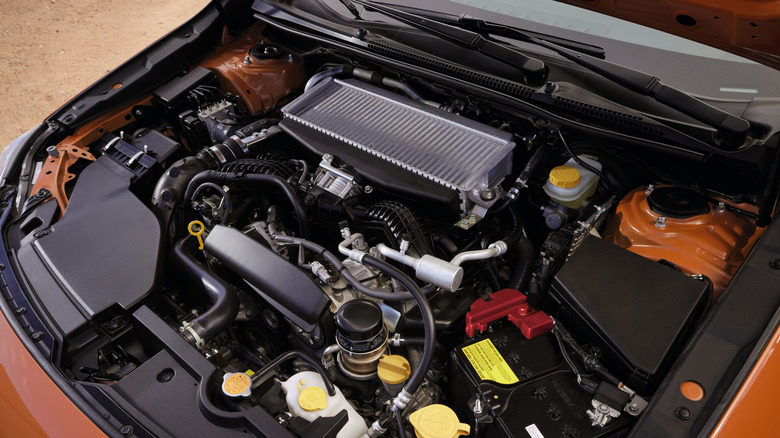
Famously used almost exclusively in Subarus, boxer engines are among the quirkier engine configurations still in common usage today. We all know them by their signature flat layout — a boxer is a type of flat-plane engine, meaning the cylinder banks are directly opposite one another. Unlike a V8, for instance, which has bank angles like 60 or 90 degrees, a flat engine's bank angle is 180 degrees.
That said, boxer engines are technically their own thing. It's a bit difficult to describe, but it's actually rather trivial to visualize. Lay your arms flat and make a pair of fists. Now smack your fists together, basically fist-bumping yourself, and do that over and over again. That's how a boxer engine works — when one piston moves in, the piston on the other side also moves in. When one moves out, so too does the other. This means that each piston connects to the crankshaft independently, using its own journal. The point of all this is to cancel out the vibrations that would otherwise present themselves in an engine where you're throwing all that mass from side to side.
Most flat engines in production cars are boxers. Subarus, Volkswagen H4s, Porsche flat sixes, and many others use boxers. And they have quite a few advantages — for example, Subaru uses boxers rather than V6s because boxer engines have a lower center of gravity and give plenty of room for the AWD system, plus you have a lower hood line. But there are also several reasons why boxers, not to mention flat engines in general, aren't particularly widespread. From packaging issues to engineering challenges, it's a complicated discussion, so let's break it down.
They take up a lot of space
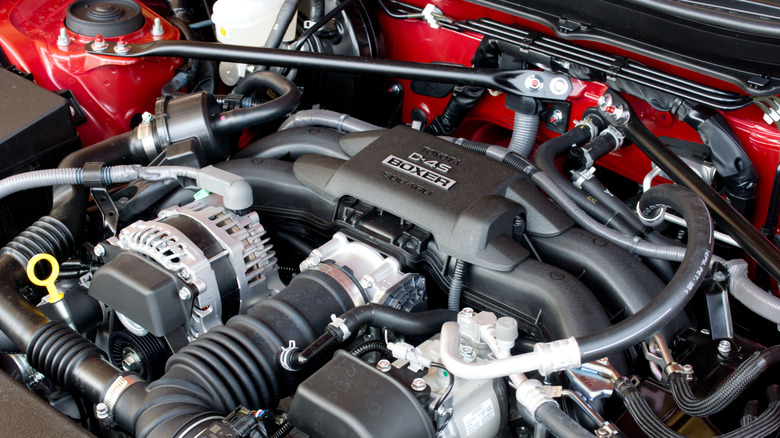
The most obvious issue with boxer engines can be observed by simply looking at the thing. If you want a nice, compact design, it's probably not a good idea to put everything all in a straight line. Forget the mechanical aspect of it for now, let's just focus on actually building the car around an engine of this type. What needs to get done for that to happen?
In a typical car, you have what essentially amounts to a cube of space that you fit the engine into. It's not just the block itself, of course — you have the exhaust headers, intake, cooling system, fuel delivery, accessories, and so on. All of that goes under the hood, using precious real estate that must also accommodate the car's front drivetrain and axles, suspension and running gear, and more. By making the engine wider, you're effectively widening the whole front of the car unless you compromise on the engine's size.
In any case, this presents a challenge for car designers because you have to build the front wheel geometry around the cramped engine bay. It also leads to creative engineering solutions, which is likely the main reason why some Subarus famously use unequal length exhaust headers, creating that characteristic rumbling sound. When your product line relies upon boxers, that's much less of an issue than if you have only one or two boxer-equipped models. From a designer's perspective, what would be the point of creating two completely different front-end configurations for a single manufacturer? It's extra expense for what would ultimately be a novelty model to most automakers.
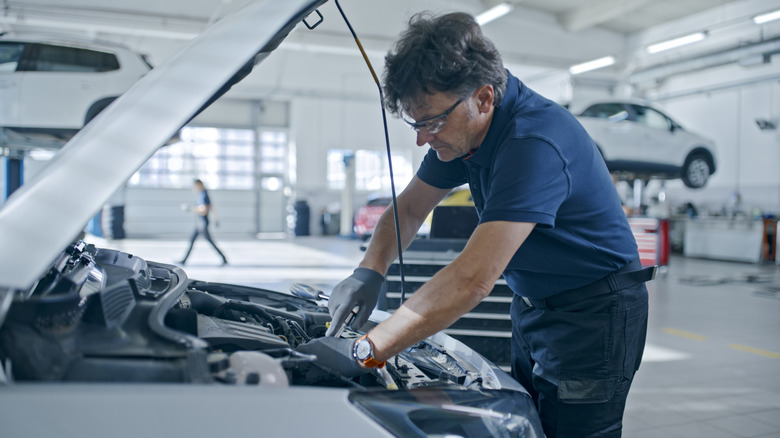
Working on these engines can be a pain
Again, this problem comes down to simple intuition. Your pistons are all the way at the bottom of the engine, basically making a big flat floor. Imagine taking everything else — alternator, cooling, forced induction, and so on, sometimes even the spare tire, and just sorta chucking it on top of the engine in a big pile. That's genuinely what a boxer looks like to the uninitiated; of course, everything is placed in a specific way and has its function. But it does mean that some parts are absolute nightmares to access.
Changing a spark plug, for example, is a pretty straightforward job on a normal engine. Sure, you may have an intake manifold in the way if you're particularly unlucky. But you generally have enough clearance to get at the spark plugs themselves without much issue — not so on a boxer engine. Because of the way the engine is laid out, the spark plugs are basically right up against the frame rails, meaning you need special tools with extensions and often have to remove other components to get at them.
This is a somewhat common thread with certain components that are buried in the depths of the block, but even the block itself can be complicated. Take a Porsche flat six, it's an extremely expensive engine to service because of its complicated internal layout. Even classic air-cooled Porsche M64 engines are bizarre, with a two-piece engine block and cylinder sleeves lined with cooling fins to give you all sorts of fun if yours needs a timing chain or piston rings.
Boxer engines are inherently complicated designs
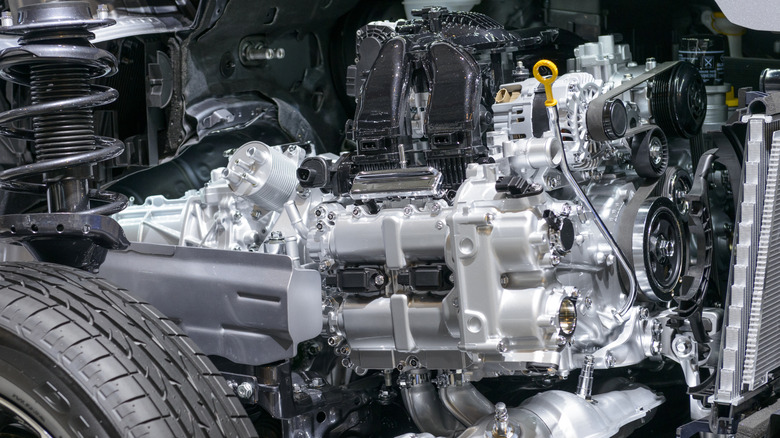
Most boxer engines feature four cylinders, with the exception of Porsche's boxer designs; we already discussed why those are ridiculously complicated. But even the more "standard" Subaru design has its quirks, all owing to that unique layout. Let's focus on the bread-and-butter H4, produced in the millions for both Subarus and classic Volkswagens alike — these engines are, of course, four-cylinders, the same number as an inline four. However, unlike an inline four, a boxer has two sets of cylinder heads, two sets of camshafts and valve bodies for an overhead-cam design, two exhaust headers, a more complicated intake — the list goes on.
In other words, this is an engine that combines the cylinder count of an inline with the complexity of a V-pattern, then shoves all that in the bowels of the engine bay below all the accessories. That isn't to say that they're bad engines, though. In fact, a lot of Subaru boxer engines are actually quite reliable while still producing good power; these things were producing 275 hp as early as 1995. But doing that required turbocharging and intercooling, plus other specialized parts to squeeze that figure from a 2.0L engine.
This ties in with the complicated maintenance procedures as well, acting as a bonus compounding issue because of how these engines are laid out. Heaven forbid you need to do more invasive procedures like a timing belt replacement, because unlike many inline engines, belt routing is hideously complex. It's not impossible, of course, just more time-consuming and specialized than an inline design.
Some engines can be oil burners
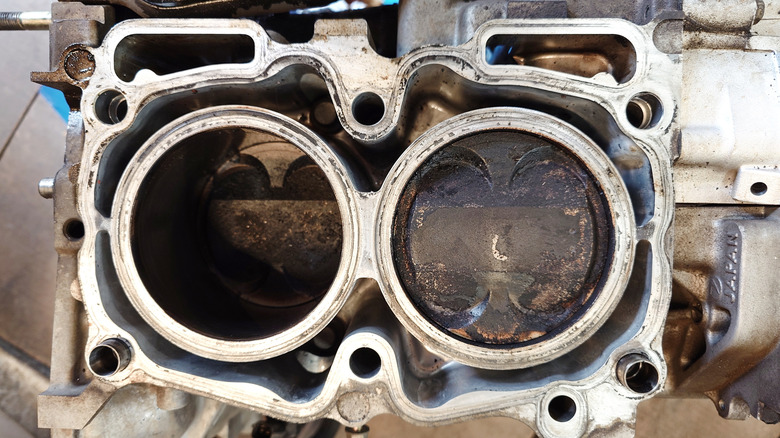
First and foremost, it's important to learn how oil circulates and why. The goal here is to use the oil pump to feed oil through the galleries up into the cylinder walls, the main bearings, and anywhere else that needs lubrication. Okay, it's more complicated, with filters, oil cooling, and so on. But let's keep it straightforward; you need to line the cylinder walls with a thin film of oil, is the point. Now we see two problems present themselves.
The first problem relates to gravity, and it means that certain boxer engine families tend to burn oil after resting or idling for extended periods. In a normal engine, gravity naturally pulls the oil back down into the pan, but boxer engines don't have that luxury. Oil can pool up on one side of the cylinder, potentially leading to catastrophic piston ring failure under heavy loads with high-mileage engines.
The second problem comes as a result of the first, and stems from the piston ring's design. A piston has a set of three piston rings, the bottom ring being the one designed to wipe away excess oil as the piston performs its down stroke (or going-in stroke on boxers, if you like). The problem comes from the ring rotating ever so slightly, and sometimes that ring rotates so that it presents a gap at the bottom of the engine. That gap will let oil that pools there by gravity slip through into the combustion chamber, meaning you're burning oil on startup; you need an anti-rotating piston ring to fix it. It apparently got so bad that there was even a lawsuit filed against Subaru surrounding this particular issue.
Some older Subaru engines have head gasket problems

Obviously, we couldn't leave without addressing the elephant in the room. It's become something of an inside joke at car meets and automotive forums that Subarus literally hate head gaskets. It actually started back in the 1990s (or earlier, in some rarer cases), thanks to certain particularly unreliable engines like the EJ25. The early Phase I EJ25? Head gasket likes to blow. Phase II EJ25? Goes through head gaskets like they're on sale. EJ253s? Imagine our surprise when they have head gasket problems.
So what exactly caused all these engines to pop head gaskets all the time? It depends on the model year; early engines had internal leaks causing the aluminum to overheat, which warped the metal over constant repeating heat cycles. This wound up contaminating the coolant and eventually fouling the head gasket, ultimately resulting in overheating.
In later engines, the leaks often happened externally, propagating in between the cylinder heads and engine block — right where the head gasket is. Both instances degrade the head gasket due to the mixing of oil and coolant, which is why you get that distinctive discoloration in the coolant. All that acid buildup, compounded by gravity not pulling it away from the seals like a regular engine, means the gasket basically melts away after a while.
The head gasket failure is a known issue for around two decades, so it's well understood by now, and most new Subaru models will never have any of these issues. The earlier rigid steel gasket design was prone to these types of vulnerabilities, which have since been corrected. But it's buyer beware for early EJ25 designs.