

9 Honda Models That Still Come With Naturally Aspirated Engines In 2026
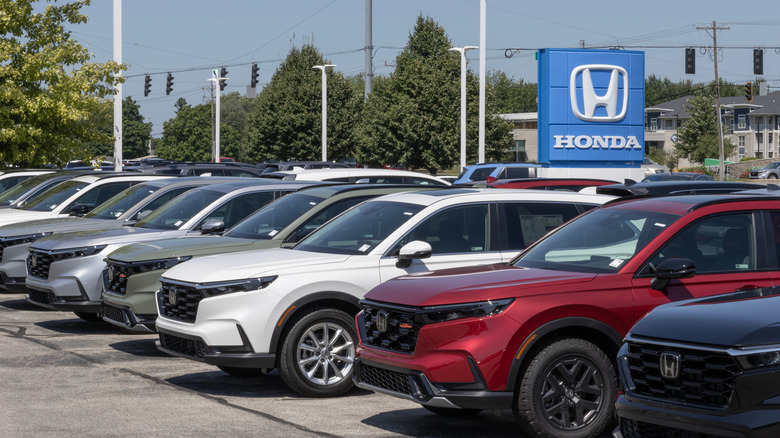
With more than 1.4 million cars sold in the U.S., Honda is one of the most popular car brands in the country. The Japanese automaker's car lineup is expansive, spans various categories, and comes with multiple engine options. While looking at the engine options offered across the brand's lineup, it becomes immediately apparent that several Honda vehicles still feature naturally aspirated engines. This is interesting when one realizes that there has been a significant rise in popularity of turbocharged engines in the U.S. market in recent years.
Among the Honda vehicles that continue to use naturally aspirated engines are several trims of the Honda Civic (both sedan and hatchback), as well as all trims of the HR-V, all of which feature a 2-liter four-cylinder engine. Honda also offers a larger 3.5-liter naturally aspirated V6 engine on several models, including the Passport and Pilot mid-size crossover SUVs, the Honda Odyssey minivan, and the Honda Ridgeline mid-size pickup truck.
In addition to these vehicles, several of Honda's hybrid offerings come with a standard naturally aspirated engine. These hybrid cars feature Honda's 2.0-liter naturally aspirated hybrid engine, which we shall discuss in detail later. For now, though, here is a closer look at five 2026 Honda models that remain available with naturally aspirated engines.
Honda Civic (Sedan and Hatchback)
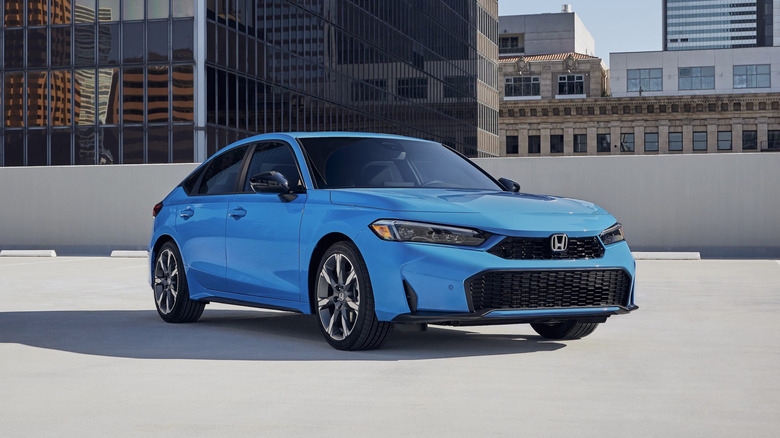
The Honda Civic is among the most popular offerings from Honda in the U.S. market and sells in pretty good numbers. It comes in two body styles (sedan and hatchback), with each option spread across multiple trim levels. The current US lineup of the Honda Civic features four distinct powertrain options: a 2.0L naturally aspirated 4-cylinder (150 hp), a Hybrid variant featuring a two-motor Hybrid system pairing a 2.0L engine (also naturally aspirated) with an electric motor (200 total hp), a 1.5L turbocharged 4-cylinder engine for the "Si" variant (200 hp), and a high-output 2.0L turbo for the "Type R" (315 hp) variant.
The naturally aspirated 2.0L engine is only offered on the "LX" and "Sport" trims on the Civic Sedan, while on the Civic Hatchback, it is an option only on the "Sport" trim. On all these variants, the engine is mated to a continuously variable transmission. This engine produces 150 horsepower at 6,500 rpm and 133 pound-feet of torque between 4,000 and 5,000 rpm. As evident, these are modest figures compared to what the Hybrid and turbocharged variants of the Civic have to offer.
With pricing for the Honda Civic (sedan) starting at $24,695, it is one of the most affordable offerings from Honda. Despite having relatively lower power figures compared to the Hybrid and turbocharged versions, the naturally aspirated versions share the fundamental strengths of the Civic platform. The vehicle is spacious, handles well, and is well equipped on the safety front. The naturally aspirated engine is therefore best suited to buyers who prioritize affordability and simplicity over outright performance. The entry-level Civic Hatchback version is slightly more expensive at $27,895.
Honda HR-V
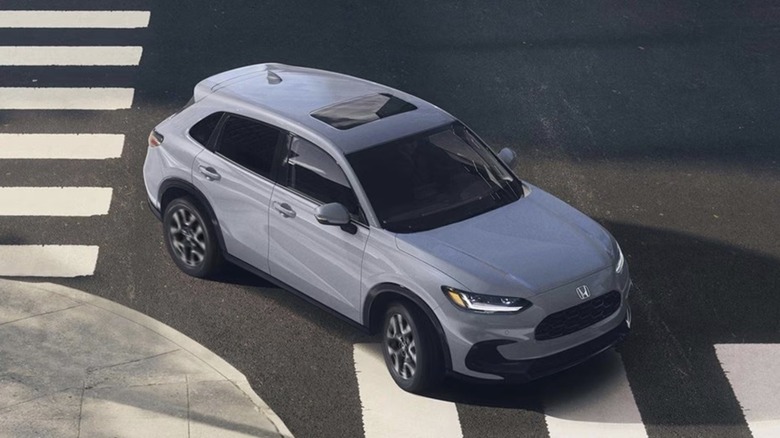
Next up, we have the Honda HR-V, which is classified as a compact crossover SUV. This vehicle is offered with a single engine option on all variants: the same 2.0-liter unit found on the entry-level variants of the Civic. The only difference here is that it is in a slightly higher state of tune. The HR-V makes 158 hp (8 hp more than the Civic) and 138 lb-ft of torque (5 lb-ft more than the Civic). Once again, looking at the numbers put out by the HR-V's engine, it is evident that this vehicle is not intended for someone with outright performance in mind.
Similar to the Civic, the HR-V's engine is mated to a CVT. Not much has changed with the HR-V since we last tested it back in 2023. The 2026 model year HR-V comes in three trim levels: a base LX variant that starts at $26,600, followed by a mid-tier 'Sport' option that has an MSRP of $28,400, followed by the top-end "EX-L" variant that will set you back by $30,450. As noted in our review, the HR-V — even in 2026 — remains a very good option for folks seeking a no-nonsense first car, and given that there are no confusing alternate engine options, choosing an HR-V becomes a comparatively simple exercise.
Adding to the HR-V's appeal is that it recently bagged the IIHS Top Safety Pick+ award for being one of the safest compact SUVs in the U.S. That being said, HR-V owners have reported several issues with the vehicle that buyers should worry about before committing to a purchase.
Honda Pilot
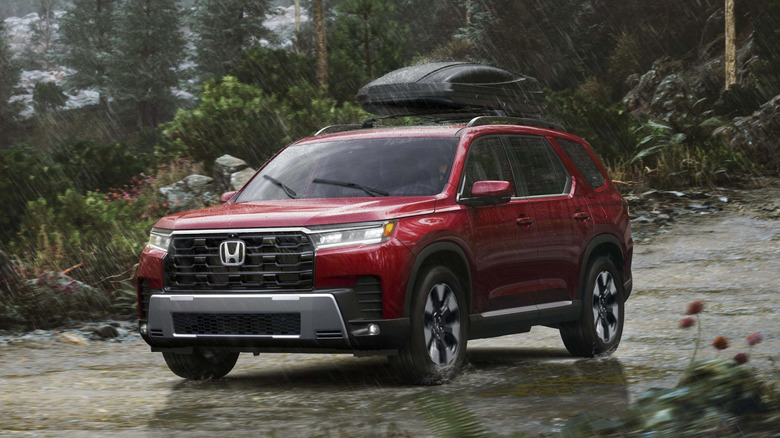
The Honda Pilot is Honda's largest mid-size three-row family SUV and has been on the market since its introduction back in 2002. Currently in its fourth generation, the Pilot received a major mid-cycle update for the 2026 model year, complete with several styling upgrades, a much larger center touchscreen, and wireless smartphone connectivity being offered as standard across trims.
What has remained unchanged, though, is the 3.5-liter naturally aspirated V6 engine that makes 285 hp and generates peak torque figures of 262 lb-ft at 5,000 rpm. The Pilot gets a 10-speed automatic transmission across all variants, although all-wheel drive is offered only on the higher trims. In our tests, the Pilot offers excellent acceleration, and the vehicle feels unstrained even while climbing steep inclines. It has a towing capacity of 5000 pounds, which makes it more than capable of hauling small utility trailers.
For the 2026 model year, Honda offers 7 trim levels of the Pilot, starting with the Sport variant, which is priced at $42,395. The EX-L trim — starting at $44,695 — comes next, followed by the Trailsport ($50,595), Touring ($51,295), Touring Blackout (52,495), Elite ($53,695), and Black Edition ($55,195). While there is no denying that the Honda Pilot is an established offering, it is always a good idea to know some of the most important things about this car before you commit to a purchase.
Honda Odyssey, Honda Passport, and Honda Ridgeline
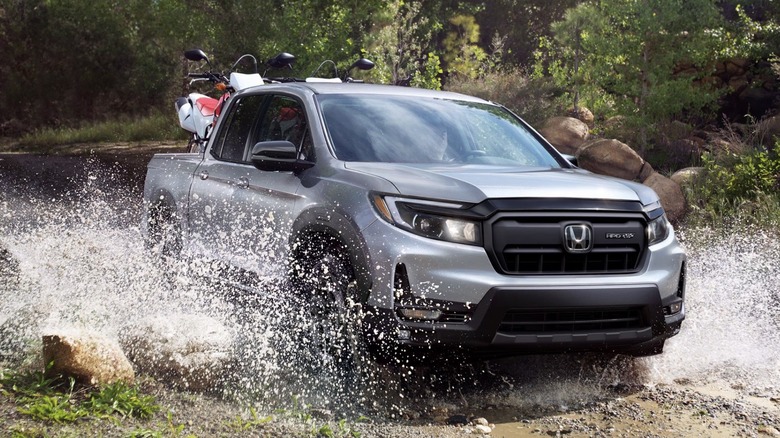
As discussed at the start of the article, Honda's 3.5-liter naturally aspirated V6 engine isn't restricted to just the Pilot SUV. The same engine is also found on three other vehicles sold in the U.S. market, including the Honda Odyssey Minivan, the Honda Passport mid-size two-row crossover SUV, and the Honda Ridgeline pickup truck.
On the 2026 Honda Odyssey, the engine makes slightly less power (280 hp instead of 285) at 6,000 rpm, while the torque figures remain unchanged at 262 lb-ft, although this is now made at 4,700 rpm. Honda offers the Odyssey in four trim levels, with the base EX-L trim starting at $42,795, going up to the top-end "Elite" variant that is listed at $51,695.
Then we have the Honda Passport, on which the engine makes the same power and torque as the Pilot (285 hp and 262 lb-ft ). What has slightly changed is the rpm at which this peak power is made (6,100 rpm). Honda sells the Passport in four trim levels, starting with the RTL trim, which is listed at $44,950. The other options include the RTL Towing ($45,650), RTL Blackout ($46,150), and the Trailsport trim, which we reviewed ($48,650).
On the Honda Ridgeline, Honda's mid-size pickup truck, the 3.5L naturally aspirated V6 engine makes 280 hp at 6,000 rpm and 262 lb-ft of torque at 4,700 rpm, which makes its state of tune identical to that of the Honda Odyssey. Honda offers the Honda Ridgeline in six variants, with pricing starting at $40,795 for the base "Sport" variant and going up to the top-end Black Edition models, which can start at $47,895.
Honda's Hybrid cars also use naturally aspirated engines
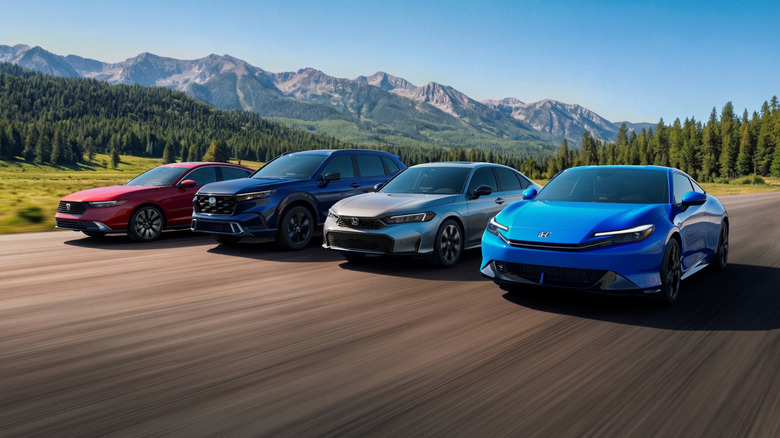
So far, we have discussed Honda cars that have nothing but naturally aspirated engines. If we expand our scope, it becomes immediately noticeable that several vehicles with hybrid technology use naturally aspirated gasoline engines that handle the ICE component. Because these vehicles also get a separate electric motor, they are classified and marketed as hybrids and would normally never make it into the list that discusses vehicles that exclusively use naturally aspirated engines.
Honda's hybrid cars for the U.S market all feature naturally aspirated engines, and include some variants of the 2026 Civic Hybrid, Accord Hybrid, CR-V Hybrid, and the Prelude. All these cars get a 2.0-liter naturally aspirated four-cylinder engine which is paired with electric motors. As with other Honda vehicles, this naturally aspirated engine is tuned differently across these models.
The Civic Hybrid and Prelude produce a combined 200 horsepower and 232 pound-feet of torque. The Accord Hybrid and CR-V Hybrid are slightly more powerful, producing 204 horsepower and 247 pound-feet of torque. Do note that these figures represent the combined output of the gasoline engine and hybrid system, rather than the engine working alone.
These hybrids also work differently from regular gasoline-powered vehicles. At lower speeds, an electric motor usually drives the wheels while the gasoline engine helps generate electricity. Under certain driving conditions, particularly while cruising at higher speeds, the engine can connect directly to the wheels.