

12 Timeless Motorcycles That Mix Old-School Style With Modern Performance
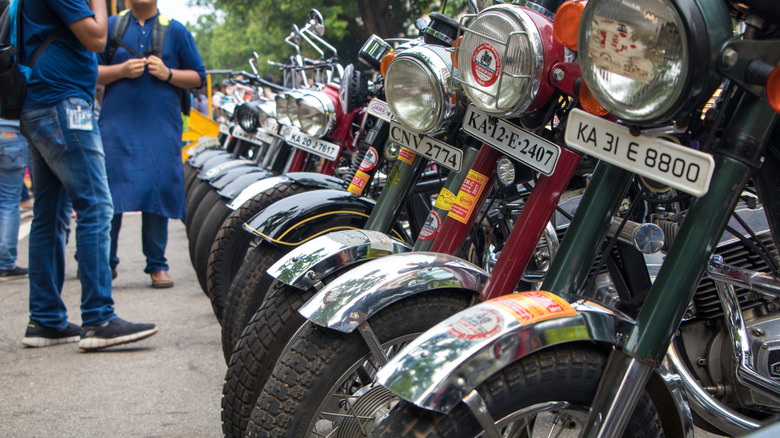
Classic designs become classic for a reason: Timelessness. While some vehicles are hopelessly outdated from the moment they roll off the assembly line, others will look as good in a century as they did the first time they leapt from the drawing board.
The problem with a machine from the bygone days of our youth (or even earlier) is that performance and reliability tend to decline the further back in time you go. The coolest restomods around combine retro looks with modern tech in a mix as iconic as chocolate and peanut butter. And it's not just about speed. Updated safety equipment and amenities make modern rides safer and more comfortable than ever.
Fortunately, motorcycle manufacturers recognize that many riders appreciate classic design. Many cater to this market by incorporating vintage styling into modern bikes. Drawing inspiration from past eras, including the history of their own brands, today's builders evoke nostalgia while remaining cutting-edge in performance and reliability.
Triumph Bonneville
Perhaps the best-known subgenre of motorcycling history is the post-war cafe racer. With World War II behind them, European bike builders (and their customers) engaged in a performance war with a style all its own. Youth of the 1950s and 1960s raced from cafe to cafe on Norton, Triumph, BMW, and Ducati bikes, and the distinct style of these cafe racers struck a chord that still resonates.
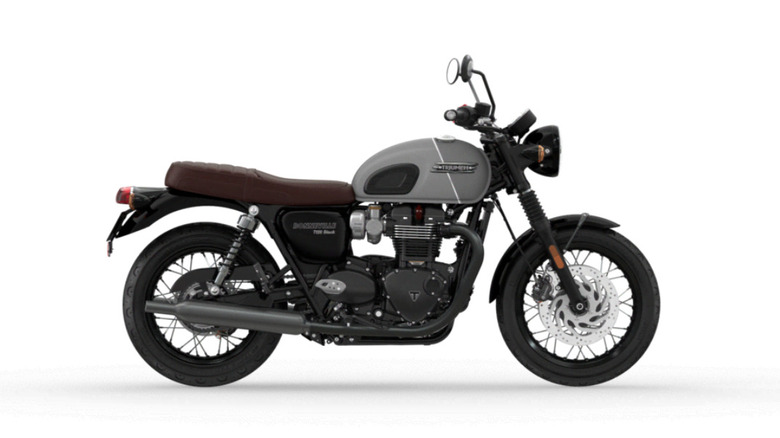
The Triumph Bonneville was one of the OG cafe racers. Introduced as the T120 Bonneville in 1959, it immediately caught the attention of power-hungry youth with its performance. The good news for those who fell in love with it then is that the nameplate is still kicking, and it pays major homage to the original design.
For 2026, Triumph produces five Bonneville models. The unwary observer would be forgiven for thinking the retro T120 Bonneville dates back to the 1950s. Minimalist, simple, and clean, Triumph strove to retain the iconic cafe look without cluttering up the picture. At a glance, you'd have no idea that the bike comes with a six-axis inertial measuring unit (IMU). Not to mention lean-sensitive ABS, cruise control, and a USB-C charging port. Electronic marvels aside, the modern T120 packs a punch with a liquid-cooled, 1,200 cc parallel twin that delivers 79 horsepower and 77 lb-ft of torque.
BMW R 12 S
BMW's legacy is as rich as any manufacturer's. During the '60s and '70s, it produced some of the best cafe racers of all time. The legendary R 90 S essentially invented the sport-touring category when it debuted in 1974. Stylish, comfortable, and performance-oriented, it was a step above the British bikes of the time, and remains beloved by BMW fans.
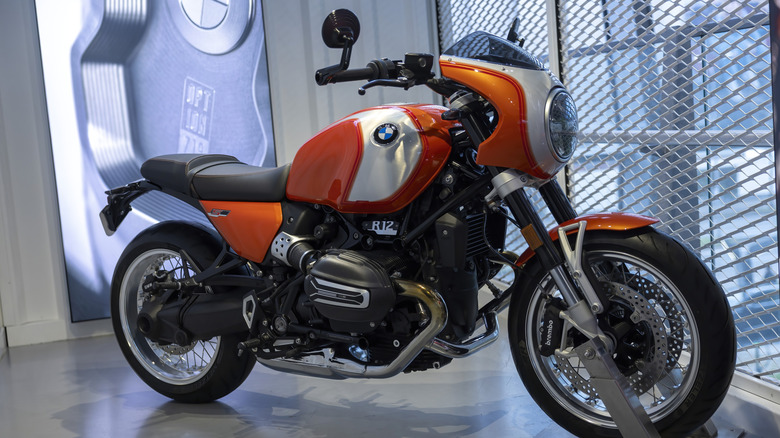
Fast forward a half-century, and BMW's R 12 S carries on that legacy with all the bells and whistles of modernity. Tucked under the 'Heritage' section of Beemer's website, the R 12 S bucks conventional categorization in all the best ways. With a swept mini-cowling, aggressive stance, and Lava Orange Metallic paint job with double-red striping and orange stitching, it's an unmistakable nod to a bike that should have looked dated 40 years ago, but doesn't. Remember what we said about timeless?
BMW complements this striking motorcycle with a bevy of up-to-date performance goodies. A 1,170 cc Boxer (of course) engine juts out of the tubular frame, making 109 horsepower at 7,000 RPM and 85 lb-ft of torque at 6,500 RPM. A six-speed constant-mesh transmission sends that power to the rear wheel via a driveshaft. Buyers also get BMW Motorrad's DTC traction control and twin 310 mm front disc brakes equipped with ABS.
It isn't just about going and stopping with the R 12 S, either. Features like hill start control, heated grips, cruise control, optional digital displays, and a trio of riding modes make it clear that BMW left the retro charm on the outside while packing the best of its modern tech where it counts.
Indian Scout
Cafe racers aren't the only classic motorcycles that riders remember fondly. Once caught in a neck-and-neck race for American hegemony with Harley-Davidson, Indian folded in 1953 only to reemerge in 2013 under the banner of the same company that brought us the Polaris Slingshot. Since then, the brand has been making headway with a series of motorcycles that draw on Indian's heritage and bring it into the 21st century.
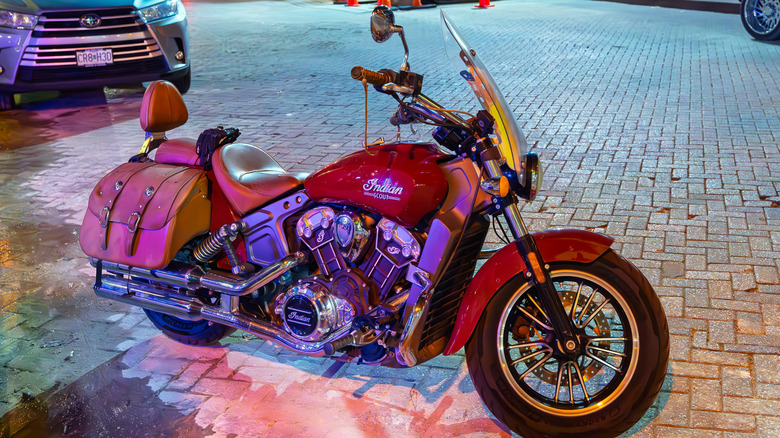
Borrowing the nameplate from one of its most fondly remembered bikes, Indian resurrected the Scout with old-school V-twin charm. The liquid-cooled 60-degree V-twin Speedplus engine delivers 105-111 horsepower, depending on the model. The Scout comes in three models, each with ABS and LED lighting. Those who reach for the Limited trim get traction control and USB-C charging, while the top Limited + Tech trim combo adds GPS, ride statistics, and a push-button start.
The design language is undoubtedly American. Aside from the V-Twin powerplant, it emulates the iconic design of the original Scout, which first entered the market in 1920. Low, lean, and handsome, the new Indian eschews the chrome popular in many cruiser engine designs for a matte black paint job that gives the bike a certain devil-may-care appearance. Combined with some truly exciting paint schemes, the modern Scout is a divine mix of old-school style and modern performance.
Kawasaki Z900RS Cafe ABS
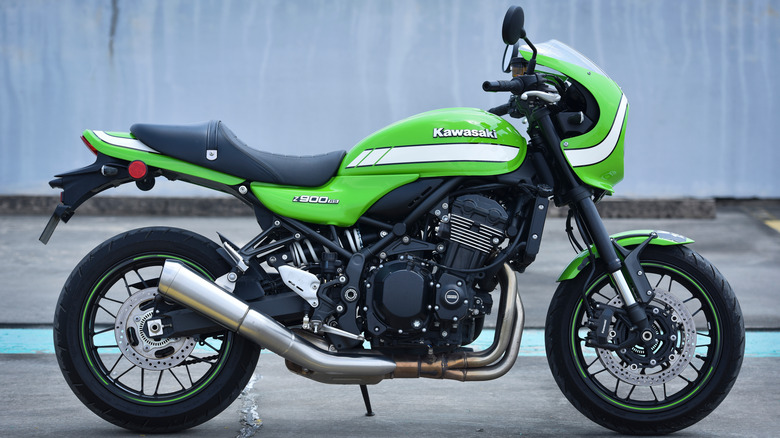
Kawasaki might be best known for its line of Ninja sportbikes or for the current production bike speed record holder, the Kawasaki Ninja H2R, but it has a long history of motorcycles from which to draw inspiration. One of those legendary bikes is the Z1, which first hit the market in 1972.
The Z1 made a big splash in the performance world and still enjoys considerable cachet 50 years later. So when Kawasaki announced it would resurrect the Z1 (which was 903 cc) with the Z900 for the 2017 model year, enthusiasts waited with bated breath to see how it would turn out.
Kawasaki clearly looked to the Z1 to inform the Z900RS's styling. Incorporating cafe-racer flourishes in the front bowl, handlebars, and stepped seat, it blended the classic look of the Z1 with modern tech. For 2026, the Z900RS Cafe ABS comes with a retro ebony paint job with pinstriping and a 948 cc, 16-valve, inline-four-cylinder engine. Weighing in at 481 pounds, it gets up and goes thanks to 115 horsepower and 73 lb-ft of torque. Riders enjoy modern touches such as Kawasaki's traction control system, anti-lock brakes, an inertial measuring unit, and cornering and ride mode settings.
Moto Guzzi V7
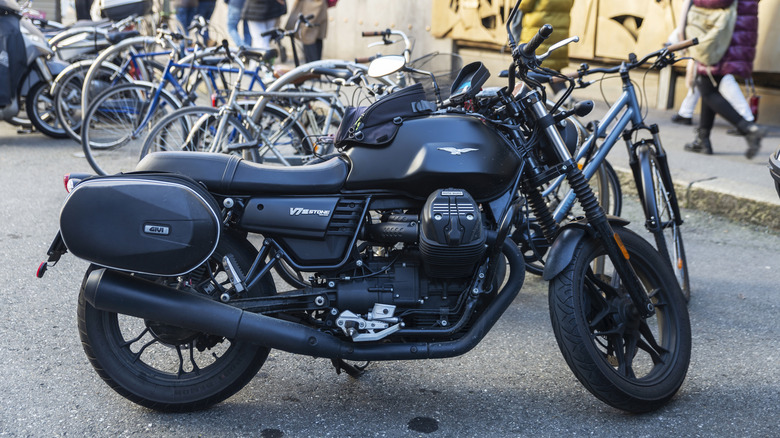
We travel to the sunny shores of Italy for our next entry, one of the best motorcycles Moto Guzzi ever made, the V7. The V7's roots date to 1964, when Moto Guzzi commissioned a new design in hopes of recapturing some of the racetrack triumphs of the 1950s. The resulting product featured a 90-degree V-twin with distinctly Italian styling. The original V7 was produced in some form between 1967 and 1974, when it went on hiatus.
With a growing interest in vintage vibes pervading the market, Moto Guzzi jumped on the retro bandwagon by unveiling an all-new V7 at the 2007 Milan Motorcycle Show. The nameplate has been in production ever since, with Moto Guzzi introducing a dazzling array of V7s with modern technology without straying far from designer Lino Tonti's original vision.
Moto Guzzi carries the V7 into 2026 with four editions: the Special, Stone, Corsa, and Sport. It retains the original 90-degree twin configuration, but this version is far more efficient than the original mill. Euro 5+ compliant, the 853 cc engine makes 67.3 horsepower and 58 lb-ft of torque. Not as much power as some entries on this list, but a leap over the original 703 cc's 40 horsepower rating.
Ducati Scrambler
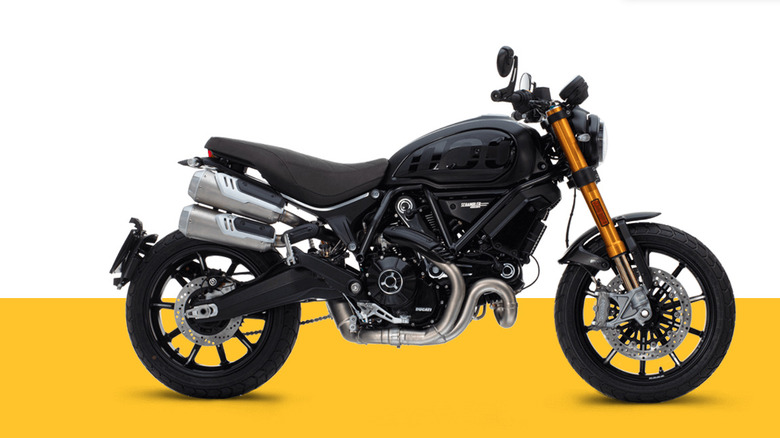
Ducati is held in high regard for its ultra-fast sport bikes, but the Italian marque also has a history with scrambles in the unimaginatively monikered Ducati Scrambler. In a bid to break into the American market in the early 1960s, Ducati built what it described as a "nonconformist" motorcycle. Road-oriented with a sprinkling of trail chops, the original Scramblers combined American and European motorcycling cultures and performance. With an initial production run between 1962 and 1974, it made enough of a splash for Ducati to reintroduce the nameplate at World Ducati Week in 2014.
For its rebirth, Ducati kept several styling cues from the original Scrambler while updating its tech and powerplant. The experiment appears to have been successful, as the Scrambler is still performing well in 2026, on the verge of surpassing its original lifespan. It currently comes in six models: the Icon Dark, Icon, Full Throttle, Nightshift, 1100 Sport Pro, and a 10th Anniversary Rizoma Edition.
Harley-Davidson Heritage Classic
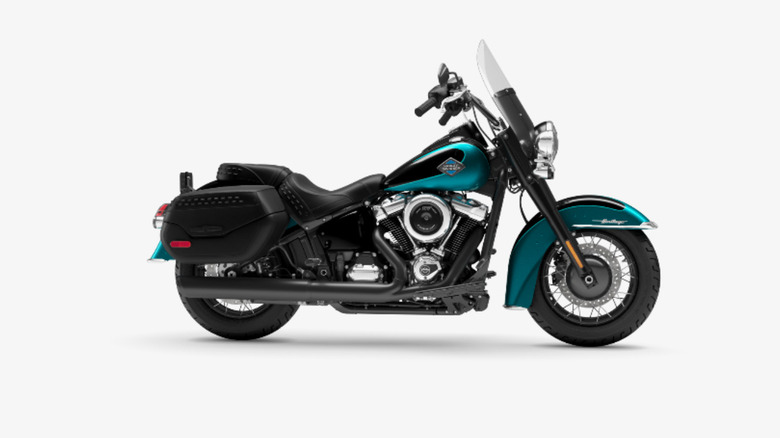
It's all in the name. The Heritage Classic is a long-running Harley-Davidson model. The Wisconsin-based manufacturer is sometimes maligned for clinging to tradition, but its designs are unmistakable American classics.
The Heritage has been part of Harley's family since hitting the scene in the 1980s. Part of Harley's bid to rehabilitate its image in the post-AMF years, it marked an important moment in Harley history. The original Heritage employed an ingenious suspension that mimicked the look of rigid-framed motorcycles while providing modern cruising comfort, launching Harley's popular Softail line.
The most recent incarnation of the model is the 2026 Heritage Classic, and it will appeal to riders who enjoy Harley's historic aesthetic. Equipped with a Milwaukee Eight 117 engine that makes 98 horsepower and 120 lb-ft of torque. Roadworthy goodies include a detachable windshield, lockable saddlebags, modern traction control systems, and, of course, that vintage panache Harley riders love so much.
Yamaha XSR900
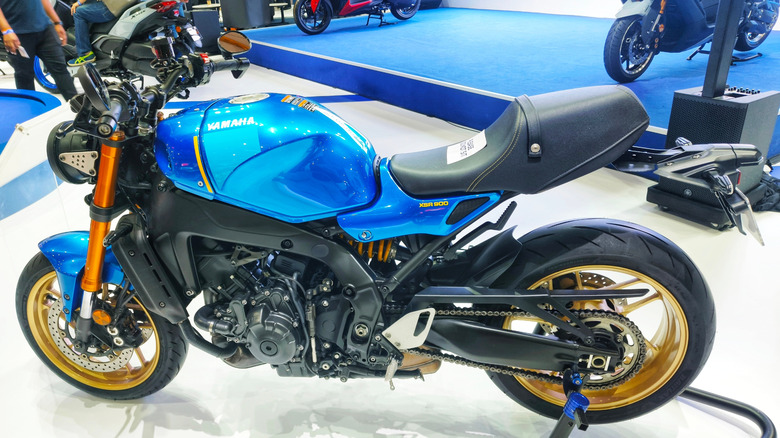
The legendary Yamaha YZF-R1 cemented Yamaha in the pantheon of superbikes, but the musical motorcycle manufacturer has a long history of ultra-competent sport offerings. The XSR900 is its current nod toward the olden days. Its origin story starts in 2014 with the release of the FZ-09/MT-09. The first XSR900 was introduced for the 2016 model year, employing an inline, 847 cc triple. Its flair must have caught on, because more than a decade later, it's still a prominent model in Yamaha's lineup, albeit now with a 890 cc triple under the hood. For 2026, the naked sporty packs 117 horsepower.
Like many of the bikes on this list, the Yammie calls back to the days of the cafe racer, which coincided with its entry into road racing competition in 1961. But it was the 1980s that proved to be Yamaha's golden period, and it is to this era that designers reached when mocking up the XSR900. The upper fairing stay duplicates that of the race-bred TZ250. Tubular framing, a racer cockpit, and optional paint schemes inspired by Yamaha's 500 cc race bikes from the late 1980s and early 1990s complete the package.
Royal Enfield Goan Classic
Part of the appeal of the old days is that things seemed a little slower back then, something many of us pine for. With a history dating back even further than Harley-Davidson, Royal Enfield is a British bikemaker with a rich heritage. Its first motorized vehicle arrived in 1898, and if you're interested in a retro-inspired motorcycle that isn't bred for the racetrack, it still has something to offer.
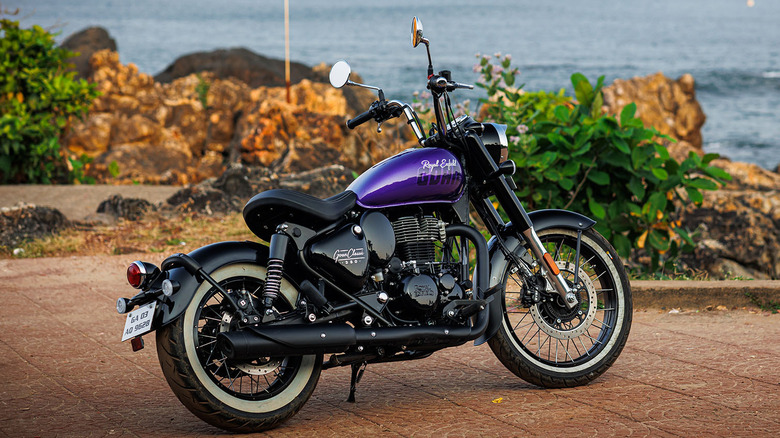
The Royal Enfield Goan Classic shuns modernity at every turn. It is inspired by the Indian (the nation, not the company) custom scene in the 1970s. The Goan region of India was known for custom bobbers with wild color combinations. The Goan Classic pays homage to those builders.
The simple and creative single-cylinder sports 350 cc displacement — far less intimidating than the speed machines that populate most of this list. With bobbed denders, a single-up seating arrangement, and the ultimate old-school reference with whitewall tires. The Goan Classic's 20 horsepower and 20 lb-ft of torque against a weight of 434 pounds, coupled with a 29.1-inch saddle height, make it a stylish and beginner- (or smaller rider-) friendly blast from the past.
Honda Super Cub 125
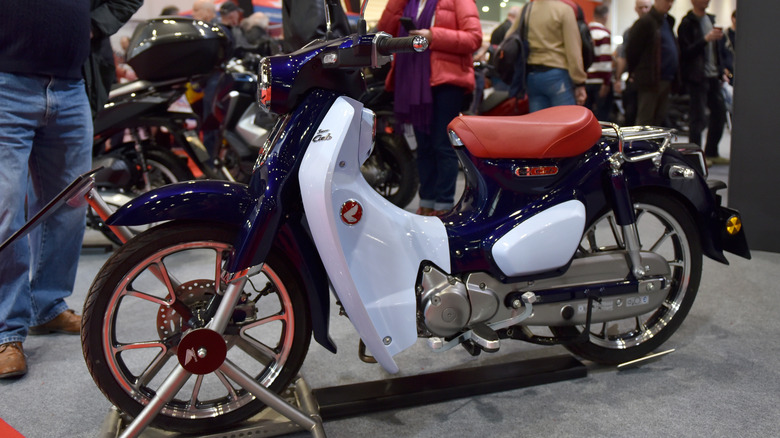
Speaking of small-displacement, big-fun motorcycles, the Honda Super Cub is nothing short of the best-selling bike in history. With over 100 million Super Cubs hitting the road since its introduction in 1958, Honda is obviously doing something right, and that thing may be adopting an if-it-ain't-broke-don't-fix-it mentality for the Super Cub.
The result is a modern motorcycle (scooter, if you prefer) that doesn't look that much different in 2026 than it did in 1958. It retains its iconic design, step-through mounting, and approachable semi-automatic transmission to make one of the best commuter scooters out there. You won't want to eat up interstate miles on the Super Cub, but for maneuvering through crowded urban areas, it can't be beat.
The newest Super Cubs use a steel frame, telescoping forks, dual rear shocks, and 17-inch wheels. Powered by a 124 cc air-cooled single, it makes a plucky 10 horsepower at 7,400 rpm and 7 lb-ft of torque at 6,250 rpm. The Super Cub was originally envisioned as an accessible people mover, and to say it has achieved that mission is undeniable.
BMW R 18
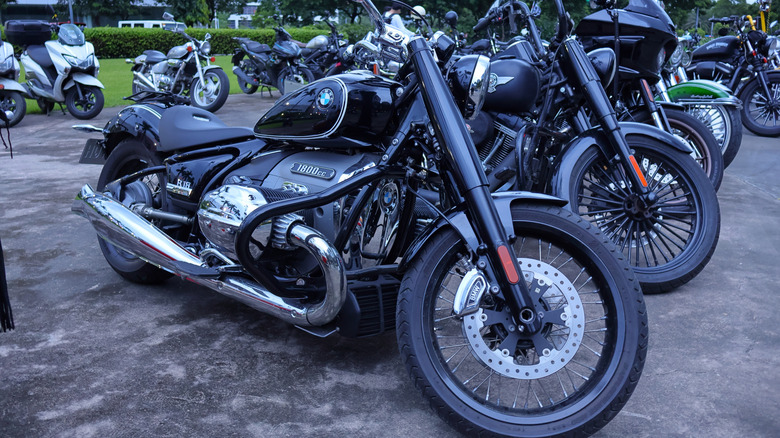
BMW is the only manufacturer to make this list twice, but its sublime R 18 is such a departure from its sport and adventuring lines that we couldn't help but include it. The R 18 was first introduced in 2020 as a pure cruiser. An updated homage to Beemer's 1936 R 5 cruiser, the R 18 directly challenged American cruiser hegemony by reimagining a segment BMW had long since abandoned.
The 1,802 cc twin-cylinder Boxer makes 91 horsepower at 4,750 and 120 lb-ft of torque at a grunty 3,000 RPM, and it also happens to be the largest displacement engine BMW has ever built. All that power channels through a six-speed constant-mesh transmission and down a shaft drive that keeps acceleration smooth. Nods to modernity include electronic intake pipe injection, a digital engine management system, and throttle-by-wire tech.
The R 18 is a popular platform for customization, a testament to the appeal of the core machine. For 2026, BMW plays with its own formula to put out multiple trims. Aside from the base R 18, there are the Octane, the Classic, the Transcontinental, and the R 18 B (for bagger, which is the long-haul package).
Janus Halcyon
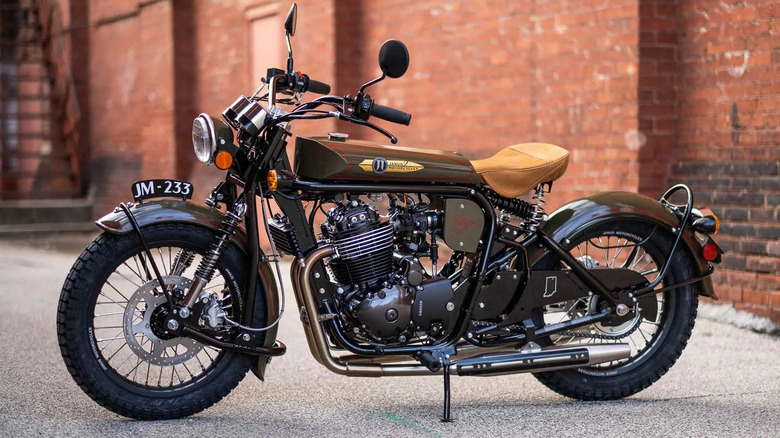
We step outside the purview of legacy builders to visit a fascinating shop located in Goshen, Indiana. Founded in 2011, Janus Motorcycles has no pedigree to draw on. Instead, it looks to the artistry of 1920s- and 1930s-era motorcycles for inspiration.
The unwary observer would be forgiven for thinking Janus' models are nearly a century old. Janus currently pushes two models: the Halcyon and the Gryffin. Both are available in 250- and 450-cc displacements, and they share an unmistakable design that places them in another century. Sprung seats belie modern suspension systems. Handcrafted bodywork and an ethos that demands locally-sourced materials wherever possible shine a light on the philosophy of its founders.
Somewhat disappointingly, Janus uses engines imported from China, but it's a global world, after all, and you'd be hard-pressed to find any machine anywhere made entirely in-house. Perhaps the most appealing thing about Janus, aside from its antique aesthetic, is its customization options. The midwestern firm is small enough to cater to your (nearly) every whim when it comes to the final product.
Janus' current flagship is the Halcyon 450. It uses a 445 cc four-stroke single with electronic fuel injection, producing 30 hp at 7,500 rpm. Against a featherweight dry weight of 345 pounds, the Halcyon stretches to a manufacturer-claimed top speed of 90 mph. It certainly won't hang with an XSR900 or Indian Scout, but for Janus, performance is a happy byproduct rather than a primary mission.