

Does The 2027 Elantra Finally Nail The Balance Between Price And Quality? Hyundai Seems To Think So
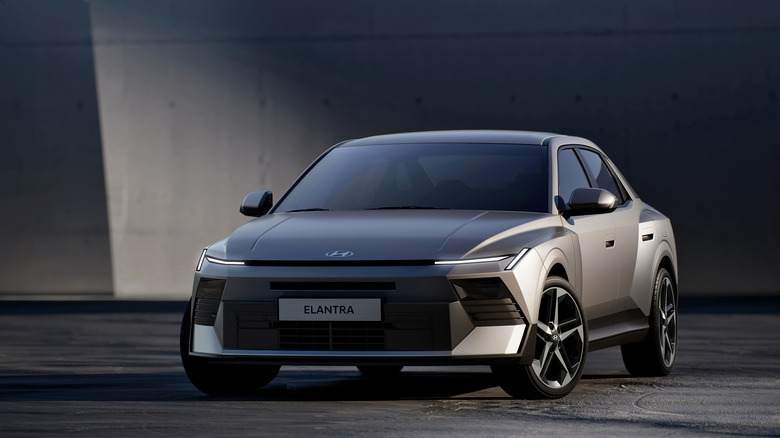
As many of you have surely viewed on our liveblog coverage of the 2026 LA Auto Show, Hyundai debuted an absolute bombshell in the compact segment: the all-new 2027 Elantra. Needless to say, I'm a massive fan of the car. For one, it looks like something out of "Cyberpunk 2077" in all the right ways — sharp angles, premium features, a retro-futuristic themed interior, and so much more. I had a feeling that this car would make waves online, and I was right — perusing forums, Reddit, various Discord group chats, car meets, whatever — people were talking about it. Frankly, it's the most I've ever heard people discuss a Hyundai Elantra before, and I wanted more.
So I took a pre-emptive step. Because I was boots-on-the-ground at the show, I was able to get a couple of one-on-one interviews, one of which was particularly eye-opening concerning the philosophy behind the new Elantra. Meaning, what sort of target demographic and design architecture was Hyundai aiming for here, what are the future plans for the Elantra, and all the little idiosyncrasies the company is particularly proud of that weren't mentioned in the livestream.
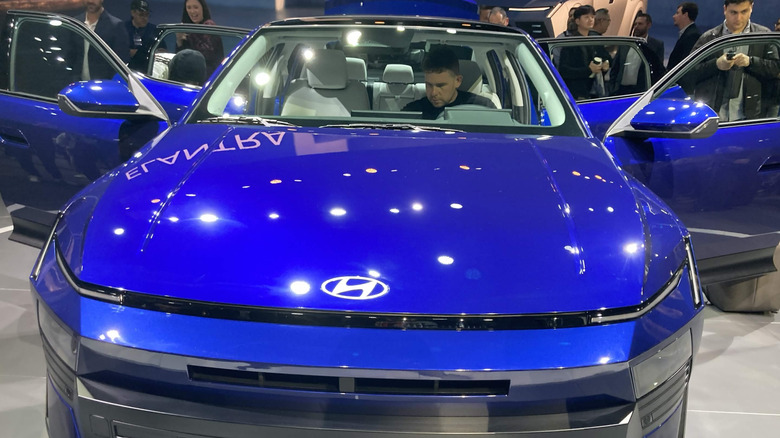
I discussed all this and more with John Simmons, Senior Group Manager of Product Planning at Hyundai North America, in a candid hour-long sit-down in front of the stunning blue prototype Elantra. Frankly, I never thought I'd say this in my decades-long studies of cars, but I'm genuinely more excited to see what's up with the budget-focused Elantra than something like the Tesla Roadster. I know that's a bold statement to some, so allow me to quantify exactly why I think this car is so special, with a little help from some insider knowledge.
It's inexpensive, not cheap
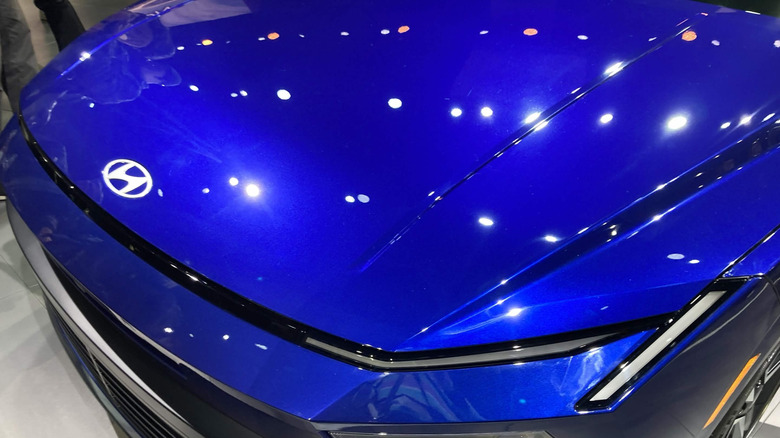
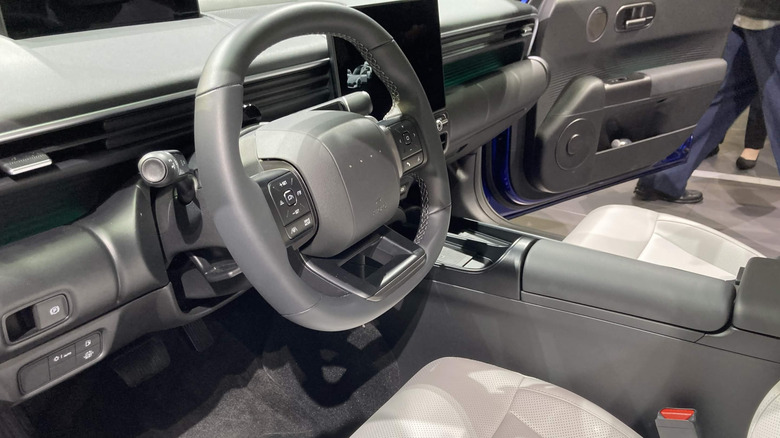
The principle thing I'm excited for has little to do with the interview and more of me actually sitting in the car itself. Now, yes, it's a display model intended to be viewed up-close, so quality control is bound to be tight. And I'm taking into account that Hyundai's Elantra lineup isn't the best when it comes to reputation — for instance, the 2026 Elantra has a recall because the wheels can randomly fall off due to loose lug nuts straight from the factory. But after sitting inside the car, feeling the steering wheel and scrunching into the seats, it really doesn't feel like a vehicle built for a sub-$30k target. It feels far better.
Once upon a time, I used to deliver car parts for a living. The company I worked for gave me a 2015 Toyota Yaris, and after driving on what felt like planks for 8 hours, I'd come home and have IcyHot on my back every single day. That seat felt cheap; the Elantra's did not. Okay, I doubt you'll get premium materials at this budget, but it was roomy and comfortable. The exterior fit and finish was superb. Even the color was simply incredible.
To focus on the last point, think of Mazda's Soul Red, how it has so much depth in that paint. That's what this color looks like to me. I made a point of it in my interview with Simmons, to which he agreed when I described the color as "bold," and talked about wanting more fun colors for the lineup going forward — something Hyundai's been doing, such as the Genesis Magma orange. It immediately catches the eye, and despite the price point, will absolutely pass the "nice car" test in a parking lot.
Customizability is at the forefront
"I think that that's the trend, particularly in the compact segment," said Simmons regarding the amount of options the brand was aiming to provide its customer base. "People want to stay in the segment. They like the size, the efficiency, but they want an affordable solution... They want more content, they want something people have even one segment up."
That's an interesting but certainly not uncommon philosophy to bring to the table. We're seeing cars routinely exceed $50,000 or more in the United States today, with budget-focused vehicles becoming far more compartmentalized by comparison. Many are regulated simply to sports cars, like the Mazda MX-5; some are fairly niche hatchbacks like the Golf or CX; others were simply phased out like the Versa. In many ways, bringing in a contemporary, stylish sedan back into such a market is a risky proposition, but this is a great way to do it.
Customizability is part of the fun of these cars. According to Simmons, one can option the Elantra up with powertrain options, styling and interior packages, and more to really personalize it, sort of like a Mini Cooper. Moreover, because of the Elantra's inherent simplicity in its design and engine, it leaves the door wide open for the aftermarket culture to come in. Something like this could very well be the next Honda Civic — an entry-level FWD compact that's got just enough power to be fun and plenty of room for personalization, both official and unofficial. That said, sadly the actual list of customization options remains a company secret, but in Simmons' words, "I think the enthusiasts really love it, and that's great business for us."
The late 1980s are back
It's a well-known phenomenon that retro-futurism sells in cars. Once upon a time in the 1960s, simulated wood was born to emulate the woodies of the 1930s. The 1990s to 2000s saw a revival of the 1960s muscle car, most exemplified in the Dodge Viper, and retro styling in cars like the PT Cruiser and Chevrolet SSR. That's just the styling front.
Then you have the waves of body types. In the 1950s, it was coupes and sedans. 1960s, sedans and wagons. Then along came the minivan, replacing the wagon. Then the crossover, replacing the minivan. Now we have larger SUVs, replacing the crossover. But larger isn't the way to go, at least not in this economy. Companies are thinking 1980s, the days of the Oil Crisis, when Japanese imports threatened to destroy the American automotive industry.
So what defined those years in terms of automobiles? You had plenty of cheap econoboxes — cars which, bluntly, were rust-buckets that fell apart constantly. Many of these cars wore badges from older muscle cars, and you don't see much of them on today's roads anymore. But we've learned our lesson, or certainly Hyundai has, from what Simmons described to me.
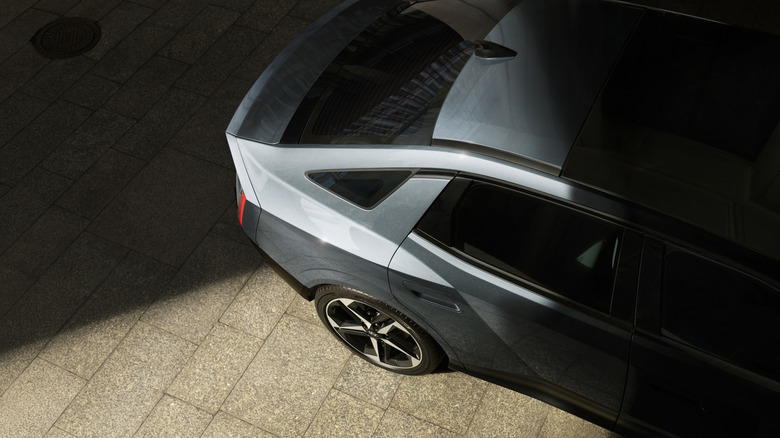
The presentation actually pointed this out as well — it's what Simmons said the team refers to as the "Art of steel." New metallurgical techniques, new steelworking plants, and more deliver that 1980s cheap compact car aesthetic without the burden of it rusting like you dunked it in Coca Cola. Plus, well, just look at it. Those lines are straight-up cyberpunk retrofuturism and that's awesome. 10/10, no notes on the design front.
It capitalizes on a budding market
The family-hauling SUV may well be on its way out, a new trend ushered in-part by a new federal rule change that alters the official definition of "light truck." But, much like the station wagon to sedan in the 1980s, we don't have to lose that family-hauling functionality.
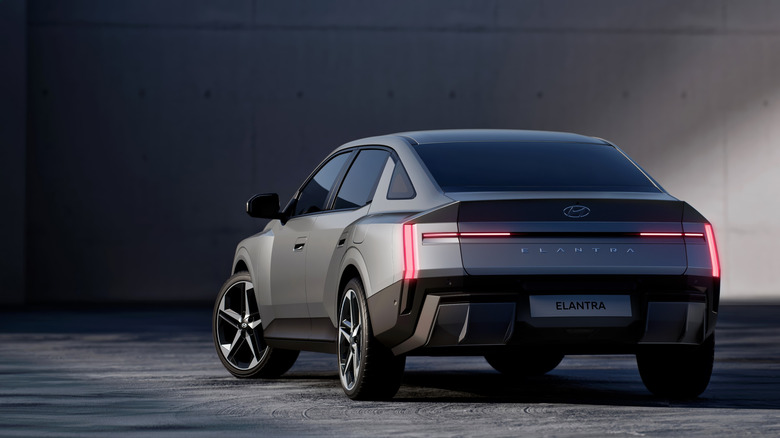
The new Elantra is boxy, and that boxiness is functional. I'm not a short girl in heels, and in my 3-inchers, I comfortably fit all 36 inches of leg into the back seat, plus there's plenty of headroom. It felt more spacious on the inside than my aunt's Telluride. That's not something many sedans do anymore, certainly not since the 2000s before everything had a curved, blob-like roof line. And the outgoing Elantra is as guilty as the rest of them, which is what makes this redesign so significant.
I referred to the design as "taking crossover functionality and squishing it down to a sedan," to which Simmons replied, "I think that's true... You're always trying to [put] additional practicality and versatility into the sedan... The rear seats fold down to add additional function... But you always want to keep that passenger space and cargo space separate, too. And that's the bargain, you know, we're pushing it as far as we can, the functionality, the utility, the versatility, [without] crossing the line." He further emphasized the importance of the three-box design while keeping that crucial headroom and comfort.
Moreover, it capitalizes on other rebellions against current automotive zeitgeists, such as the trend towards minimalism and touchscreen everything. Yes, the new Elantra does have buttons and switches, and yes, they feel good to press. I can actually operate the climate control without taking my eyes off the road, what a neat concept.
It's exactly what we've been asking for
In case it wasn't obvious, I'm not a billionaire. I have zero concept of that kind of money. Now yes, I was as enamored as everyone else when the Tesla Roadster did a bunch of flips and accelerated to 60 in less than a second during that livestream we did, but I'm never going to own one. Sure, one was there at the Convention Center, but that'll be the only time I see one, most likely. The new Roadster will basically require oligarch levels of income to acquire.
The Elantra, meanwhile, is something which I could feasibly own. But more than that, as an enthusiast, it's something I've actively been asking for, for years. I grew up in the 1990s and 2000s, during the heyday of tuner culture. I bought "Gran Turismo" when it came out, I watched "The Fast and the Furious" in the theater, and I was that girl who browsed the DuPont Registry hoping that someday I could own a Skyline GT-R. Now I've grown up, I have money, I have my dream car, but I still have that passion.
All of us are in the same boat, us Gen Y's. We love these sorts of cars, but we don't have a lot of disposable income. So we buy used and fix them up as best as we can because we're not spoiled for choice anymore; everything is out of reach. And here comes Hyundai with the steel chair to the rescue. Seeing the Tesla Roadster didn't evoke much in me, but seeing this brought that little girl back again. I want more cars like this. Cars that are affordable and fun to drive. This new Elantra gives me that hope.