

5 Muscle Car Redesigns That Totally Missed The Mark
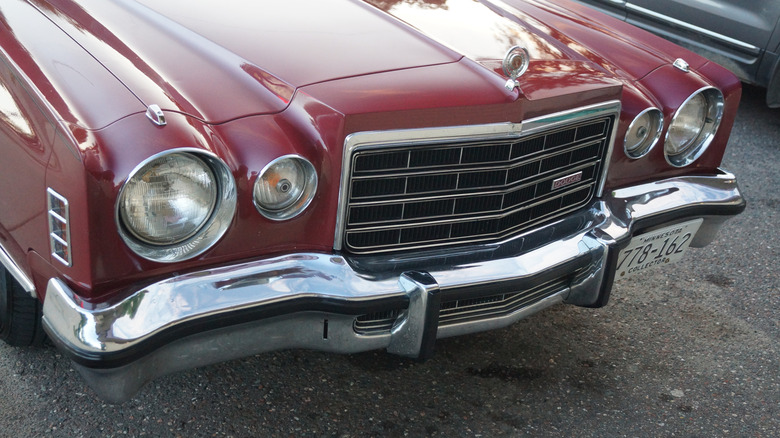
Let's ask a fairly obvious but complicated question to start with: What exactly is a muscle car? It depends on who's answering, but let's look at some common qualities. A muscle car is basically a passenger car with a massive engine under the hood and little else. They're generally based on something more pedestrian — a Chevelle SS uses the same platform as a Malibu, a Barracuda came standard with a Slant Six mated to a three-speed manual (along with many other famous Mopars, for that matter), and so on. The point, then, is you have what's ostensibly a sedan, with sedan handling, that goes way faster than one would expect in a straight line.
Over time, those designs evolved into some of the most legendary cars of the 1960s, 1970s, and beyond. Even today, we have cars like the Charger and Challenger, Camaro, and more that carried the muscle car torch into the 21st century. These were handsome, muscular designs that epitomized aggressive, sleek looks and a Hotwheels-like aesthetic, and were arguably some of the finest designed machines to leave American showrooms. Legends like the B-body Mopars, A-body GMs, the Mustang, whatever else — name a popular muscle car and you'll find a fanbase that loves its looks.
That didn't always last from one generation to the next, though. Okay, beauty is subjective and we openly admit that. But there are some muscle cars that are such a stark departure from the original that they barely resemble their former selves at all, much less something "muscle-y." Some even carried on the design philosophy and nothing else, using chassis that are unrecognizable to the original. Whether it's due to the influence of the Malaise Era or skipping a generation or two, let's take a look at some of the most egregious examples of this phenomenon.
1985 Chevrolet Nova
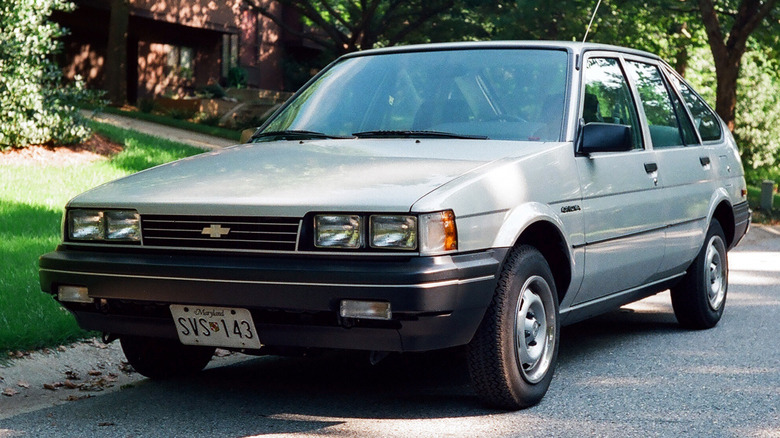
Admittedly it's tough not to go for the fruit that's this low-hanging. The Chevrolet Nova was GM's basic compact sedan of the 1960s, starting out life as the Chevy II back in 1962 — the "Nova" name was originally a trim level, like the Pontiac GTO. But it quickly made a name for itself as an excellent muscle car in its own right, certainly by the early 1970s. The Nova even kept the same general proportions in the early Oil Crisis. Okay, good so far — wait, what is that? That thing in the photo up there happened in 1985.
Yeah, so let's get it out of the way: It's a rebadged Corolla. No, really, it's a four-door 80-series Corolla fitted with a 74-horsepower 1.6-liter four cylinder. Okay, it's not a "redesign" as such, but it's a compact economy sedan — the same thing the old Nova was, just built for the 1980s rather than the 1960s. Still, who knows what led General Motors to thinking it was a good idea to market this thing as a Nova. That isn't to say the 1985 Nova was a particularly bad car, but let's be real here, there is no world in which you can call a rebadged base-model 1980s Corolla a "muscle car."
Was it a bad car, though? Not really — at the end of the day, it's a 1980s Corolla, and it actually mimics the Chevy II's design philosophy deceptively well. The original Nova's intent was to be a cheap, compact economy car offered in numerous body configurations, which this new Nova certainly accomplishes in spades. Plus it has Toyota reliability, which always helps with cars of this vintage.
1988 Pontiac LeMans
Admittedly, the nomenclature here gets somewhat confusing because Pontiac had this habit of making trim levels into separate cars. Originally, the LeMans was actually the premiere trim of the 1962 Pontiac Tempest before transitioning to its own model in 1964. It might look familiar to anyone who knows what the 1964 GTO is — a GTO is, again, a LeMans up-gunned with a performance package, just one of many interesting facts about that car. Here's the fun part: The LeMans stayed in continuous production right up to 1981, still rocking that semi-muscle vibe, but actually in a really true-to-its-roots way.
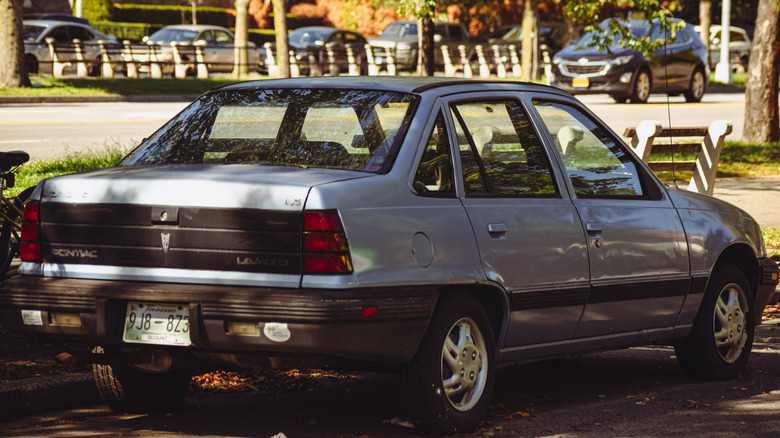
Then Pontiac pulled a bad one right out of its hat with the 1988 Pontiac LeMans. What on Earth is this thing? Honestly, not too many people know the answer because it was so genuinely boring and terrible. But basically it's four badges deep into badge-engineering. A 1990s Pontiac LeMans is, in short, an Opel Kadett that was rebadged as a Chevy Chevette, which in-turn was sold by Daewoo as the Daewoo LeMans, or Daewoo Racer in some markets, then rebadged again as a Pontiac in the United States. Complicated enough? Well, it certainly kept the entry-level sedan trend for the LeMans alive, for what it's worth.
In terms of good or bad, the LeMans is a creature of extremes, perhaps due to survivorship bias. Like any cheap beater from this era, it's not the highest quality automobile — it'll overheat and trip pieces will fall off at random intervals from the factory. But a well cared-for example, rare as it is today, will get you from Point A to B extremely efficiently when it's in the mood to run.
1975 Dodge Charger
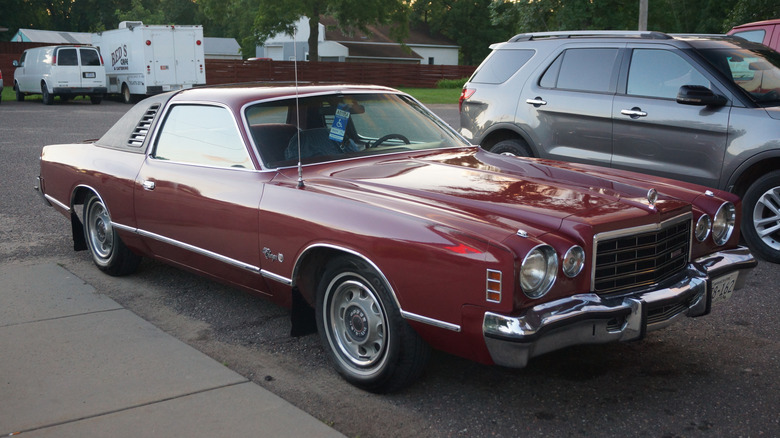
There are a few cars that simply need no introduction. The Toyota Camry for sedans, Jeep Cherokee for SUVs, Chevrolet Corvette for sports cars, and the Dodge Charger for muscle cars. It's arguably the poster child for the muscle car — the 1960s and early 1970s variants, specifically. The Charger has a remarkable history, needless to say, especially the first two generations. Then along came the First Oil Crisis and everything changed. The hot-ticket item at the time was personal luxury — full-size American land-yachts coexisted with small imports like the Volkswagen Beetle and Datsun 510.
Muscle cars grew in proportion, the Charger included, with its luxury options outshining the muscle variants. This cultural shift, plus the increased emissions regulations and meteoric rise in gas prices, spelled the end of the Muscle Era in 1973. Enter the 1975 Charger, a car best described as continental in terms of both size and pace.
Gone were the performance options of old, replaced with, at most, a 400 ci V8 invariably mated to the TorqueFlite automatic transmission. It was heavily marketed towards the luxury segment, apparently having rid itself of all traces of its muscle heritage apart from the name, like a boring salaryman ashamed of having been to a few parties back in college. It's not a particularly bad car, per se, just a completely inappropriate car for the era. There's a reason why these massive coupes died out by the 1980s — their slow, inefficient, and poor-quality designs couldn't keep up with the market demand for cheap Japanese compacts.
1974 Ford Mustang II
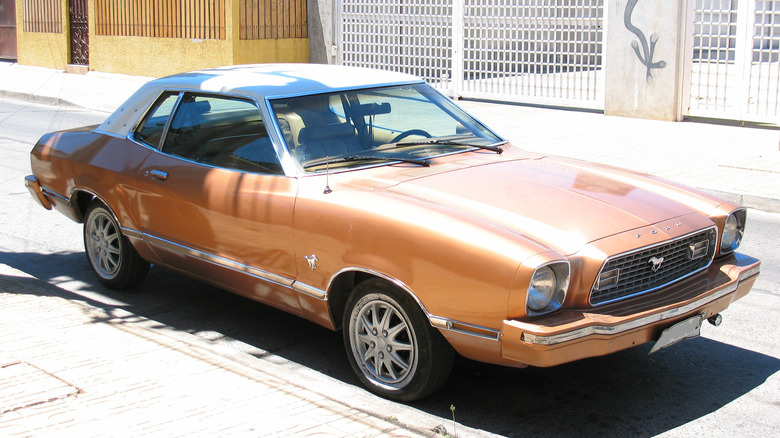
The Ford Mustang is such a pivotal car in American culture, it has an entire subgenre named after it: the pony car. There isn't much left that hasn't been said about it, but suffice it to say, the Mustang was among Lee Iacocca's finest hours, certainly during his tenure with Ford. It single-handedly popularized the "V8 in a compact car" formula used throughout this period, copied by other giants like the Chevrolet Camaro and Plymouth Barracuda after its massive success. It soon became a fully-fledged muscle car by the early-1970s, with midsize entries like the Mach 1 and Boss 429. But Ford wanted to take the nameplate in a different direction.
Enter the Mustang II, which coincidentally arrived at the absolute perfect time — right as the Oil Crisis set in, 1973 for model year 1974. If whiplash was a car, it'd be this. You're going from an intermediate-sized sports-luxury coupe known for its V8s to something resembling a Pinto with the nose stretched out — and no V8 option at first.
That said, yes, this is easily the most loathed vehicle bearing the Mustang name in history, arguably even more than the Mach-E. Mustang enthusiasts like to see this thing as borderline sacrilege, despite the fact that it likely single-handedly saved the Mustang name from succumbing to the Oil Crisis graveyard. It wasn't bad for what it did, though — like the original Mustang, the Mustang II gave people a sporty car in an accessible package, just built with a different era in mind, which is why hundreds of thousands were sold every year.
1988 Buick Regal
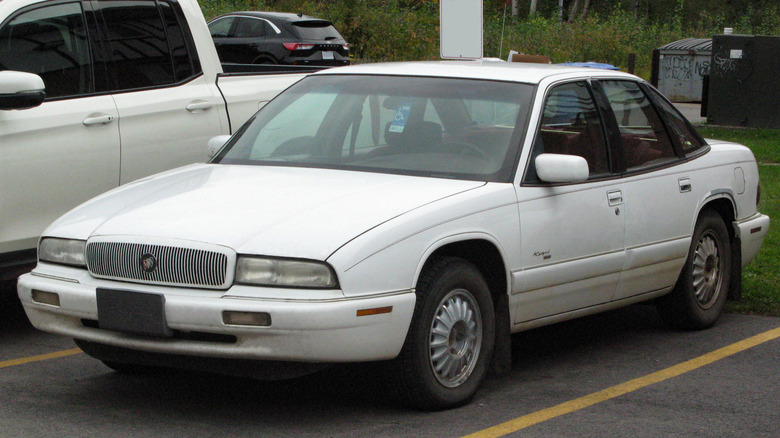
The classic 1980s Buick Grand National lineup is among the most well-known sleeper muscle cars ever built, and certainly one of the most unexpected. It's undoubtedly best known for its GNX trim level, an all-black missile with an incredibly distinctive silhouette and an intercooled turbo 3.8 V6. In fact, it was so iconic, people started calling it Darth Vader's car. How, then, would Buick follow up such a distinctive, effortlessly intimidating look?
Answer: Buick built a generic front-wheel drive car that had all the personality of an empty floppy disc on wheels by comparison. Obviously there was no turbo on this model, Heaven forbid something fun came out of this generation, but Buick did relent and put the 200 hp 3.8 back into the Regal Gran Sport in 1995. Nevertheless, the damage was done as far as the muscle heritage was concerned — Buick instead turned its attention to building aggressively regular cars ever since.
Regular or not, though, there's a reason why you still see a lot of these classic 3.8s on the road today. Many people consider the 3800 V6 to be among the greatest engines ever built. And say what you want about Buicks — slow, regular, whatever. But they're comfortable, well-built, and consistently reliable for over three decades now. But a high-quality regular car, a muscle car does not make. Despite their build quality, you'll never see one fly down a drag strip with any amount of hustle without some serious investments under the hood.