

5 Reasons Why You Should Buy A Soundbar
We may receive a commission on purchases made from links.
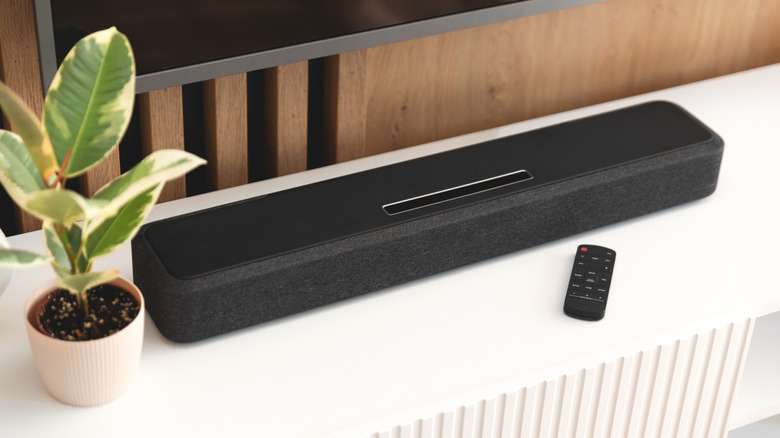
If you want a truly immersive, audiophile-worthy experience in the living room or home office, then the go-to for most people is a nice pair of bookshelf speakers, or a full home theater speaker setup. It's miles better than the built-in audio on your TV or your laptop, that's for sure. That said, there's another option people don't always consider: a soundbar. Soundbars are (mostly) all-in-one speaker systems contained in, well, a black bar. See the image above. You plop one right in front of the TV and usually get impressive, expansive sound for a device that doesn't physically seem capable of it. While they certainly aren't the best choice for every person, in every scenario, there are a few reasons why you might want to get one.
I've been using a soundbar for a while now, and it has impressed me with how good and loud it sounds for its size and price tag. We'll be looking at soundbars from the perspective of someone who wants a soundbar for the family TV, the personal workspace, or any other screen where a traditional bookshelf speaker or surround sound setup might not be ideal. Soundbars come in all shapes and sizes, and you should definitely do thorough research before buying one, but these are five reasons why (generally) they're a good choice.
Setup is ridiculously easy
There is a lot to consider when putting together a home theater system. You have to figure out where to position both the speakers themselves and the furniture to get the right acoustics, which gets increasingly difficult the more speakers you have — such as in a surround sound system; you'll have to wire them up and manage/hide the cables; you likely want to set up a receiver, which is a pretty daunting bit of hardware to tackle on its own if you've never touched one before. The list goes on.
Conventional speaker setups are usually quite involved projects that could easily take a whole weekend to finish. Trust me, I know from experience. Soundbars, on the other hand, are the complete opposite. To oversimplify a bit, you basically just set them down in front of your TV/monitors, plug them in, and they work. Soundbars do need to be positioned correctly for optimal sound, that is true, and in some cases may require a wall mount; some of them include a separate subwoofer that requires additional setup. But even the most complex aspects of soundbar setup (like calibration) can often be done automatically. On the whole, if the competition is about how easy the whole process is, soundbars win.
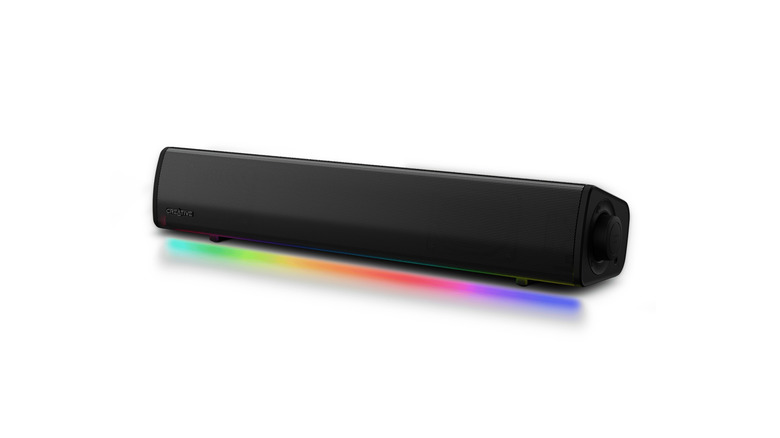
Some soundbars are easier still. To give a concrete example, take this Creative desktop soundbar. It's literally one USB-C cable to power it and transmit audio, and when I set it up, it worked as soon as it was powered on. So if you want better audio than your TV or monitors produce by default — soundbars can sound excellent — but you don't want the hassle, they're a great choice.
It takes minimal space and produces minimal clutter
Traditional speaker setups involve multiple speakers (surround sound setups start at six, total) that take up space and need a bit of "breathing room," i.e., they are picky about placement; speakers shouldn't be too close to walls or corners, need to be at specific heights, and can sound wrong if supported on the wrong sort of surface, among other things. And that's before we mention the space taken up by mounts and stands. So generally speaking, they're going to be permanent space-hogging features, and will likely require you to adjust the room's furniture configuration. They also have tons of wires and extra hardware (like amps and receivers) that can cause things to get messy.
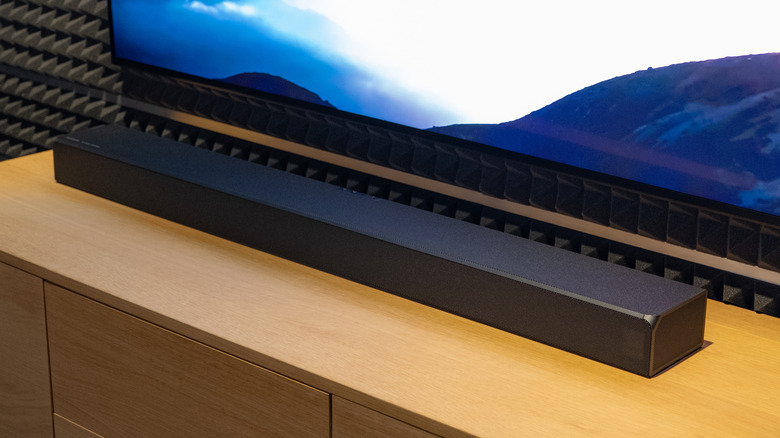
Soundbars hog less space and produce less clutter. Depending on which model you buy, you have the soundbar, its connecting cables (only a single power cable, if it supports wireless audio), maybe a wireless subwoofer, and that's basically it. Soundbars don't need receivers. And since all (or most) of the speakers are restricted to the main body's box, the only mess a soundbar might cause is from its wires on the back being disorganized. They do benefit from good placement, but aren't as affected by poor placement, in my experience.
I'd also argue soundbars take up less space, visually speaking. That's not to say speakers don't look nice, but a soundbar can sort of "disappear" into the TV stand or in front of computer monitors, and feel more minimalistic. It's a very modern look, and almost futuristic in a way — a comparatively tiny slab filling your room with theater-like sound.
It requires (almost) no extra gear

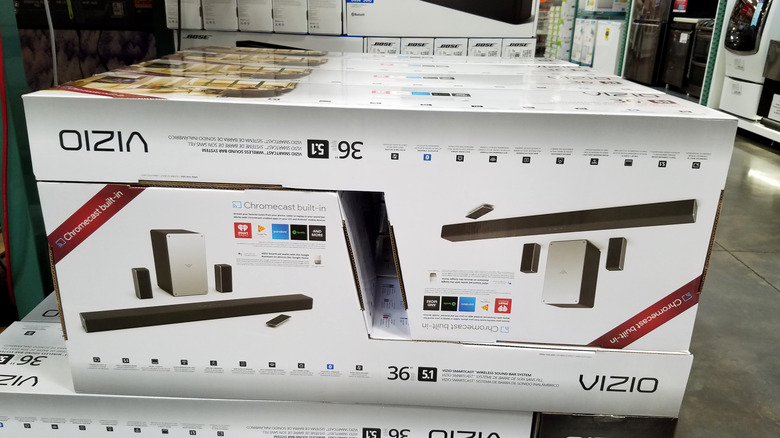
Open up a soundbar, and you'll be surprised by how little is in the box. Take, for example, this Vizio 2.1 soundbar. Inside, there's the soundbar, the subwoofer, and a bag with cables and mounting gear. And that's basically all you need to set it up. Compare that to speaker setups, where you may need to individually purchase the speakers, amp, receiver, mounts, wire, banana plugs, and other items, as well as any necessary tools, like wire strippers. Those are items you have to purchase, keep track of, and (if they break) replace, complicating things.
Soundbars are beautifully conservative and simple in just how little you need to get them up and running. Again, speaking from my own experience, I had my soundbar up and running in 10 minutes. It didn't require anything that wasn't inside the box, nor did it require a single tool. Meanwhile, when I've set up speaker systems in the past, I've been stalled because I was missing this or that, or had to run to a relative's house to grab a tool.
It's a financially compelling all-in-one package
Another big selling point for soundbars is the bang they give for your buck. As proof, just look at these soundbars for under $200. Smaller soundbars meant for desktops often cost even less.
To be clear, we're not saying "soundbars are cheaper than speakers" or "soundbars produce equivalent sound to speakers at a lower price." Someone would need to do extensive testing and somehow find speaker sets and soundbars that have similar-enough acoustic performance to call them equivalents, and then compare prices to determine which is the better deal. That would be nearly impossible to prove.
The point is, soundbars are — even independent of speakers — a good all-in-one package and can often be had for a reasonable price. Combine that with the fact that they're easy to set up — and space efficient — and that price becomes even more compelling. Having said that, there are a ton of great deals on speakers too. You can find some excellent budget speakers at all price points.
They can do surround sound in one box
True surround sound requires at least a 5.1 system, or five speakers and a subwoofer, going up to 9.1, or nine speakers and a subwoofer. Several of those speakers have to be physically to the sides and behind you, since obviously that's how your ears perceive relative positioning. Despite this, some soundbar models can come close to achieving a "surround" sound effect, or at least seem like they have a wider soundscape than their physical constraints should allow them to.
Some soundbar models achieve this by bouncing sound waves off your ceiling and the walls so they hit your ears at different angles and produce a more surround-like experience. You can see a visualization of the sound waves in the video shown above from Sony Electronics; the rebounding waves come in at you from above and the sides, in theory creating much more immersion than if the sound waves were blasting straight at you. It's not true surround sound, which is why we put it in quotation marks, but regardless, it's incredible technology to create additional "speakers" without them actually, physically being there. Sound aside, it also means you don't have to give up any more space to a surround sound speaker system.
Further, setting this up is easy. Many soundbars will automatically handle the calibration for you. You just press a button, and the soundbar uses its own audio to measure the room and figure out the acoustic math. All you have to do is sit back and enjoy the final result.