

The Most Commonly Changed Car Parts (And What They Cost To Replace)
For many car owners, there comes a canon event in the ownership experience, usually after buying your first car. And that is when you're standing in the shop, looking at a quotation for a certain job — be it something as mundane as an oil change, or something larger like a full alternator replacement — and wondering whether you're getting ripped off. Well, though cars are engineering marvels, as with all machines, there are certain consumable parts on the vehicle. Many of these are routine maintenance items that are expected to be changed after either a certain duration has passed, or a certain mileage number has been crossed.
The car is only the start of a long and unfortunately recurring financial relationship (that tends to reveal itself at the worst possible moments). A car is less like an item you own, and more like the chance to pay a subscription for brake pads, oil, and batteries. The downside to avoiding these essential replacements (as and when due) is, of course, an even larger dent in your pocket down the line, not to mention the safety aspect.
The frustrating bit is how often no one gives you a straight cost — the quotations from garages can range from fair to wishful thinking on the mechanic's part. So, while we have relied heavily on our own experiences with the prices listed in this article, we've also triple-checked with some independent quotes, as well as with online estimation services like the RepairPal calculator.
Engine oil filter (with oil change)
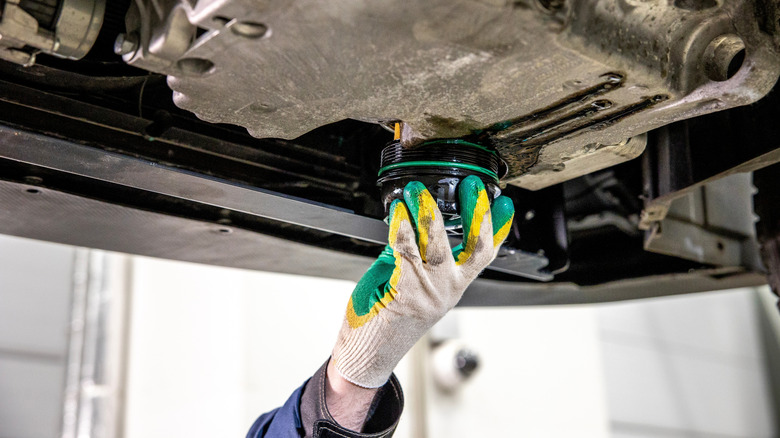
This is perhaps the most common maintenance item on your vehicle if the rest of it is in good running condition. While the exact time interval between your oil changes varies by the exact make of your car, a general rule of thumb is to do it every 6,000 to 7,000 miles, or every six to 12 months, whichever comes first. These figures are for synthetic oils (which most new vehicles use anyway), while conventional oils you'd probably be better off doing the change earlier. In any case, your vehicle's owner manual will have the exact oil change interval specified, and you should follow that, unless you have reason to do the change earlier.
And if you're wondering about the 12-month rule of thumb, it's because even if you don't drive the car, the oil comes into contact with metal and air even when sitting. This turns it acidic, which reduces its effectiveness. The good news is that oil filters are one item where you can safely go with aftermarket parts, as opposed to getting original equipment manufacturer (OEM) units, so you can save a bit of money at each change, which adds up over the long run. We've even ranked 21 of the best oil filter brands on the market for you in previous coverage. While you can get away with just changing the oil, the filters are around $20, and keep the oil clean preemptively. Expect the entire job (with filter and oil cost included) to cost between $160 and $188.
Engine air filter
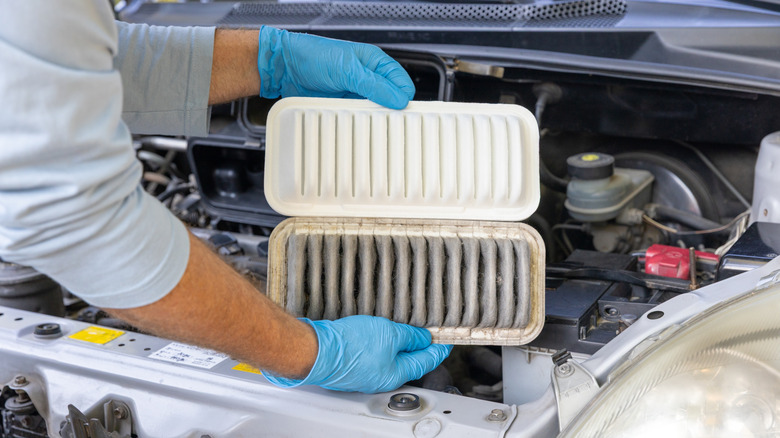
Next up, we have the engine air filter, which is different from the cabin air filter — and many people miss this distinction. Most cars on the roads today have internal combustion engines, which mix air with gas to make power. Unfortunately, our air has a lot of things in it that shouldn't be there, such as dust and debris. If this debris gets into the fuel-air mixture in the engine, it could cause a whole range of problems. That is why cars run the air through a filter before it hits the combustion chamber(s) in the engine. This filter is very commonly located inside a sealed box somewhere under the hood of the car.
Over time, the engine air filter can get clogged up, especially in areas like the pollen belt (Oklahoma, Arkansas, New Mexico, and so on) or in dusty desert states like California, Nevada, or Texas. Symptoms of a clogged air filter include rather sluggish acceleration, lower gas mileage, and excessive, dark-colored exhaust smoke. All of these could also be caused by other problems with the car so don't avoid a check. In general, aim to change your air filter whenever it gets clogged, or around 12,000-15,000 miles; some owners can get away with longer intervals. For those who fancy a DIY job and want to save on some labor, it's perfectly possible to change the engine air filter on your car yourself. For an in-shop job, expect it to cost between $79 and $99 for regular cars.
Cabin Air Filter
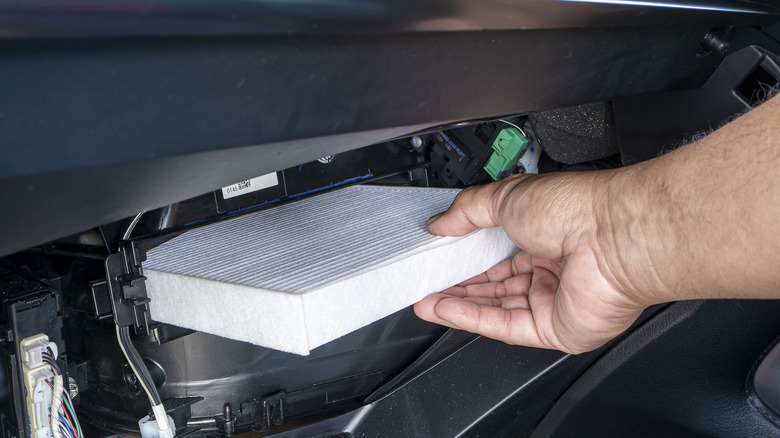
The other kind of air filter that commonly needs replacing on a car is the cabin air filter. This is what catches particles, dust, pollen, and other lighter-than-air debris before it enters the cabin, keeping the air that the occupants breathe clean and free of particulates.
Depending on where you live (again, pollen belt states and dusty states fare poorly here) and how often you drive, you will need to change your cabin air filter about once per year, or roughly every 15,000 to 20,000 miles as a rule of thumb, whichever comes first.
If, however, you experience reduced air flow from the HVAC system in the car, if your windows fog up extremely frequently, or you get unpleasant smells inside the cabin every drive, then you may have to replace your cabin air filter immediately. Luckily, it's an extremely minor job and expense, coming in between $91 and $114 for most vehicles, and that includes parts and labor.
Windshield wiper blades

Are you even really American if you haven't looked at the price of a windshield wiper change, thought you could do it yourself, and then absolutely botch the job and be left staring out of your streaky windscreen? The good news is that many times you only have to replace the blades in your wipers and not the whole assembly, as the latter is a considerably more expensive option. Combined with parts and labor, replacing the blades will cost drivers somewhere in the range of $100 to $123, according to RepairPal.
However, if you buy the blades yourself and are really careful when changing them, the price is basically just for the part itself. At the time of writing, a veritable range of options was available at Wal-Mart for between $15 and $40 — so this could actually end up being a rather affordable job. We also have a "hack" for you to try that can stop you wasting money on windshield wiper replacements.
If you do decide to replace your car's windshield wipers yourself, whatever you do, don't leave your windshield wipers in the "up" position when changing the blades. That's how you find out the exact replacement cost of your windshield — ask us how we know. Once the old blade is out of the assembly, carefully lay the bladeless arm against the windshield, preferably with a small towel for padding in between the metal arm and the glass.
Tires
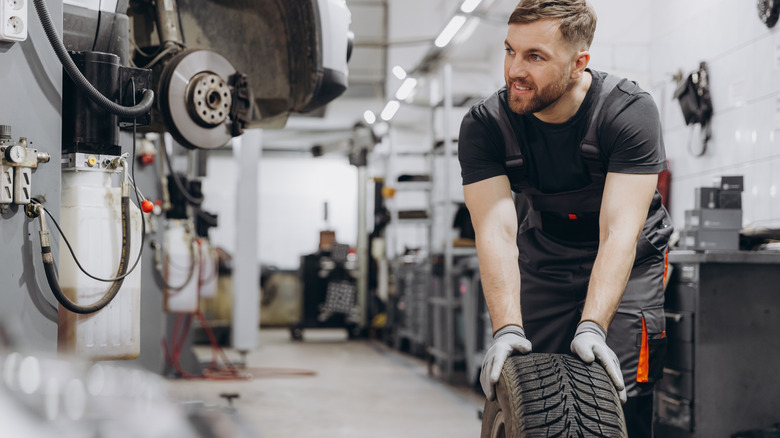
A huge number of car owners in America buy tires at least once a year, and the price has a lot of variability. For instance, a set of new tires for a Toyota Corolla will be significantly cheaper than the ones for a high-spec luxury SUV. You also have to account for the type of tire, whether it is all-terrain, off-road focused, a winter tire, a special kind (e.g. runflat), or a general-purpose road tire — all that affects the price significantly. Another thing that a lot of people do not realize is that depending on your car's drivetrain (FWD, AWD, RWD, 4WD), you may have to change different individual tires, or even the entire set. In some cases you will also need to rotate the tires every few thousand miles.
For FWD and RWD vehicles, you can sometimes get away with only replacing two tires — and the new set should go on the back axle. For 4WD and AWD vehicles, it's much more advisable to change all four tires regardless of the life left in any one. This is because AWD and 4WD systems monitor each wheel's spin speed, and tires with newer tread spin slower than worn ones, causing the car to think the wheels are slipping and applying incredible stress to the drivetrain. There are many cheap tires that are also high-quality, so you might be able to get a good deal, depending on season and any ongoing sales. The range for tire replacements is from $410 to north of $1,100 for a four-piece set.
12-volt car battery
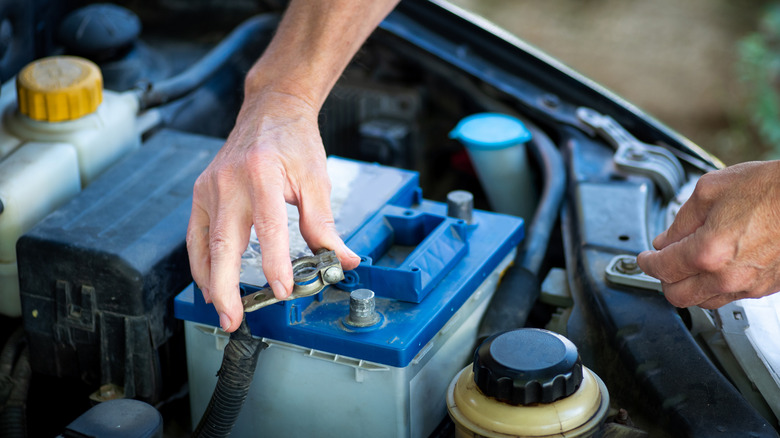
Factors such as water ingress, frequent use in hot temperatures, and possibly faults in the car's electrical systems over time can cause the battery to degrade. Age is also a factor, with newer-technology batteries (like AGM, or advanced glass-mat) units generally lasting longer than conventional batteries. Signs that your car battery is getting close to replacement include the car struggling to crank, hearing a "click-click" noise when you go to turn it on, finding your interior and headlamps to be dimmer than normal, and the battery housing itself being bloated, puffed, or leaking, among other things.
Seeing the battery indicator on your dash light up could also be an sign that it is time to change the battery, though other problems might also cause it to illuminate, like a loose terminal wire. If it is time to change your car battery, getting the right kind could increase the interval to the next change by a factor of up to a couple years. For instance, if you live in a really cold area, getting a battery with a higher CCA (cold cranking amps) could be beneficial, with less stress on the battery on cold days. There are many types of car battery, such as wet-cell, calcium wet-cell, lithium-ion, absorbent glass-mat, enhanced flooded batteries, and more. The letters on your car battery are a good starting point for researching which kind your car uses. Additionally, note that cars with an auto-stop-start feature require a higher class of battery. The total cost for a non-luxury vehicle should be between $456 to $493.
Brake pads
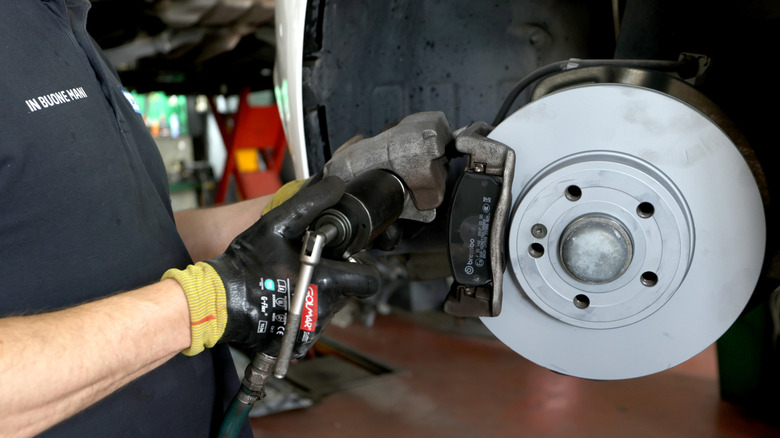
Brake pads are metal plates that have a friction material on the inside of each pad. When you apply the brakes, these metal plates close in and jam against the rotors, which are attached to the wheel itself. The friction material causes the rotor to slow, and thus, in turn, the wheel, bringing the car to a stop. When new, the brake pads are about 12mm, or half an inch thick. You should aim to have your brake pads inspected with the potential to replace them when the pad is about 4mm to 6mm (⁵⁄₃₂ to ¹⁵⁄₆₄ inches) thick. If any of your brake pads are 3mm (⅛ of an inch) or lower, replace them immediately.
Though many garages recommend that you replace your brake rotors and pads at the same time (and this is generally a wise idea), if the rotors are in good condition, you can sometimes get away with getting only the pads changed. However, if your budget allows, try and get both parts changed – think of it as preventative maintenance. The brakes are the one item on the car that you do not ever want failing. Typically, you can expect your brake rotors to last anywhere from 20,000 miles to 35,000 miles, though this depends heavily on your use. Heavier SUVs and trucks will chew through pads and rotors faster, especially with aggressive driving. For an average-sized crossover, budget between $300 and $400 for brake pads on one axle, though you can get cheaper parts at retailers like Wal-Mart.
Brake rotors
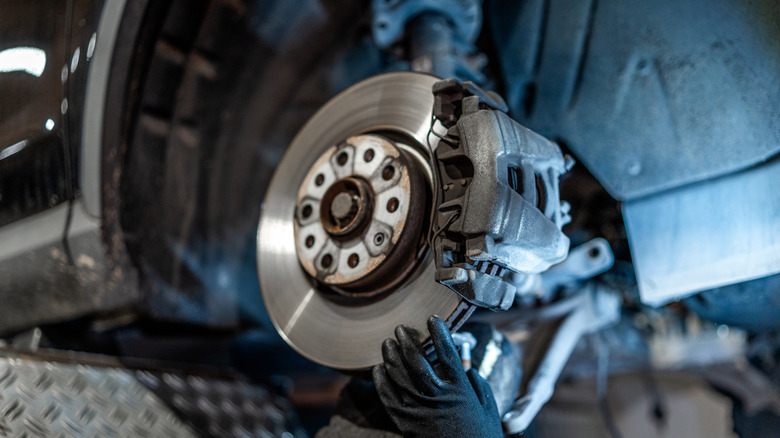
As we mentioned above, it's prudent to get the rotors replaced when you're getting the brake pads changed if possible. In some cases, if money is tight, certain garages might be able to resurface your rotors, though getting this done multiple times can be dicey, and you will have to eventually shell out for new rotors.
The brake rotors are what the brake pads grab onto, and are themselves attached to the wheel — more specifically onto the wheel hub assembly, which rotates with the wheel. Several customers I served during my apprenticeship at a VW garage seemed to think — confidently and incorrectly — that the rotors were attached to the axle. Depending on your driving style, people can have rotors last as long as 60,000 miles, or have them wear out as quickly as 30,000 miles or possibly even sooner in extreme cases. It's always a good idea to have the tech do a quick inspection with a caliper at your oil changes.
The prices for brake rotor replacement can range from about the high $500s to about $700, depending on the make and model of your car, with larger vehicles generally needing bigger and more expensive rotors. Signs that your brake rotors need replacement include that characteristic pulsing in the brake pedal, visible damage (scoring, cracks, grooves, etc) in the rotor, longer stopping distances than you're used to, and the formation of a lip at the outer edges of the rotor (where the pad ends up not contacting the rotor).
Spark plugs
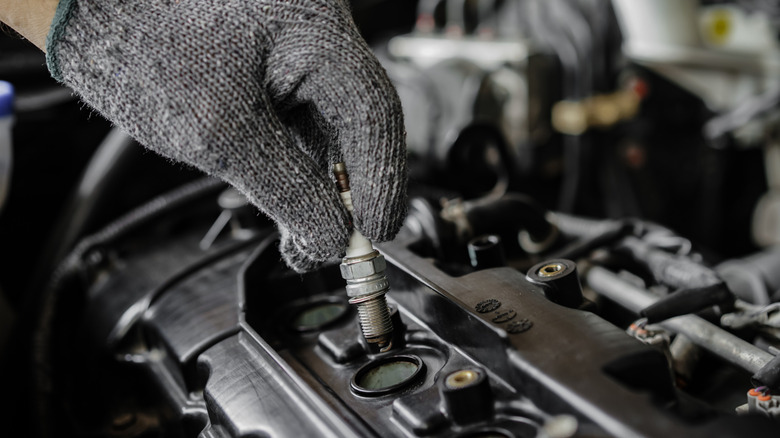
We should give readers a disclaimer that spark plugs aren't that common of a part to be changed — certainly not as much as say, engine oil — but they are a common enough issue to warrant being on our list. It's also worth mentioning that only gasoline engines have spark plugs, as diesel-powered units use compression ignition and not spark ignition. Spark plugs, like the name suggests, provide a spark inside the combustion chamber that ignites the air-fuel mixture, which is then converted into thrust.
You could also potentially find the correct spark plug kit for your vehicle (it can differ between models) much cheaper if you hunt around on online retailers like Wal-Mart, though it's unlikely you're going to worm out of the relatively high labor costs of this job. You could always do it yourself if you have the know-how, but changing spark plugs is a very knowledge and time-intensive job that is best left to the professionals unless you really like losing sprockets in your engine bay.
Also note that there are many different kinds of spark plugs available, though iridium units should get the job done just fine for most people's daily use cases. Budget about $300 on the lower end and $400 on the higher for most spark plug replacements, and that's including both parts and labor. The telltale symptoms of failing spark plugs include rough, erratic, or slow acceleration, lower gas mileage, rough idling, and engine misfires.
Serpentine belt
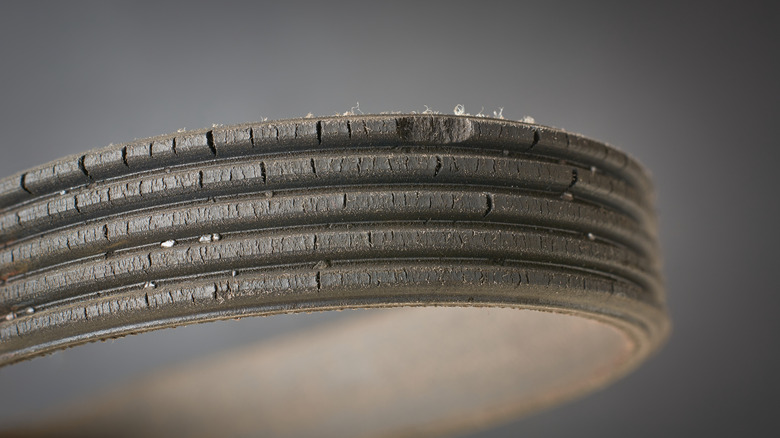
This part is also known as the accessory drive belt sometimes, and that's a pretty big clue as to what the use of the part is. The serpentine belt is a long belt that has ridges running lengthwise at regular intervals. It is driven by the crankshaft, and transfers power to several other key vehicle systems. Common systems that rely on the serpentine belt in most modern vehicles include the air conditioning compressor system, the water pump for the radiator(s) in your car, the power steering system, and the alternator unit.
If your serpentine belt fails or has reduced efficiency, you will immediately notice problems with your battery and its charging, the power steering becoming less responsive, and even the engine overheating if your ride's water pump is belt-driven. Characteristics of a loose serpentine belt include that irritating, jarring squealing sound after the car has been standing a while.
If your belt has visible damage to it, such as missing a few ribs (the "ridges" that we mentioned), or a glossy surface — since these are usually matte-finished — then your belt needs replacement. On most cars, this is luckily a fairly quick and easy job, depending on the location of the belt. Budget between $150 and $212 for an accessory belt change including parts and labor. Some cars, like certain V6 Altimas and Post-OBD-II BMWs can be more problematic. For example, with Beemers, the pulleys are below an air filter housing (under a shroud, no less!), so you'd be working blind.
Alternator
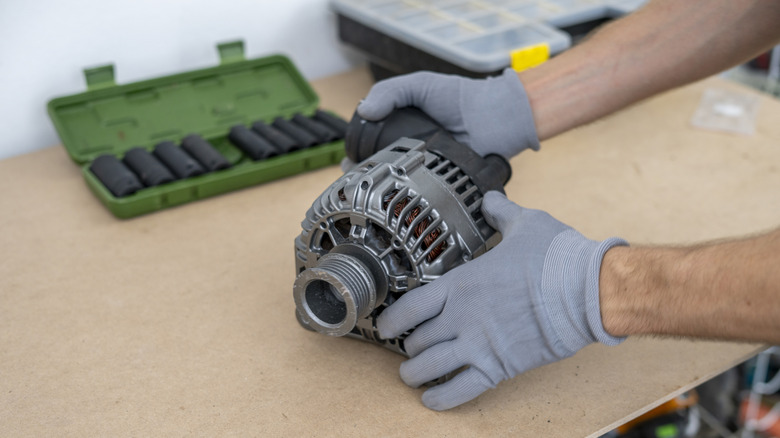
This little gizmo is what helps your car battery recharge while you drive. You start the car, the car battery helps it start, the engine powers the crank, the crank powers the serpentine belt, and the serpentine belt powers the alternator that then charges the battery. If your battery is not charging, the cause is usually going to be one of these two parts not working properly — now you know. Signs of a failing alternator include a weaker-than-normal battery, randomly dimming lights, an odd smell like melting rubber from the engine bay (though this can be from other causes too), and issues with the car turning over, especially when cold.
An easy fix to see if the alternator needs a closer look is to use a multimeter tool to test your battery voltage. To do this, put the engine on, turn on every possible electrical system (lights on, blast the AC, put the screens on, etc) and connect the multimeter to the battery. If it reads under 13.5 volts, ask a garage to take a peek at the alternator, as that's where the problem likely lies. Now, on many cars, the alternator is located rather low in the engine bay, meaning it can run into issues, especially with water. An alternator failing is not mega common, but chances are that it can happen to you. Unfortunately the fix is both labor and money intensive, coming in between $800 and $1,100 for both parts and labor. The cost can be even higher in some cases.