

The 2027 Nissan Rogue Hybrid Does Things Differently. Here's Why That's A Good Thing
Aside from pickup trucks, compact crossover SUVs are the most popular among new car shoppers. They've replaced midsize sedans as the default choice for people who just need a car, and don't fantasize about being a cowboy or construction worker.
That means there isn't much room for creativity here. Compact crossovers are popular because the existing template appeals to a very broader range of consumers. Given how important these crossovers are to an automaker's bottom line, it's not worth the risk of trying something different. Unless you're Nissan.
The last Nissan Rogue was a perfectly okay small crossover, and that just wasn't enough. Launching it in the midst of a pandemic probably didn't help either. That third-generation Rogue arrived in 2020 (as a 2021 model), and by 2024 Nissan was staring down financial ruin and a potential forced merger with Honda.
So while the 2027 Nissan Rogue Hybrid does something most competitors are already doing by introducing a hybrid powertrain, it does so in a different way. Nissan's e-Power system is unlike any hybrid system currently available in the United States, and it makes the new Rogue drive like nothing else in its competitive set (a non-hybrid version will arrive later). It's something unexpected in a market segment defined by the opposite.
e-Power to the people
Since the Toyota Prius popularized the concept, all hybrids sold in the U.S. have been some variation of the parallel type, where both an internal-combustion engine and electric motor (or motors) can directly power the wheels. The Rogue is a series hybrid, so its gasoline engine acts solely as a generator, with all propulsion handled by two electric motors. It's more like a diesel-electric locomotive than a conventional hybrid car.
Other automakers have come close to bringing a series hybrid to the U.S. The Chevrolet Volt could only use its engine to directly drive its wheels in a very narrow window, and the same is true of Honda's current hybrids. Potential issues like efficiency at highway speeds, as well as noise and vibration, made this the easier path.
It may also be why, even though e-Power debuted in Japan in 2016, and Nissan claims to have sold nearly two million e-Power hybrids in 68 countries since then, the automaker dragged its feet on bringing the system to the U.S. That's been discussed almost since e-Power's debut, and Nissan even once planned to build a new Infiniti lineup around these hybrids. That obviously never happened, but in the Rogue at least, e-Power was worth the wait.
Unassuming specs
However, that's not apparent from the spec sheet. The Rogue Hybrid's powertrain consists of an electric motor for each axle, providing standard all-wheel drive, powered by a 1.6-kilowatt-hour battery pack that's charged by a 1.3-liter turbocharged three-cylinder engine. This isn't the same engine used in the non-hybrid Rogue; it ditches the variable compression ratio system and is tuned to run at lower rpm, in line with its role as a generator.
Total system output is 225 horsepower, which is about 20 hp more than a Honda CR-V Hybrid and 30 hp more than a Subaru Forester Hybrid, but about 10 hp less than an all-wheel drive Toyota RAV4, which comes standard with a hybrid powertrain. Nissan says the Rogue Hybrid will do zero to 60 mph in 6.4 seconds, which won't impress car enthusiasts, but is more than fine for a car without sporting intentions. That's thanks to EV-like instant torque deployment.
Hybrids are all about fuel economy, though, and Nissan's estimate of 38 mpg combined (41 mpg city, 36 mpg highway) doesn't raise the bar. The CR-V Hybrid is EPA-rated at 37 mpg combined (40 mpg city, 34 mpg highway) with AWD, while an AWD RAV4 is rated at 42 mpg combined (46 mpg city, 39 mpg highway). And I averaged just 31.4 mpg over a day of driving, likely because the route consisted mostly of highways and backroads, so that 41 mpg city estimate didn't come into play.
Resets expectations for hybrid refinement
What really sets the Rogue Hybrid apart is the way it drives. With the gasoline engine pushed to the background, it sets a new standard for mass-market cars. Even under hard acceleration, there's hardly any discernible engine noise. And because there are no clutches or Toyota-style planetary gearsets to deal with, the application of power is as smooth as can be. Nor is there any delay, even in situations where the battery might be low, such as an overtaking maneuver following sustained highway-speed running. Other hybrid crossovers seem crude by comparison.
The Rogue Hybrid also boasts strong regenerative braking like an all-electric car. In its maximum setting, you don't need to use the brake pedal in most of the time, and regen can bring the car to a stop given enough distance. For urgent braking, a "smooth stop" feature lets you stand on the pedal while software automatically modulates braking force to ensure unsecured items in the rear seats don't become projectiles.
 Stephen Edelstein/SlashGear
Quietness and smoothness are qualities normally associated with luxury cars, so what Nissan has achieved here is impressive. And the Rogue Hybrid has inoffensive, well-damped suspension tuning that contributes to the feeling of comfort. But it doesn't cater to driving enthusiasts. The very calmness that makes it a great daily driver is also a barrier to engagement.
It's not just another SUV
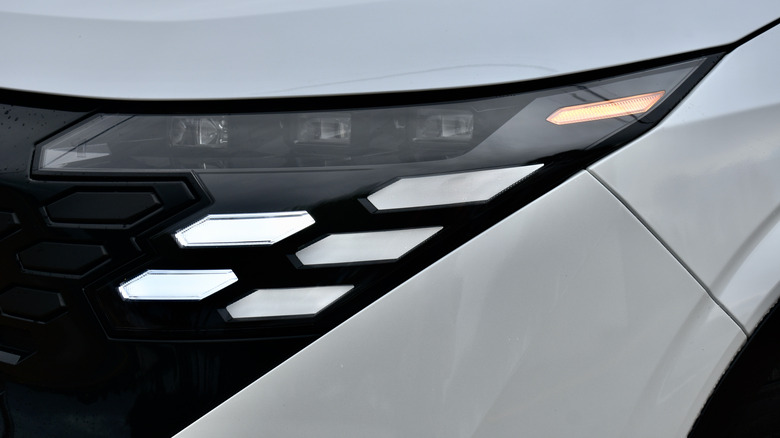
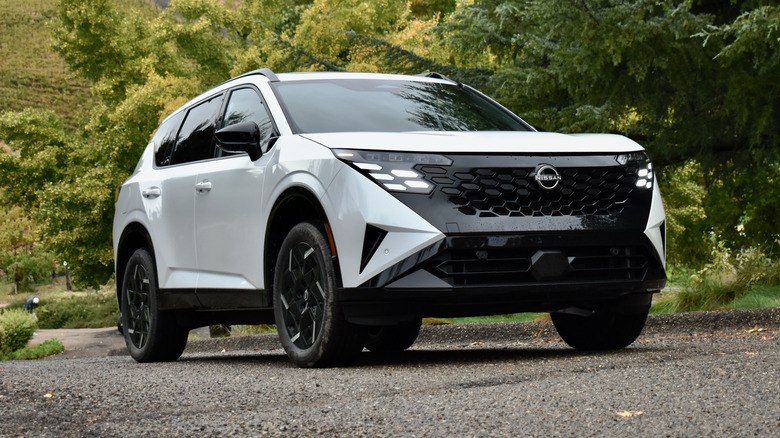
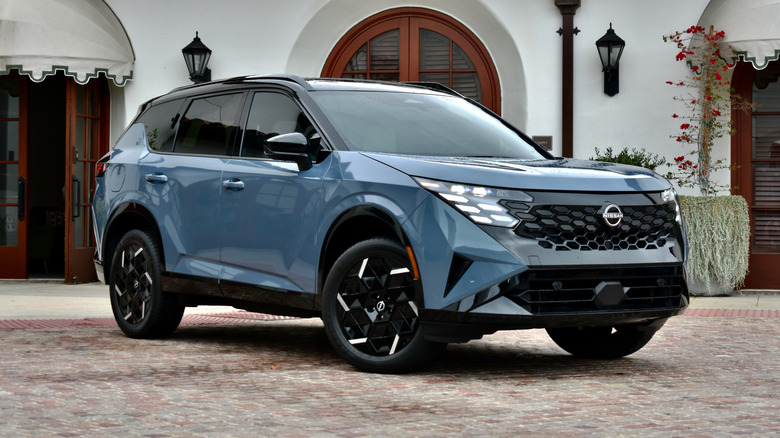
The unorthodox hybrid tech is wrapped in imaginative design. Instead of boxy, truck-like styling a la RAV4 and Forester, Nissan embraced the Rogue's car-based roots, just as it did with the memorable first-generation Murano.
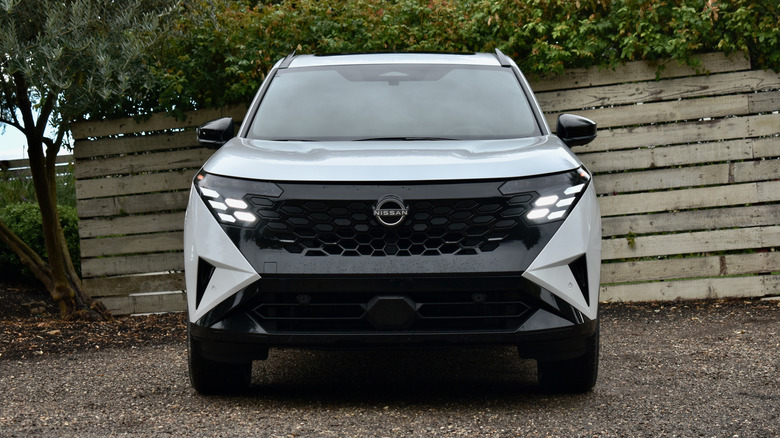
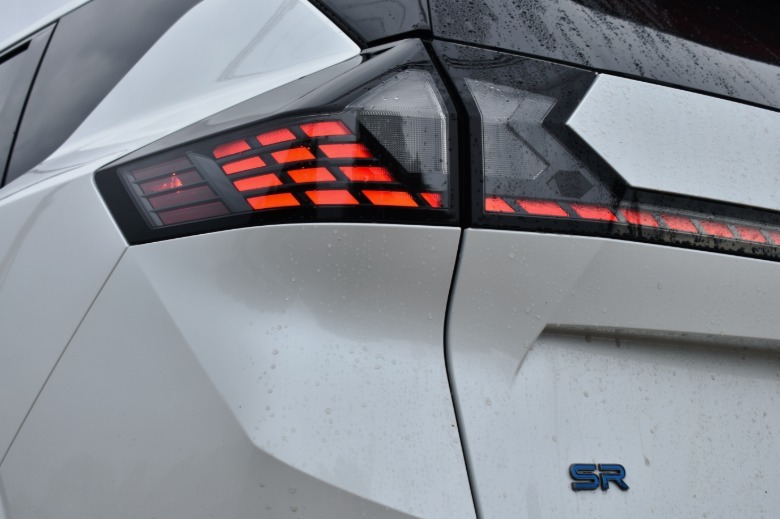
This fourth-generation Rogue deliveries the faceted design theme of the future we've been promised by countless concept cars and sci-fi art pieces. And it works, thanks to an impressive attention to detail. The headlights nicely blend with the grille thanks to pixel-like elements, and the grille in turn is nicely framed by the surrounding body panels and air intakes. The latter direct air around the front wheels to create a curtain effect that reduces drag.
 Stephen Edelstein/SlashGear
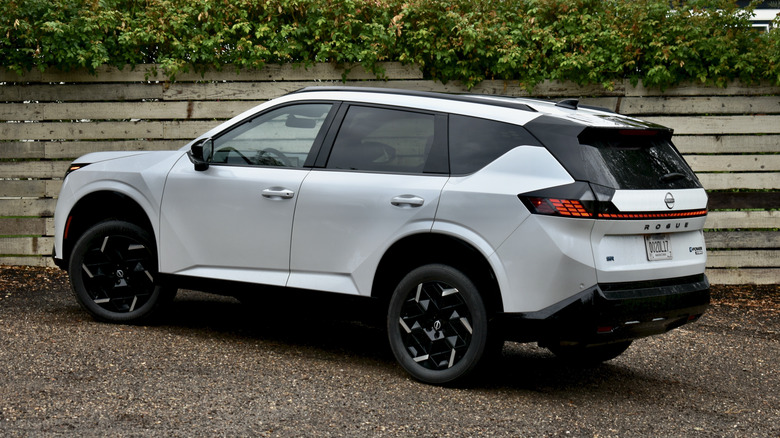
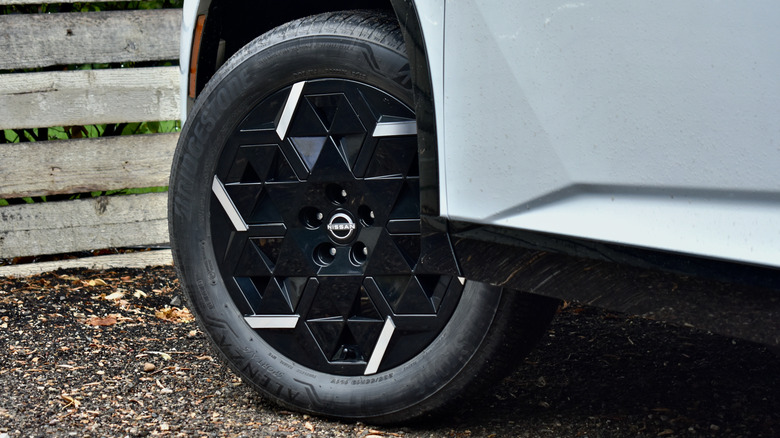
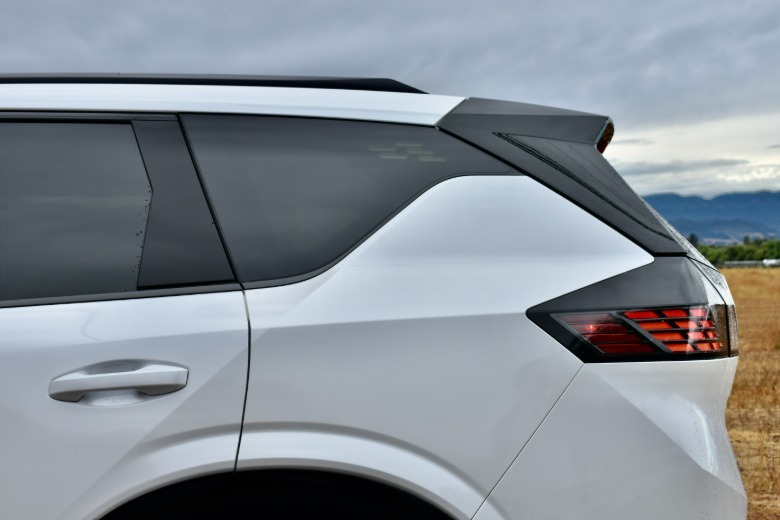
The Rogue's silhouette is that of a traditional SUV, a nonnegotiable item because of buyer tastes and the need for an elevated driving position and maximum interior space. But the faceted theme is still apparent in how the body is broken up into a central hexagon encompassing the passenger compartment, with sharp lines forming the front and rear fenders branching off it.
Every time I glanced at the Rogue, I found interesting details like these. And when I stepped back, they all blended together into a pleasingly cohesive whole. This isn't a car that instantly overwhelms the viewer with its beauty, but it's not one you'll get tired of looking at either.
Interior overdelivers on style, but not space
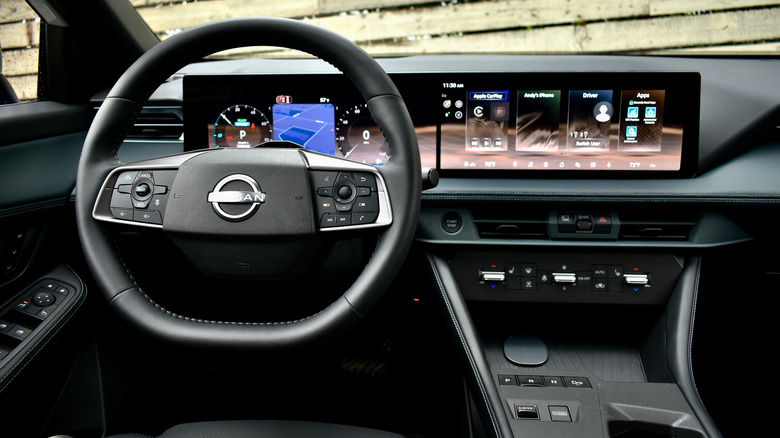
The test car's interior was also more stylish than the segment norm. Nissan only had midlevel SR models with the optional Technology Package on hand, as these will proceed other trim levels to dealerships by a few months. As equipped, the Rogue Hybrid put a slightly pricier Toyota RAV4 Limited Nissan had on hand for comparison to shame.
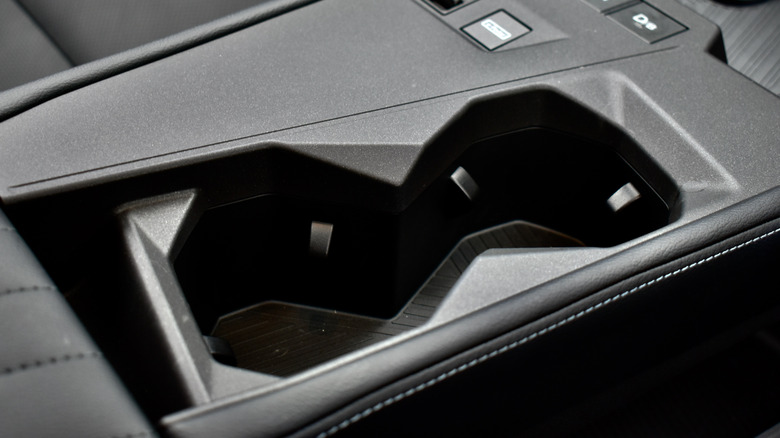
In contrast to the RAV4's dreary all-black interior, the Rogue's was a more welcoming mix of gray and light blue. The Technology Package also includes leatherette seats with quilted stitching inspired by puffer jackets. The door armrests are angled like they're reaching for the dashboard, and the cupholders look like craters made by very large D&D die. It's a stark contrast to the indifferent interior design of the Toyota. Nissan also chose plastics with a non-reflective satin finish and a simple layout for the controls, including the pushbutton shifter, which makes Honda's and Toyota's versions look needlessly complex.
The rear seats are less hospitable, with less legroom than competitors. At 34.4 cubic feet, cargo space behind the rear seats trails the RAV4, Honda CR-V Hybrid, and Kia Sportage Hybrid, but surpasses the Subaru Forester Hybrid and Jeep Cherokee. The 65.9 cubic feet of space with the rear seats folded is an unqualified last-place figure. But the Rogue is still a very spacious vehicle for people who, a generation ago, would likely have been buying a midsize sedan.
Straightforward interface with worthwhile tech extras
The screen layout sticks closer to orthodoxy than the rest of the interior. The redesign replaces the separate instrument cluster and infotainment touchscreen with matching panels placed side by side to create one long display. The screens measure 12.3 inches as standard, but 14.3-inch versions are optional. Wireless Apple CarPlay and Android Auto remain standard, with Google Built-In apps and Wi-Fi connectivity (the latter requiring a subscription) on higher trim levels.
The screens and their quick responses are thoroughly modern, but the graphics are not. Gauges and touchscreen icons float off the background in a way that's unintentionally retro. It's also a bit disconcerting, as the background has graphics of its own that can sometimes be hard to mentally separate at a glance. Menu layouts are pretty straightforward, though, and Nissan included physical controls (not haptic touchpads) for vital functions like climate control, audio volume, and driver aids.
Nissan also provides some unexpected features, like a magnetic device charger (with an option for two) and wide-angle and "transparent hood" views for the 360-degree camera system. The version of Nissan' ProPilot Assist driver-assist system offered here only offers hands-free operation at lower speeds, but it doesn't require a subscription like the full-speed hands-free version does.
2027 Nissan Rogue Hybrid verdict
Nissan originally planned for the new Rogue to be a 2028 model, and so its rollout is happening in stages. The SR trim level with the optional Technology Package should be arriving at dealerships as you read this with a $43,065 base price. The rest of the 2027 Rogue Hybrid arrives in early 2027, including an SR model sans Technology Package that's $4,000 cheaper.
An SV trim level will slot below the SR with a $37,065 base price. There will also be a $2,100 Premium Package for the SV, and a top-shelf Platinum trim level starting at $45,065. The previous-generation, non-hybrid Rogue also remains on sale for 2027. It will be replaced by a non-hybrid version of the car you see here for 2028.
The Rogue Hybrid should land roughly in the middle of the segment when it comes to pricing. That, along with its just-average fuel economy and unproven hybrid system, might make it less appealing to consumers looking for a commuting and errand-running appliance. And that's fine, because there are plenty of those in this segment already.
Nissan focused on the things that make cars interesting. The Rogue Hybrid makes a design statement and its interior delivers more than just basic function. While it's not sporty, it's better to drive than the competition, and Nissan achieved that in a way that engineering nerds will appreciate. If nothing else, the Rogue Hybrid is something different, and we could certainly use more of that.