

Jeep's New Hybrid Cherokee Has RAV4 And CR-V In Its Sights, But Does It Deliver?
Everyone loves the Jeep Cherokee. Even people with just a passing interest in anything automotive probably recognizes a classic XJ Cherokee and starts smiling. I know I do. Next to the Wrangler, it's one of the more famous Jeeps to every wear slats on the grille. Other than the collector prices well-maintained examples garner today, I have scarely a bad word to say about classic Cherokees. However, the XJ left us in the early 2000s and there were a few years were the automotive scene was Cherokee-less.
Then, in 2014, Jeep resurrected the Cherokee with a much less boxy design, a high tech (for the time) nine-speed automatic transmission, LED lights, a fancy turbocharged four-cylinder, and rather good fuel economy for the era. The styling definitely leaned more towards crossover SUV than cardboard box like the XJ, but it was a proper off-roader like a Jeep should be, locking rear differential and all.
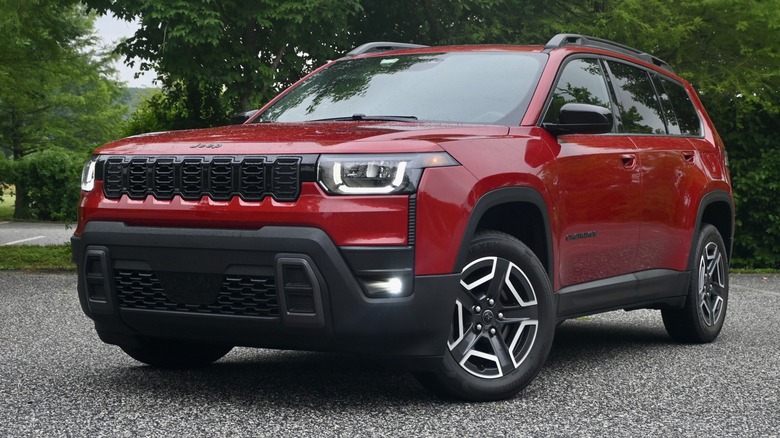
Now, after a few model years in the wilderness, the Cherokee is back with a huge redesign. It's boxier, has a hybrid drivetrain as standard, and is poised to be a more entry-level model into the Jeep family, as opposed to luxo-models like the Grand Cherokee or Wagoneer. For SlashGear, I covered Jeep's announcement of the new Cherokee a number of months ago and I was optimistic about Jeep's attempt at a more efficient and angular model in the Jeep repertoire, so I was more than ready when a red 2026 Jeep Cherokee Laredo showed up.
A new chiseled Cherokee
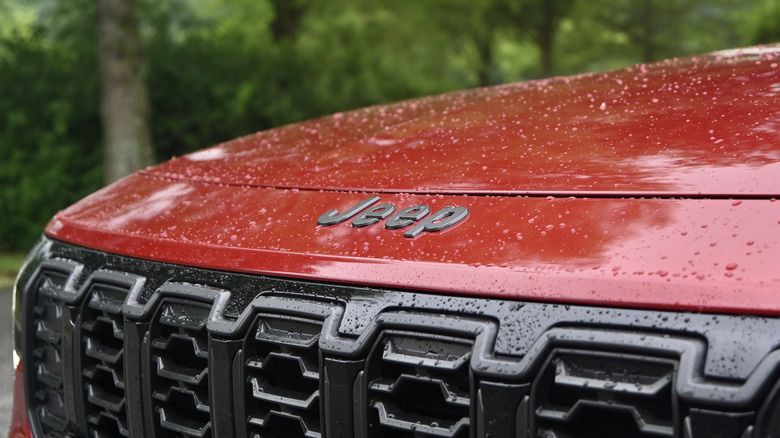
Like every Cherokee from the XJ on, the new Jeep is a unibody crossover-ish SUV that purports to extol an off-roading or otherwise "Trail-Rated" lifestyle. In this current iteration, that takes the form of a 1.6-liter engine that works with two electric motors to give 210 horsepower and 230 pound-feet of torque. More importantly, it nets a combined 38 miles per gallon (I saw close to 40 mpg when I was driving carefully). Gone are the days of the gas-thirsty six-cylinders (as good as the old 4-liter was).
Stylistically, I like it a lot. I've never been a crossover hater, but at a certain point, all the compact SUVs start looking the same. Jeep broke out the rulers and straightened out all the edges with the styling. In the greater scheme of the Jeep lineup, it fits with the rest of the Jeeps like the aforementioned Grand Cherokee. It really does just look like a scaled down Wagoneer.
Not all that exciting
But how is it to drive? Even though this is the first year for this drivetrain and one of the scant few non-plug-in hybrids Stellantis has ever offered in North America, I didn't run into any teething issues. It was smooth and didn't really make too much noise at all. I suspect that the electric motors take up a lot of the drivetrain work, while the gas engine keeps things happy.
I was most impressed with the fuel economy. Just by nature of being a little frugal, I try to wring out every possible MPG while driving and I'm pleased to announce that I could get over 40 mpg when I was trying. That's impressive for any hybrid SUV, and otherworldly for a Jeep.
It wasn't all that exciting in the handling department, but I don't expect that from a near entry-level SUV with 200 and change horsepower. It felt confident on the dirt road where my parents live and, in classic Jeep fashion, it excelled when the weather got sketchy. Just don't expect it to be a rally car or plan on doing any Paris to Dakar runs with any amount of expediency. On-road driving was just fine, and really a huge step up from the milk crate-like handling of the old XJs.
An unpretentious hybrid
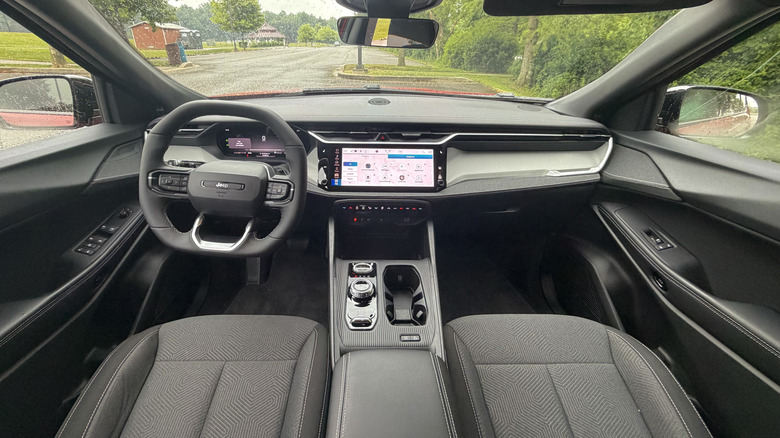
On the inside, it's a Jeep, and not one of the luxury models either. The Laredo trim I drove was well-equipped enough with power seats, rain-sensing wipers, and a sun-roof, but it wasn't all that luxurious. It did have cloth seats after all. But I don't want to frame this as a bad thing: Modern SUVs tend to have a bloat problem and aspire to be a luxury car. The Cherokee makes no such proclamations outside of a few nice creature comforts. It's comfy and unpretentious. But if you want to be fancy, there are higher trim levels. Personally I thought Laredo was more within the general no-nonsense Jeep ethos and a perfect trim for first impressions.
In fact, I genuinely liked the 2026 Jeep Cherokee. I can't find anything "wrong" with it apart from some few rattly interior bits or little quality quirks here and there. But that's to be expected with the few first year of production and especially a very early vehicle like I drove. Assuming Jeep can iron out those issues over time, and keep up with battery and electric motor production while also keeping prices sane, I think the brand could have a good mass-market seller on their hands. Just the Jeep Cherokee name alone is going to sell more than a few models.
Pricing out the Jeep
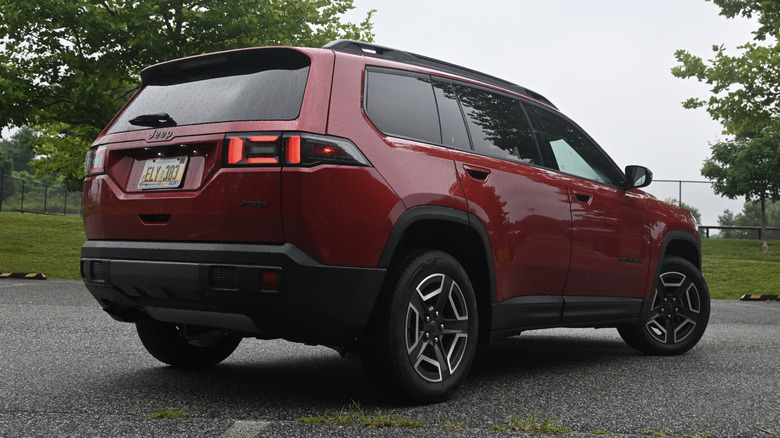
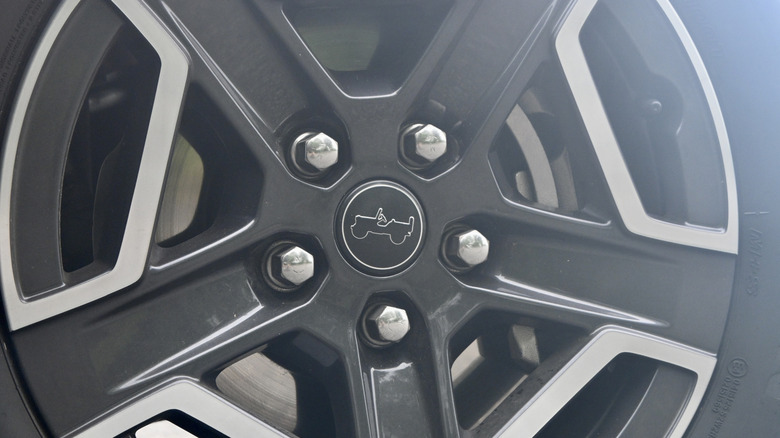
There's also the price to reconcile with. The starting price is a flat $35,000. The Laredo trim gives you fog lights, more chargers, 10-way power seats, remote start, and 18-inch aluminum wheels. It starts at an even $38,000. The sole option on the model I drove was the dual-pane sunroof that cost an extra $1,595. Throw in the destination charge of $1,995 and you very efficiently arrive at the final price of $41,590.
If you pick and choose your options, you can absolutely get a new Cherokee for substantially under $40,000. For an SUV that can get 38 miles per gallon from the factory, that's not a bad deal. But the Cherokee doesn't exist in a vacuum, so how does it stand up against the competition? Well, among American brands, GM is right out because it doesn't offer a hybrid SUV. For Ford, the least expensive hybrid SUV is the Ford Escape. However, it is not currently certified for sales in a few states for emissions issues, so that might not be a great contender.
2026 Jeep Cherokee verdict
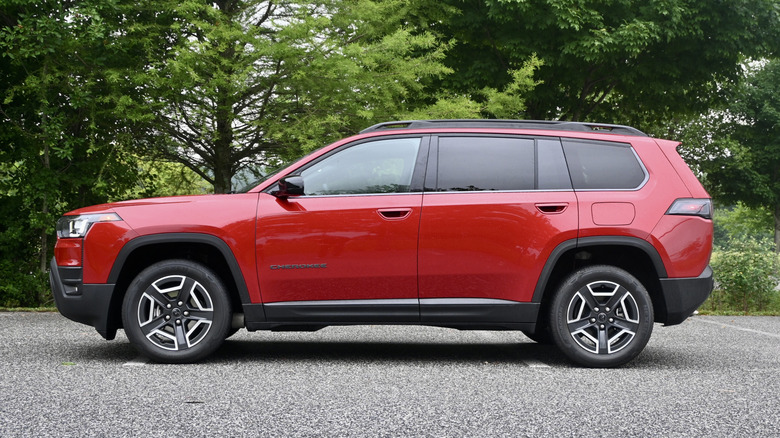
That leaves the 2026 Cherokee facing down the titans of the segment, the Toyota RAV4 Hybrid and the Honda CR-V Hybrid. All three — the Jeep, the Honda, and the Toyota — are very competitive in fuel economy, general interior feature set, and storage capacity. Both the RAV4 and the Cherokee can tow 3,500 pounds; the CR-V Hybrid falls short at only 1,000 pounds. For storage, the Jeep can fit 68.3 cubic feet behind the front seats. The RAV4 Hybrid has 70.4, and the CR-V Hybrid has 71.8.
However, the real kicker is that although the RAV4 and CR-V Hybrid can mostly be obtained for less than the Cherokee I drove (the Toyota starts at $31,900 and the Honda starts at $35,630), neither crossover comes with all-wheel drive — or really any off-roadiness — as standard. You have to upgrade to the RAV4 Woodland or CR-V Hybrid Trailsport for the Cherokee-chasing privilege, or tack on extra costs for all-wheel drive on lower trims ($1,200 for Toyota and $1,500 for Honda).
If you are already predisposed to liking Jeeps, the decision is pretty much made for you. However, if you are brand agnostic, there's a hard choice ahead. We already know that the RAV4 Hybrid and CR-V Hybrid are good: They've each been successes for years. But a new contender has joined the normcore hybrid SUV fight, and it's one that has more than a chance of making the other big brands take notice.