

8 SUVs Quicker Than A Mazda MX-5 Miata
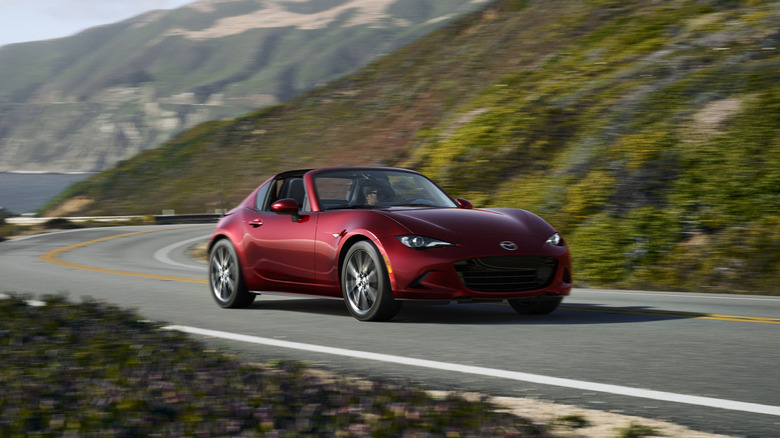
At the lower end of the sports car segment, you'll struggle to find better value for money than the enduring Mazda MX-5. If you want a lightweight, analog feel behind the wheel over outright power, this compact Japanese car will deliver exactly what you're looking for.
Weighing just 2,366 pounds, Mazda aims for a 50/50 weight distribution, with the 2.0L four-cylinder engine helping the car hit a sweet spot in overall power-to-weight ratio. 181 horsepower and 151 pound-feet of torque might not sound like much, but thanks to its low weight, it still goes from 0 to 60 mph in 5.5 seconds, and the ST costs only $30,370.
As good as the MX-5 is as a small, lightweight driving machine, practicality isn't exactly its strong point. It's pretty much out of the question if you need space for the family or a generous amount of cargo room. If you can spend a bit more (sometimes quite a lot more), a solid selection of SUVs can beat the MX-5's off-the-line performance, with many shaving off half the time it takes to reach 60 mph. Some also put driving dynamics high on the priority list. Here's a look at eight SUVs that beat the latest Mazda MX-5.
Audi RS Q8
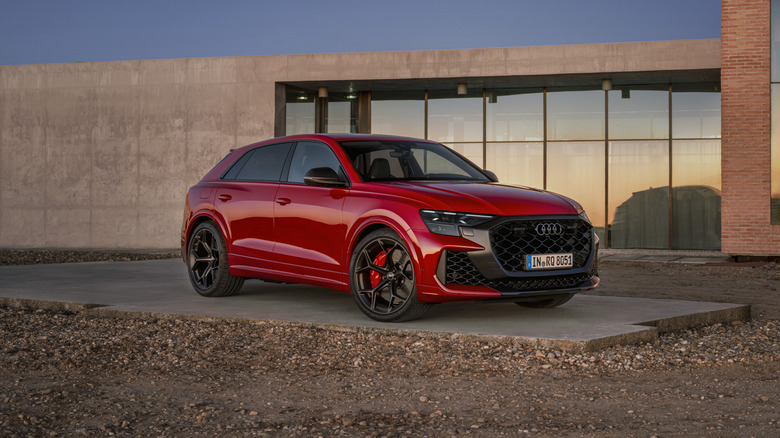
Despite Audi investing heavily in its EV lineup in recent years, the manufacturer's most powerful SUV still runs on gas. Introduced in 2019, Audi took its midsize SUV, gave it a racing-sport treatment, and began production of the RS Q8. As of 2027, it's still in its first generation, though it received a 2025 model-year refresh. The styling updates made an already appealing SUV even better, but the real talking point was under the hood.
While early RS Q8S already produced 591 horsepower, the newest models bump that to 631 horsepower and 627 pound-feet of torque, thanks to the twin-turbocharged 4.0L V8. With the RS 6 gone, the RS Q8 is the most powerful combustion-powered Audi by a wide margin. Official numbers list 3.4 seconds to go from 0 to 60 mph, but Car and Driver testing clocked 3.1 Seconds. Not bad for a car about 3,000 pounds heavier than the MX-5.
Rivian R1S
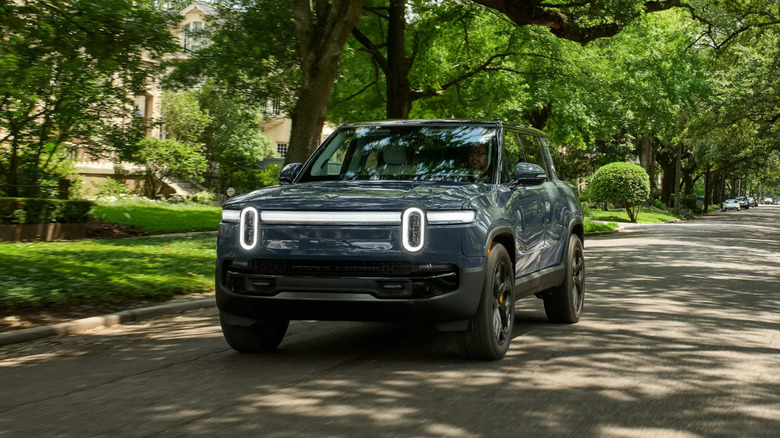
Mazda won't sell any pure EVs through 2027, the complete opposite of California-based Rivian. Since the R1S SUV and R1T pickup launched in 2022, Rivian's direction has been clear, and the massively improved 2025 R1S helped fully realize it. Right now, three trims of the flagship SUV are available: the Premium, the Performance, and the Quad. The specs differ significantly, but all three unsurprisingly blow the MX-5 out of the water in acceleration.
Electric power still isn't for everyone, but if you don't mind ditching a traditional engine, Rivian's offering is incredibly tough to beat for raw performance and practicality. Starting with the Premium trim, it hits 60 mph in 3.4 seconds thanks to the dual-motor setup. The tri-motor Performance ups the output to 850 horsepower and a 2.9-second 0-60 mph time, and the Quad trim gets there in 2.6 seconds, making it the fastest SUV MotorTrend has ever tested, with a massive 1,025 horsepower that lets it beat most supercars on sale right now.
Lamborghini Urus SE
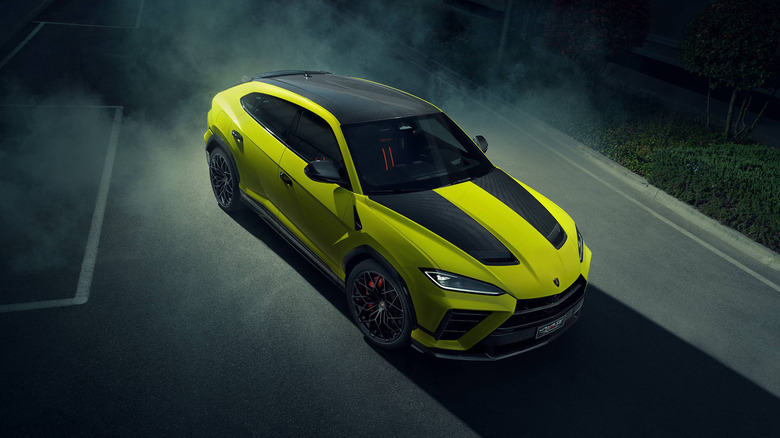
Since Audi owns Lamborghini, it's no surprise that the Italian brand gets many core components from its parent company. As for core components, some Lamborghinis share engines with their German counterparts, though that's rare now after the recent string of discontinuations. One relationship that still exists, though, is that the Urus shares an engine with the RS Q8. However, since 2025, the plug-in hybrid Urus SE is the only one you can buy, making the SUVs very different.
The twin-turbo 4.0L V8 is still used, but paired with an electric motor, it produces 789 horsepower in the standard SE trim. For 2027, Lamborghini has reintroduced the Performante badge for the Urus, this time as the SE Performante. As you might have guessed, this pushes the hybrid powertrain even further, producing 801 horsepower and 738 pound-feet of torque. The result is a 3.3-second 0-100 KMH (or 0-62 mph) time, according to the manufacturer.
Dodge Durango SRT Hellcat
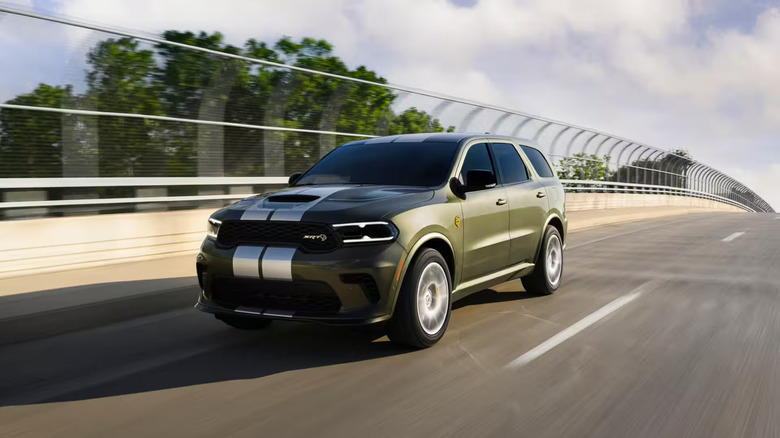
Several all-American SUVs top the timing sheets for acceleration, many of them either electrically assisted or a full-on EV. If you want a pure, gas-powered SUV that delivers extreme performance, though, Dodge has had the answer since 2021: the Durango SRT Hellcat. The Durango is the only SUV left in the lineup after the Hornet was axed, and its trims cover a wide spectrum, but all still have a performance-focused edge.
The base trim produces 295 horsepower, while the HEMI V8 on others bumps it to 360. The SRT Hellcat jumps up significantly, though, with 710 horsepower and 645 pound-feet of torque from the supercharged 6.2L V8. Gas mileage is low on the priority list here, but if you want blistering speed from a muscle SUV, the 2027 Durango SRT Hellcat hits 60 mph in just 3.6 seconds.
Hyundai Ioniq 5 N
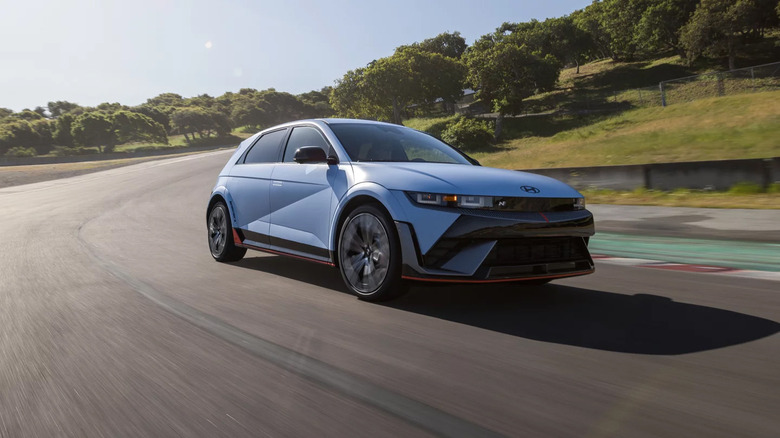
Performance isn't the main focus for most of Hyundai's Ioniq lineup; it prioritizes efficiency and affordability. The departure of the standard Ioniq 6 has shortened the lineup, though the 6 N is still set to come to the U.S.; the Ioniq 5 and Ioniq 9 SUV now have to do all the work. While the former is frugal and practical in its base guise, the compact SUV is also where Hyundai has branched into the performance SUV market, giving it the N treatment and making the most of its powertrain to make it as track-ready as possible.
Made available in the U.S. in 2024, the Ioniq 5 N has drawn more attention than the N Line cars that came before it. Its maximum 641 horsepower has helped, thanks to the dual-motor setup that also provides all-wheel drive as standard. As a result, it was the fastest SUV MotorTrend tested before Rivian bolstered the R1S, reaching 60 mph in 2.8 seconds. At $59,900, it also undercuts the EVs it competes with on performance.
Aston Martin DBX707
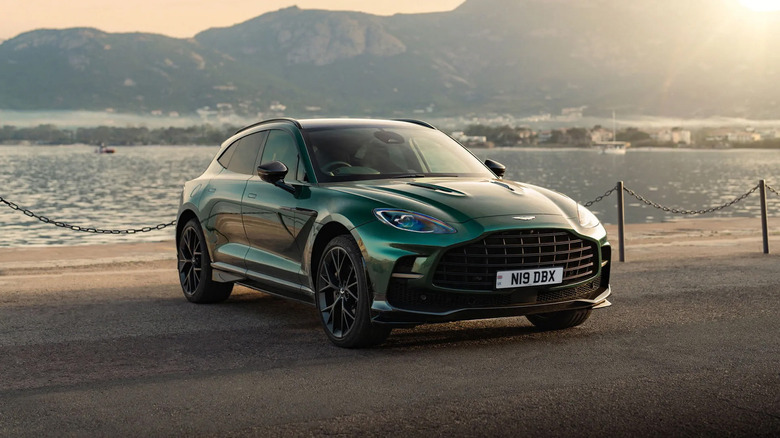
SUVs like the Lamborghini Urus have few direct rivals, as most manufacturers prioritize either luxury or supercar-esque performance and rarely combine the two. However, one brand that goes head-to-head with the Raging Bull is Aston Martin, with the DBX707 putting down some pretty impressive numbers in its own right. A manufacturer that's always prided itself on industry-leading luxury, you won't find a shortage of top-tier materials and cutting-edge tech inside, but the SUV's power is arguably its most impressive feature.
Powered by a 4.0L twin-turbocharged V8, the latest DBX707 produces a healthy 697 horsepower and 664 pound-feet of torque. You used to be able to get a less powerful DBX with 542 horsepower, but the 707 is now the only option. That's not a bad thing, though, because if you can afford one of these, you may as well get the one that goes from 0 to 62 mph in 3.3 seconds. This matches the Urus SE Performante without needing any hybrid assistance.
Ford Mustang Mach-E Rally
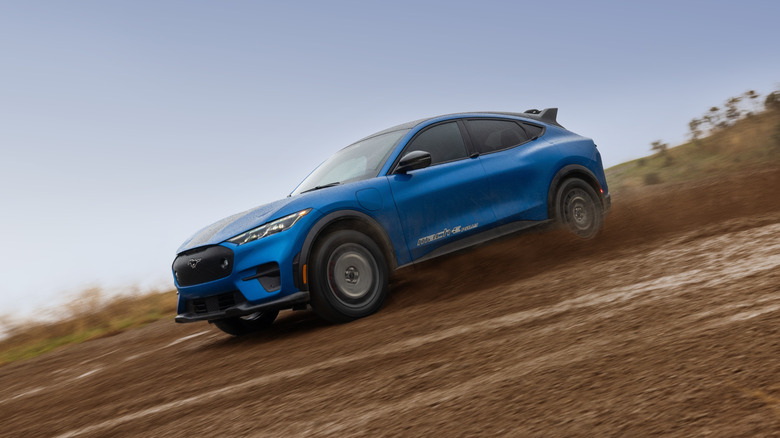
The Mach-E has been on the market long enough now that it's almost developed its own identity, rather than being trapped in comparisons to the standard Mustang, a completely different car. Putting the Mustang name on an electric SUV was certainly a bold move, but the Mach-E doesn't fall behind on performance compared to its two-door muscle counterpart, especially as Ford has continued to roll out more extreme versions since its 2020 introduction.
Car and Driver tested the base Select trim, which hit 60 mph in 5.6 seconds, just behind the MX-5. However, the top-spec Rally trim gets things closer to R1S and Ioniq 5 N territory, with a 0-60 mph time of 3.1 seconds. With a dual-motor setup as standard, the Rally trim (hence the name) also gets plenty of upgrades to make it just as capable off-road as it is on the tarmac. If you don't need MacPherson front struts or rallycross-tuned dampers, the GT trim makes the same 480 horsepower and hits 60 mph in a slightly slower 3.3 seconds, but still well ahead of the Mazda.
Porsche Cayenne Turbo GT
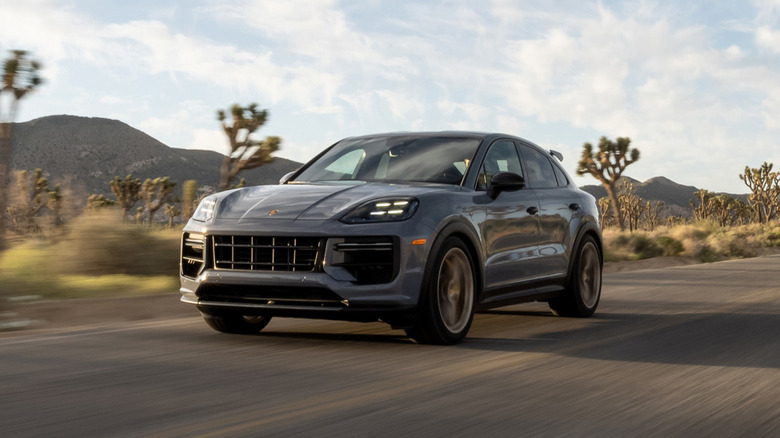
Another SUV that competes in the ultra-luxury performance segment comes from Porsche. It doesn't get as much attention as its direct rivals, but on paper and on the tarmac, the Cayenne Turbo GT is every bit as fast as the Urus and DBX707. Porsche isn't exactly new to making cars that pair incredible driving dynamics with raw speed, and the 911 and outgoing 718 are hard to beat in their own segments. The same effort goes into the top-spec Cayenne, with the manufacturer's adaptive suspension, dynamic chassis control, and torque vectoring included.
For the engine, Porsche also opts to run the Turbo GT on pure combustion power, despite lower trims using hybrid systems. A fully electric version is on the way, though. But the current model's twin-turbocharged 4.0L V8 doesn't need any help, producing 650 horsepower and 628 pound-feet of torque. Porsche says the SUV will go from 0 to 60 mph in 3.1 seconds, but MotorTrend gets it there in 2.9 seconds. These numbers don't come cheap, though, with a $214,800 price tag.