

11 Cool Mini-Gadgets You May Not Realize Exist
With so many new gadgets being pumped out into the market lately, it's easy to focus on mainstream devices and fail to notice some nifty little ones. There are many tiny devices built to solve specific problems or are just nice-to-have everyday carry gadgets. For instance, you could get yourself a power bank that literally splits into two to share with friends, or own a remote-controlled paper plane to play around with. You could also splurge on a Discman to relive the '90s.
These three devices are just a few of the 11 mini-gadgets you may not realize exist. We're going to look at how each one of them works, what makes it interesting, and whether it may be worth your while if you have the budget. Nine of these are 2025 releases or newer, with the other two having come out in 2020 and 2024 — so they are still relevant and solid mini-gadgets in case you want to get yourself one.
Maglynx MagSafe Charger
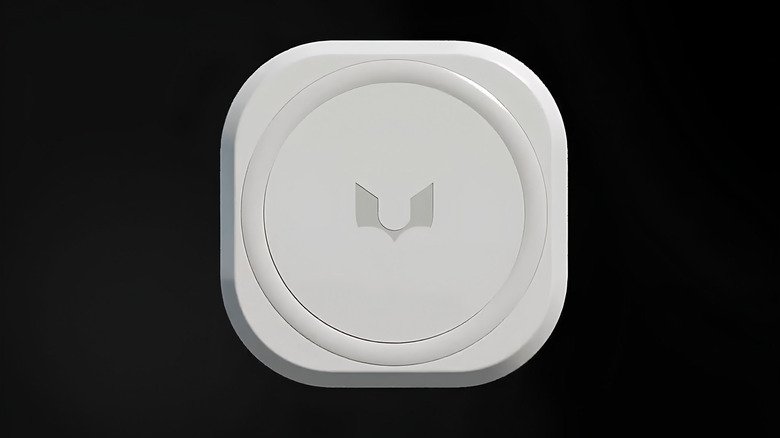
Most wireless chargers aren't really wireless, as you'd still need a cable to pull power from an outlet to the charging unit. The upcoming Maglynx MagSafe Charger might be one of the few exceptions, as it plugs directly into an outlet, eliminating the need for a cable. Your compatible devices, like iPhones or AirPods, then attach magnetically and remain suspended against the wall alongside the charger.
With everything connected and charging, the outlet area basically becomes a minimalist charging dock. Once you're done wirelessly charging your device, you unplug the Maglynx, fold the retractable prongs, and throw it in your pocket or bag for on-the-go use. There's a slightly more advanced model (Maglynx Pro) that supports Apple Watch charging above the main charging pad — plus a USB-C port if you want to charge other devices.
The upgraded model is particularly useful if you want a single charger for all your devices on the go. It lets you charge both wireless- and wired-charging devices, like headphones and tablets. At the time of writing, the Maglynx is yet to be released, and there's still no official release date. It's been plagued by delays, so it's just a waiting game for now. The idea isn't bad at all — if it does eventually see the light of day, it's one of those minimalist gadgets that would be hard to resist if you want to reduce clutter around your workspace or in your backpack.
Nimble Share Power Bank
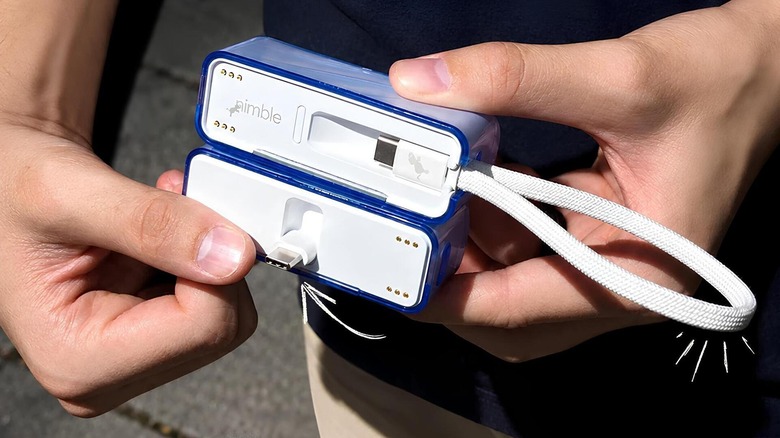
When out with friends or family, a thoughtful gadget like the Nimble SharePower will offer juice to two people at once. Not in the way you think — by connecting two phones to one power bank. Instead, you literally split the 10,000mAh power bank in half. You keep one, and the second person can use the other half across the room or even leave with it. Now you have two independent 5,000mAh power banks, each capable of providing up to 20W. When you snap them back together via magnets and pogo pins, they become one larger-capacity power bank, the size of a deck of cards, with a higher 35W total output.
The two parts of the Nimble SharePower are slightly different. One half uses a flip-up USB-C plug, so it goes directly under a phone without a cable. The other half has a built-in USB-C cable, which also doubles as a lanyard for carrying the power bank. At first glance, it looks a bit gimmicky, but I can see how this unusually clever gadget can come in handy for people who move around in groups.
Tiny Vinyl Player
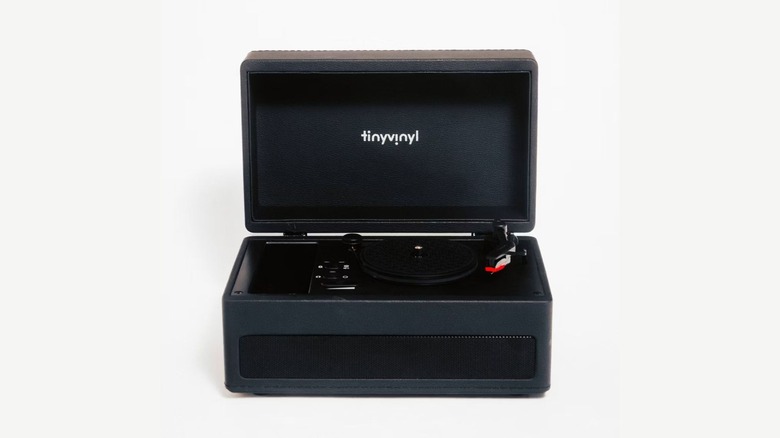
If you're into vintage music players, you can relive the old times with the Tiny Vinyl Player. This is no ordinary vinyl player — it's built for the brand's Tiny Vinyl records, which carry one song on each side. These small records can also work on many standard turntables, so this little player is more of a novelty than a requirement to play them. However, at just $50, it would be worth considering one if you fancy building a playable miniature music collection.
The Tiny Vinyl Player is covered in faux leather on the outside, and it features built-in speakers, a control panel, and storage designed to carry up to five records. The internal speakers are tiny, so you might want to use good-quality external speakers via Bluetooth or wired output for the best listening experience. Like a full-size vinyl player, this device's tonearm and lock are delicate and should be handled with utmost care. It's an inexpensive collectible and a fun gift, and it can serve as a kid's first functional record player.
Insta360 Snap Selfie Screen
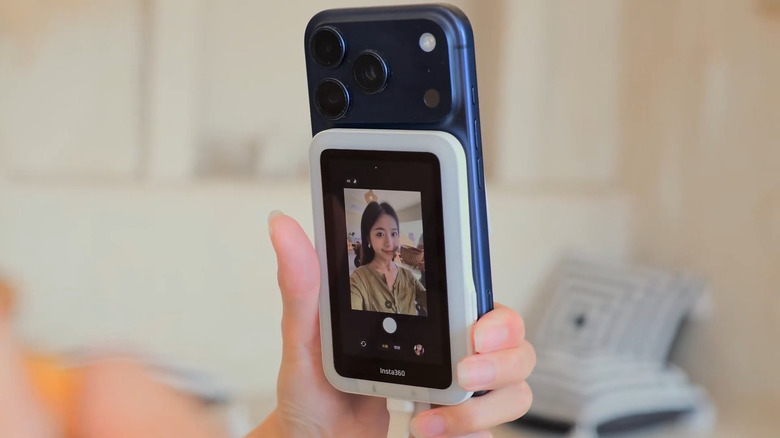
When self-shooting photos or videos on your phone, the only options you have are using the front camera or standing in front of a mirror if you want to utilize the superior rear lenses. However, this isn't practical on non-foldable phones, and the Insta360 Snap Selfie Screen supplies the missing viewfinder when using the rear camera. It's just about the size of a standard MagSafe wallet when attached to the back of a phone. Once attached, you connect it to your phone via USB-C, and it will mirror whatever's on your screen. The cable also supplies power from your phone to the screen.
The Insta360 Snap has touchscreen support, which you may have to enable through your phone's settings. Once you've set it up, you can pinch to zoom, switch between modes, take photos, and even operate your apps from the back of your phone. To boost how your photos and videos look, the screen adds a built-in LED with adjustable color temperatures — there's also a variant without the light that costs $10 less. It also has a folio cover to protect it from scratches and accidental screen touches when your phone is in your bag or pocket.
Mondo Robotics' Beni robot
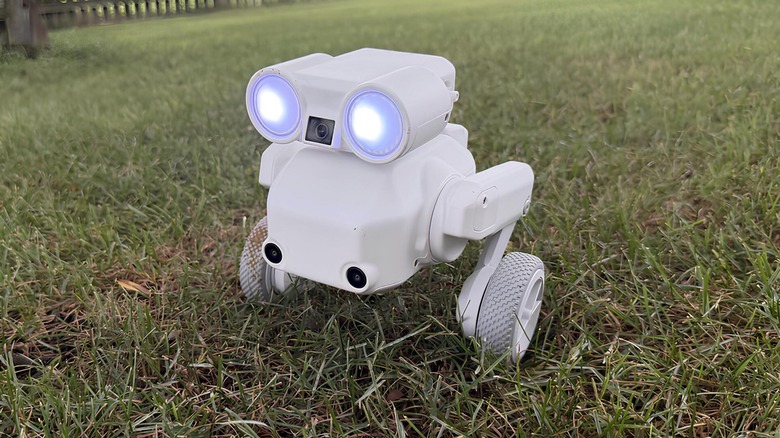
We recently got our hands on an adorable self-balancing camera robot called Beni from Mondo Robotics. It comes with a very particular talent — rolling after a selected subject and recording the footage from close to ground level. Through its app, you can control its movement and camera, or even perform sideways flips. The flips are gimmicky but add a little bit of fun when operating the device. It runs on a pair of wheels, can reach speeds of up to 17.9 mph, and can move on uneven terrain.
In our review of Beni, we found it to be rough around the edges as a camera, especially when dealing with obstacles and the shooting perspective. However, it did a pretty good job hopping over the obstacles when controlled manually. It's also quite pricey at $750 at the time of writing — but overall, it's a nice little robot companion to have following you around, especially if you're into individual sports. Mondo Robotics may be onto something here, making Beni worth monitoring for future upgrades in hardware and software — and a friendlier price, of course.
Fosi Audio Disc Nano CD Player
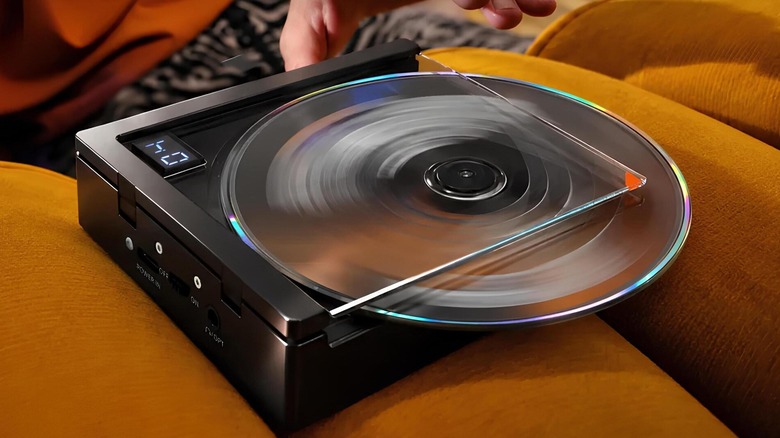
If you grew up in the '90s, the Fosi Audio Disc Nano is a modern take on the Discman, which was one of the coolest gadgets to own at that time. It adds a built-in battery and Bluetooth like most modern gadgets while also catering to wired 3.5mm and 4.4mm outputs. The standout thing about the Disc Nano is its appearance — a semi-exposed layout that gives it a cool look wherever you place it. The player is smaller than a standard CD, which means part of the disc spins beyond the device's body.
The exposed disc looks like a reckless design for sure, given how delicate CDs are, but it looks really good from a stylistic standpoint, and I see this being more of a novelty gadget or collectible for most people. On top of that, the Disc Nano adds something else that's oddly useful — a MagSafe ring mount that lets you attach it to compatible devices, including your phone. If you decide to carry this around, you can just hook it up to the back of your phone instead of having to worry about managing two devices.
Satechi OntheGo 7-in-1 USB-C Hub
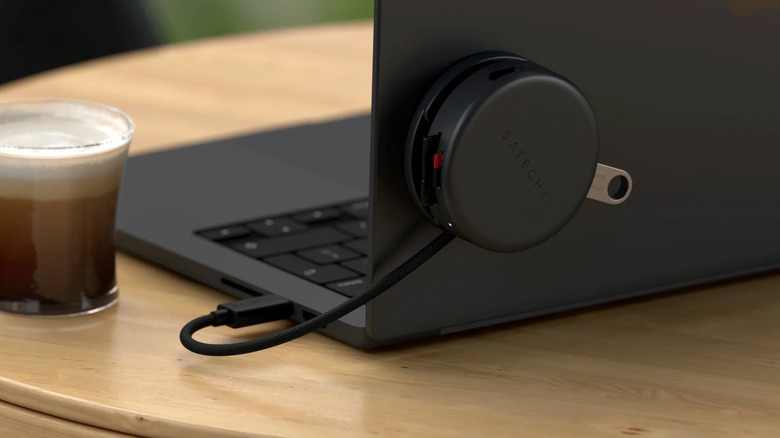
USB-C hubs are useful accessories given how modern laptops are being sold with as few as two ports — basically just one, since one is usually the charging port. However, most USB-C hubs come with one problem — they can be an eyesore since they dangle awkwardly from your computer. For this reason, they're also not practical to use on phones. Satechi's pocket-sized OntheGo USB-C Hub solves this problem by magnetically attaching to your device and neatly hiding the host cable.
The circular-shaped 7-in-1 OntheGo hub comes with the following connections: HDMI, Ethernet, two high-speed USB ports (both USB-A), and SD and microSD card readers. It also supports up to 80W USB-C passthrough charging. It comes with an adhesive magnetic ring for mounting on your MacBook, tablet, console, or any other non-MagSafe device. Speaking of Magsafe, if you own an iPhone 15 or newer, you can connect the hub directly to the back of your phone, making it a fun and useful gadget for content creators. There's also a cheaper 5-in-1 variant with two fewer ports (Ethernet and microSD reader, with one USB-A swapped for USB-C) that offers less passthrough power (60W).
Powerup 4.0 Paper Airplane
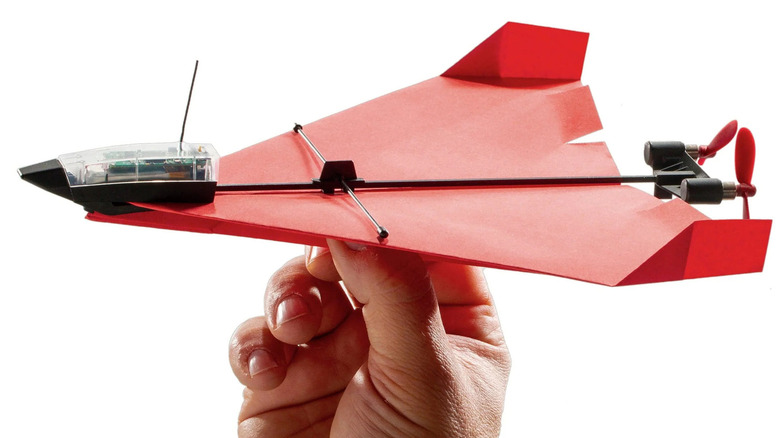
As a child, I used to fantasize about being able to control the many paper planes I built. Little did I know that it would become a reality several years later. The PowerUp 4.0 is a propulsion and steering system that does just that. It comes as a 0.7-ounce module that you strap onto a folded plane, and it allows you to control the plane over Bluetooth via an app on your phone with virtual controls. The app also lets you monitor stuff like battery level, and you can get finer controls and acrobatic modes if you want your paper plane to perform advanced tricks.
In the box, the flight module comes with four pieces of paper with guidelines on how to fold the perfect plane. Once you fold it, you can install the module on your paper plane and secure it using your own tape. Flights can last up to around 10 minutes on a single charge, and the plane can go as fast as 20 mph. Bluetooth range is up to 230 feet. If you're worried about the fun being short-lived, charging up the battery takes just half an hour. You can use whatever kind of paper you can get your hands on, so you're not just limited to the supplied paper. Piloting the PowerUp 4.0 involves a bit of a learning curve — so expect a few crashes when flying for the first time.
Kodak Charmera
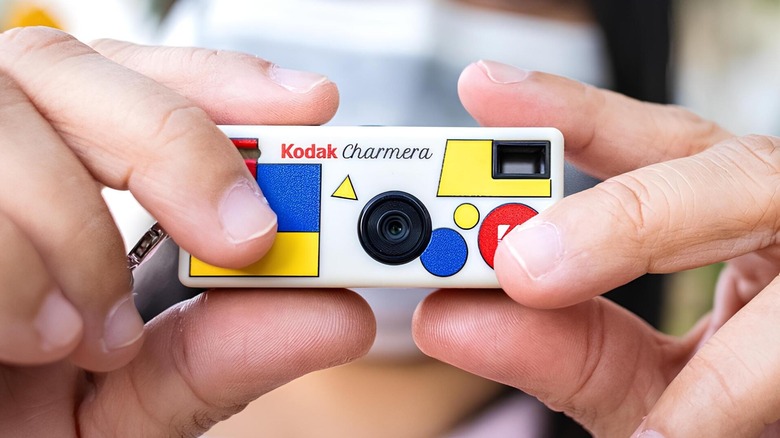
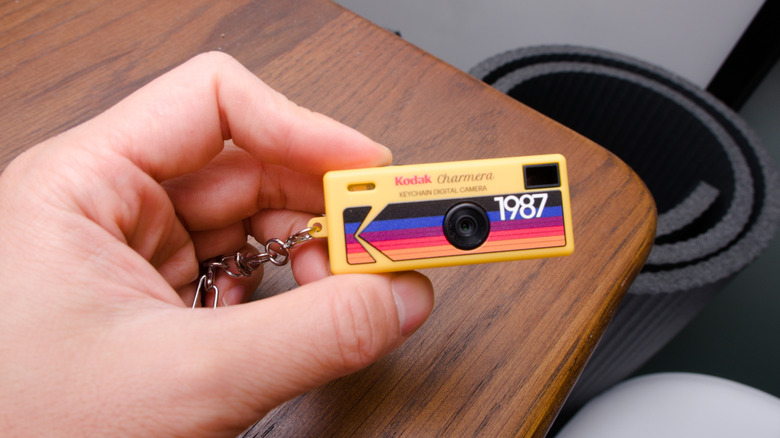
The Kodak Charmera is a tiny and playful everyday photography companion that can live on your keychain. It's inspired by Kodak's 1987 Fling disposable camera, measures just 2.3 inches on its longest side, and weighs about an ounce. Despite the tiny size, it packs a 1.6MP sensor and enough juice to take at least 120 stills on a single charge. On top of that, you get a 0.9-inch display, a viewfinder, and an LED flash that comes in handy when taking close-up shots.
Being a $35 mini gadget, the Charmera comes with all the limitations you might expect. For instance, in our review of the camera, we observed blown highlights and missing shadow details in photos of high-contrast scenes. It can also record 1440 x 1080 video, but the end product resembles footage from an old webcam, and you'll need to separately purchase a microSD card to save your files. But this shouldn't be a big deal if you see this as just a fun little toy to gift your child or a tool to make photography spontaneous again.
Rollei 35AF Film Camera
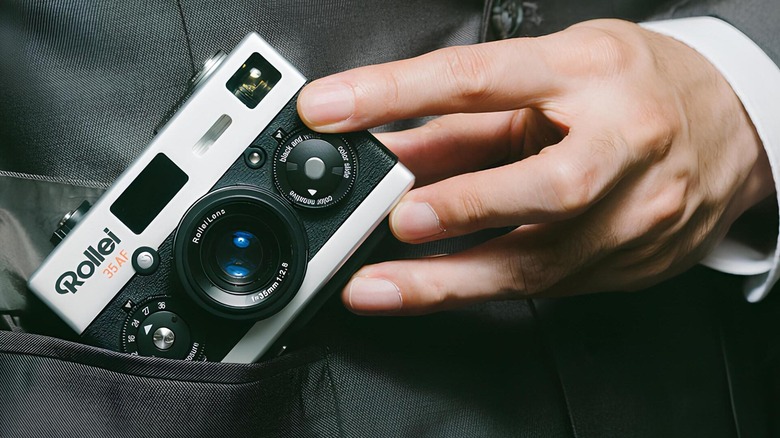
If you fancy old-school cameras, the Rollei 35AF commits to 35mm film paired with modern assistance. The camera's compact rectangular body pays homage to the 1966 Rollei 35 but is noticeably larger yet somehow lighter. That's where the similarities stop, though. Some of the notable upgrades include LiDAR autofocus, an OLED display, center-weighted autoexposure, and a built-in flash. All these plus several other modern takes make it much easier to handle, even for an amateur photographer. For instance, Photo Thinking found exposures to be highly successful despite the unforgiving nature of slide film.
I'm no camera expert or enthusiast, but the Rollei 35AF definitely evokes nostalgia and would make a solid collector's item. It's a pricey unit but also a very good-looking little gadget to have on you if film photography is your thing. There are many much cheaper film camera options you could buy instead, but Rollei's design, especially the variant with a chrome finish, sells it for me.
Casio The Special One S100X Calculator
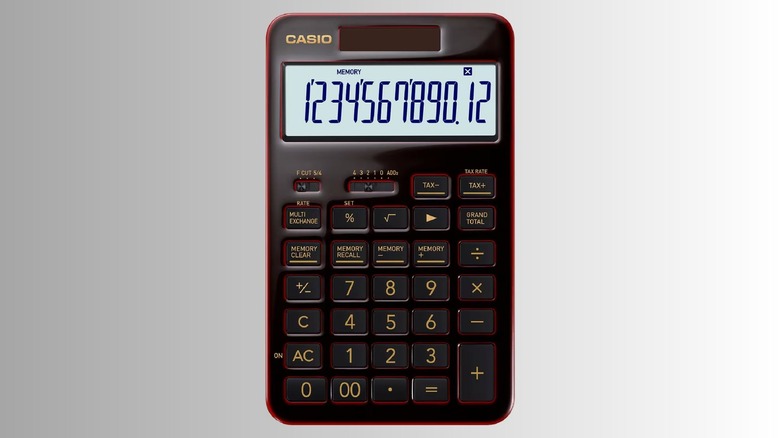
Desktop calculators are forgotten pieces of tech that we almost never think about unless we come across one — let alone one that costs north of $600. Casio's The Special One S100X is as special as the marketing name suggests. Underneath, it's just like most desktop Casio calculators. The exterior is where the attention lies with this device — it features a hand-applied urushi lacquer finish using a technique called tamenuri, a Japanese technique associated with high-end items like wristwatches rather than calculators.
To apply the finish, an artisan applies layers of pure filtered lacquer sap over the calculator's milled aluminum-alloy body for 30 consecutive days. The end result is a glossy black surface with a distinct red gradient along the edges. This tedious process is what drives the price as high as it is. Other than that, the inner workings are those of a standard Casio calculator, including solar power backed by a CR2025 battery. The battery is rated to last for seven years if used for one hour every day.
The Special One is more of a collector's item, as just 650 of these were made, and they were sold out at the time of writing. Each unit comes with a gold-stamped presentation box and a laser-engraved serial number. Getting one right now will likely have to involve the secondary market, if one exists for such an item.