

5 Modern Convertible SUVs That Are Made For Year-Round Use
Convertibles appeal to a very niche set of customers, with less than 1% of all new vehicles sold in the U.S. in 2026 having a retractable roof. In fact, only a handful of mainstream automakers are still even offering traditional convertibles. Put simply, they are impractical for inclement weather, often feature tiny backseats (or none at all), and usually handle worse than their hardtop counterparts due to increased chassis flex and weight.
That being said, some automakers have attempted to offer modern crossovers and SUVs with removable roofs that combine the safety and security of four driven wheels with the freedom of open-air motoring. Through some impressive engineering, compromises have been kept to a minimum, allowing buyers to have a single vehicle that can handle multiple seasons and driving conditions. While some models were around for just a short blip, others have been mainstays of their lineup for decades.
Nissan Murano CrossCabriolet
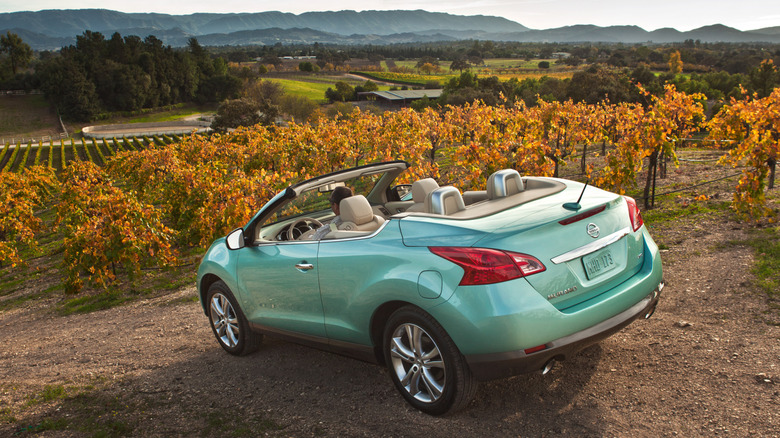
Available for only four years, the Nissan Murano CrossCabriolet was introduced to the North American market in 2011. Nissan lauded it as the world's first all-wheel-drive convertible crossover. We were lucky enough to be invited to a Nissan showcase in Dallas to get first-hand experience behind the wheel. Prices started at $47,200.
Nissan wanted people to rethink what a convertible could be: spacious enough for four adults, ample cargo space, a heightened seating position, and the ability to thrive in rainy and slick weather. The CrossCabriolet only came in one fully-loaded trim, which included HID headlights, 370Z-inspired LED taillights, quilted heated leather seats, a heated steering wheel, Bose surround sound, GPS navigation, and a rearview backup camera. The top-down cargo space measures 7.6 cubic feet, enough to fit two bags of golf clubs. With the top up, capacity expands to 12.3 cubic feet.
Although it shares its V6 powertrain (rated for 265 hp and 248 lb-ft), AWD, and Xtronic CVT transmission with the standard Murano, almost everything behind the A-pillar was unique to the CrossCab. The doors are 7.9 inches longer to allow for backseat access. The B-pillars have been removed entirely. The roof, which offers one-touch functionality, was fully insulated for sound deadening and year-round comfort. It features a primary glass rear window along with a plastic secondary, upper window that allowed pop-up roll bars to deploy and penetrate through in the event of a rollover (and acted as a skylight on nicer days). Nissan even managed to have the coefficient of drag with the roof up nearly identical to the four-door hardtop model (just 0.39 Cd versus 0.37 Cd, respectively).
Range Rover Evoque Convertible
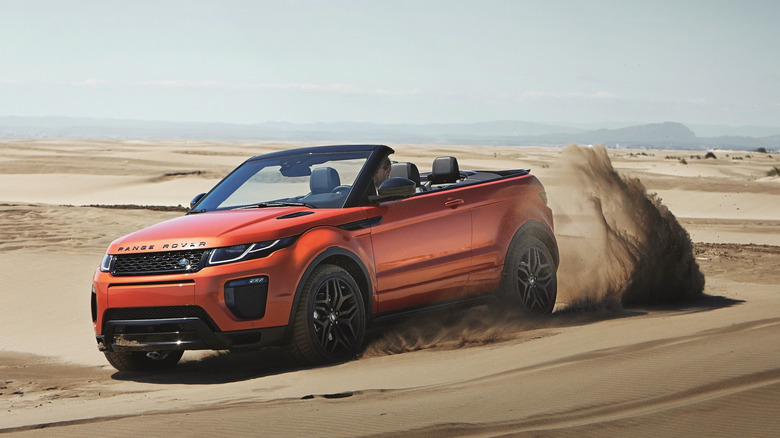
Land Rover itself may not be a stranger to producing practical SUVs with soft tops, as evidenced by the original Series I and Defender (both of which made our list of the 10 most iconic Land Rovers ever produced), but its luxury division, Range Rover, certainly was. That is, until the 2016 Range Rover Evoque Convertible debuted. The Evoque was already unique for offering both two-door and four-door versions, and adding a droptop to the lineup further differentiated it from the sea of premium European crossovers.
Range Rover made sure not to compromise on one foundational quality: off-road performance. The Evoque Convertible was tested to meet the same all‑terrain standards as every previous Land Rover vehicle. It can climb 45-degree gradients, tilt 35 degrees, wade through up to 19.7 inches of water, and even features approach, breakover, and departure angles of 19, 18.69, and 31 degrees, respectively. A standard four-mode Terrain Response System offers specific settings for snow, mud, and sand. The electronic rear differential even offers torque-vectoring. Known as Active Driveline Four-Wheel Drive, the system automatically transitions between 2WD and 4WD to help improve traction and fuel efficiency.
The sole powertrain, a turbocharged 2.0L four-cylinder producing 240 hp and 251 lb-ft, mates to a nine-speed ZF automatic transmission. First gear intentionally has a very short ratio to deliver brisk acceleration and excel at low-speed off-roading. Thicker A-pillars offer improved rollover protection. Enhanced structural bracing offers chassis rigidity comparable to the hardtop coupe. The bodywork behind the now-pillarless doors is exclusive to the convertible. The insulated Z-fold fabric roof can be lowered in just 18 seconds and raised in 21. When up, it maintains the same sleek silhouette as the hardtop Evoque.
Jeep Wrangler
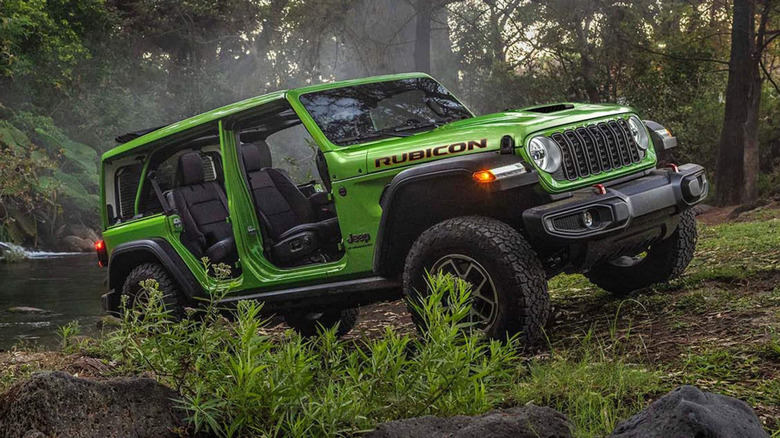
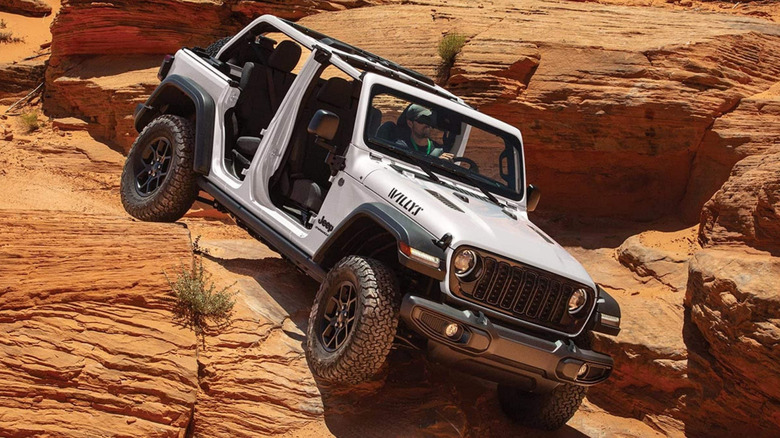
Jeep's history with open-top, off-road-ready vehicles dates back to the 1941 Willys (we've done a deep dive on its legacy here), and that influence continues in today's Wrangler. Known as the JL generation, it was first introduced in 2018 and offered both a two-door and four-door variant. Staying true to its roots, the Wrangler still features body-on-frame construction, a seven-slot grille, round headlights, square taillights, and a Trail Rated 4x4 System that Jeep claims makes the Wrangler the most capable SUV ever.
Known as one of the only true open-air SUVs on the market, the Wrangler features easily removable doors, a foldable windshield, and a trio of top options: hardtop with removable Freedom panels, manual-folding softtop, and a new Sky One-Touch Power Top, which features a full-length retractable canvas roof that can be operated with a single push of a button. For 2026, power comes from either a turbocharged 4-cylinder, a naturally aspirated V6, or a naturally aspirated 6.4L Hemi V8. An eight-speed automatic transmission is standard, but the V6 is available with a six-speed manual.
Depending on trim level, three distinct 4X4 systems are available. Command-Trac offers part-time 4WD and a 2.72:1 low range. Optional Selec-Trac is full-time 4WD, with the system automatically switching between RWD and 4WD. Rock-Trac, standard on Rubicon, is available in both part-time and full-time. A 4:1 low gear ratio allows for smoother, low-speed crawling and increased torque at the wheels. You can pair up to 35-inch all-terrain tires with 17-inch beadlock-ready wheels. When properly equipped, the Wrangler is capable of approach, departure, and breakover angles of 47.4, 40.4, and 26.7, respectively. It can also ford up to 35 inches of water.
Ford Bronco
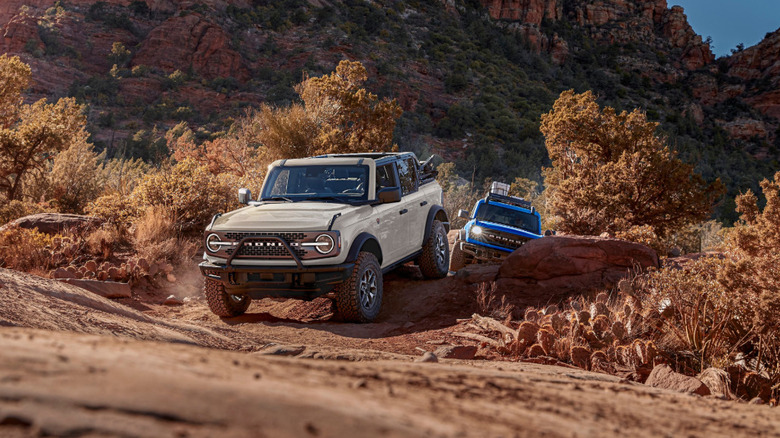
-After nearly a 25-year hiatus, the Bronco returned in 2021 riding on a fully-boxed steel frame and platform shared with the midsize Ranger pickup. Featuring standard 4WD and available in both two-door and four-door variants (a first in the Bronco lineage), it's intended to directly compete with the Jeep Wrangler. In 2026, the Bronco could be optioned with a 60th Anniversary Edition Package, which includes unique paint, graphics, and a bunch of throwback-inspired Easter eggs.
The Bronco features easily removable doors and a variety of top options. Two-door Broncos come standard with a removable three-piece modular hard top, with both a fully-retractable or front row-retractable twill soft top available as an optional extra. Four-door Broncos come standard with a vinyl retractable soft top, with a four-piece modular hard top and both twill soft tops optional. Two powertrains are available for 2026: a 2.3L turbo-four or a 2.7L twin-turbo V6. The Bronco Raptor, first introduced in 2022, features an even more powerful 3.0L twin-turbo V6. All engines get a ten-speed automatic, but the I4 can be paired with a seven-speed manual.
Depending on trim level, two different two-speed transfer cases are available. The standard setup offers part-time selectable engagement and can be shifted on-the-fly. There is also an advanced setup complete with an electromechanical transfer case and the ability to automatically switch between 2H and 4H. Numerous off-road enhancements are also available, including 35-inch all-terrain tires, beadlock-capable wheels, skid plates, locking diffs, electronically disconnectable sway bars, and active-dampening shock absorbers. Every Bronco has a maximum of 33.5 inches of fording ability and at least 8.3 inches of ground clearance.
GMC Hummer EV SUV
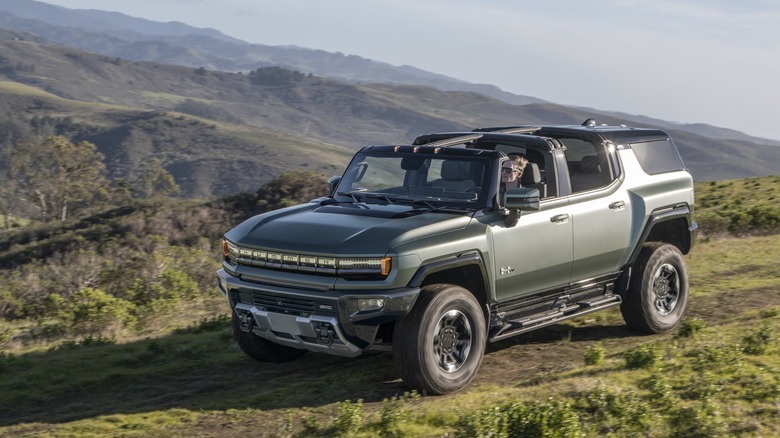
A new, electrified era for Hummer began about a decade after General Motors discontinued it in 2010. Now wearing a GMC badge, both a pickup truck and SUV are available, and both are equipped with multiple electric motors, large battery packs, and a ton of off-road goodies. We got to experience a 2025 3X SUV and found it impossible to ignore.
For 2026, GM decided to throw even more power at the Hummer EV. The entry-level dual-motor 2X model offers up to 570 hp, with the optional Extreme Off Road Package boosting that to 635. Stepping up to the tri-motor 3X model unlocks up to 830 hp. All Hummer SUVs feature four-wheel steering (with the ability to CrabWalk for even better maneuverability). All Hummers also include the Infinity Roof, a removable four-panel modular hardtop. Even the front I-Bar can be removed for a completely topless experience. You can upgrade to translucent panels or even equip a Sky Convertible Top that replaces the two front panels with a manually-operated fabric cover.
GM made sure that the Hummer was still capable of traversing any terrain. Compared to the pickup, shorter overhangs on the SUV allow for improved approach, departure, and breakover angles of 49.6, 49.0, and 34.4 degrees, respectively. 35-inch all-terrain tires are standard. The air suspension allows for up to 16 inches of ground clearance and 13 inches of wheel travel. An optional Extreme Off Road Package includes full underbody skid plates, rock sliders, mud-terrain tires, simulated front and rear lockers, and additional cameras mounted beneath the SUV, along with the previously mentioned boost in power.