

BMW Made The 2027 7 Series Even Better, And I Know Which I'd Buy
A full-size luxury sedan was once the last word in automotive status symbols. There's a reason they look so good parked next to private jets in advertisements and Instagram posts. Then full-size luxury SUVs arrived and, as SUVs have done with every other rung of the automotive social ladder, initiated a hostile takeover.
So like a landmark fine-dining restaurant that's no longer garnering as many five-star ratings as it once did, the BMW 7 Series is getting some renovations and adding new items to the menu. The process began a few years ago, when the seventh-generation 7 Series (this auspicious generation is known as the G70 to BMW fans) debuted as a 2023 model. It featured unorthodox styling that thankfully hasn't been repeated on other BMW models, and lavish tech that made it like a mini CES on wheels.
It turns out that this car was an unfinished project. For 2027, the 7 Series and its electric i7 counterpart get a thorough midcycle refresh that includes new styling, BMW's latest infotainment tech, and, for the i7, new battery cells and motors from the Neue Klasse EVs. It's much more extensive than the typical BMW refresh, what the automaker calls a "Life Cycle Impulse" (LCI). And it helps bring the current-generation 7 Series and i7 into focus.
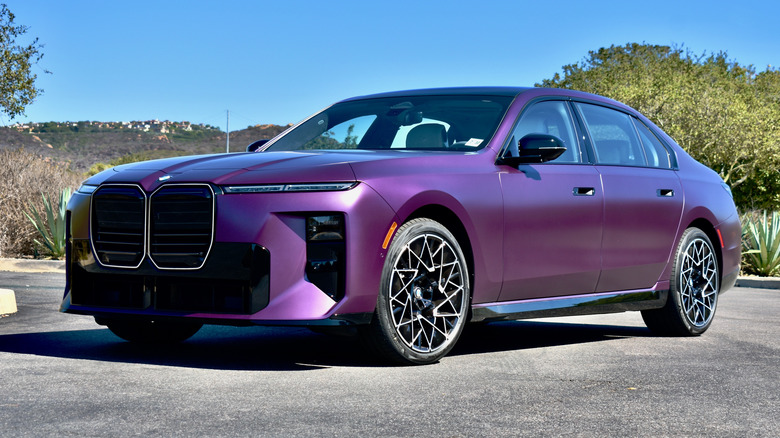
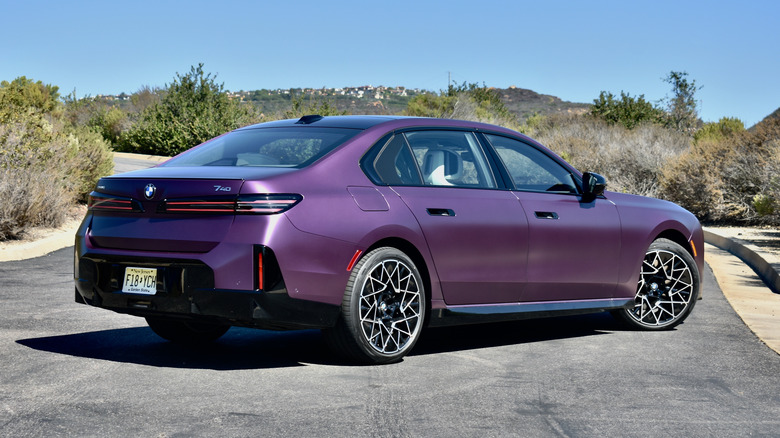
This is what the current-generation 7 Series should have looked like from the start
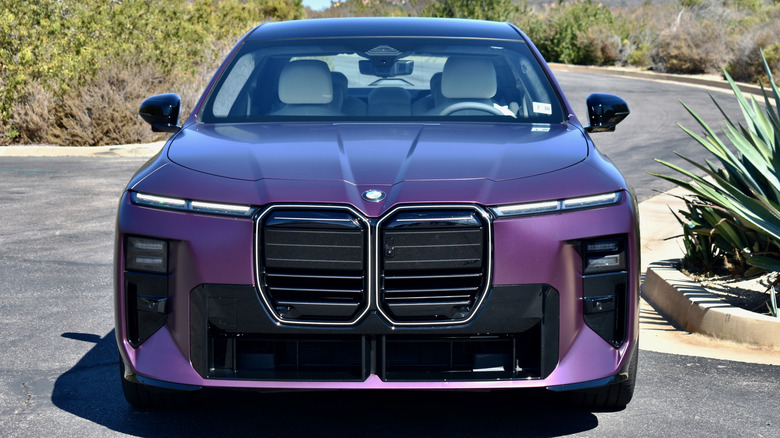
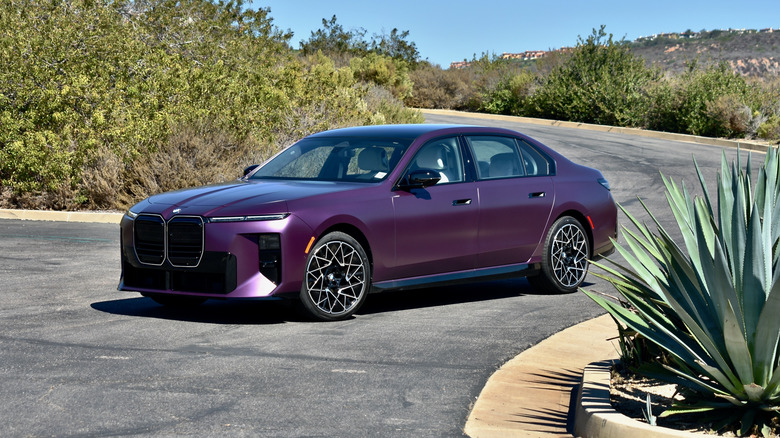
The new 7 Series probably won't be many peoples' favorite design, but it's major improvement over the pre-refresh version. It seems to be what the designers were aiming for in the first place; they just missed the target the first time around.
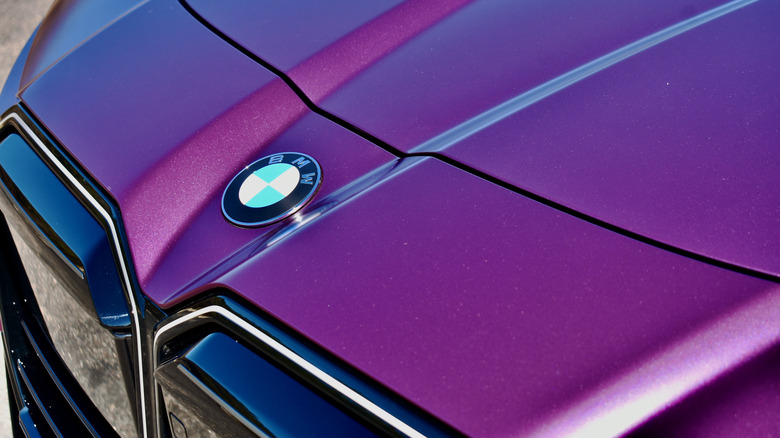
The exterior is cleaner, with fewer extraneous details. The rear end doesn't have as many steps as before, and larger taillights help distract from what clutter remains. The grille is still enormous, but it's now properly integrated with the rest of the front end thanks to a hood that echoes the shape of its kidneys and the elimination of the blackout trim that surrounded it on some models. Every line on the front fascia—including the daytime running lights that can be fitted with crystal elements—is now sharper, giving the 7 Series a confident sneer.
It may wear its size more boldly than before, but the 7 Series still has too much visual bulk. The tall body makes the wheels look too small, and is why the car needs that big grille. And it very much looks like a car designed for a cartoon oligarch who runs over poor people for fun. But the 7 Series can't do subtle. It has to play the role of nouveau riche, leaving the old-money role to its Rolls-Royce Ghost platform-mate.
New interior design works remarkably well
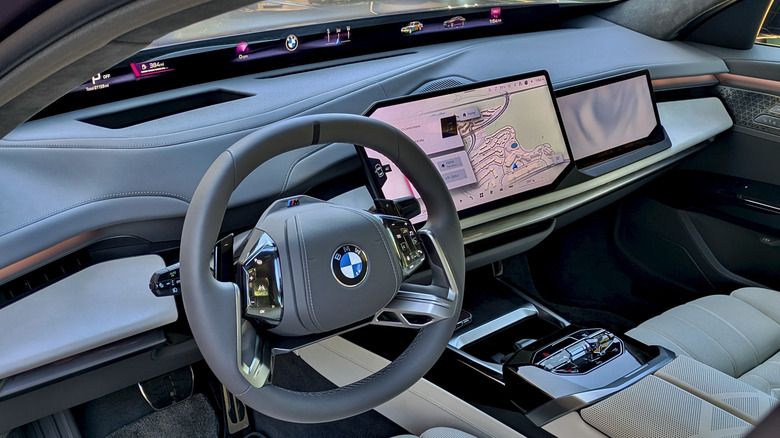
Changes to the interior are just as extensive, and in a way, even more impressive. BMW transplanted the Panoramic Vision display from the new X5 and its Neue Klasse EVs, along with its attendant touchscreens, into the existing cabin.
It's hard to tell that the 7 Series wasn't originally designed this way, though. The panoramic display slots in nicely at the base of the windshield, the dashboard isn't weirdly deep or misshapen, and the new central touchscreen looks just as stylish as it does in the other BMW models where it's appeared so far. Instead of a boring rectangle, it's more like a parallelogram. Why haven't other automakers tried this?
Throw in the squared-off steering wheel (to keep the view of the panoramic display free), and there's an unmistakable high-tech feel that runs counter to the expectations of this very traditional segment. You can still get open-pore wood, carbon fiber, or Alcantara dashboard trim, but what really completes the look is the programmable ambient lighting that makes the plastic trim undergirding the high-end materials sparkle.
This is a more imaginative interior than we usually see from an established automaker, which is nice to see. But the major elements are shared with less-expensive Bimmers, which makes it feel less special. It's mainly the elevated quality of the materials and the optional reclining rear seat that denote the 7 Series' flagship status.
Tech party's in the back
The dashboard layout may be lifted straight out of the X5 and iX3, but that means it works just as well. The panoramic display is perfectly placed for easy viewing while driving, and the view directly ahead is reduced to essentials like speed, navigation prompts, and driver-assistance status. Other widgets are placed further to the right, but still easily glimpseable from the driver's seat. You can even decorate the screen with a tiny image of a BMW art car.
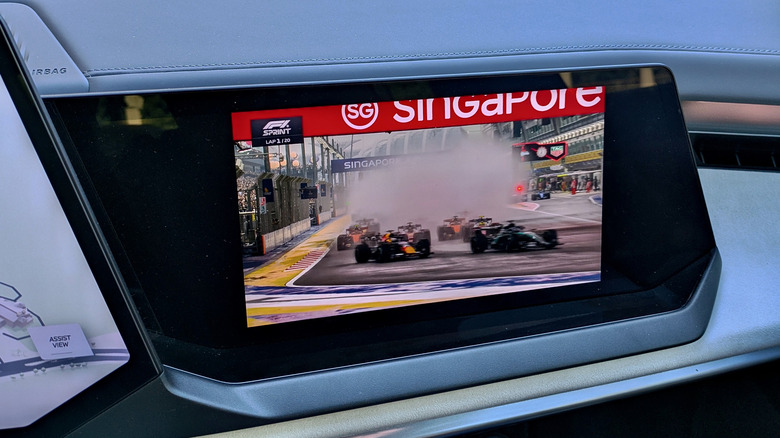
The 17.9-inch central touchscreen has sharper graphics and a more practical menu layout that makes better use of the home screen. Wireless Apple CarPlay and Android Auto are retained, as is native voice recognition. The latter gets AI integration so it can answer trivia questions. A 14.6-inch front-passenger screen is also standard, with video-streaming capability. But instead of a filter, BMW uses the driver-monitoring system to pause the video when the driver glances toward the screen.
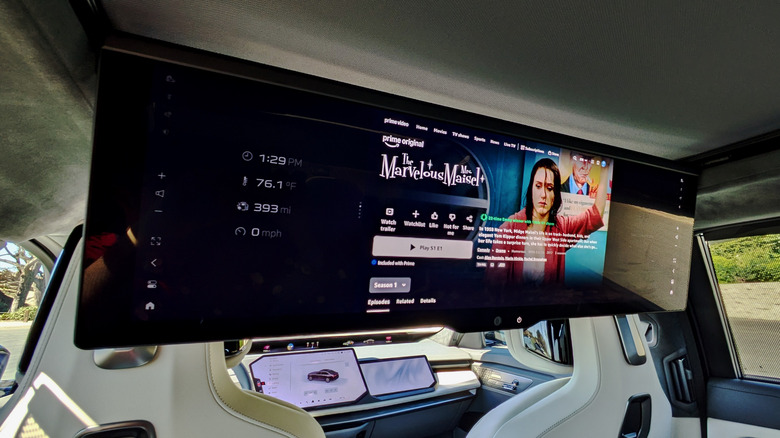
Again, this is all stuff you can get in more common BMW models. What really sets the 7 Series apart is the optional 31.3-inch Theater Screen for rear-seat passengers. Controlled by (unattractive) touchscreens in the doors, it's essentially a back seat television, complete with native streaming apps. A Zoom app is new for 2027 as is a digital rearview mirror for the driver that probably should've been included in the first place. The ultra-wide screen isn't the ideal format, but it's not like any other automaker offers anything like this.
Big EV improvements
BMW cut back powertrain choices for 2027, but there's more on the way. The rear-wheel drive 740 and all-wheel drive 740 xDrive are powered by a turbocharged 3.0-liter inline-six connected to an eight-speed automatic transmission. The inline-six produces 394 horsepower (11 hp more than before, thanks to a new turbo) and 398 pound-feet of torque. BMW says it will do zero to 60 mph in "less than five seconds," which it will need to do to match the six-cylinder Mercedes-Benz S 500 4Matic.
The electric i7 comes standard with a dual-motor all-wheel drive powertrain. The base i7 50 xDrive is rated at 449 hp and 487 lb-ft of torque, getting it from zero to 60 mph in 5.3 seconds, according to BMW. The i7 60 xDrive has 536 hp and 549 lb-ft, enough for zero to 60 mph in a BMW-estimated 4.6 seconds.
Both i7 models have a 112.5-kilowatt-hour battery pack that uses cylindrical cells like the iX3 and iX5 crossovers. That, and other efficiency improvements, boost maximum EPA range by 59 miles, to 373. The i7 also switches to the NACS port and can now DC fast-charge at up to 250 kilowatts (up from 195 kW) before, accommodating a 10% to 80% charge in 28 minutes. Level 2 AC charging is unchanged at 11 kW and 11 hours for a full charge.
A 750e xDrive plug-in hybrid will join the lineup later in 2026, followed by a twin-turbo V8 M760 xDrive at a later date.
Sporty when wanted, serious when needed
As much as BMW changed about them, both the gasoline 7 Series and the i7 drive pretty much the same as before. But that's okay, because whether it's powered by an internal-combustion engine or electric motors, the 7 Series combines traditional big-sedan cushiness with BMW's trademark sporty handling. Frank Martin would approve.
This is nothing as dramatic as the cliché Jekyll/Hyde personality split, or even a matter of drive modes (although you do get those, of course). It's just a matter of how you drive. Act like a chauffeur and keep the pace sedate, and the 7 Series provides calmness uninterrupted by the outside world. Put your foot down, and it responds like a smaller car, maintaining its composure despite the laws of physics working against it.
Of the two variants available at launch, the i7 provides the better experience. Its electric powertrain is perfectly suited to a big luxury sedan, with copious torque needed to get a car this heavy moving with urgency, all in luxurious silence. The 740's inline-six is still a great engine, but it doesn't make enough of an impression here to counter the strong argument made by the i7. It's also striving for unobtrusive torque delivery, and the dual electric motors just do that better.
Driver-assist tech that's more polite
The refresh also extends to the 7 Series' driver-assist features, which adopt BMW's new "Symbiotic Drive" concept. The goal is to have the various driver aids work in the background, rather than fighting the driver or intervening when it isn't necessary. That was generally the case for most of my time with a 740 xDrive and i7 60 xDrive, which was free of the lane-keep assist beeps and steering-wheel tugs that have become a part of modern motoring.
The 7 Series also features BMW's Highway Assistant hands-free driving system, which worked well aside from an overly-strict driver-monitoring system. Pretty much any eye movement seemed to trigger warnings, and while driving an iX5 with the same hardware in different lighting conditions, the system had trouble functioning at all.
And as good as Highway Assistant is, BMW appears to be further away from rolling out a door-to-door hands-free system that also works on surface streets, like the MB.Drive Assist Pro system Mercedes is already taking customer money for. BMW doesn't have any firm timing for the release of an equivalent system. And even when it does, such tech is no longer exclusive to high-end models like the 7 Series, so that's not a reason to spend so much on one.
2027 BMW 7 Series and i7 verdict
And spend you will. If nothing else, the 7 Series justifies its prestigious image with a base price of $101,350 for the rear-wheel drive 740 model. The all-wheel drive 740 xDrive is a small step up at $104,350 before options, while the electric i7 50 xDrive and i7 60 xDrive are bit pricier still at $107,750 and $126,250, respectively.
Typically for this high-end corner of the market, those prices are just starting points. Options like $12,000 two-tone paint or the $4,750 Theater Screen mean real-life MSRPs will be much higher. I drove a heavily-optioned 740 xDrive and i7 60 xDrive that cost approximately $135,000 and $160,000, respectively. Even those prices aren't bad compared to what one could pay for a Rolls-Royce Ghost or Bentley Flying Spur, though.
The 7 Series' most direct competition is the Mercedes-Benz S-Class, which also gets a major refresh for 2027. The Mercedes' styling may also prove polarizing, but it strikes a much better balance between old-school luxury vibes and modern tech than the relentlessly futuristic BMW. Conversely, the Mercedes EQS sedan and Lucid Air make more sense as EVs than the i7, but don't have that traditional big-sedan feel. So in addition to being better to drive than gasoline 7 Series, the i7 has a better-defined niche.