

7 Pickup Trucks That Are Quicker Than A Base Chevy Silverado 1500
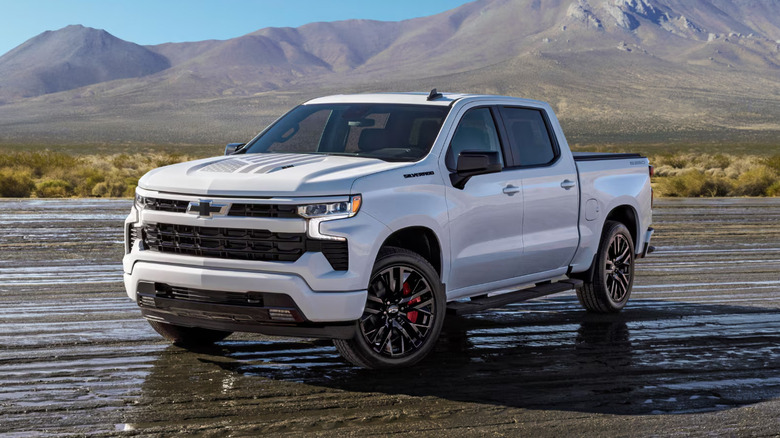
The Chevrolet Silverado has been one of the top choices if you're in the market for a full-size SUV for quite a while now, and for good reason. As one of the few all-American nameplates in the segment, the 2026 Silverado is competitive just about everywhere you look, with a maximum towing capacity of 13,300 pounds and 71.70 cubic feet of cargo space. However, to unlock these specs, you'll have to spend a decent amount of money on the correct trim levels and options.
The base trim for the 2026 Silverado starts at $39,695, including destination fees, and while the best features are missing, it's still competitive in its own right. While outright performance isn't a major focus for most full-size trucks in their base guise, MotorTrend still manages to get the base 310-horsepower 2.7L turbocharged inline-four to 60 mph in 7.1 seconds. And if you want to beat that with recorded data, you'll have to either drop sizes or spend more on better engines in full-size rivals. Here's a look at seven pickup trucks that are quicker than the base Chevrolet Silverado off the line.
2026 GMC Canyon
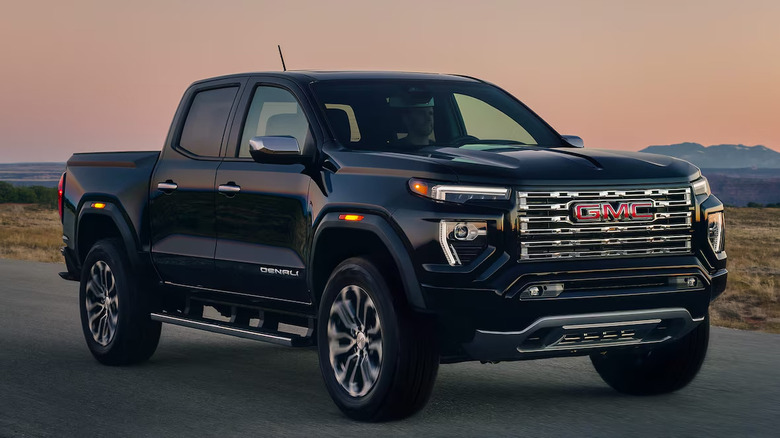
Alongside Chevrolet, GMC is the other GM brand with a couple of pickup trucks in production. GMC's trucks are marketed as more luxurious than their Chevrolet counterparts, but stripped to the core, the mechanics are fundamentally the same, sharing platforms, engines, and nearly every key component. The full-size Sierra is the GMC equivalent of the Silverado, but if you want a quicker GMC truck, dropping down to the Canyon is the answer.
Competing in the mid-size pickup segment, the Canyon is what the Sierra is to the Silverado, but to the Colorado. Under the hood of every 2026 Canyon is the same 2.7L inline-four engine found in the base Silverado, producing a solid 310 horsepower and 430 pound-feet of torque. This includes the new AT4X trim that we had a great time with earlier this year. When combined with its naturally lower weight compared to the Silverado, MotorTrend's tests showed the Denali going from 0 to 60 mph in 6.8 seconds.
2026 Ford Ranger 4WD
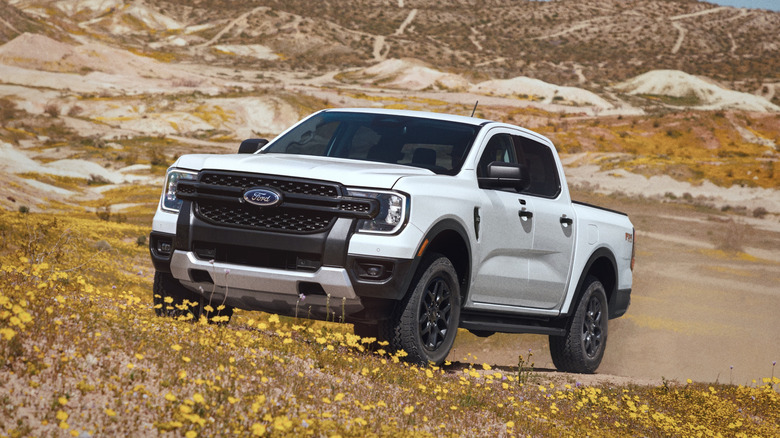
Staying within the mid-size segment, another key contender that has been setting standards for a while is the Ford Ranger. Unlike GM's approach to its mid-size trucks, Ford offers a few engines in the 2026 Ranger: the base 2.3L turbocharged inline-four producing 270 horsepower, a 2.7L twin-turbocharged V6 producing 315 horsepower, and the Raptor-exclusive 3.0L V6 producing 405 horsepower. Do note that the base XL trim is only available with the base 2.3L offering.
One thing that's available on all trims, unless it's standard already, is the upgrade to four-wheel drive from two-wheel drive. To get acceleration better than the 2026 Silverado, the four-wheel-drive upgrade is a must, with the base engine sending power to all four wheels to reach 60 mph in 6.9 seconds, according to MotorTrend. Car and Driver managed a better time, though, at 6.2 seconds. For the 2.7L engine with four-wheel drive, the Ranger got there in 5.6 seconds, and the Raptor in 5.3 seconds.
2026 Toyota Tundra 4x4
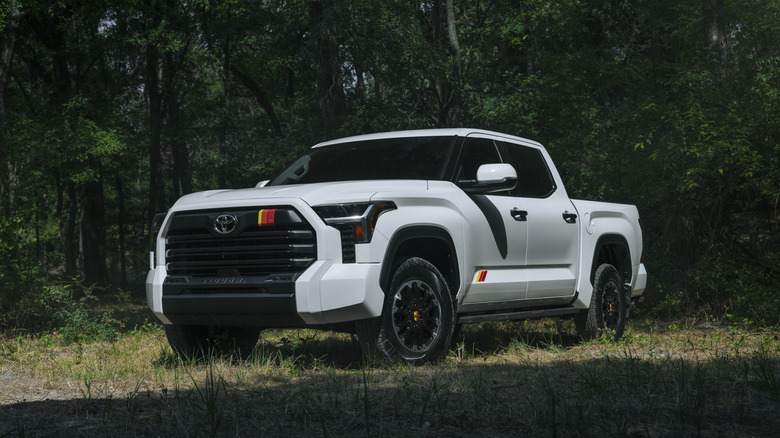
Regarding the full-size trucks that actually go head-to-head with the Chevrolet Silverado, the all-reliable Tundra is one of its long-time and closely matched rivals. Unlike the mid-sized trucks we've covered so far, the Tundra follows suit with much of the full-size segment by offering different engine options, but in its own way. The same 3.4L twin-turbocharged V6 is under the hood of every non-hybrid 2026 Tundra, but the base trim gets the lower-output version, while the more powerful version is used in the rest of the lineup.
The base SR trim therefore produces 358 horsepower and 406 pound-feet of torque. For the SR5 trim and upwards, the high-output version puts down a stronger 389 horsepower and 479 pound-feet of torque. Both Car and Driver and MotorTrend's testing produced the same results for the 0-60 mph run with the Tundra's more powerful engine, with the former outlet noting that it used the four-wheel-drive setup to achieve 6.1 seconds.
2026 Ram 1500
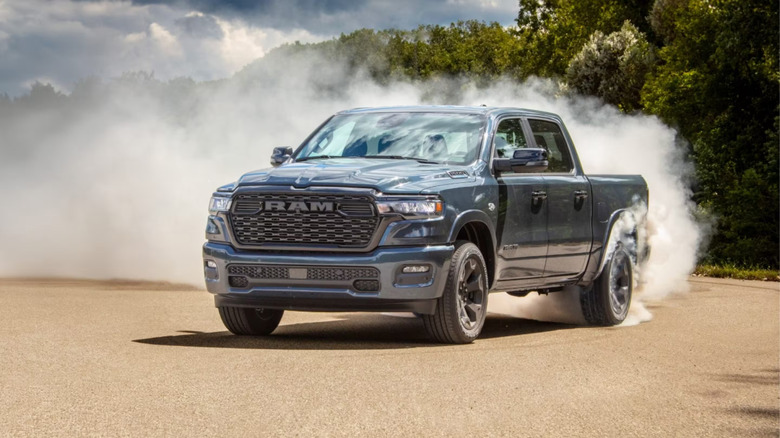
If a full-size pickup truck is where you think your needs and/or taste sit, then there's a good chance the Ram 1500 has come up more than once as a potential option. While most of the segment does a good job of offering comfort even in their base trims, this is where the Ram justifies its price point in the higher trims. And to get one of these trucks that's quicker than the base 2026 Silverado, the higher trims are where you'll have to go.
Under the hood of the Tradesman, Express, Warlock, and Big Horn is, as standard, the base 3.6L V6 producing 305 horsepower, which isn't exactly spritely. It took MotorTrend 8.1 seconds to reach 60 mph with this engine, but if you go for one of the Hurricane inline-six engines, which we think are better choices overall than the larger V8, you can shave that time down considerably. The standard output version, available as an option for the mentioned trims and standard for the Laramie and Rebel, uses its 420-horsepower output to reach it in 5.2 seconds. Go for a trim with the 540-horsepower version, and you can knock another half a second off.
2026 Chevrolet Colorado
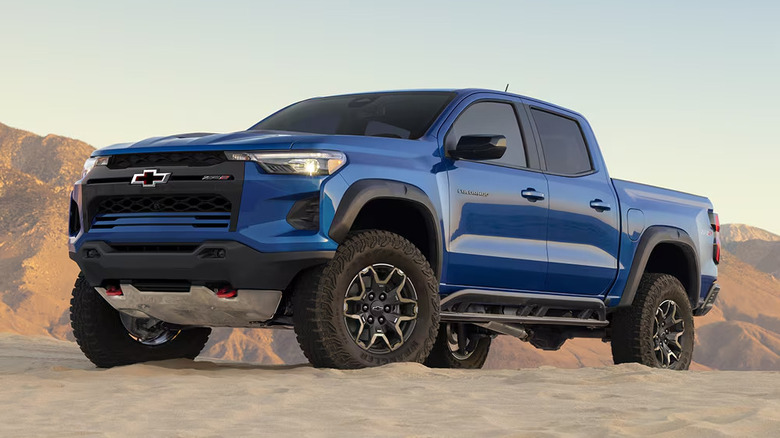
We've already mentioned the Colorado briefly as Chevrolet's version of the GMC Canyon, or vice versa. As siblings, the Colorado is also powered by the faithful 2.7L inline-four that is proving useful in multiple applications, with its 310 horsepower and 430 pound-feet of torque being capable in both base trims and top-spec off-road beasts such as the Canyon AT4X and, in the Colorado's case, the ZR2.
As such, the 0-60 mph times the 2026 Colorado achieves are very similar to those of the GMC Canyon, which isn't surprising. MotorTrend tested a few different variations of the Colorado, with the four-wheel-drive layout understandably reaching 60 mph fastest in six seconds flat. Car and Driver's tests echo very similar results, driving the ZR2 to a slightly slower time of 6.2 seconds.
If you love the look of the Silverado but are willing to sacrifice size for speed, the Colorado shares many similarities with the larger truck and is a better choice than the Canyon in that regard. It's also cheaper at $32,400, but it does lack some standard convenience features compared to the GMC.
2026 Ford F-150 V6
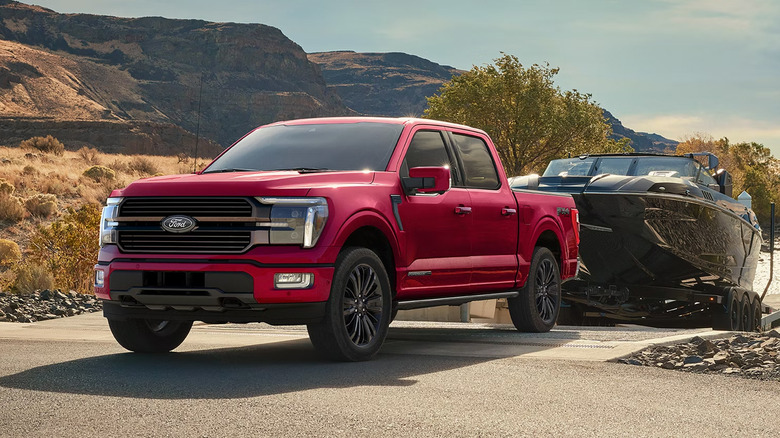
The truck that has dominated the pickup truck segment in sales for decades is none other than the Ford F-150. Setting the standard in multiple key areas for the segment, there are quite a few reasons why you'd choose the F-150 over the competition, including the Silverado. Alongside its expansive towing features and interior tech, the 2026 F-150 also offers a decent lineup of engines available across most trims.
For the base XL trim, the F-150 gets a 2.7L V6 producing 325 horsepower and 400 pound-feet of torque, which is slightly higher than the Silverado for the former and slightly lower for the latter. To get comfortably below the 7.1-second time of the Silverado, though, either the 3.5L twin-turbocharged V6 or the 5.0L V8 will get the job done, both of which can be chosen for the XL trim instead. With the V6, Car and Driver went from 0 to 60 mph in just 5.3 seconds, whereas the larger V8 did it in six seconds. For reference, both engines produce 400 horsepower, but the V6 has 500 pound-feet of torque compared to the V8's 410 pound-feet.
2026 Rivian R1T
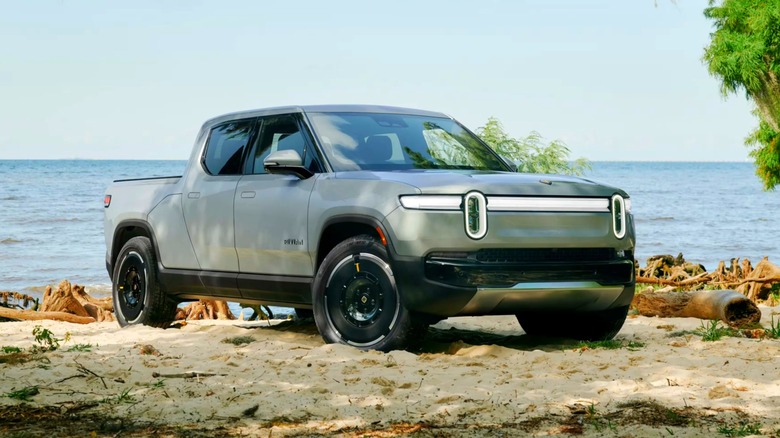
Every pickup truck on this list is powered by a traditional gas engine, albeit some with mild hybrid assistance, but none are purely electric. If all-electric power is something you're open to instead of a more traditional powertrain, the Rivian R1T is one of the top choices, particularly if you value pure performance above all else. The R1T is one of the EVs that costs quite a lot, starting at $79,980. This makes it comfortably the most expensive truck on this list in its base guise, but the startup does a good job of justifying the price tag.
Along with plenty of cutting-edge tech you expect in a new EV that costs this much, there's hardly any truck on the market that can go toe-to-toe with the R1T for speed. The base trim uses the dual-motor setup, putting one motor on each axle, resulting in standard all-wheel drive. Producing 533 horsepower, it goes from 0 to 60 mph in 4.5 seconds, which drops to 2.9 seconds with the tri-motor setup in the 850-horsepower Performance trim. The real showstopper, though, is the Quad trim, which puts out 1,025 horsepower from its four motors and reaches 60 mph in a mere 2.5 seconds, according to the manufacturer.