

5 Drawbacks Of Hybrid Cars You Should Consider Before Buying One
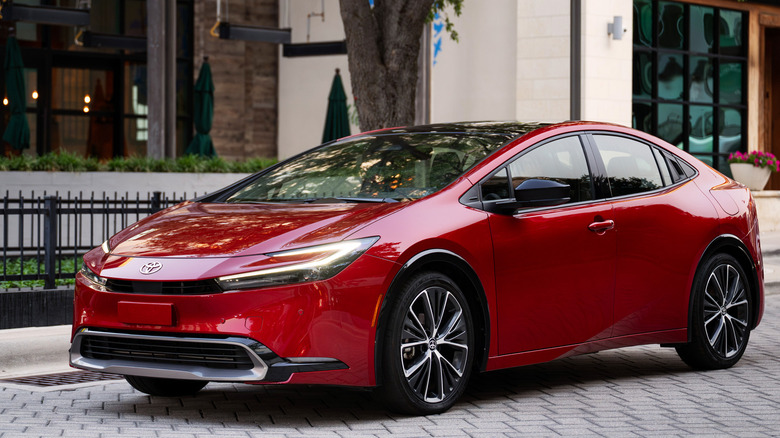
Hybrids are some of the best cars in today's economy, thanks to a combination of practicality, proven reliability (well, sometimes), and their gas-sipping fuel efficiency. Plus they come in all shapes and sizes, ranging from the relatively compact Toyota Prius to full-size trucks like the F-150 PowerBoost. The Prius even set a Guinness World Record for fuel economy in a production car, driving coast-to-coast in the United States with 93.158 MPG. They're generally excellent cars for a variety of purposes, particularly in urban environments and short commutes. But, like anything in the automotive world, it's not without various downsides.
All the benefits of a hybrid also incur certain penalties, as one might expect when fitting a single car with two complete powertrains and forcing them to cooperate. It's not a perfect science, as evidenced by how every manufacturer does it a little differently. And that's not even getting into how many types of hybrids there are — series and parallel hybrids, plug-in hybrids (PHEVs), Range-Extended Hybrids, Mild Hybrids. Every type has its own individual pros and cons, so as not to muddle the discussion, we'll only talk about ones which affect the majority of hybrids across the board.
To be clear, we're defining a hybrid car as one which uses a combination of batteries driving electric motors plus an internal combustion engine together in the same vehicle. While that's certainly a large umbrella, even this category shares many common issues, ranging from complexity and weight to price and usability. Let's dive in and explore the top points.
Hybrids cost more money
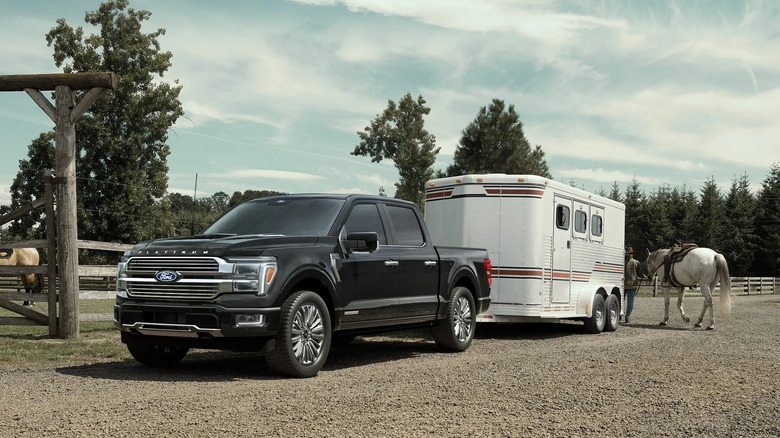
Likely one of the most relevant points from a customer perspective is that just about any hybrid model costs thousands of dollars more than an equivalent combustion-powered vehicle. Take the Ford F-150 PowerBoost versus the standard EcoBoost, for example. For starters, the hybrid option isn't even available on the base-model trim, so you're already going for an STX at the bare minimum. Moreover, it adds a total of $6,120 on top of any MSRP for a 2026 model year truck, representing about a 15 percent price hike for the base-model.
This general rule also applies to cars that are offered exclusively as hybrids, with the most common example being the Toyota Prius. Base sticker price for a 2026 Toyota Prius comes out to $29,745 before shipping and dealer fees, whereas the Corolla knocks over $6,000 off that with a starting price of $23,125. That's a substantial up-front savings for a first-time buyer, someone on a budget, or someone with poor credit.
Of course, that hefty up-front cost also comes with its own caveats, the most obvious being the savings further down the line. While yes, a hybrid is absolutely more expensive off the showroom floor, no regular production combustion-engine car in the past two decades could ever hope to get close to the Prius's mileage numbers. The closest thing to ever come to it was the Volkswagen XL1, and that was basically a radical hypermiling concept car with extra steps. Plus, if push comes to shove, one can always buy used — a first-gen Honda Insight remains an exceptionally practical hybrid that can be found for four-digit money.
Hybrids weigh more
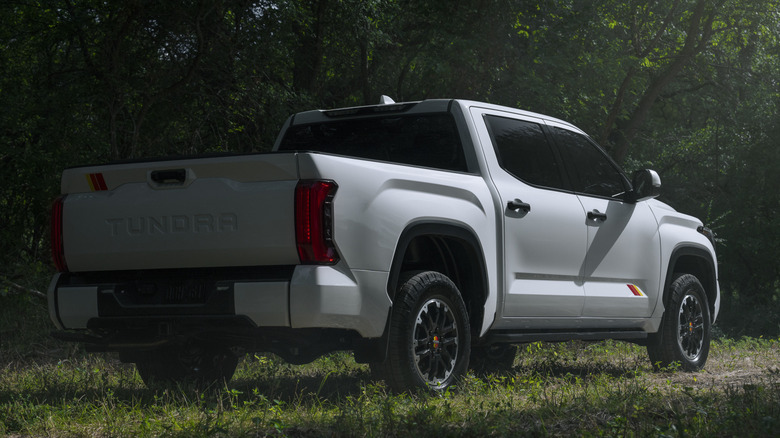
At first this doesn't seem like too bad of a downside. We're all familiar with the concept of "autobesity," after all — the arms-race happening all over the place where cars are getting bigger and bigger. And the larger they get, the heavier and more dangerous they become, prompting other manufacturers to make their cars bigger to compensate, and so on. Lightweight cars these days are sparse, indeed, and the proliferation of electric powertrains aren't exactly helping. Batteries are bulky and heavy — though there have been strides to reduce these deficits, such as solid-state batteries being developed in China. But in general, these cars are heavier than combustion-powered equivalents.
Why does the weight matter so much, though? Let's set aside safety and discuss what happens at an anatomical level. For one, pavement isn't impervious. The more a car weighs, the more force it exerts on all the imperfections in a road's surface, like jamming a shovel further down than it normally goes. This means more road maintenance is needed.
Moreover, the additional weight means that the car itself must by necessity have to put up with bigger forces going through the suspension and running gear. Components like rubber bushings, brake pads and rotors, tires, and so on are all subjected to extra weight bearing down on them.
Lastly, there's the matter of performance. It takes comparatively longer to stop something that weighs more, and acceleration can be sluggish if you don't have the benefit of both powertrains acting in unison. Weight distribution and balance may also be affected as well, given the heeft of the battery pack and electric motor(s).
Hybrid systems are complex
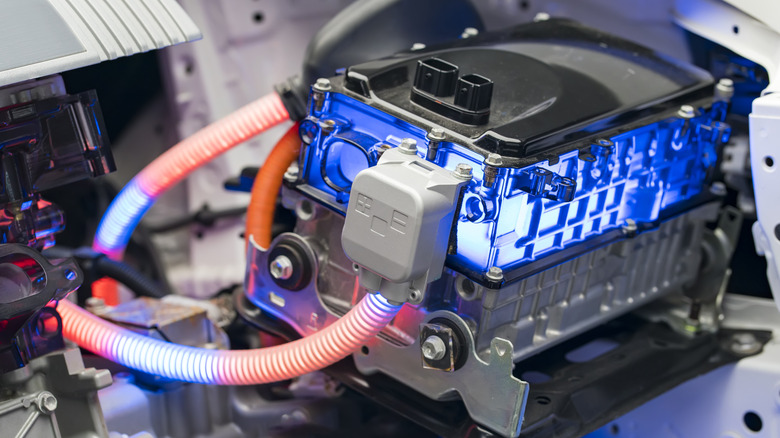
It takes a lot of engineering work (and plenty of computers) to get an internal combustion engine and an electric powertrain to play ball. This falls in line with both why the hybrid vehicle is more expensive and weighs more than its traditional sibling; you're having to cram all of that tech into a relatively small footprint. If you look at an exploded diagram of a typical hybrid car, you'll see parts on top of parts on top of even more parts, all linked together with a series of cables, wiring, and mechanical components.
This inherent complexity means more failure points, and therefore less reliability in some cases. Some hybrid cars are legendarily unreliable in comparison to their regular counterparts; take the F-150 PowerBoost, for example. The 2025 model year had a frankly ludicrous score of 7 of 100 on Consumer Reports' reliability scale, making it the least reliable vehicle of that model year by a long shot. Granted, the standard F-150's score wasn't great, with 36 out of 100 for its own part, but that might as well be 1990s Toyota Hilux levels of reliable by comparison.
Manufacturers are well aware of the disadvantage of having so many systems work in concert with one another. Recent innovations range from Hyundai patenting a new wind-based recharging solution for EV batteries to Faraday Future patenting a new transmission concept for hybrids. Other companies have simply relied on decades' worth of ironing out the teething issues enough to produce sub-$30k hybrid models, such as the Kia Niro, Honda Civic, and Toyota Corolla.
Running costs are expensive

Given their complexity and weight disadvantages, the natural progression leads to an increase in the general running costs of the vehicle. What this translates to is factors like repairs, sourcing parts, and any DIY work. For one, these are highly specialized machines, despite their relatively general application. So if you have, for instance, a dead battery or malfunctioning software, you're basically out of luck and have to take the car to someone qualified to repair it, which costs money. Right-to-repair only goes so far with these vehicles.
Moreover, the parts themselves aren't cheap, either. Batteries alone can run you deep into four-figure territory, depending on what type of hybrid you have. Some hybrids have combustion engines do most or all of the work, whereas others have the engine act as a sort of generator while the electric motors do the rest. Each of these types have their own associated parts and systems, and not everything is obvious anymore. Gone are the days of regular cars that are easily-wrenchable.
That said, despite their inherent complexity and increased maintenance costs, hybrids are statistically more reliable than gas-powered equivalents. It's all-electric and PHEV cars that have all the issues, generally stemming from them being relatively new designs with more teething issues to work out. Electric cars are a rapidly-evolving category, with technology changing practically with the moon phases. For the average consumer, this means that you're buying into effectively something bordering on a beta test with some of these vehicles, so expect additional expenses in-turn whenever you go to the repair shop. They may also be more to insure as well, as they tend to be more expensive and are popular as urban commuter vehicles where traffic, and therefore risk of accident, tends to be heavier.
They don't work well in certain applications

Hybrids are unquestionably incredibly useful cars, but they're also somewhat niche in comparison to dedicated combustion cars or EVs. That's down to how the hybrid system actually functions — they don't have the full capability of either configuration, being a compromise of both. So you have an electric motor with a battery that might not be able to power the thing beyond inner-city driving, and an internal combustion engine that has to work overtime pulling a quarter-ton of ballast everywhere when the battery dies.
This becomes especially apparent in specific situations, such as highway driving, for example. Say you put on cruise control and you're lazily driving for a few hours down the interstate — you're running only on combustion power, and it's dragging around that extra mass which, again, equates to longer stopping distances. Granted, regenerative braking is a thing, but you'll be doing far more of that in a city versus a highway. So if your commute involves mostly highway driving, then why bother with a hybrid?
Likewise, because the car is a compromise between the two systems, you'll never have the full power of either, which is bad news if you're towing, for instance. Moreover, the additional weight of towing puts undue strain on the regenerative braking system. Cargo capacity may also suffer, given the fact that the hybrid powertrain has to go somewhere. So if you're doing one or more of these tasks regularly, it's likely better to opt for a dedicated EV or combustion-powered car that's designed with that kind of range and versatility in mind. That said, certain purpose-built hybrids do exist, such as hybrid semi-trucks with specialized braking systems, but that's an extreme case.