

New Hyundai Patent Could Change The Way EV Batteries Are Charged Forever
Many modern cars are much bigger and heavier than they once were, and a lot of that's down to the sheer amount of tech crammed into every one. EV batteries and motors, hybrid systems, modern conveniences, sensors, diagnostic equipment — the list goes on. What do all of these items have in common, though? They all use power. Generating that power has been a near-constant source of head-scratching for engineers since the early days of cars, but what if the next big innovation is actually in hindsight after all?
Enter Hyundai with a rather interesting concept, which the company calls a "Vehicle Wind Power Generation System." The patent publication, US 20260168477 A1, describes the it as "A vehicle energy harvesting system includes a grille positioned at a front surface of a vehicle body frame, at least one shutter unit positioned inside the grille and configured to open and close a portion of the grille, a power generator unit positioned adjacent to the shutter unit and fixed to the vehicle body frame, and a controller configured to control the shutter unit based on a vehicle speed."
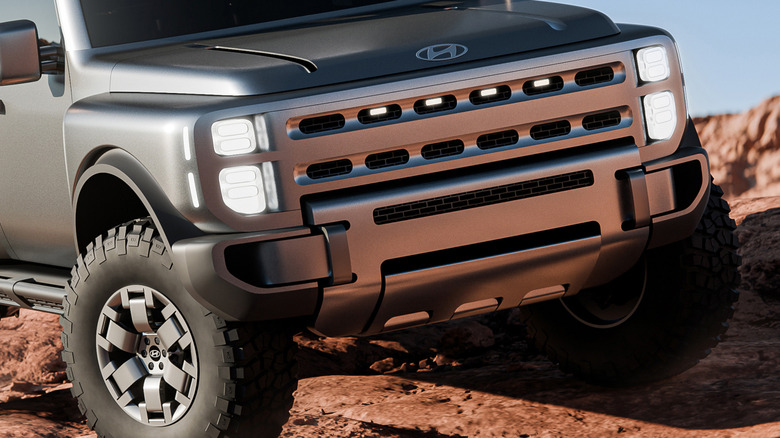
What does all that mean, exactly? It's a windmill. Or, more accurately, a windmill fitted behind a retractable grille, designed to capture passing wind and convert it to energy with an electric generator, probably for future concepts like the Hyundai Boulder SUV. How does it work, and will it actually do what it's supposed to? Let's find out.
How it's supposed to work

Given that this is just a patent application at this point, we should treat this as a proof-of-concept with many details that are subject to change. According to the information we have now, though, the concept works by harnessing passing wind and converting it to electricity, mainly at low speeds. Higher speeds, so the patent claims, subject the system to too much aerodynamic drag for it to be worth the energy recovery.
A car equipped with this system will use a system of retractable ducts, acting like pop-up headlights but with little windmills instead of lighting. The drawings call for two such units, one on either side of the vehicle, positioned below the headlights and beside the main grille, likely blending in with the rest of the cooling ducts on the front fascia. The wind-powered generators connect to a transformer, converting the voltage and introducing it to a rectifier. That then alters the voltage from AC to DC, where it's fed into a DC-DC converter. Finally, it leads into the auxiliary and main batteries to recharge the whole system. In a sense, it's not too dissimilar from the electromagnetic regenerative braking systems that are so crucial for EVs, except it's using wind power instead of kinetic energy.
Like regenerative braking, the overall goal is to capture otherwise wasted potential energy, not to take away energy that could be used for work. That's where the retractable doors come in, blocking off the generators and hypothetically allowing the car to run purely on EV power or with its combustion engine if it's a PHEV.
Will it actually do anything?

This is the big question — it's two windmills on the front of the car, likely not much bigger than one of those handheld fans you have in the summertime, if the drawings are to be believed. How much power could it realistically generate, and is it worth the added complexity and weight? We think so, at least in its current iteration, and here's why.
Let's run a hypothetical scenario. Say you're going 65 mph on the highway and notice some traffic up ahead, forcing you to slow down. The system's ducts will open up and allow controlled airflow over the generators. Sure, those generators will take some of the energy from the airflow and add drag, sure, but it doesn't matter because you have to slow down anyway. Now you're going about 35, and the ducts are wide-open. Along with regenerative braking, you're effectively continuously recharging the batteries as you drive along. Obviously, a couple of windmills won't charge the whole thing, but a few miles of extra range will never hurt.
There are many scenarios where one of these would be quite useful. City driving is the most immediate example, but it may well excel in any situation where you're slowing down from higher speeds and could use that otherwise parasitic drag to good effect. Is it reinventing the wheel? Not really; we've had wind-powered machines practically since the dawn of agriculture. But unlike other innovations such as Faraday Future's experimental PHEV transmission, Hyundai's concept appears simple, clever, unobtrusive, and useful. With a few years of perfecting the design, it may well become a mainstay on Hyundai EVs.