

Dodge's 2026 Charger R/T Sixpack Feels Like Peak Muscle Car Nostalgia, And Not In A Good Way
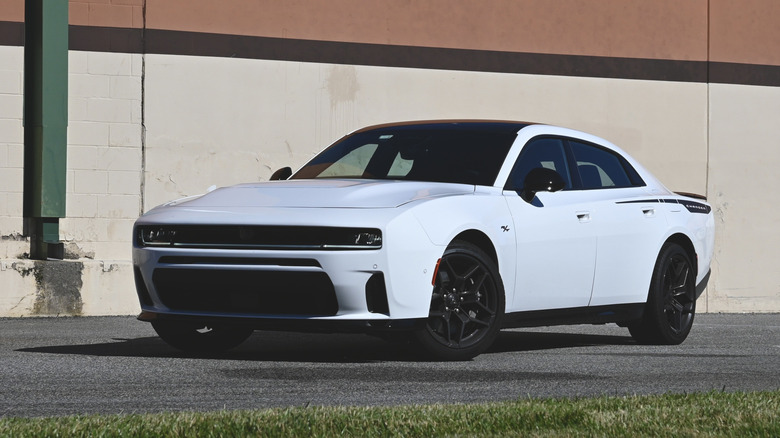
The Dodge Charger, as it exists in 2026, is actually two distinct vehicles. Actually, if we are being pedantic (and let's face it, we usually are), it's actually four vehicles. There are the four-door and two-door variants of the electric Charger Daytona, a car I was thoroughly disappointed with, and the coupe and sedan versions of the gas-powered Charger.
Now, my experience with the electrified Charger was definitely underwhelming, to the point where I can't recommend it to anyone who wants a performance EV that doesn't do a convincing imitation of a brick whenever the electrons housed within throw a fit. But the 2026 Dodge Charger R/T "SIXPACK" sedan that showed up in my driveway had a different powerplant altogether, a more conventional Stellantis "Hurricane" sat under the hood.
Within the past year, it's been pretty well established that Stellantis has had incredible difficulty with hybrid or electric cars, to the point of discontinuing just about all of them after a long series of recalls. The Charger Daytona wasn't my first experience of problematic Stellantis-brand electrification: I struggled with the plug-in hybrid Chrysler Pacifica a few years ago. What Dodge has demonstrated before is that it knows how to make a muscle car through the advent of supercharging and aggressive pricing with the Dodge Charger/Challenger twins and the Hellcat phenomenon. Does this new generation of Charger carry the muscle car torch?
A new Charger with a new engine
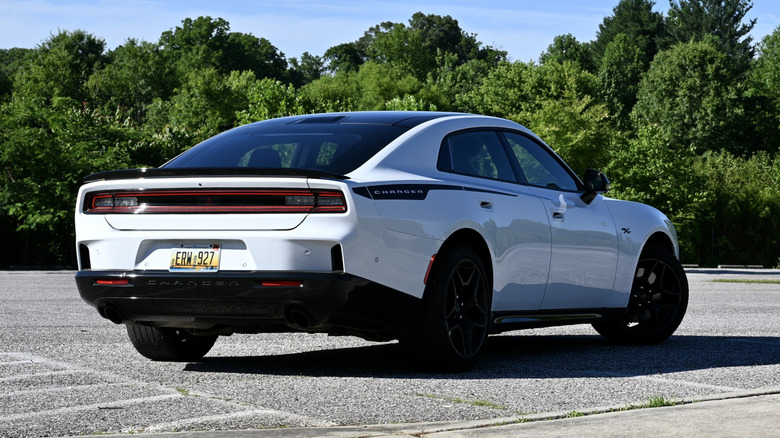
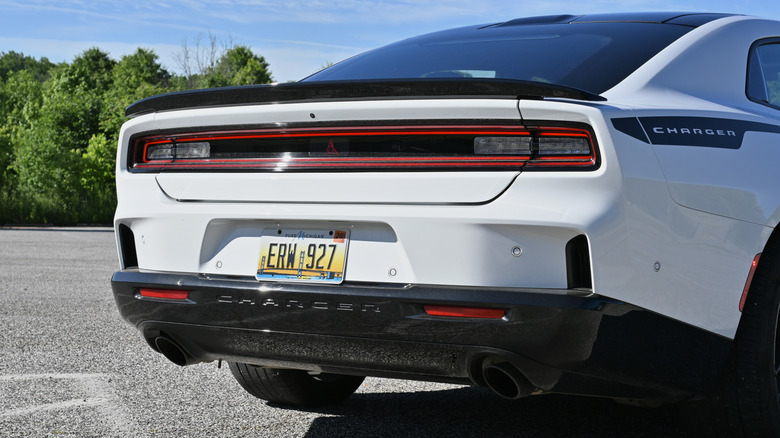
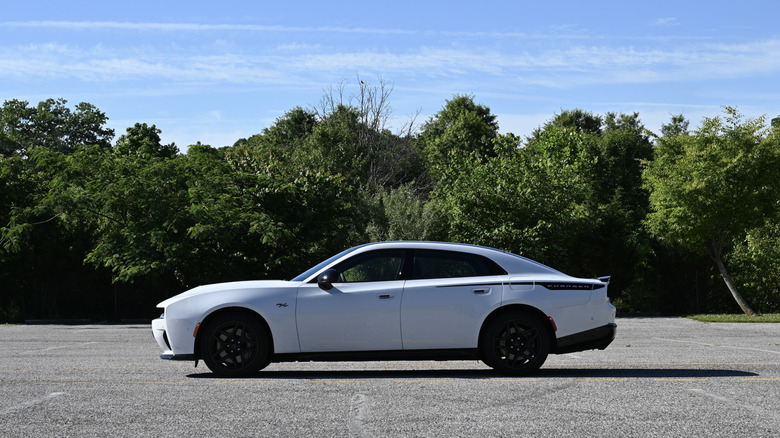
The new Charger, especially the sedan, looks like a combination of the prior Challenger and a Charger. It has a big fish mouth grille and it's incredibly wide. As a sedan, it looks almost cartoonishly long, but given the whole vibe and ethos of Dodge through the past few years, "cartoonish" might be taken as a compliment. Either way it's a big vehicle, and the "Knuckle White" paint scheme leans towards "belligerent whale" if I were forced to assign an animal to it.
Powering the new Charger is a 3.0-liter twin-turbo inline-6 called the "Hurricane" that's already made its home in a few Jeeps and Ram trucks. For the Chargers, it's differentiated from the electric models with the "SIXPACK" name. In this particular application, the R/T trim, it outputs a pretty healthy 420 horsepower and 468 pound-feet of torque to all four wheels (the Scat Pack bumps that up to 550 horsepower). Dodge says it will go from 0-60 in 4.6 seconds. You don't buy a car like this for fuel economy, but it's rated at an "adequate" combined 20 miles per gallon.
A look at the numbers
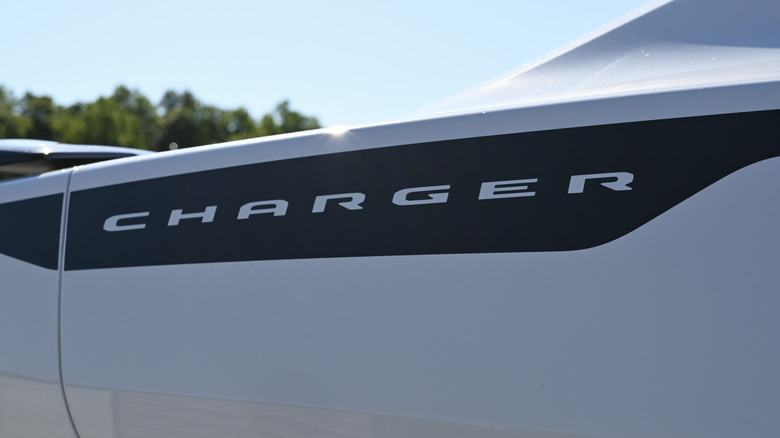
So how is it to drive? In short, it's pretty miserable. The Hurricane is a good engine, and I quite liked it in the Ram Warlock I tested in 2025, but the sheer heft of the Charger sucks all the fun out of a torquey inline-6. It does weigh 4,741 pounds after all, or roughly 500 pounds heavier than the prior V8-powered Charger.
4.6 seconds from a stop to highway speed isn't slow, but it really isn't all that quick either. In the age of a fairly attainable sub-four second 0-60 time, almost five seconds seems like it's lacking. If you went solely by Dodge's advertising, you'd think that the Dodge Charger was the fastest car on planet Earth, but in reality, it's quite a bit slower to launch than a lot of EVs, and even something like the Toyota GR Corolla can beat it by a hair.
There's a joke among the automotive crowd that even the biggest and baddest muscle cars of the 1960s and 1970s would get destroyed in race against new commuter cars like the Honda Accord or Toyota Camry, just thanks to how far automotive technology has progressed and how horsepower has been democratized. Somehow, in 2026, Dodge has done that again with the new Dodge Charger, as it's officially slower than a Corolla hatchback.
A muscle car without the muscle
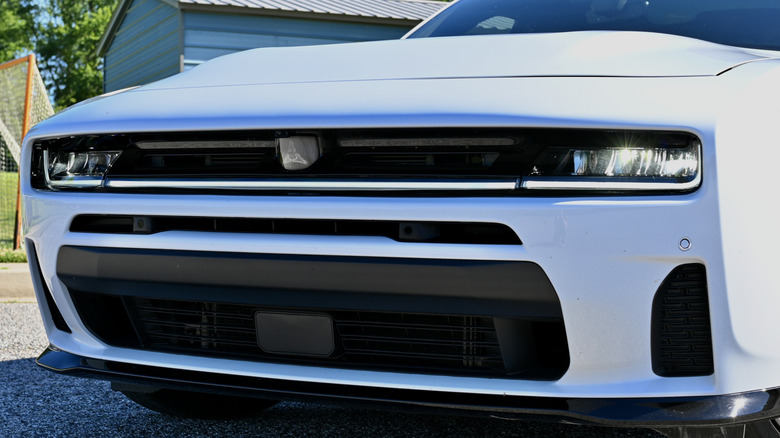
Driving dynamics take a back seat to the fact that the Charger really is very heavy and not at all compliant. The car plows through corners at anything higher than a moderately sedate pace, and it feels more like driving a truck or SUV than a muscle car.
That would be fine it it was fast in a straight line, like a bona-fide drag racing car, but it isn't: the eight-speed automatic transmission doesn't seem to be in any real hurry to accelerate. It feels slow, regardless of the actual numbers. The all-wheel drive does its best to keep the car stable, but it appears to hamper the rowdy muscle-car-ness of the Charger by sapping any and all fun out of the driving experience altogether.
You can switch to rear-wheel drive if you so desire, but you also lose the added benefit of the front wheels providing grip. You might not mind that when doing Sheetz parking lot donuts, but given the Dodge's weight and remote steering feel it could be more problematic on actual roads. Like every other part of this car, it's a frustrating compromise.
I've driven plenty of boring crossovers and entry-level sedans. I daily-drive a Chevy Cruze, a car that's diametrically opposed to fun. I've also driven a lot of performance cars that will give you heart palpitations due to speed. The Dodge Charger SixPack, unfortunately, fits in the former category. It's loud, goofy, and brash, but if that doesn't get you anywhere, it's all sound and fury signifying nothing.
No escape from mediocrity
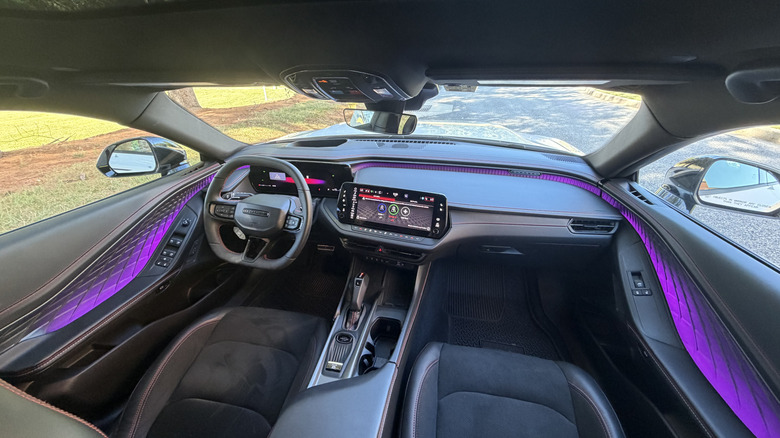
There are benefits to being a huge sedan, so even without speed or the feeling of speed, how is the Charger to sit inside and watch the world gawk at your (perhaps ill-advised) financial investment? Well, as with the outside, the inside doesn't work all that well either. It feels cheap and thrown together without much care, even with its fancy ambient lighting. Leather accents collide with Playskool-grade plastic that wouldn't be out of place in a late 1990s Dodge Neon.
Given the fact that the final sticker price of this car approaches $70,000, it's pretty egregious that the interior feels worse than cars with less than half that price. Even the most bare-bones Nissan Sentra feels better put-together than this. Call me flippant or hyperbolic all you want, but it just doesn't feel good to sit in. When it comes to ergonomics, it falls short as well, with a huge interior requiring a bit of stretching to reach controls and a windscreen that's so raked back and aggressive that a World War II-era tank probably has better viewing angles.
Dodging a bad deal
So it's not especially fast, cheaply made, and really big, but is it at least affordable? No, it is not. It has a starting price of $51,995 for the four door ($49,995 for the coupe), which already puts it well north of base model BMWs, Mercedes, and Mustangs that would annihilate this car in every category. This Charger, however, had quite a few extras.
The "Customer Preferred Package 21A" costs $4,995 and adds heated/ventilated front seats, performance tracking pages in the 12.3-inch UConnect infotainment screen (a screen that stopped working and required a reset several times over the course of the week), a wireless charging pad, and a heads-up display. The "Blacktop package" adds blacked out exhaust tips and badging for $1,295.
The $2,995 "Performance Handling group," named somewhat ironically, adds extra drive modes, Brembo brakes, 12-way power bucket seats, and a launch control mode. The full-length glass roof is $1,395. The sole saving grace of this car is the 18-speaker Alpine sound system, which sounded pretty good. Unfortunately it's a $1,795 add-on. Lastly, the white paint color is a $695 extra. Throw in the destination charge of $1,995 and you arrive at the final price of $67,160.
2026 Dodge Charger R/T Sixpack verdict
You already know there are better ways to spend over $67,000. "But it's a performance car, it's allowed to be expensive," you may argue. Remember, a V8-powered Dodge Charger with almost 500 horsepower could be had for under $60,000 just a few short years ago. In the contemporary American performance car department, a Ford Mustang GT — a better car in every measurable way apart from interior space — starts at $46,800, with a 500 horsepower Mustang Dark Horse (also available with a six-speed manual) coming in at $66,070 when you include fees and destination charges.
Meanwhile, used C8 Corvettes can be had for under $67,000 all day long. If you want a performance sedan, $67,000 puts you comfortably in entry-level BMW M-car and Mercedes-AMG territory. The BMW M340i xDrive is quicker with a 4.1-second 0-60 time and starts at less cash at $64,300. The Mercedes-AMG C43 sedan, an actual performance car, starts at $64,150.
The 2026 Dodge Charger R/T Sixpack is a disappointment. It's too big, too slow, too expensive for its own good, without giving any real benefit. The size doesn't do anything if it handles poorly, the neat engine doesn't help you if can't get out of its own way, and the exorbitantly high price tag isn't a bragging right if it's a demonstrably worse value than other brands. What kind of bizarro universe are we living in where the Dodge is a worse money proposition than the Mercedes?