

8 Vintage V8 Trucks You Can Snag For Peanuts Right Now
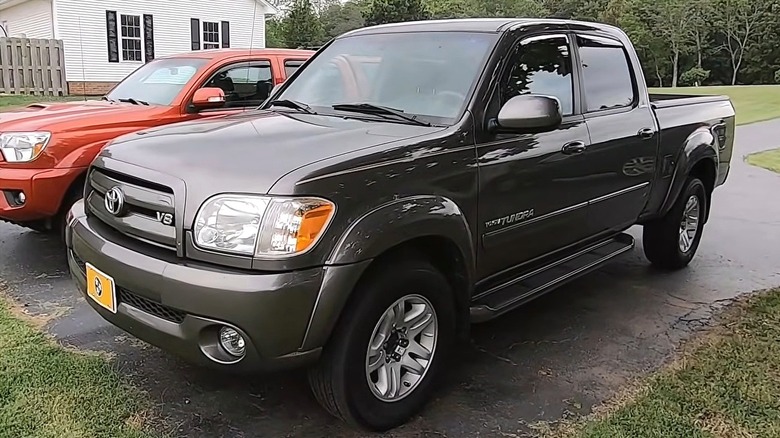
There's a window in the used market for vintage trucks with actual V8s, sitting at prices that would have seemed impossible just a few years ago. Mind you, these trucks aren't the type that'll cost you twice the purchase price just to make roadworthy; they are just honest, old-school iron sitting at the sweet spot where depreciation has bottomed out, and collector premiums haven't arrived yet. That middle zone is exactly what this list is about, plus you can also find them through private sellers pricing to sell, on classic car platforms where realistic market data keeps values grounded, and even at auctions where a slow bidding room works entirely in your favor.
What makes these particular trucks worth hunting down goes beyond the price tags. Since every single one of them left the factory with a V8 under the hood, either standard or as a genuine factory option, you'll be getting displacement, torque, and the mechanical specs that make ownership genuinely enjoyable rather than a headache. Plus, they were designed in an era when a knowledgeable owner with basic hand tools could handle most of what the truck would ever need, and that philosophy shows up in parts availability, community support, and the overall cost of keeping one on the road.
Each truck here has its own powertrain story and its own reason for landing on this shortlist, but one thing they all share is a price point that puts a vintage V8 in the cheap zone.
Ford F-Series (1980 - 2003)
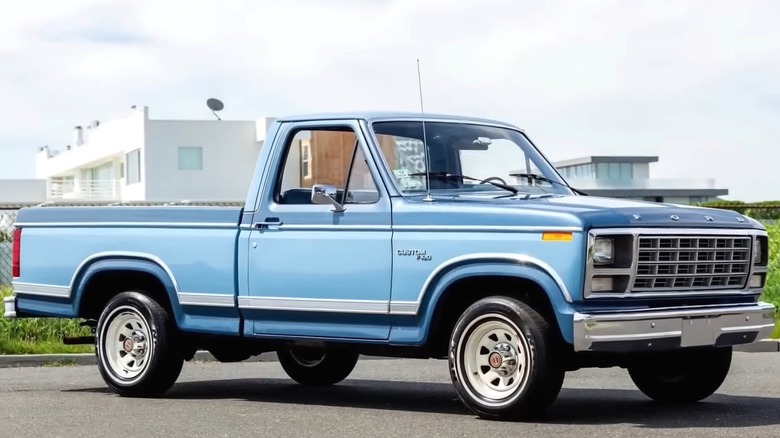
The F-150 story starts back in 1973, when the first ones rolled out of Ford's Dearborn and Kansas City truck plants as the sixth generation of the F-series lineup. To work around tightening U.S. emissions standards at the time, Ford slotted it right between the heavier F-250 and the lighter F-100 right before it left the market in 1983, which also explains why they have similar looks.
The sweet spot for buyers today runs from the seventh generation through the 10th, meaning any F-150 built between 1980 and the early 2000s is fair game. These trucks came in all kinds of configurations over the years — 4WDs, RWDs, regular cabs, SuperCabs, different bed styles, and a rotating cast of engines to match. The seventh gen alone, which ran from 1980 through 1986, went from a 5.8-liter V-8 in 1984 to a 5.0L V-8 in 1985, which is nice because those trucks are still around, and one F-150 XL even sold this year for as little as $3,300.
You can get a ninth-gen 1995 F-150 for around $6,495, and for the tenth generation, a 2003 model has been spotted listed for as low as $3,078. Even Kelley Blue Book puts the trade-in value on a 2003 XL STX 2D Regular Cab at roughly $1,725, with a base XL 2D carrying a fair market price of around $3,200. Even if you want something a little nicer, stepping up to a better SuperCrew Cab trim still only puts you at a fair price of about $4,275.
Dodge D/W-Series (Third-Gen)
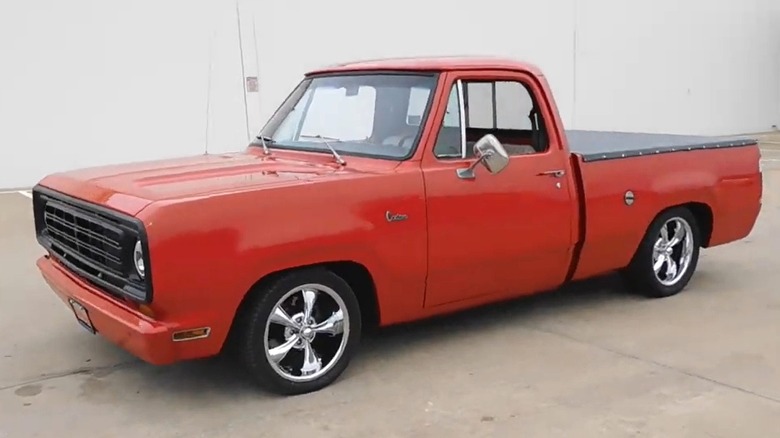
For anyone who has a soft spot for vintage American iron, the third-generation Dodge D/W Series is one of the V8 trucks that you'd love, and the best part is, finding one for well under $30,000 is more realistic than you might think.
Dodge introduced the third-gen in 1972 under the AD setup and right away split the lineup into two distinct families to give buyers a clear choice. The W-Series covered the four-wheel-drive side of things, while the D-Series handled the two-wheel-drive crowd, and both came in short-bed and long-bed setups with your pick of manual or automatic transmission depending on how much muscle and traction you were after. The engine options were so broad that buyers could spec from a 243-cubic-inch diesel to a 360-cubic-inch small-block V8, or even a 400-cubic-inch V8, all the way up to a 440-cubic-inch V8, even though the series was designed during the height of EPA regulations. That variety extended across the whole family, including the heavy-duty W-200, W-100, D-100, and D-150, and also in specialty builds.
By 1980, those trucks received fresher updates and some new tech before the D-Series badge was changed in 1981 in favor of the Ram badge that's still on Dodge trucks today. As for what they're actually selling for now — a 1974 D200 recently changed hands for $8,000, and Bring a Trailer moved a 1978 W400 fire truck for $7,400, with another example from the same year fetching $9,600.
Dodge Ram & Power Ram (1981-1993)
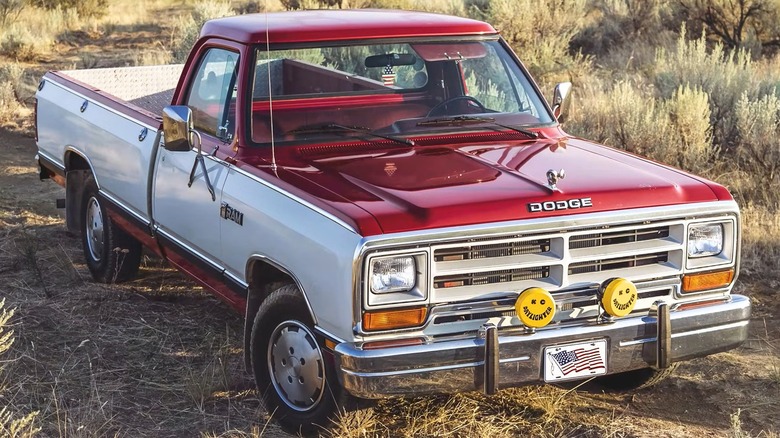
When Dodge quietly retired the D-Series badge in 1981, the Ram badge simply picked up right where it left off, just under a fresher identity. The hood ornament carried over, the same DNA stayed intact, and the whole thing just kept getting better through a twelve-year run before the second generation took over in 1994. Over that stretch, Dodge kept the lineup broad enough to cover just about any buyer. The Ram came in 150, 250, and 350 variants, all in four-wheel and rear-wheel drives, so whether you were hauling on the highway or pushing through rough terrain, there was a trim level that fit the situation. While the Cummins 5.9-liter diesel became the engine most people associate with this generation, Dodge kept V8 options on the table for those who wanted to stick with gasoline.
That versatility is one of the reasons why these trucks are still out there and still very much affordable. Classic.com recorded a 1981 Power Ram W250 selling for as low as $5,300, which sits at the low end of the market. That's not all. A Dodge Ram D250 sold for $6,400 this year, and Cars & Bids moved a 1990 Dodge Ram D150 for $7,000 at auction. Even on the fuel side, you'd expect these trucks to be punishing, but they aren't — according to Kelley Blue Book, a 1993 Dodge D150 Regular Cab can dip as low as 16 mpg on the highway.
Toyota Tundra (First-Gen)
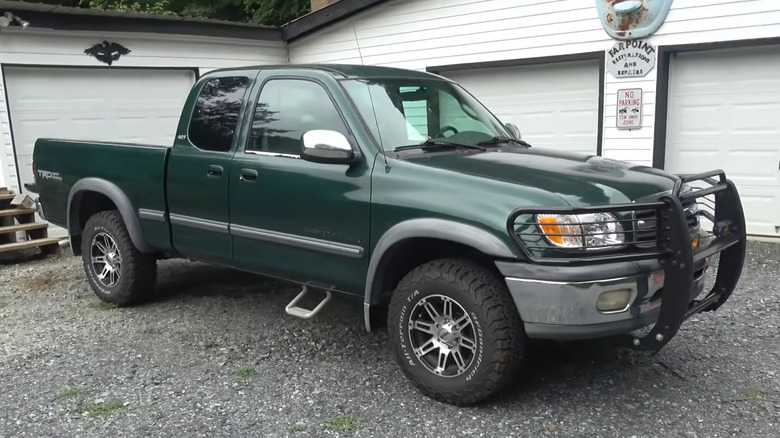
The first-gen Toyota Tundra has quietly been making a case for itself for years. Given current market conditions, there's never been a better time to grab one than now.
The Tundra's story goes back further to when Toyota first pulled its cover off at Indiana's State Fair in '98, positioning it as the truck that would carry the brand into America's full-size segment. Toyota even built it right there in Indiana, and by 2000 the Tundra was on U.S. roads as a single-cab or extended-cab pickup. Unlike its predecessor, the T100, buyers could opt for a 4.7-liter V8, the 2UZ-FE, rated around 245 horsepower in 2000 through 2004 models. By 2005, Toyota had added a Crew Cab body style to the mix, and its horsepower had risen to 282 horsepower before settling back to 271 hp by the time the first-gen's run wrapped up in 2006.
As for pricing, how much you would pay for a Tundra really comes down to its overall condition. Still, regardless, finding a first-gen for around $5,000 is very possible, all thanks to its aftermarket and deep support for anyone looking to do swaps or tweaks down the road. Last year a pair of 2006 Tundra Access Cab Stepsides sold for $7,300 and $8,000, and Bring a Trailer moved a 2001 Tundra Access Cab Limited for $8,200. In 2026, a 2006 Double Cab SR5 went for $8,100, and Edmunds is currently showing a 2006 Limited Cab for as little as $4,349.
Dodge Dakota (1987-1996)
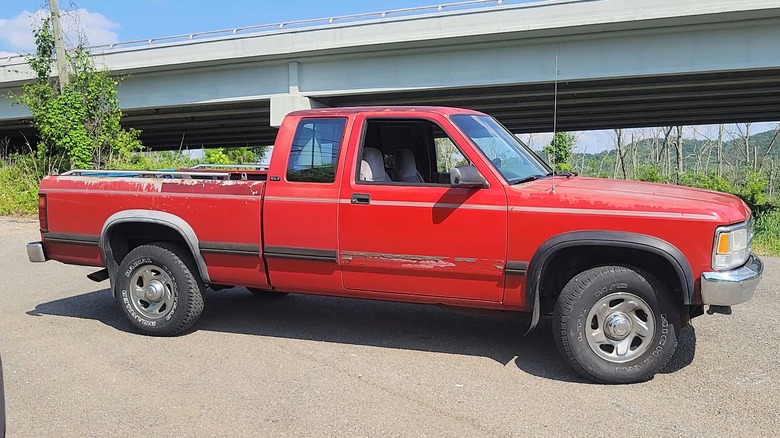
Chrysler rolled out the 1987 Dodge Dakota specifically to challenge the likes of the S-10 and Ford's Ranger, positioning it as a midsize truck with rear- or four-wheel-drive options and a Club Cab body style. That first year, though, the Dakota only came with a V6 built off the bones of the 318-cubic-inch V8, not what V8 buyers expected, but that changed in 1989, when the Shelby trim finally brought a genuine V8 to the lineup, and Dodge built only 1,500 of them. Under the hood sat a 5.2-liter Magnum V8, paired to a four-speed auto gearbox and a limited-slip differential, putting out a torque of 270 lb-ft, which was enough to make it one of the highest horsepower pickups of its time at about 175 horsepower.
Alongside the Shelby, the Dakota lineup also included LE and Sport trims through the end of its first generation in 1996. Despite the rarity behind that V8, the Dakota Shelby is still worth picking up today. That run holds surprisingly accessible value, and prices on the used market are still low. Bring a Trailer sold a 1989 Dakota Sport for $3,300 this year and a 1996 Dakota for $6,400 last year, while Cars & Bids moved a 1989 Dakota convertible for $8,888. To top it off, KBB pegged a 1996 Dakota's resale value at just $2,363 as of 2025.
Chevrolet C/K (Third-Gen)
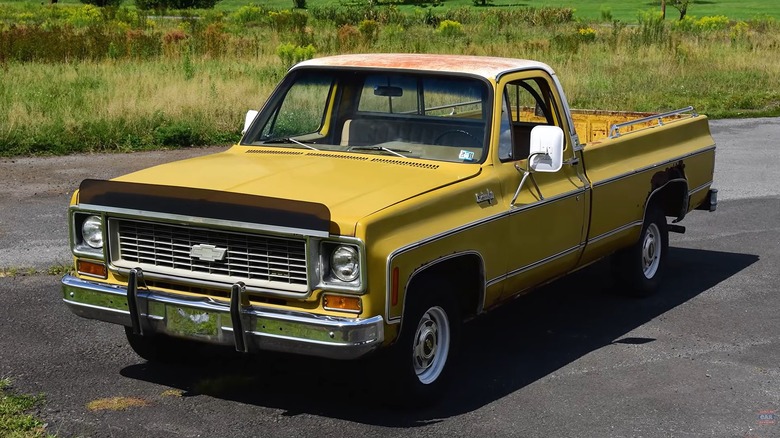
Spanning from 1973 through 1987, the C/K series third-gen became one of Chevy's most iconic trucks, moving 666,619 units in its debut year alone. Buyers had plenty to work with from the factory, too, with three-quarter-ton, one-ton, or half-ton configurations on offer, along with stepside or fleetside bed setups and a crew cab layout for those who needed the extra room.
Under the hood, Chevy gave buyers genuine V8 muscle right out of the gate. Early trucks could be optioned with the legendary 454 big block or Oldsmobile's 350 V8, paired to a bunch of gearboxes depending on the specific truck. But across its 14-year run, the powertrain story evolved more than a few times. After 1974, Chevy pulled the 307 — which topped out at around 130 horsepower — and replaced it with a dual-barrel 350 horsepower, and then in 1977, that original 350 that was good for 155 horsepower got nudged aside by a dual-barrel 305. GM kept the changes coming by adding the LF9 diesel V8 to the lineup in 1978, and by 1982, both the 305 and 350 gasoline V8s had given way to a 6.2-liter diesel as the era of fuel economy concerns reshaped what truck buyers were asking for.
What makes the surviving square bodies even more compelling today is how accessible prices are in the recent market. A 1984 C20 crossed the block through Hagerty last year at $2,545, while Hemmings sold another C20 for $4,100. This year, Bring a Trailer and Mecum each moved a C10 for $4,700 and $4,400.
GMC C/K series
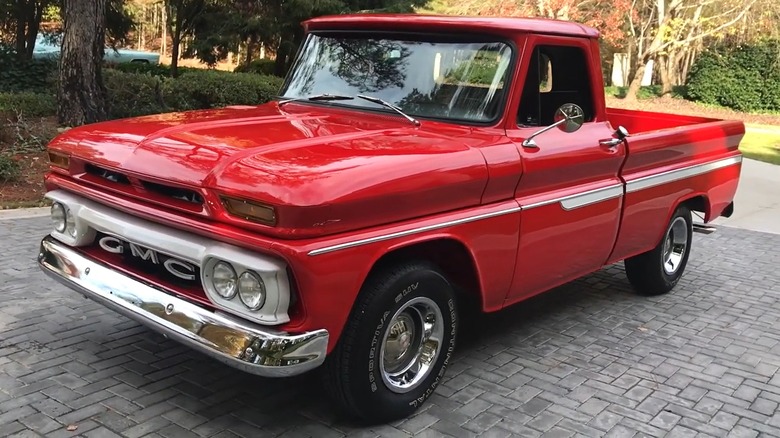
The Chevrolet C/K series' influence dates back to 1960, when the series debuted as the successor to the Task Force lineup, featuring a decoupled torsion-bar front suspension that no other vehicle in its class had offered before. Before the more familiar 30, 20, and 10 trim levels, early rear-wheel models used the C2500, C1500, and C1000 badge system to distinguish themselves from four-wheel drives that used the "K" prefix, though they got retired in favor of "R" and "V" in the fourth generation before the nameplate finally retired in 1999.
During its span, the opening gen, which covered the early-to-mid '60s, gained a 327ci small-block V8, while the second generation, which arrived in 1967, made a 283 V8 its base power plant. By 1968, it added a 396 big-block and a 307ci small-block V8, and 1969 brought the swap from the 327 to the 350ci V8 — the same year the 396 took on hauling duty. Heading into the fourth generation, the GMT400 platform arrived with the 454 big block in 1988, eventually backing buyers with V8s like the 5.0-liter, the 7.4-liter big block, and the 6.5-liter diesel, depending on the truck buyers opt for.
For a truck that's one of Chevrolet's most successful models, it is still within reach on the used market, and it's possible to get one for at least $2,500. A 1978 C10 Custom and a 1973 C20 camper each sold for $5,000 – the latter through Bring a Trailer last year — while a 1987 R30 crew cab went for just $1,100 this year.
Jeep J-Series (1963 - 1987)
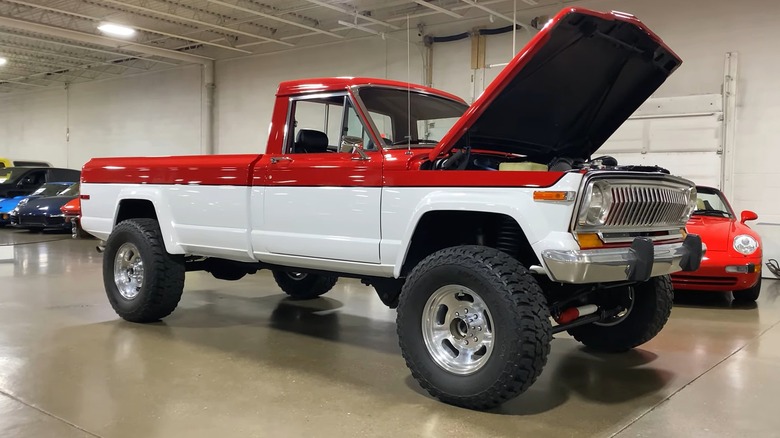
Jeep spent 24 years building one of the most capable V8 pickups of all time, and somehow time has made it so accessible today. What became the J-Series entered the market in 1963 under the Gladiator badge, rolling out in two trim configurations — the lighter-duty J-200 and the heavier-hauling J-300 — in either rear or four-wheel drive. Towards the end of '65, the lineup had been reshuffled into the J-2000, J-3000, and J-4000, plus it was that same year the nameplate slid a 327-cubic-inch AMC, better known as the Vigilante V8 engine, under the hood for its debut, punching out somewhere between 250 and 270 horsepower depending on which carburetor the truck left the factory with.
By 1971, the J-series were no longer called the Gladiators, and that same transition also brought fresh engine options the following year, adding the 304 and a 360 AMC V8, though the 304 retired after just a single season. Jeep then brought in the 401 AMC V8 into the lineup for 1974, and between that and the 360, the truck had enough under the hood to stay relevant through its final year in 1987.
To grab one right now, just budget between $3,950 and $9,995 for a used 1965 model. Plus, Bring a Trailer sold a 1964 Gladiator last year for just $7,350, a pair of 1969 examples for $7,950 and $8,600, a 1976 J-20 matched that same $8,600 mark, and a 1986 J-10 closed at $7,200.
Methodology
Every truck on this list had to earn its place through three filters, and its first filter was era. Nothing built after the mid-2000s qualified, because the whole point was to spotlight trucks from a time when V8 engines were standard issue, and you could still work on them with a basic set of hand tools. The second filter was the engine itself. Every truck had to leave the factory with a V8 as either standard or optional equipment — no retrofits, no swaps, no creative reinterpretations of what counts as a V8 truck. If the factory didn't build it that way, it wasn't included on the list.
The third filter was price. A truck that only shows up at Mecum once a decade for $40,000 isn't accessible, so to make this list of "Vintage V8 Trucks That You Can Snag For Peanuts," drivable examples had to fall below the $10,000 mark. That meant cross-referencing active listings across Bring a Trailer, Classic.com, Autotrader, and Kelley Blue Book, then checking those figures against Hagerty's valuation data to make sure the numbers reflected what real buyers are actually paying, not just what sellers are hoping for.