

5 Things To Consider Before Buying Any Ryobi Pressure Washer
We may receive a commission on purchases made from links.
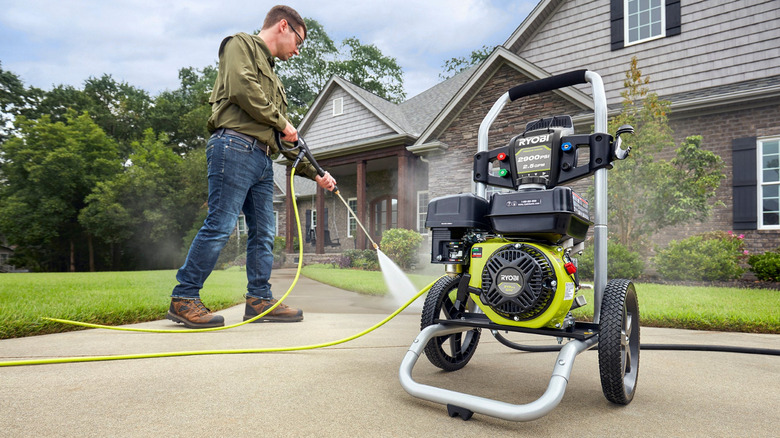
Buying a new tool of any kind can be a little harder than you expected, especially if you don't know much about it. What normally makes the choice easier is that most tools, from drills to hand saws and beyond, can be found for cheap — as long as you're fine going with a mediocre model. When in doubt, you can just get a corded tool for less than $100 from a retailer like Harbor Freight. Since pressure washers, even those from a budget-friendly brand like Ryobi, are all quite expensive, it's best to consider all the variables before settling on one that seems to satisfy your needs.
Speaking of this brand, there are some things you should know about Ryobi pressure washers in particular. Most of what you'll find in this article, however, will apply just as well to any other brand of pressure washer. If you already have some of the brand's power tool batteries and you want to avoid gas and corded washers at all costs, then you should probably stick with Ryobi. Otherwise, this guide will still help you should you choose to branch out into a Westinghouse, an Ego, or any other brand.
Differences in power sources between gas and battery
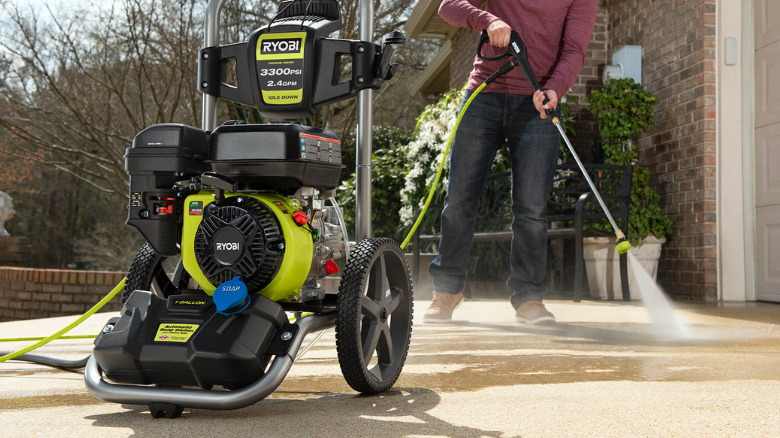
In the last few years, power tools have been rapidly moving away from gas and towards battery-powered models. Most of the biggest toolmakers have stopped making gas-powered models aimed at DIYers, and even corded tools are often relegated to budget options. There are two exceptions to this rule, however: professional gear and yard tools. The latter includes pressure washers.
Regardless of the kind of power source you go with, maintaining and cleaning a Ryobi washer will take some effort. If you're looking to make things as simple as they can be, avoid gas-powered washers: Their engines tend to have a more demanding upkeep, since oil and filters need to be replaced regularly. So, why would you go with anything but a battery-powered Ryobi washer? Skipping over the subtler differences between power sources, the main reason is max PSI pressure and gallons per minute (GPM).
Ryobi seems to only have two gas pressure washers still on sale, the 3,300 PSI 2.4 GPM Washer and the 2,900 PSI 2.5 GPM Washer, and both use a 212cc engine. If you need high PSI and GPM at the same time, these are the Ryobi units for you. Currently, battery-powered washers just can't compete. Corded electrical washers, like the biggest Westinghouse models, can be just as powerful as gas-powered ones, but Ryobi only makes budget corded models. If you want a powerful washer that doesn't use gas, you'll have to go with another brand.
Compatible nozzle types
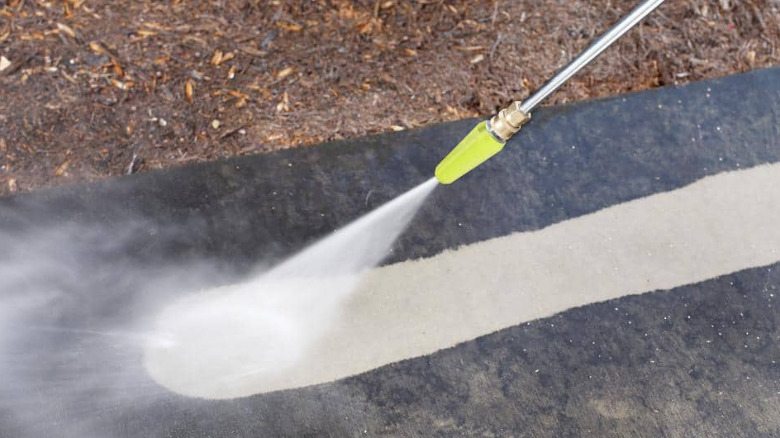
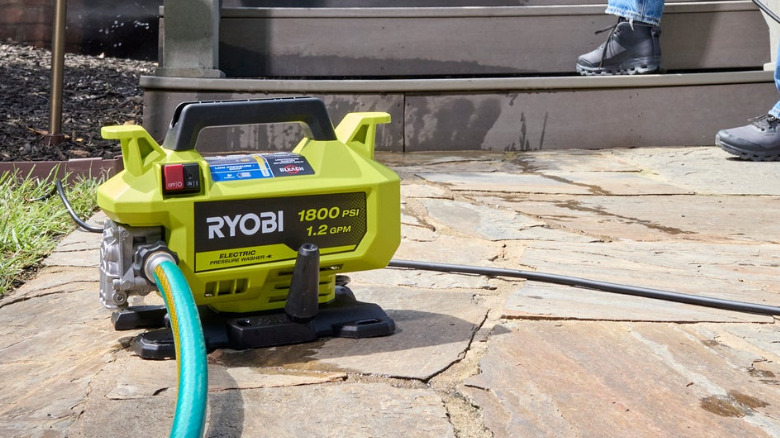
Most Ryobi washers come with at least a couple of nozzles of different types. Even the cheap, handheld 1,800 PSI 1.2 GPM Cold Water Corded Electric Pressure Washer includes a semi-heavy duty 15-degree nozzle and a "turbo nozzle" for concentrated water streams. The latter is more suited for treating stubborn grime, but should not be used on delicate surfaces. Using too much pressure, like that generated by a smaller nozzle, is one of those pressure washer mistakes that can ruin your car, strip paint off a surface, and break windows.
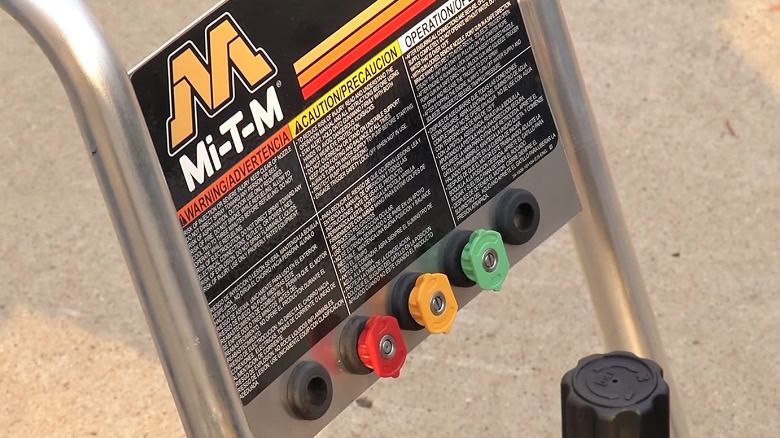
Usually, nozzle types are identified by color. Red nozzles (0-degree) are the most powerful, directing water through a very small opening. Yellow (15-degree) covers a larger area than Red, but it's still quite strong, while Green (25-degree) is fairly mild while still being focused on a limited area. Finally, White (40-degree) and Black (65-degree) nozzles are very gentle, and they're intended more for regular washing than power washing.
If you don't want to change your nozzle as you go from job to job, you can get an accessory that can switch between multiple nozzle modes. If you get one of the more expensive Ryobi washers, you may find one of these included in the price. The 3,000 PSI 1.1 GPM Cold Water Electric Pressure Washer, for example, comes with a turbo nozzle and a 5-in-1 nozzle that includes Red, Green, and White sizes, as well as two extra-large Soap modes for gently distributing the liquid.
Maximum PSI and GPM
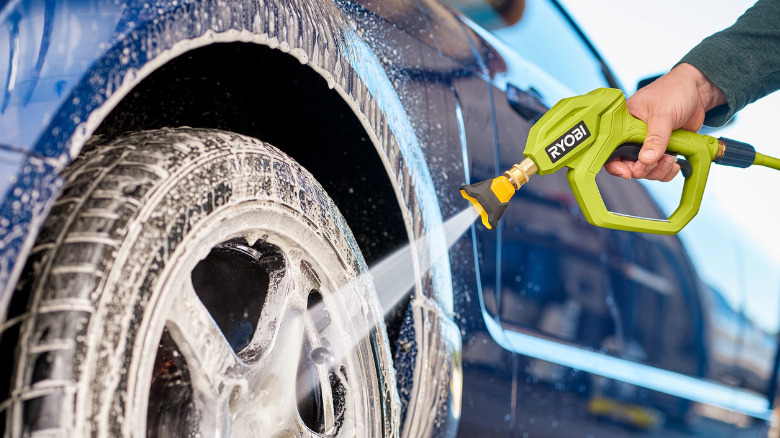
When choosing a pressure washer, few factors are more important than max PSI and GPM. PSI indicates pressure in pound-force per square inch; the higher it is, the more powerful the water jet can get. GPM tells you how many gallons per minute are leaving the pressure washer. Higher PSI gives you more stripping power while high GPM lets you pour down more water, but for most jobs, you'll want a good balance of both. With that having been said, what's a good PSI value for a pressure washer? As is often the case, the only right answer is "it depends."
Unless you're looking to do exclusively very light duty work, you don't want to go far below 1,000 PSI. If you can reach 2,000 and 1.5 GPM, even better. That puts you squarely in the realm of light-duty, which in power-washing terms means cleaning your car or somewhat brittle items like grills and lawn furniture. You only need to go higher (somewhere between 2,000 and 4,000 PSI and close to 2.8 GPM) if you plan to use the washer to clean the driveway, the sidewalk, and your home's walls, and for removing though stains. These jobs are categorized as medium-duty, so what about heavy-duty washers? Simply put, unless you're a professional, you don't need these, as they're meant for industrial cleaning.
While the max PSI that a tool can produce depends on the machine itself, using the right nozzle is equally important when tackling a difficult job. No matter how powerful your washer is, you won't remove the dirt hiding in the cracks of your driveway with a loose 40-degree white nozzle.
Included and compatible accessories
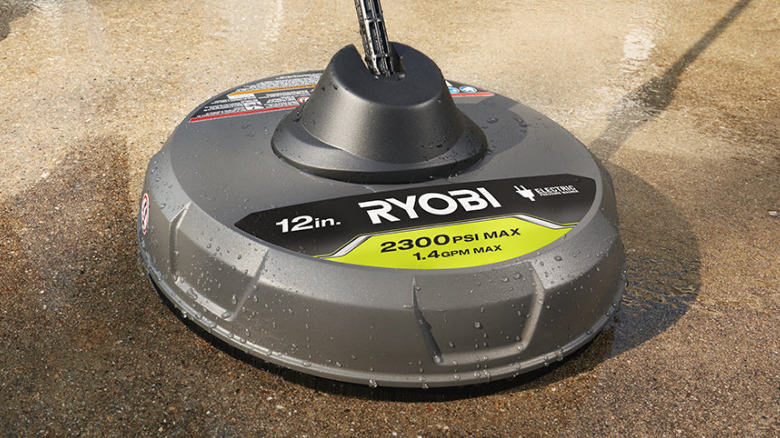
A pressure washer can be a versatile tool, but only if it's accompanied by a good list of accessories. Thankfully, lots of Ryobi washers come equipped with them. These include spray wands, trigger handles, hoses, and soap applicators. Of course, most pressure washers also come with nozzles.
If the pressure washer you have your eyes on doesn't come with the right accessories, it's possible it will be compatible with generic attachments sold by Harbor Freight and other hardware stores. There are also a few Ryobi-made accessories for pressure washers that can add new functionalities to your new tool. Just because these are made by the same company, you can't be sure that they'll definitely fit your Ryobi tool. Just to be safe, double check that they use the same attachment standard.
One of the most useful Ryobi accessories for a pressure washer is the Water Broom, a pair of wheels with a tube in the middle that lets you comfortably turn water pressure toward the ground or for reaching vehicle undercarriages at a more convenient angle. Another accessory that can make cleaning driveways and sidewalks easy is the Surface Cleaner, which cleans a 12-inch wide horizontal area at a maximum of 3,100 PSI and 1.2 GPM with rotating water jets.
Renting instead of buying
There are a lot of tools that you should definitely rent instead of buying, but for many users, a pressure washer isn't one of them. There's so much you can do with a pressure washer — cleaning your car, getting dirt off a hardwood deck — that it justifies keeping one around the home all-year round. However, if you're only looking for an affordable Ryobi washer because you need it for a single job, renting might be a better solution.
You can rent a light-duty 1,400 PSI 1.5 GPM electric pressure washer from Home Depot for less than $50 per day. If you only need the washer for one job, this could very well be a better use of your money than buying a cheap $100 Ryobi tool that you won't ever use again. If you need more power, however, the price goes up significantly. A 2,700 PSI gas-powered pressure washer comes in at $90 per day, while a 4,000 PSI model is over $100 per day. Of course, the cost of buying a tool like these instead of renting it is also high, so you're still saving a lot of money.
If you absolutely want to go with a Ryobi pressure washer even when renting, you'll have to shop around. We couldn't find a major hardware store chain like Home Depot that rents Ryobi pressure washers, but if you're lucky, you could find some available at a local business or in your community's tool library.
Methodology
This list aims to answer the most common questions that a potential buyer of Ryobi pressure washers could have, as well as giving them information about topics they might have never thought about before. To find these topics, we read many guides on how to pick a good pressure washer, taken from sources like Consumer Reports, Home Depot, and blogs written by industry professionals. We chose to ignore the aspects that needed no explaining and condensed the rest into the list you see above.