

Driving Czinger's $2.7m Hypercar Makes You Feel Like A Fighter Pilot
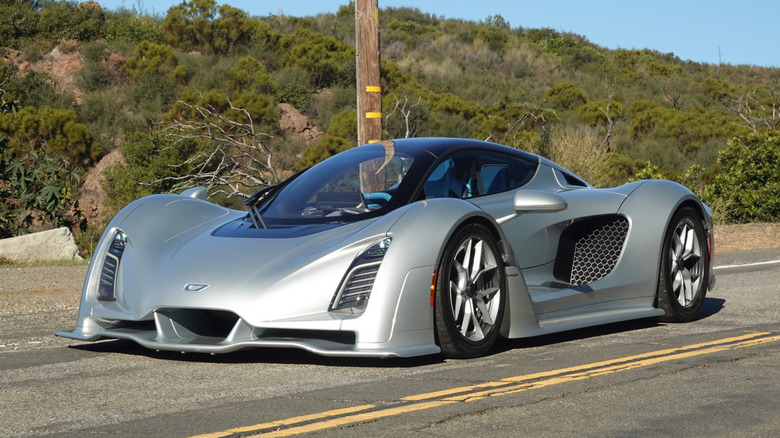
Year in and year out at Monterey Car Week, automotive startup and industry disruptor Czinger Vehicles brought seemingly the same outlandish hypercar to show off and made seemingly the same presentation about groundbreaking tech repeatedly. Of course, the journey from concept to production car for any startup always takes longer than expected—which seems doubly accurate for a company building something so aggressively against the mold.
Then, news of track records across America falling to the wild iterative-designed and 3D-printed 21C broke, prompting questions of what exactly "production car" even meant in the modern era.
 Michael Teo Van Runkle/SlashGear
But now, with customer deliveries underway and Czinger's tech proliferating throughout the automotive industry, the time finally came to schedule media drives. So I joined the Czinger team in Malibu for a thorough morning in the canyons, highly curious to experience how madcap innovations and starfighter style translate to driving dynamics on public roads. Without the chance to do any track driving, my few hours behind the wheel required adopting a whole new level of awareness to adjust my brain to such truly mind-boggling performance.
Adult supervision required
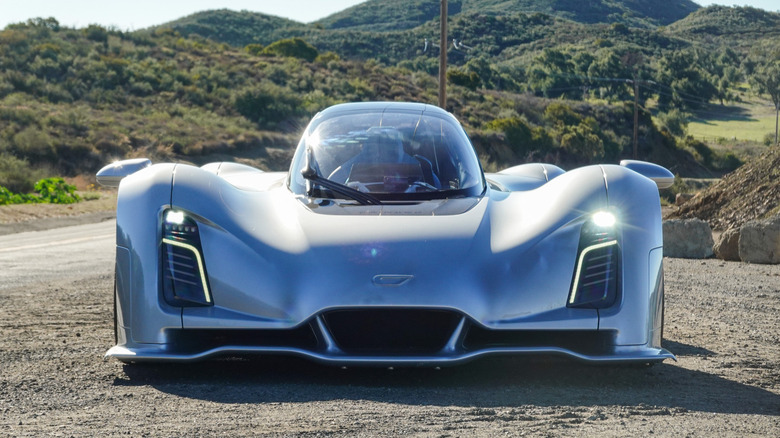
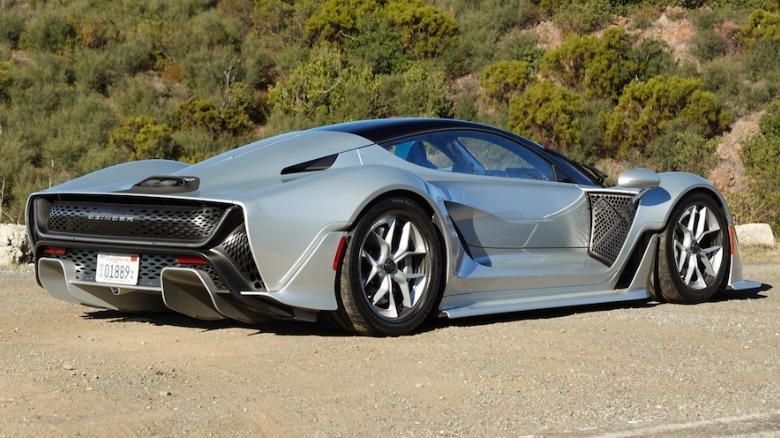
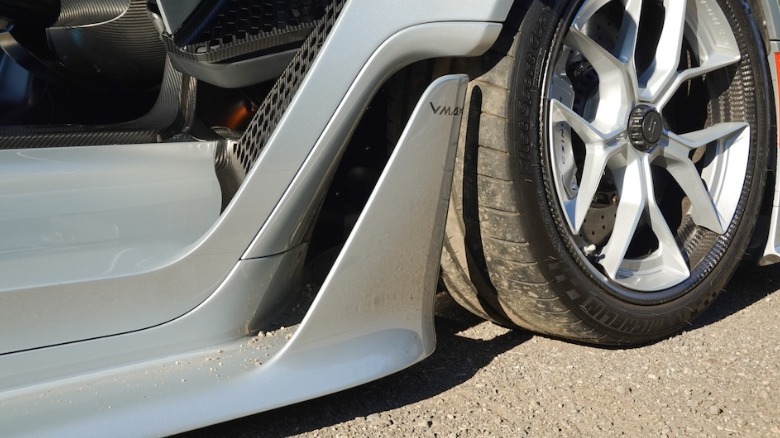
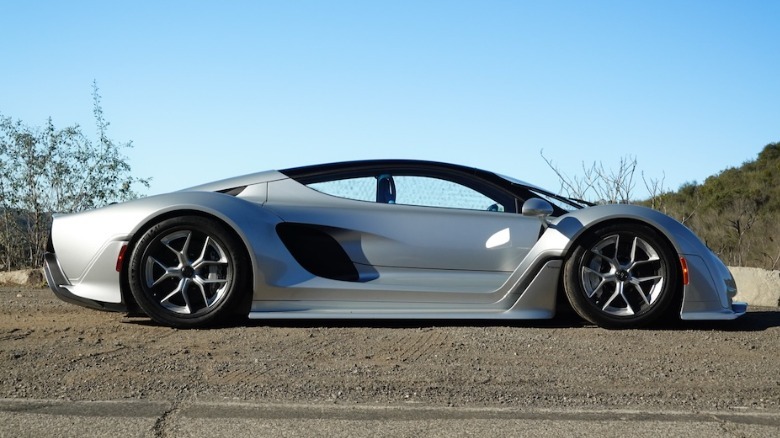
My 21C pulled up in the top-speed aerodynamic configuration that Czinger dubs Vmax, for obviously reasons, versus the more be-winged and choppier downforce car designed for hardcore track work. A supervisor joined—can't blame Czinger, given the power and pricing—who climbed into the rear seat first, effectively straddling me as I then scooted across the wide side pods that house the battery packs and settled into the cozy front seat.
 Michael Teo Van Runkle/SlashGear
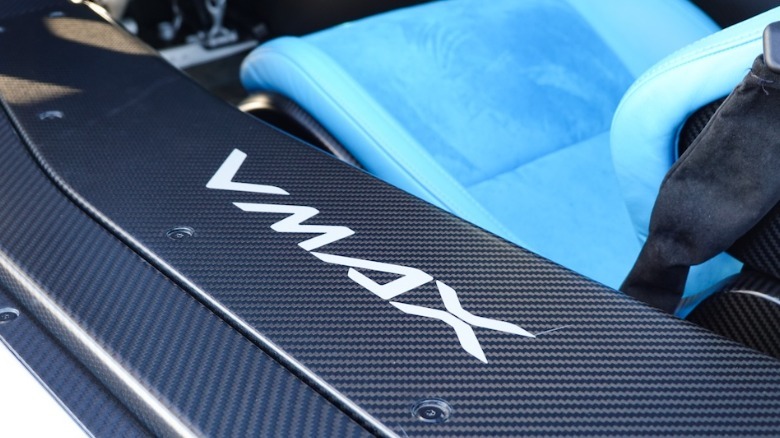
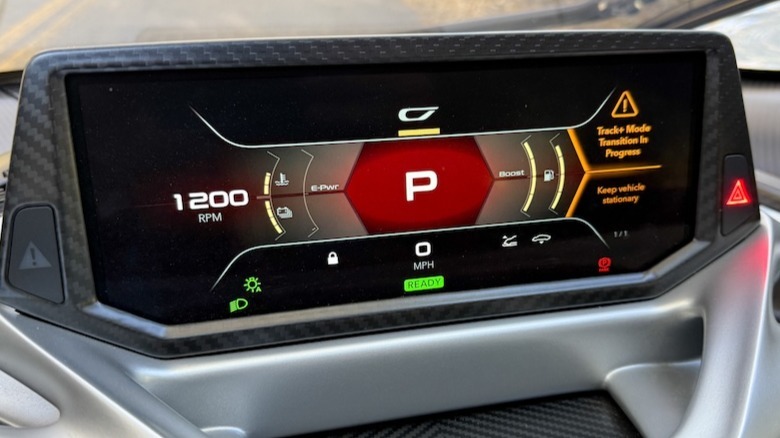
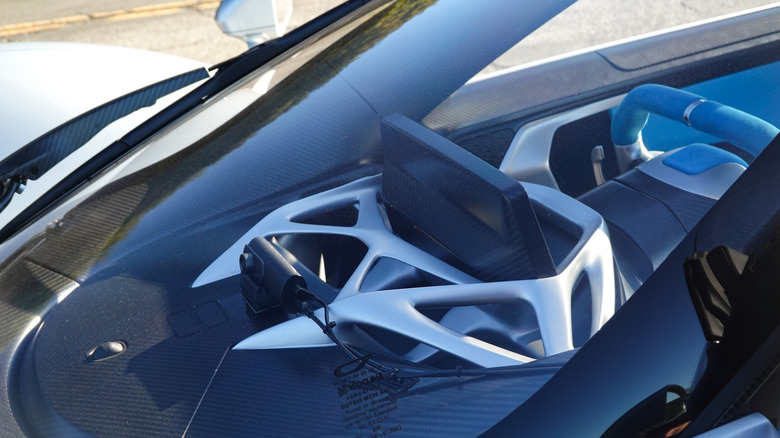
There's no easy way to make the climb but, once inside, the cockpit felt simultaneously spacious and futuristic. I noted the narrow front windshield and excellent lateral visibility, while clocking the simple dash, small gauge cluster, steering wheel buttons, and switchgear.
 Michael Teo Van Runkle/SlashGear
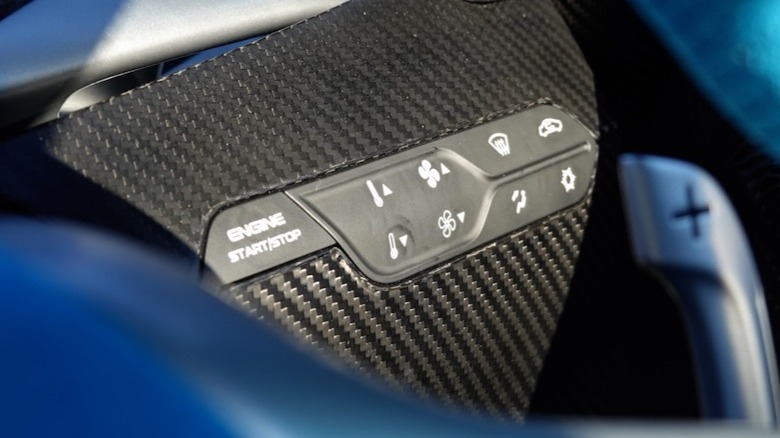
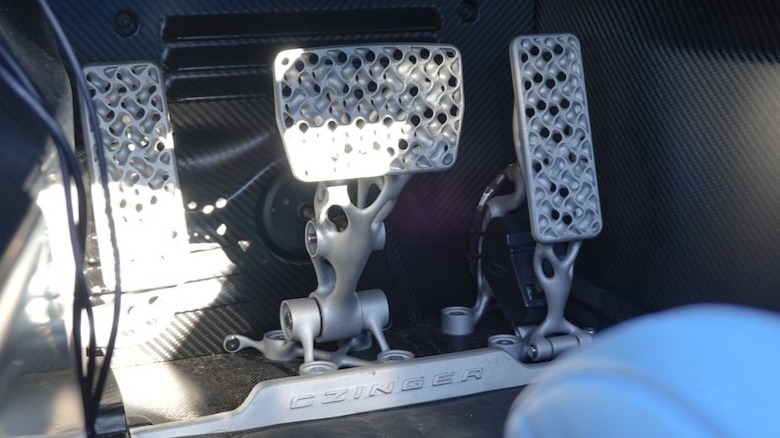
No massive infotainment screens or CarPlay here, to say the least (Though Czinger reached out to inform SlashGear that CarPlay through the gauge cluster — in frighteningly similar fashion to Ferrari though at least without horrific haptic touch controls — is on the way)! A few of the switches and buttons as well as the gauge cluster supports reminded me of all the 3D-printed components cradling me, my poor passenger, and the advanced drivetrain within this four-wheeled spaceship.
Getting comfortable, inside and on-road
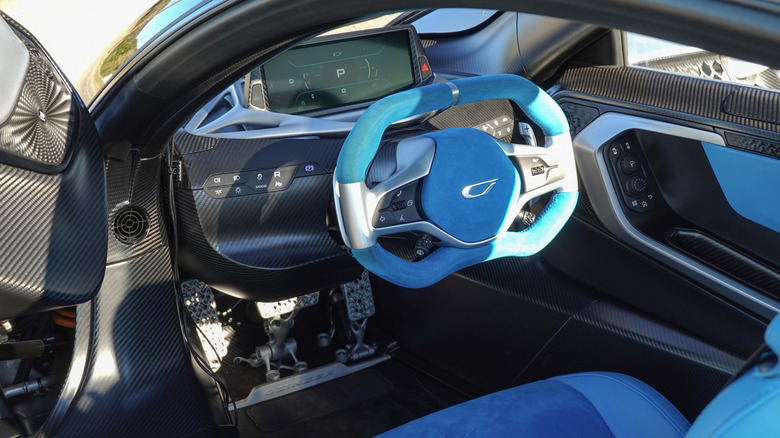
Some of the other switchgear, made of rubber, seemed appropriate lest my hands get sweaty with nerves. And yet, even pulling away in Street mode, I quickly marveled at how easy it is to drive the 21C easily. Street mode sticks mostly with the dual front 268-horsepower electric motors, only cueing up the gasoline engine when required for more acceleration until the 4.2-kilowatt-hour battery starts to run low.
 Michael Teo Van Runkle/SlashGear
Using the gasoline engine effectively as a generator until fully warmed up helped Czinger complete California Air Resources Board (CARB) smog testing requirements, a process that co-founder Lukas Czinger told me took much more time than expected after early modeling success. The engine preheats the catalytic converters, but CARB also does a so-called "shed test" to detect any evaporative chemicals.
 Michael Teo Van Runkle/SlashGear
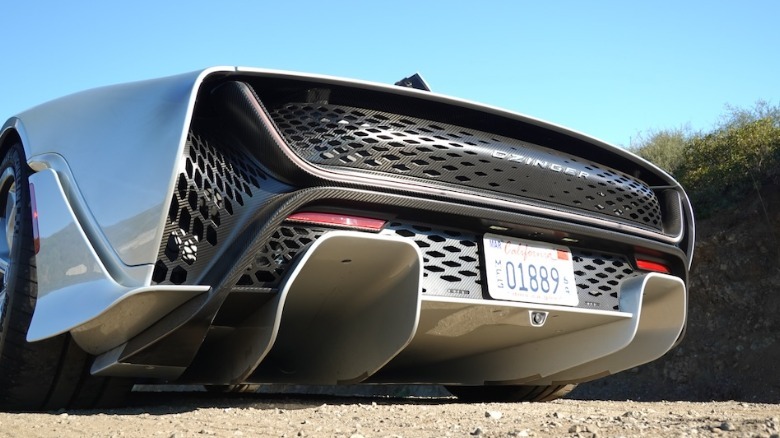
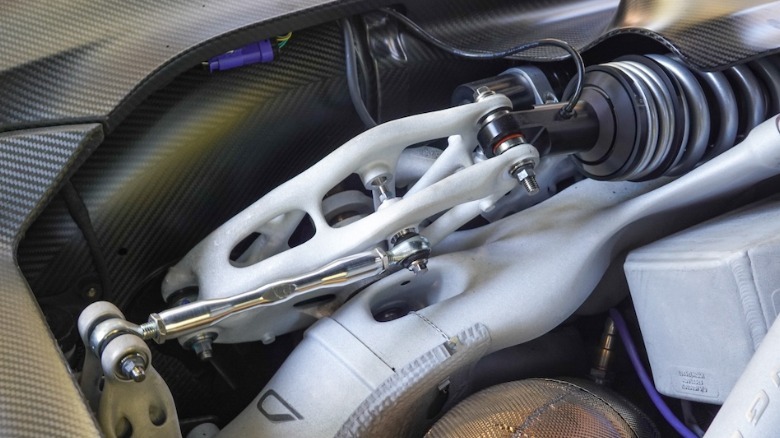
The 21C eventually passed this stringent protocol—fully street-legal, then, rather than stuck with prototype racecar status. And therefore, rather than going all-out on stiffness, Czinger tuned the suspension to ride surprisingly smoothly in Street mode. The damper compliance absorbed bumps and cracks in the road, no doubt aided by the reduced unsprung mass of the additive 3D-printed lightweight suspension components. I never needed the 25 millimeters of front axle lift, other than one time pulling off onto a dirt turnout for photos. And actually placing the wheels on the road, from a center seat, took up no thought at all because the front wheel arches remained directly visible to my right and left, seemingly just in front of my heels down in the pedal box.
Center seat fighter jet
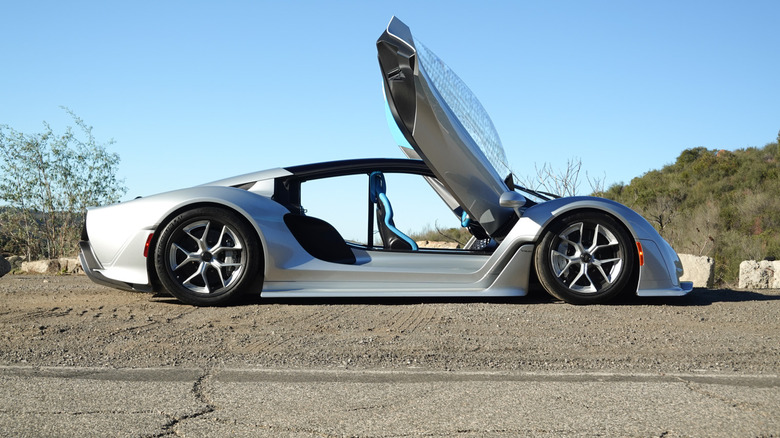
I do enjoy a center seat, though I have yet to experience a McLaren F1 nor a Speedtail firsthand, and the only challenge of the configuration (other than getting inside) reminded me of motorcycles more than anything: dodging pebbles and rocks on the canyon roads. Straddling obstacles required some conscious effort, letting the lowslung chassis glide over even though I occasionally grimaced expecting to hear bad noises from the underbody. Then, once up into those canyons, I then felt the familiar urge to dial in more hardcore settings and hopefully approach somewhere near the 21C's limits.
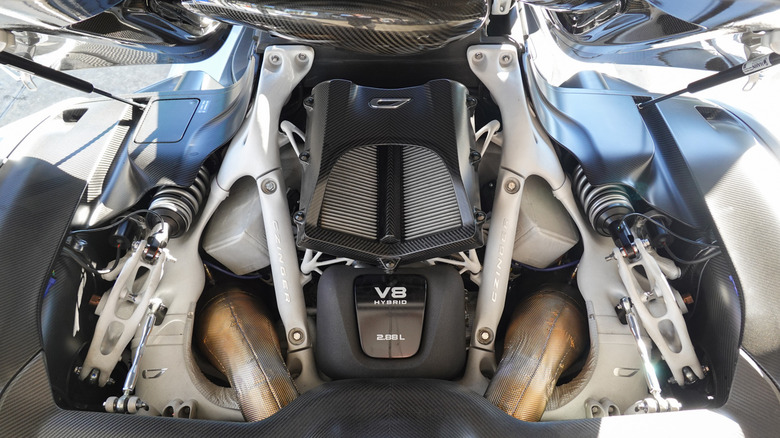
At full throttle, the dual electric motors and a teensy twin-turbocharged 2.88-liter V8 can peak at 1,250 horsepower. The gas engine needed to occupy minimal space behind the long 1+1 cockpit, so Czinger took inspiration from IndyCar engines in the 1990s—hence the 11,000-rpm redline and two turbos that push up to 22 psi of boost.
 Michael Teo Van Runkle/SlashGear
Originally, Czinger described the V8 as a motorcycle-derived concept that used Kawasaki heads to reach that stratospheric rev limit, but now the company claims to have reworked the powerplant using proprietary Divergent software to create a unit fully designed and built in-house.
The 21C's limit far exceeds the edge of safety and sanity
Actually achieving a 0-60 time of 1.9 seconds or hitting a top speed of 253 miles an hour seemed off the table for the day. Anything but the smoothest, straightest roads make putting down so much power almost impossible, and despite the all-wheel-drive layout, I noticed traction control intervention quite frequently. My own sanity also kept the drive slightly more sedate, since I wanted to avoid killing myself, the car, my passenger, a soccer mom, and any deer on a beautiful Malibu morning.
I probably only hit full juice once or twice on wide-open sections of asphalt, the seven-speed sequential banging through gears with an almost violent torque shove once back on the power. Truly, the 21C can unleash that kind of neck-snapping and eyeball-searing acceleration typically reserved for nothing but the Rimac Nevera, Lucid Air Sapphire, or Tesla Plaid. Yet as wild as the rollicking powertrain, the physics-defying handling almost emerged as the car's more important trait.
Bucking industry trends
Despite a relatively substantial curb weight of 3,668 pounds, Czinger stuck with a heavy steering wheel rather than aiming for the light effort of other AWD hybrids (a la modern Ferraris, the Aston Martin Valhalla, and Lamborghini's Temerario and Revuelto which all come to mind). So the chassis gripped the ground, sending direct communication to my hand as I wrangled through corners, intent to sense the electric motors pulling and regenerative braking with clear input and response.
 Michael Teo Van Runkle/SlashGear
Cornering hard therefore required serious effort and concentration, but the payoff came as lateral g forces loaded up the tires. And again, I rarely reached the limit, despite purposefully trying to enter corners later and later, harder and harder. And all this without ever entering Track Mode Plus, which drops the ride height another 30 millimeters—so low that the undercarriage risks damage anywhere outside of a racetrack. And this wasn't even the high-downforce car!
Hard work out of the office
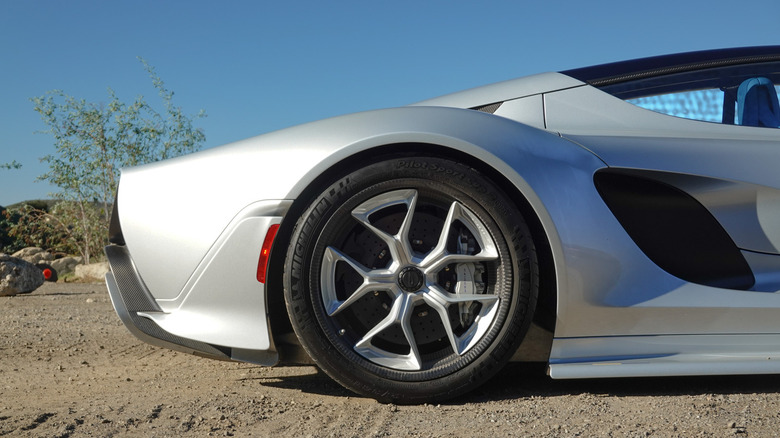
As I adjusted to the sheer physical demands of driving the 21C, I discovered how much both the chassis and powertrain loved trailbraking. Without causing too much nosedive, I let the front wheels regen by just feathering the brake pedal all the way to apex, setting some rotation and slip angle from the 265-mm front and 325-mm rear Michelin Pilot Sport Cup 2 tires without dipping into the throttle pedal, which usually triggered the nannies and caused lurching that upset my sense of balance.
As a microcosm of the entire experience, the brake pedal alone steps up another notch even compared to early McLarens, with remarkable regen blending between the motors and the massive carbon-ceramic friction brakes (which don't yet feature the highly-touted brake nodes but still get the job done easily with six-piston monoblock calipers on 16.1-inch rotors up front, and four-piston chomping 15.4-inch rotors at the rear).
 Michael Teo Van Runkle/SlashGear
Bold, aggressive, and challenging—both mentally and physically—despite the softer setting of Street mode, is the 21C an easy hypercar to live with? Though comfortable and compliant with the suspension as soft as possible, I struggle to think of daily driving a Czinger. Instead, the almost prototype nature of something so radical fits better in my mind as more of a weekend warrior or track toy. Yet as much as I'd relish the chance to flog the high-downforce car around a big circuit (HANS device on to save my weak neck muscles), the idea of owners risking something so valuable and influential also seems unlikely.
Industry effects rippling outward
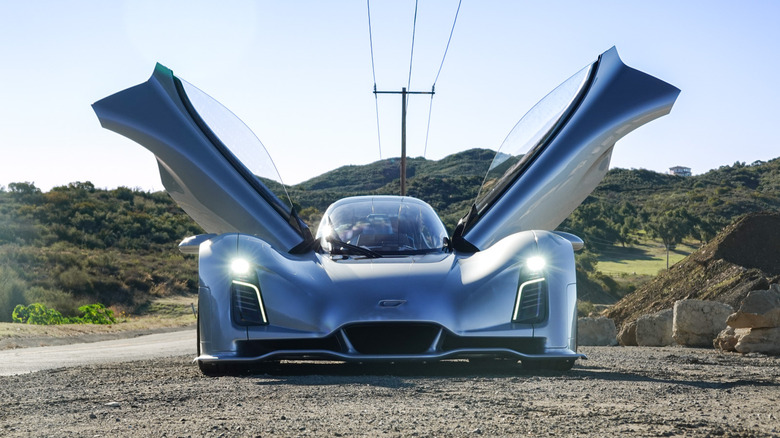
As an early car, my tester's fit and finish probably lack the final touch Czinger hopes to achieve for customer cars. A few clunks and rattles, as well as some aesthetic details that don't quite fit the multimillion-dollar hypercar mold as well as a Bugatti Chiron Super Sport, for example, stood out in something that ratcheted up to $2.7 million as-specced over a $2.3 million starting price.
But then again, from the perspective of a pure driving experience, the 21C reaches incredible heights from a new car company making a first attempt to set new standards for design, development, and production efficiencies as much as all-out performance. And quite obviously, other automakers worldwide took one look at the car and concept then either partnered with Czinger or cribbed the pareto-optimized shapes for themselves.
 Michael Teo Van Runkle/SlashGear
McLaren's new W1 used some of Divergent's powdered metals and laser construction methods. Aston Martin actually beat McLaren to the punch with the DBR22's subframe. And Porsche also tested similar techniques for a 3D-printed 911 GT2 RS engine piston as well as a housing unit for an electric drive motor. Late to the party or early adopters, few other companies and few automotive enthusiasts will ever get the chance to actually experience what Czinger achieved with the 21C, though.
After a morning in Malibu, I can call myself one of the lucky ones. Though unfortunately, still unlucky enough that I got stuck tasked with the job of trying to express in mere written words not only the firsthand impressions of such unbelievable performance, but also what I suspect will go down in the history of the hypercar as a singularly unique moment with the clear potential to radically change the future.