

6 Toyota Engines That Seemingly Last Forever
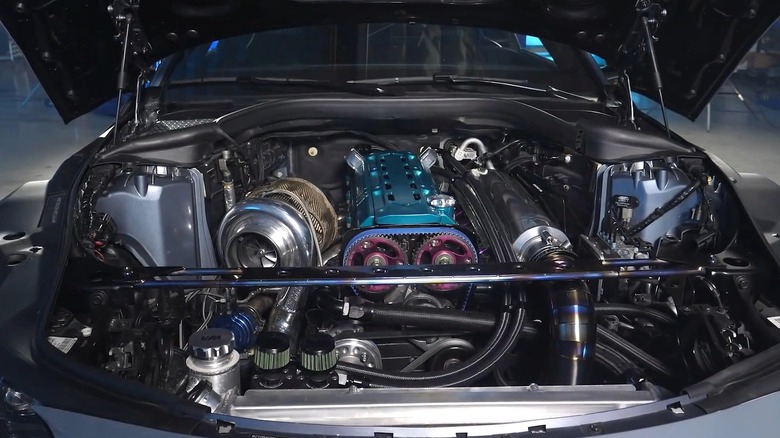
There's a reason Toyota has one of the most loyal followings in automotive history, and it has everything to do with what's under the hood. The company has a long history of building engines that keep piling on miles long after others have been retired, rebuilt, or even replaced entirely. Ask folks who've owned Tacomas, Land Cruisers, or even an older Lexus with a clean service history, and you'll hear the same thing from them all about how different their engines are.
Yes, Toyota has delivered plenty of both raw power and cutting-edge technology over the years, but that's not why these engines stand out. It goes deeper than that. For decades now, their focus has consistently been on strong internals and designs built to handle heat, heavy loads, and long service intervals without disappointing you. Take engines like the 2JZ or the 1UZ, for example. Their cast-iron construction is so stout that the blocks can handle double or even triple their factory power without the internals giving up.
This list takes a closer look at those Toyota engines that routinely outlast the vehicles they're bolted into. Whether in trucks, SUVs, or even everyday sedans, it's not unusual to see them cross 250,000 miles or even 300,000 with nothing more than basic maintenance. Engines like these are a big part of why Toyota continues to maintain a solid 4.0-out-of-5.0 reliability score on RepairPal. In other words, these are the kinds of engines that seem like they could run forever as long as you keep oil in them.
2JZ-GTE
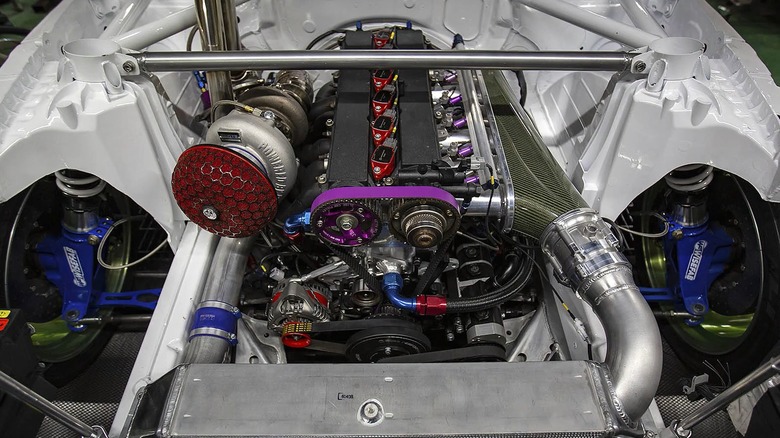
The Toyota 2JZ-GTE showed up as early as 1991 in Japan, stuck well into the 2000s, and never really left the conversation after that. People who wanted it then got it firstly on the Aristo before it found its way into certain Supra models. Most Americans got to know about it from the fourth-gen Supra Turbos that sold from 1993 all the way through 1998.
As for its foundation, Toyota built the 3.0-liter DOHC inline-six on a closed-deck cast-iron block and inside it, you'd see stuff like forged crankshaft locked down by seven main bearing caps, under-piston oil squirters, and a non-interference valvetrain. Toyota also included a bolted oil cooler right around the block just in case of any sideways.
Despite all of that, its sequential twin-turbo setup on the North American market was rated at just 320 horsepower. Even the ones in Japan were producing around 276 horsepower at roughly 318 lb-ft during the "Gentlemen's Agreement" era, even though everyone knew the hardware had plenty more in its reserve. That is why 400-horsepower builds with basic bolt-ons are so common nowadays, and if you get the right turbos and fuel upgrades, you can push it to around 800 horsepower or even four digits. Still, even legends have their weak spots — Tensioner brackets failures, oil pump leaks, and faulty crank pulleys, just to name a few. However, this engine can still cruise past 400,000 miles if you stick to its basic upkeep like regular oil changes.
1UZ-FE
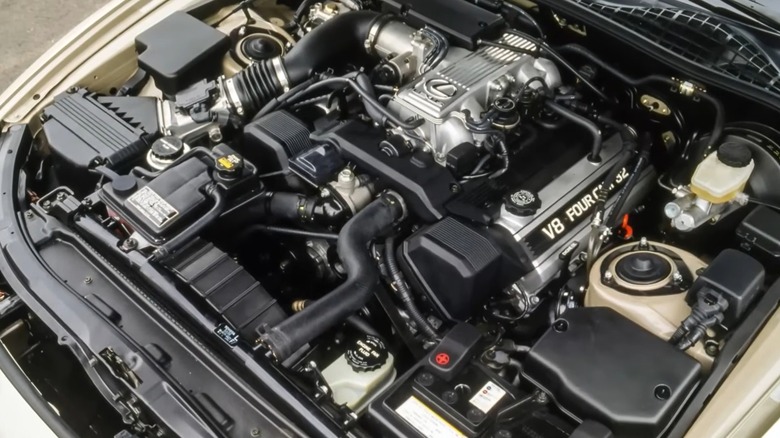
The 1UZ-FE debuted around 1989 in Toyota's LS 400, and when it did, it was like the closest anyone could get to a race engine. Soon after, this 4.0-liter V8 started showing up in other cars like the Toyota Crown and the SC 400, marking Toyota's serious push into the premium market. They poured over a billion dollars into development, brought in thousands of engineers, and ran it through serious testing before it officially went under any hood. It still remains one of the most reliable Lexus engines.
Its secret sauce was the steel crank paired with DOHC 32-valve aluminum heads because they were genuinely ahead of their time. That and other features by its side helped to cut down on vibration and heat, as well as to keep things composed no matter how hard it was pushed. The earliest versions put down around 260 horsepower, but later updates were introduced that nudged it closer to 300 horsepower. If that's still not enough, bolt a supercharger on a stock bottom end, and you'd get somewhere around 700 horsepower without even cracking the block open
The most impressive thing about the 1UZ-FE is just how long it lasts. These engines are known to hit 200,000 miles on nothing but routine oil changes and belt services. Circa 2015, one LS400 reportedly crossed the one-million-mile mark. People are still swapping 1UZs into other vehicles, mostly because its parts are easy to find.
22R-E
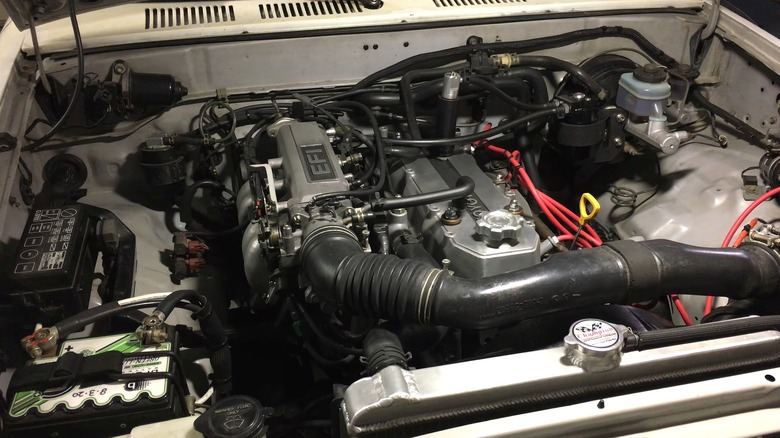
Ask anyone who's spent real time in the off-road world and the 22R-E almost always comes up when the conversation turns to the most dependable gasoline engines ever made – for good reason. This 2,366 cc inline-four engine is part of Toyota's R-series family and traces its roots straight back to the 20R, an engine Toyota had already spent time getting right with a forged steel crankshaft, connecting rods, and a timing chain-driven overhead cam. All the 22R-E did was to build on that foundation in 1981, and along the way, it also powered workhorses like the Hilux, Corona, Celica, and the 4Runner until 1997.
The turning point came in 1985 when Toyota ditched the old carburetor for the electronic fuel injection system, skipped the hydraulic lifters and made several other upgrades, which brought noticeably better cold starts and steadier fuel delivery across the board. After those upgrades, output started hovering around 115 horsepower and roughly 140 lb-ft of torque, and Toyota was perfectly fine with that because the real focus was durability. One owner even clocked more than 370K miles on a 22R-E in his 1985 1-ton, which really says it all. That said, no engine is perfect. Worn timing chain components can chew into the timing cover, and its ignition system can fail with age, but if you catch them early, both are actually straightforward fixes.
2GR-FE
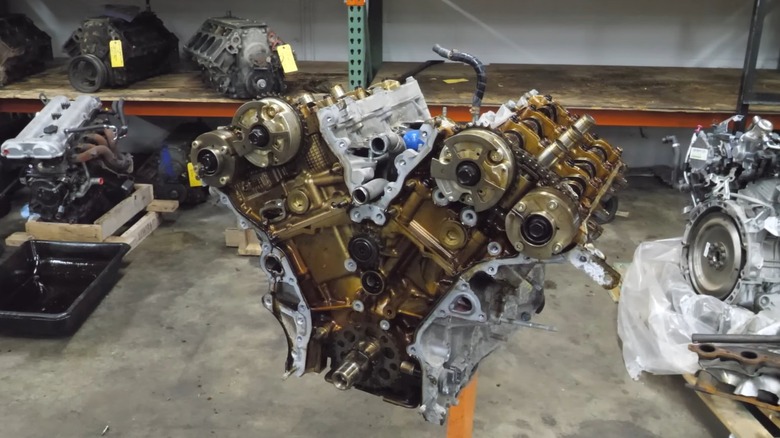
If you've ever driven a Camry, Highlander, or a RX 350 that felt so effortless, there's a good chance the engine under the hood is a 2GR-FE. Since it touched down in 2004, this V6 has been one of Toyota's most trusted modern engines, spreading across a couple of its lineups. Their reputation even caught the attention of the Lotus, which they eventually also used to power the likes of Evora and Exige.
The 3,456 cc engine is built entirely from aluminum, both around the block and on the cylinder heads, which helps keep weight low without sacrificing strength. It also runs on a 60-degree V-angle with a DOHC 24-valve setup, hydraulic lifters, and a timing chain that puts the belt service headache to rest for good. The Dual VVT-i sits on top of all that, sharpening throttle response, keeping fuel efficiency honest, and staying clean enough to satisfy both Euro 4 and Euro 5 standards without any drama. This is why it can put down around 280 horsepower, with a torque coming in near 350 lb-ft, depending on how you tune it.
However, where it gets a little bit tricky is in its pre-2010 versions with VVT-i oil lines and the original latex hoses being the usual troublemakers. Swap them out for aluminum lines, and that puts that problem to bed for good. Even water pumps and ignition coils will also demand attention because of age, but with OEM replacements, you can go somewhere around 400,000 miles.
1GD-FTV
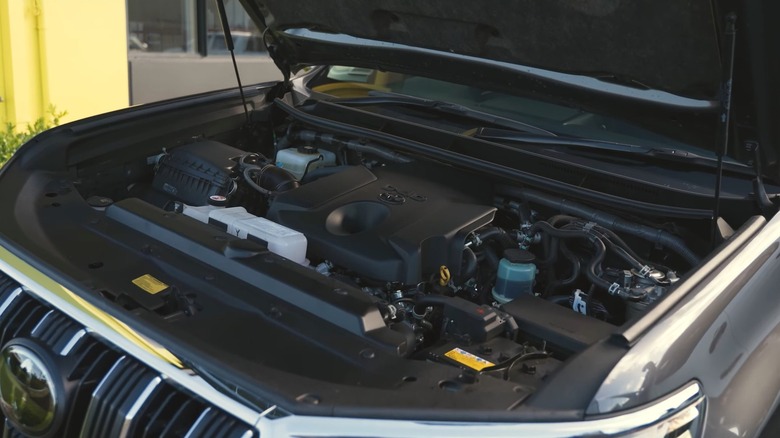
When it comes to the best diesel engines Toyota has ever made, the 1GD-FTV sits right at the top of that list, and that's because of its longevity. Toyota rolled out this D-4D turbodiesel in 2015 as its first engine from the GD banner, and right away it took over from the KD family that had powered Toyota trucks for years. That switch alone brought better fuel economy, torque, and even pulling power at the bottom of the rev range, which matters a lot when you're loaded up and crawling through rough terrains in workhorses like the Hilux and Land Cruiser Prado.
Inside, the 2,754 cc inline-four works with a Denso common-rail direct-injection system and a variable-geometry turbocharger, while a timing chain and hydraulic lifters keep the valvetrain simple and long-lasting. What really separates this diesel engine from the crowd, though, is what Toyota packed into its internals. Nobody had combined SiRPA piston coating and Thermo Swing Wall Insulation Technology in a production engine until Toyota broke new ground with the GD family. That combo turned out to be a big deal, pushing the engine's peak thermal levels up by roughly 44%, while slashing heat lost through cooling by more than 30%. Toyota also took things a step further by fitting this engine with its very first urea-based SCR setup for diesel, and that's precisely what puts it comfortably within Euro 6 emission limits.
1GR-FE
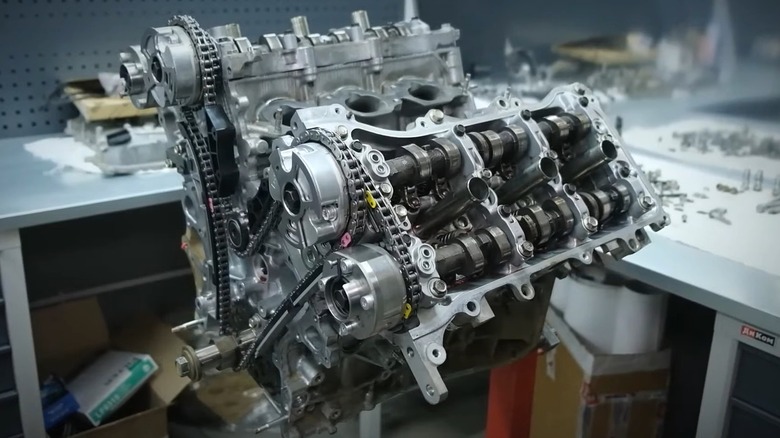
Not many engines have the kind of build that the 1GR-FE has. Toyota introduced this engine in 2002, a few years before its cousin, the 2GR-FE, and what started as a single application under the hood of the Land Cruiser Prado eventually grew into something much bigger. The FJ Cruiser, Tacoma, Tundra, Hilux, and Fortuner all got it across multiple markets, and it became one of the strongest 4Runner engines ever to find its way under their hood.
This 3,956 cc engine rolled out in two distinct batches. The original, that one ran VVT-i on the intake cam side only, and crank out about 250 horsepower and roughly 280 lb-ft of torque. The second batch on the other hand came around 2009 with Dual VVT-i across both shafts. One update made a real difference, sharpening throttle response, improving efficiency, and pushing output closer to 285 horsepower depending on tune and market. On top of that, models like the FJ and Tacoma had the option of a TRD bolt-on supercharger for anyone who still felt like they needed more.
Of course, the engine isn't completely flawless. Over time, you might run into things that aren't serious dealbreakers, like ticking noises, water pump leaks, valve wear, or worn ignition coils. However, with routine maintenance, the engine will likely carry you past 250k miles.
Methodology
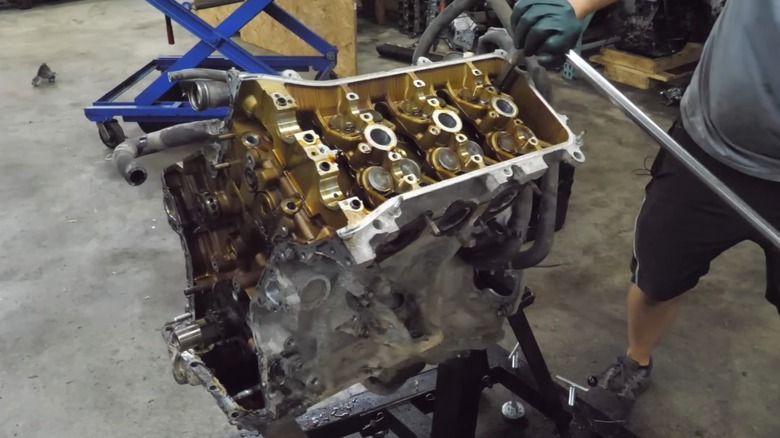
To figure out which Toyota engines actually deserve a spot on this list, many angles were considered, but it all started with one simple question: how much abuse can these things really take? From there, it became easier to narrow things down to engines that regularly hit 200,000 miles and, in plenty of cases, go well beyond that. To back that up, trusted outlets like MotorTrend, Road & Track, Motor1, and AutoEvolution were used as sources, then cross-checked with owners' communities where people share how these engines actually hold up over time. The next filter was consistency. The thinking here was simple: what keeps these engines going year after year? When Toyota keeps an engine in production and continues dropping it into new models without constant redesigns, that usually says a lot about how solid the original engineering was.
Normally, not everyone sticks to service intervals perfectly, so engines that can handle a missed oil change, handle hard driving, or carry heavy loads without falling short in performance naturally stand out. That then led to looking at where these engines actually put in the work. Engines that spend their lives in trucks, SUVs, and high-mileage pickups get stress-tested in ways that quickly expose their weaknesses, so it only made sense to prioritize them. Finally, durability doesn't mean much if keeping the engine alive is a headache, so engines lacking simple designs, long-term support, and strong parts availability didn't make the cut.