

11 Small Vehicles To Steer Clear Of Due To Low IIHS Safety Ratings
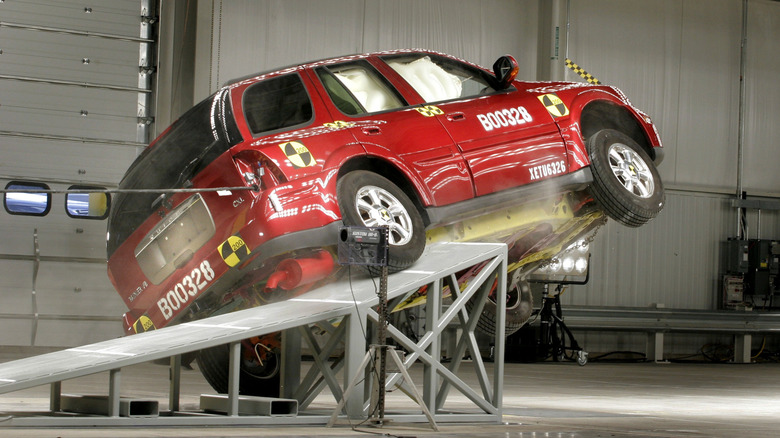
Amongst the SUV craze that has swept the market in recent years, cars in general — and smaller cars in particular — have been overlooked. However, for buyers that are considering getting a vehicle on the smaller side, all too many of the most popular models and years have safety issues that aren't mainstream knowledge. The Insurance Institute for Highway Safety (IIHS)monitors these issues, operating an independent crash testing program that evaluates everything from side impacts to rear occupant safety. Their four classes of rating, ranging from good, acceptable, marginal, and poor, give us an unbiased idea of how well a car will perform in a particular type of crash test, such as side impact, head-on, marginal overlap, and so on.
IIHS testing is quite important as it focuses on actual collisions, not on theoretical safety systems that might or might not kick in. The IIHS sticks crash dummies in cars, rams them into obstacles at fixed speeds, and then measures the results. The small vehicles on our list received a "poor" safety rating in at least one main IIHS test, or several "marginal" ratings in multiple tests, and are all from relatively recent model years (being 2021 or newer models). With all that said, here are 11 small vehicles that didn't fare very well in certain IIHS tests. Most of these vehicles are quite popular in America, and buyers should be aware of these safety issues when considering a purchase.
2025 Nissan Sentra
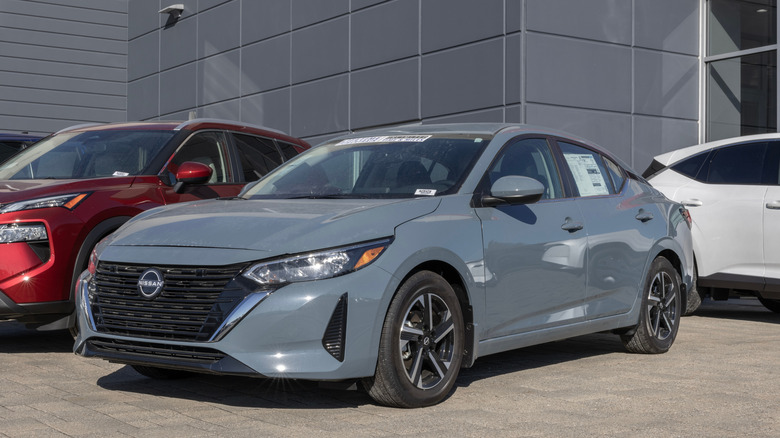
First up, we have the 2025 Nissan Sentra, a popular sedan that is affordable and has decent specs on paper. The 2025 Sentra has a two-liter four-cylinder engine, and begins at $21,590 with a $1,245 destination fee, making it an affordable choice for many. However, the IIHS gives it a "P" for poor rating in terms of crash mitigation, headlights, rear passenger restraints, and dummy kinematics, and an "M" for marginal in terms of moderate overlap front impacts. It also scores an "M" in terms of driver head protection. Furthermore, the 2025 Sentra only gets an "A" score in terms of side impacts, which doesn't exactly inspire confidence.
When the IIHS says "dummy kinematics," it refers to how the dummy (meant to simulate an occupant) behaves in the crash. It measures things like whether or not the crash dummy hit the airbag, what position it assumed after hitting the airbag, if the head made contact with a hard surface at any point in the crash, how much the steering column moved with respect to the dummy, and how the seat belts restrained the dummy. Additionally, whenever the IIHS says something like "moderate overlap front impact," it means a somewhat diagonal impact between two vehicles moving opposite to each other. As of 2022, the moderate overlap front impact tests also include data for the rear passengers in a vehicle. When the word "small" is used instead of "moderate" in terms of overlap impacts, this means a moving vehicle colliding with a fixed object like a tree.
2024 Kia Forte
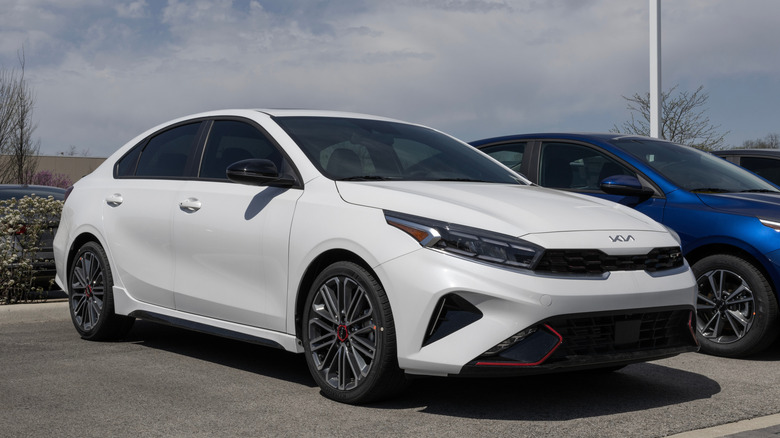
The Kia Forte is now almost two decades old, having been introduced way back in 2008 as a replacement for the Kia Spectra. It is also known as the Kia Cerato in some markets, and as the Kia K3 in Korea. For 2024, it had a base MSRP of $19,990, which didn't account for a $1,155 fee that covered delivery and handling. The 2024 model came with a two-liter inline-4 engine that made 147 hp and 132 lb-ft of torque, and it could seat up to five passengers across two rows. While that combination of price and performance is quite attractive, and used models can be had for even cheaper, this 2024 model wasn't exactly cream-of-the-crop when it came to safety ratings from the IIHS, which is why buyers should be a little wary of the vehicle.
To start off, the 2024 Forte got "P" ratings in front and side impact tests and also for its headlights, along with an "M" rating for accident prevention. There were pretty heavy driver injuries recorded in the side impact tests to the torso and lower body of the crash dummy. Further testing by the IIHS also says the LATCH child seat tethers — short for Lower Anchors and Tethers for Children — were set too deeply in the seat, making them harder to access. This earned the LATCH system in the 2024 Kia Forte a rating of only an "A" — which is obviously less than desirable when dealing the safety of child passengers.
2023 Subaru Crosstrek
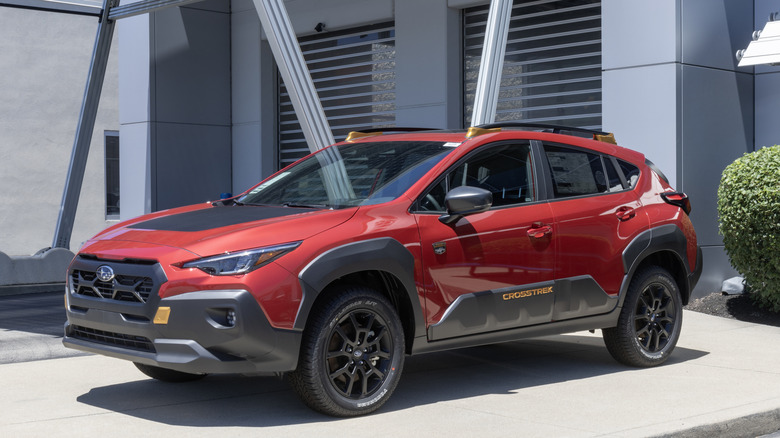
For many years, the Crosstrek has been the cheapest Subaru SUV on offer, and this remains true, even in early 2026. The base model, non-hybrid 2026 Crosstrek comes in with a base MSRP of $26,995 (plus $1,420 destination), making it quite a tempting buy. However, some drivers might want to look to the used market to snag a better deal on a pre-owned Crosstrek. For 2023, the base Subaru Crosstrek came with a two-liter flat-four engine with a manual gearbox and could seat five passengers, but buyers should exercise caution with this model year.
For 2023, the Crosstrek earned a "P" in the IIHS moderate overlap front impact and side impact tests. This was quite a surprise for the 2023 model, as the 2022 variant had actually been awarded IIHS Top Safety Pick honors. Updated test criteria is likely to blame; as of 2022, the IIHS included rear passengers in the updated moderate overlap front impact tests, and the older test gave the Crosstrek a "G" rating. This begins to paint a pretty clear picture: The updated test scores suffered due to of potential injuries to the rear passengers.
This is confirmed once we look at the detailed crash reports, with good safety for the driver and front occupant but rear passengers saw injuries recorded to the head and dummy kinematics (rated "M"), and the chest (rated "P") in the updated moderate overlap front impact test.
2025 Volkswagen Taos
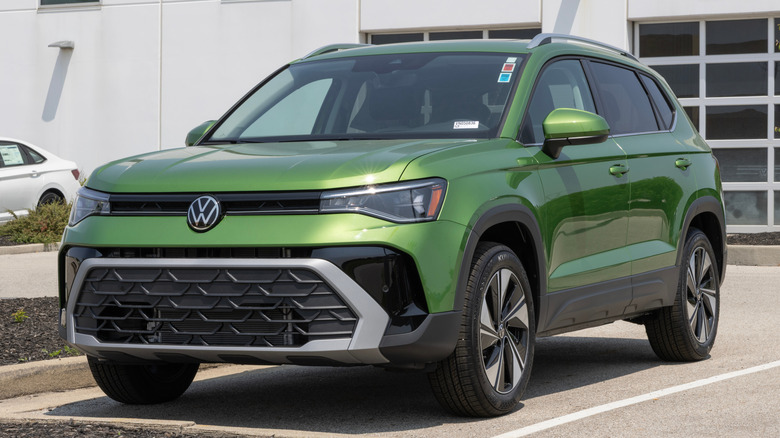
The five-seater Volkswagen Taos was released in the U.S. in 2020, making it quite a recent addition to the VW SUV lineup, situated as it is below the Tiguan both in price and size. The 2025 Volkswagen Taos in particular came with a 1.5-liter inline-four engine and had a base MSRP of $24,995, along with a freight charge of $1,425. However, it comes under our scrutiny because it comes up a bit short in certain areas of its IIHS safety test.
For starters, it has "A" for "acceptable" crash ratings in the side impact and small overlap front tests; readers should recall that the "small overlap" means colliding with a stationary fixed object, like a utility pole. The safety ratings for the headlights can also be either "A" or "G," and this varies by trim, with the The Taos S getting a "G" rating and the Taos SE and SEL trims getting an "A" rating.
Furthermore, the Taos also scored with solid "G" ratings throughout the individual test components, but with moderate possible injuries to the chest of the rear passenger, earning it an overall "M" score in the moderate overlap front impact test and an overall "A" score in rear passenger dummy kinematics. Though these scores might seem relatively minor, the 2025 Taos also gets a "P" rating for the seatbelt reminder system and for its included front-on crash prevention driver safety system, tipping the scales further away from acceptability.
2025 Cadillac XT6
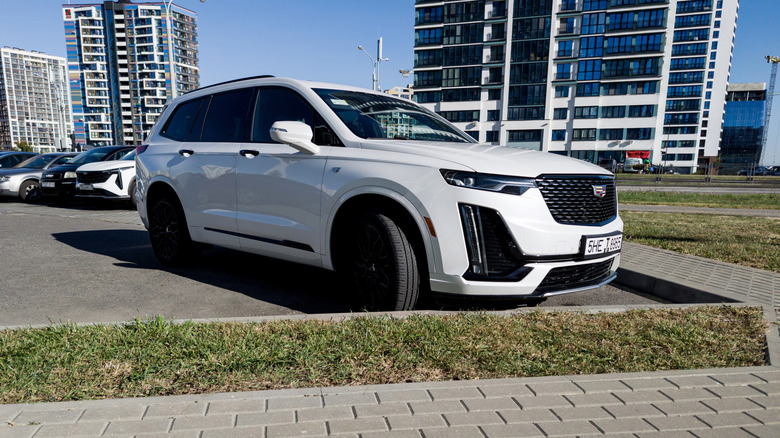
The first (and one of just three) American cars on this list with poor safety ratings is the Cadillac XT6. It is a small-to-midsize luxury SUV that borrows a lot of its front fascia looks from its larger sibling, the Cadillac Escalade; interestingly, that vehicle can be be optioned with more horsepower than a Camaro ZL1. The 2025 model of the XT6, however, only comes with a 3.6-liter V6 engine, though it can seat seven passengers. It also has a base MSRP of $49,195 (delivery $1,495). At first, this SUV's safety ratings seems passable, as it gets an "A" for "acceptable" rating for its headlights, seat belt reminder system, and its LATCH child seats in IIHS tests.
Yet it's worth breaking down that "A" rating for its LATCH system, which came about due to the number one and three lower anchors being too deep in the seat for easy access, and for the number four and five tethers not being easily distinguishable from other hardware in the car. While minor, the pedestrian-crash avoidance system in the SUV also got an "M" safety rating. Worse yet is that the XT6 gets "P" ratings in both the side impact and the moderate overlap front impact crash tests. While the front passengers came off fairly okay in the moderate overlap tests, the rear passengers would sustain injuries to the head and chest, and the overall rear dummy kinematics for the vehicle earned an "M" rating.
2025/2026 Kia K5
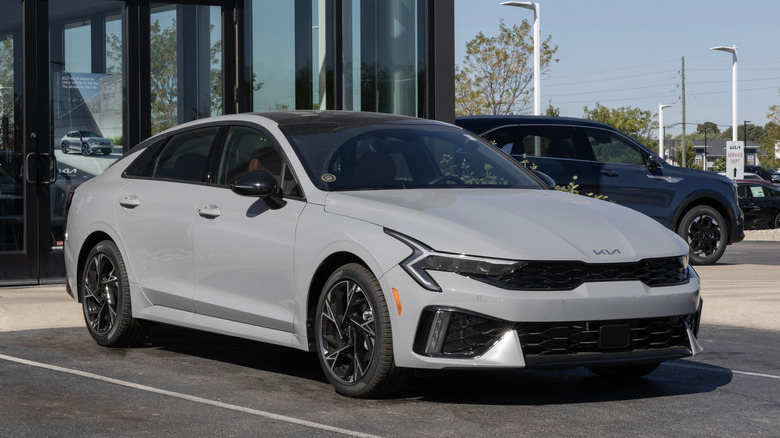
Another entrant from Kia on this list is the 2025 Kia K5, a slightly upmarket (for Kia anyway) four-door sedan that was introduced back in 2021. It's worth mentioning that both the 2025 and the 2026 models for the K5 have many of the same issues — this could be a cause for concern, as Kia doesn't seem to be on the ball when it comes to fixing these issues. To begin with, the 2025 model gets an "acceptable" rating for the LATCH system and the seat belt reminders and an "M" rating in the side impact test. However, it also gets a "P" rating in the moderate overlap front impact because of a high risk of head injuries to the rear passenger, along with "M" ratings in rear dummy kinematics and chest injuries.
Now, where most manufacturers would snap to the design board to fix these issues, the 2026 Kia K5 continues to have the exact same ratings and issues. The 2026 model comes in with a base MSRP of $27,490 with a destination freight charge of $1,175, bringing the total out-the-door price for a new K5 to $28,665 — at which point safety should be non-negotiable. 2026 models come with a 2.5-liter inline-four engine making 290 hp and 311 lb-ft of torque and can seat five passengers across two rows of seating; the vehicle has 16 cubic feet of rear cargo space.
2025 Nissan Kicks
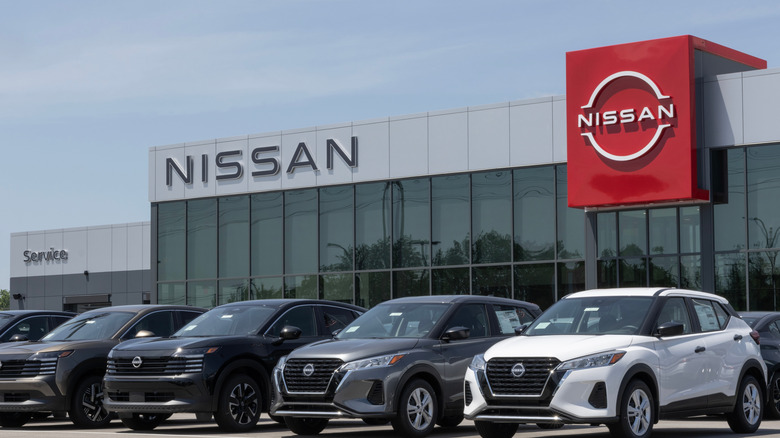
The 2025 Nissan Kicks is the next vehicle on our list. This model should be approached with caution, since it isn't the most stellar in terms of IIHS ratings. To start with, the 2025 Kicks gets an "M" for seat belt reminders and for its front-on crash prevention system. It also gets a "P" in the moderate overlap front impact test, with a further "P" rating for rear dummy kinematics and an "M" for injuries to the head of rear occupants.
The 2025 Nissan Kicks had a base MSRP sticker price of $21,830, to which a $1,390 destination fee would be added. The engine in this vehicle was a two-liter inline-4 that made 141 hp and 140 lb-ft of torque, which was plenty for the five passengers it could carry. What's particularly interesting is that the Nissan Kicks actually changed its overall profile silhouette in 2025, going from a hatchback to a wagon that year. This is interesting because its earlier profile earned it an IIHS Top Safety Pick for 2024, but its newly redesigned body style in 2025 earned it a "Poor" rating in the IIHS tests mentioned above. Credit where it's due, Nissan was on the ball with immediate fixes; in 2026 the Kicks once again has "G" or "G+" in all crashworthiness ratings.
2022 Honda HR-V
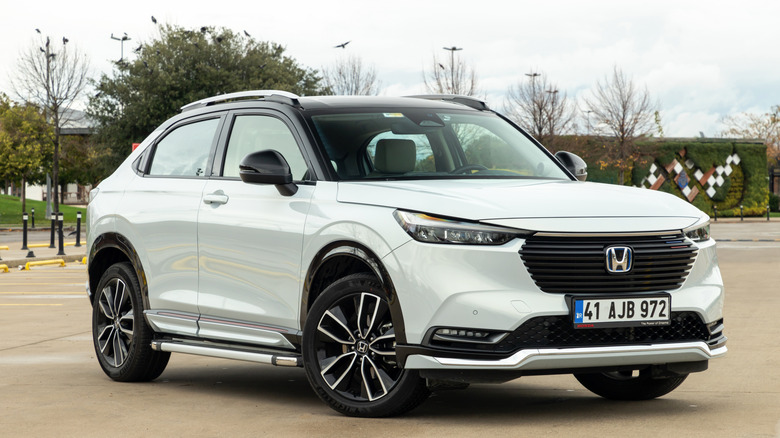
The Honda HR-V is yet one more example of a popular, small five-seater SUV that Americans love. However, certain model years of this mini-SUV should be approached with caution. Specifically, the 2022 HR-V deserves scrutiny, as it got rated "acceptable" for its LATCH system, and "poor" for its seat belt reminders and headlights (certain trims, like the EX and EX-L, got an "M" rating for the headlights). Further cause for concern is that the 2022 HR-V gets a "P" rating in both the moderate overlap front impact tests and the side impact crash test.
For the moderate overlap front impact, the front occupants got a "G" rating in all test elements, but the rear passengers got a "P" for head, neck, and chest injuries and an "M" for rear dummy kinematics. For the side impact test, both the front and rear passengers got an "acceptable" rating for chest injuries and a "marginal" rating for thigh injuries; the vehicle itself got a "poor" overall rating in terms of the structure and safety cage. In yet another example of a brand being proactive when it comes to safety ratings, Honda did turn this around and become a Top Safety Pick Plus (the best possible rating) the following model year. For 2023, the Honda HR-V came in with a base sticker price of $21,420 and a destination fee of $1,225; and featured a 1.8-liter inline-four engine.
2025 Mitsubishi Eclipse Cross
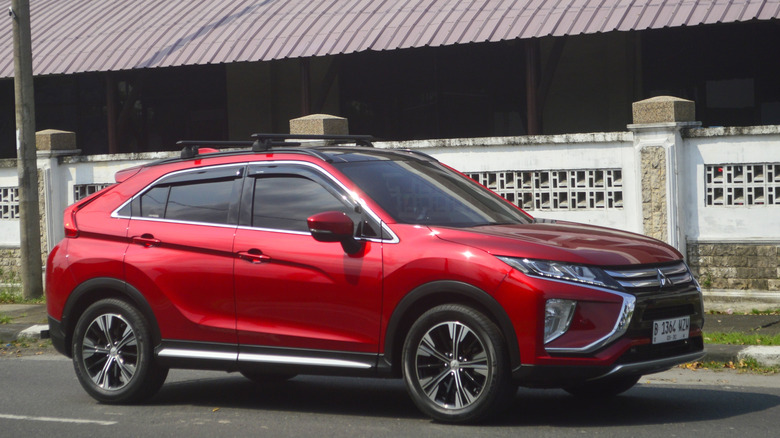
Car enthusiasts who've found themselves going down the Japanese car rabbit hole will know the Mitsubishi Eclipse for the strange bump it used to sport in its hood. However, in recent years, the Eclipse is more well-known in its new form as the objectively ugly crossover SUV called the Eclipse Cross. While it's been problematic in terms of IIHS safety ratings since at least 2022 according to the data we found, it's the 2025 model year that we want to discuss specifically; it SUV scored a "P" for the seat belt reminder system, for the side impact tests, and for the moderate overlap front impact tests.
Notably, in terms of the side impact, the driver somehow came off worse than the rear passengers, with a "P" for torso injuries and an "M" for pelvis injuries. It is a bit worrying that Mitsubishi clearly hasn't been actively trying to fix these persistent issues, given that they've been around for almost half a decade now with the vehicle; this is why we must caution potential buyers of the SUV to do their own due diligence before making a purchase decision. The 2025 Mitsubishi Eclipse Cross came in with a base MSRP of $27,695 (destination $1,745) and had a 1.5-liter Iinline-4 engine that made 152 hp and 184 lb-ft of torque. It seats five passengers across two rows of seating and has a cargo space of 23 cubic feet in the trunk.
2021 Jeep Compass
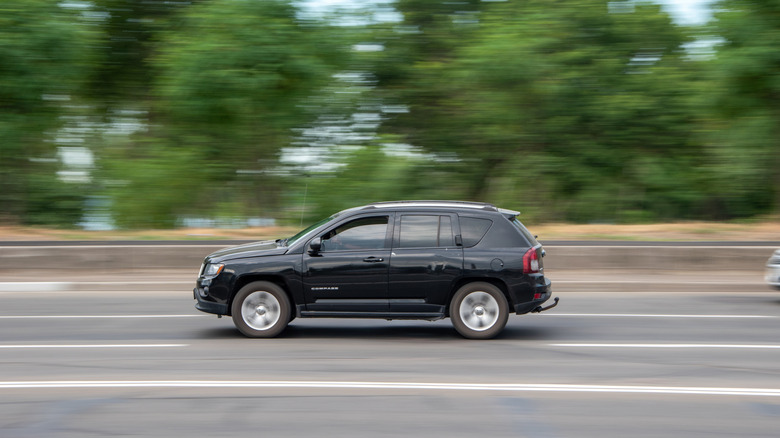
As we mentioned earlier, only three out of all the vehicles with low safety ratings on our list come from American makers; One is from Cadillac, and the other two are from Jeep. The first of these Jeep entrants is none other than the ever-popular Jeep Compass, specifically the 2021 model. For starters, it got an "M" rating for the seat belt reminders (no data was available for the LATCH system). The headlights got either an "M" or a "P" rating depending on trim — the Compass Limited and Trailhawk trims, and every trim with the optional driver assistance pack, got an "M" score. Everything else received a "P" rating.
The vehicle also got an "M" in the updated side impact test and a "P" in the updated moderate overlap front impact test. For the side impacts, the structure got an "M" score, while the driver got an "A" and a "P" for injuries to the torso and pelvis respectively. Rear passengers got an "acceptable" rating for their torso and pelvis injuries in the side impact test. In the moderate overlap front impact test, the driver had all "G" ratings, while the rear passengers got a "P" for head, neck, and chest impacts, earning the 2021 Jeep Compass an overall "P" rating in that test. The 2021 Compass had a base MSRP of $23,915, a destination fee of $1,495, and a 2.4-liter, four-cylinder engine that made 180 hp and 175 lb-ft of torque.
2023 Jeep Renegade
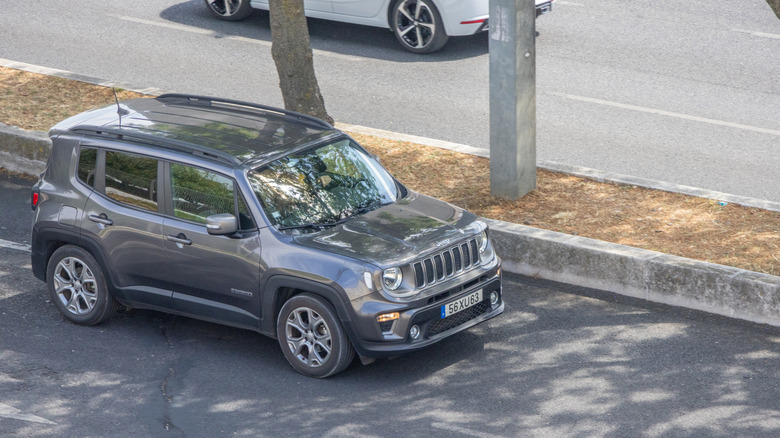
The last of the American-made vehicles on our list is Jeep's smallest offering, which is the Renegade. The 2023 model year had a few issues when it came to IIHS safety ratings, starting with the number one and three anchors for the LATCH child seat system being located too deep in the seat of the vehicle, which resulted with the system earning an "acceptable" rating overall. Then, the headlights got a rating of "acceptable" to "poor," depending on the specific trim and option package of the vehicle; the seat belt reminder system also got a "marginal" rating overall.
The small overlap front test, when conducted for the passenger side, yielded an "acceptable" rating ("G" rating for the driver side small overlap front impact), while the side impact updated test came with a "marginal" rating. The 2023 Renegade also got a "P" rating in the moderate overlap front impact test; most of the damage went to the rear occupants, who got "P" ratings for injuries to the head, neck, and chest. The 2023 Jeep Renegade had a base MSRP of $29,445, to which a destination freight fee of $1,595 would be added. The car has just a 101-inch wheelbase, could seat five passengers across two rows of seating, and had 19 cubic feet of cargo space in the trunk. It features a 1.3-liter, four-cylinder engine that made 177 hp and 200 lb-ft of torque, which would have probably been plenty for its modest stature.