

12 Used SUVs Under $8,000 Consumer Reports Recommends
Buying a new SUV offers many benefits, such as manufacturer warranties that cover most of the vehicle's important components, including the engine and bodywork. Some of the best car warranties on the market also include nice bonuses such as complimentary maintenance and roadside assistance programs, further sweetening the deal.
Unfortunately, the rise in average new vehicle prices that took place in 2025 — a trend which doesn't look like it's going to reverse anytime soon — means that buying new may not be quite as accessible as it used to be. Sure, the most affordable SUVs available generally offer good value for those who need the ride height or utility, but what if one can't quite stretch to the $20,000 or so that a new Hyundai Venue will cost? Well, that's where the used market comes in.
Of course, deciding to buy a used SUV is just the start: The next step is deciding which used SUV to buy. After all, there have been a ton of these vehicles released over the years, and trying to figure out the best ones can be tricky. Thankfully, we can rely on trusted outlets like Consumer Reports, which maintains a database of SUVs that have received its "CR Recommended" award. Here, then, are 12 of these SUVs that you should be able to get for less than $8,000 — although pricing will, as always, differ depending on where you are.
2007 Toyota Highlander
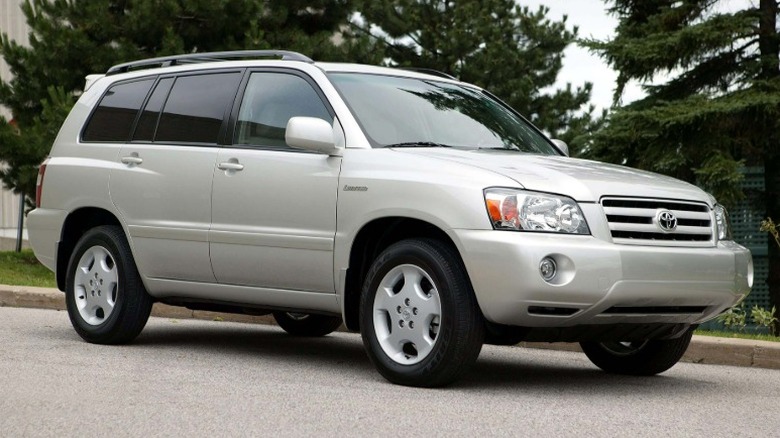
One of the oldest cheap SUVs that Consumer Reports recommends is the 2007 Toyota Highlander, which debuted a year before the Japanese automaker introduced the second generation of this SUV. This particular iteration debuted in 2001 as a two-row five-seater and, while not particularly stimulating to drive, was a sensible choice with a quiet and comfortable ride. Buyers could choose between a 2.4-liter inline-4 and 3.0-liter V6.
Toyota introduced an optional third row to the Highlander for the 2004 model year, along with other welcome changes including a new 3.3-liter V6 that made 230 hp and a power boost for the 2.5-liter inline-4. These changes, especially the addition of the third seat, give the Highlander an advantage compared to most of its peers on the list, provided you can get hold of a three-row model. All of the other sub-$8,000 SUVs that have earned a CR Recommended award, at least as of February 2026, are two-row SUVs.
But while all post-2004 first-gen Highlanders are fair game if you just want three rows, the 2007 model is the one to go for. Toyota had upgraded the Highlander's engine yet again by this time, replacing the 3.3-liter with a 270-hp 3.5-liter V6. It's not all about power, either, as the 2007 model also received extra airbags for better safety in case of a crash. It also seems to be quite a reliable model given the small number of recalls and complaints on the NHTSA database.
2006 and 2007 Lexus RX 400h
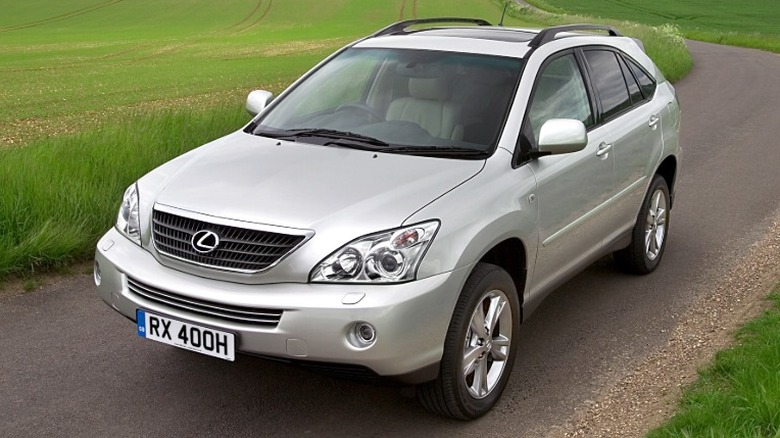
Just because you're on a tight budget doesn't mean you can't try and be a bit eco-friendly. Two model years of the Lexus RX 400h hybrid earned CR Recommended awards and should be available for well under $8,000, making these SUVs a cheap way to get into hybrid motoring — and to buy into some of that classic Lexus luxury.
The 2006 RX 400h was the Japanese marque's first hybrid, setting the stage for a long lineage of electrified models that lasts to this day, including the Lexus UX300h we reviewed in 2025. It paired Toyota's 3.3-liter V6 with two electric drive motors for a combined output of 268 hp, a healthy increase from the gasoline-only RX 330's 230 hp. Reviews at the time appreciated the RX 400h's luxury and performance — Car and Driver recorded a 6.6-second 0-60 mph time — although the meager fuel economy improvements meant that it wasn't really going to pay for itself at the pump.
Lexus didn't change much for the 2007 model year, so choosing between these two years really comes down to how good a deal you can get on the RX 400h you're considering. That said, there are some differences to be aware of: the 2006 RX 400h had Lexus' Adaptive Front Lighting System (AFS) as standard, but this was made optional for 2007. The newer model, however, gained a tire pressure monitoring system not present on the first-year model. It was also available with walnut and bird's eye maple trim, neither of which was available in 2006. CR expects the 2006 and 2007 RX 400h SUVs to be available starting from $6,075 and $5,450, respectively.
2009 Toyota Highlander Hybrid and 2010 Toyota Highlander
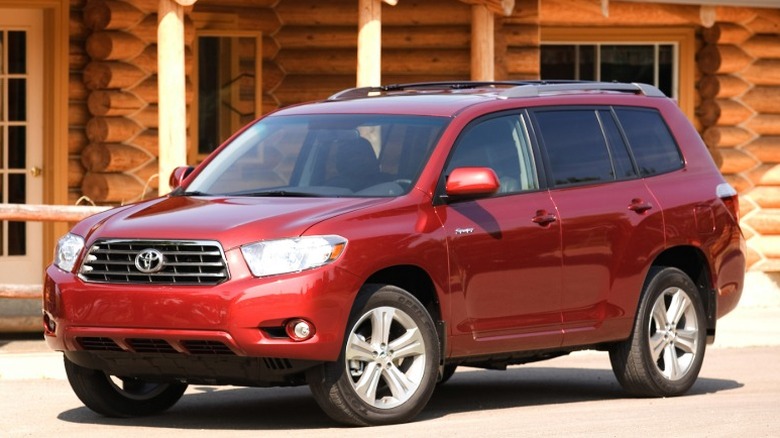
Toyota unveiled its second-gen Highlander SUV in 2007, with the revamped model debuting for the 2008 model year. Changes weren't too drastic but present all the same, and the most notable was likely Toyota's decision to abandon the first-gen model's 2.4-liter inline-4 in favor of two V6 engines: the 270-hp, 248-lb-ft 3.5-liter already present in the 2007 Highlander or a hybrid 3.3-liter V6. The latter had three electric motors, with two assisting the engine and the other serving as a starter, producing a total of 270 hp and 212 lb-ft of torque.
The 2009 Highlander Hybrid, which was unchanged from the 2008 model, is expected to be available from $6,325 according to CR. For that outlay, buyers get a three-row SUV capable of 27 mpg in the city, four-wheel drive courtesy of a dedicated rear electric motor, and a cushy ride thanks to its independent suspension. However, the NHTSA reports that there have been 10 recalls for the 2009 Highlander Hybrid involving issues including stuck accelerator pedals and short-circuit-prone seat heater wiring, so you'll want to make sure any model you're looking at has been repaired.
Those of you who want a CR-approved gasoline second-gen Highlander should turn to the 2010 model instead, which should be available for $7,000 or so. The 2010 Highlander is available with the 3.5-liter V6 or a 187-hp, 2.7-liter inline-4, a more economical engine that Toyota introduced for 2009. Beyond that, these two models are essentially identical, with the same smooth ride and safety features — including stability and traction control, ABS, and braking assist — and, unfortunately, similar histories with recalls.
2011 Toyota Venza
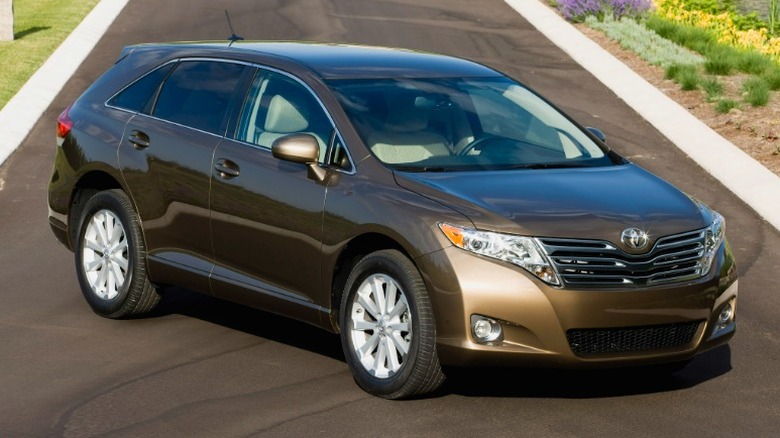
The 2009 Toyota Venza first broke cover at a 2008 auto show as an attempt to split the difference between sedans and SUVs. The intention, then, was to appeal to North American families with a combination of SUV utility and sedan handling characteristics, with the result broadly looking like a station wagon. Critics received the Venza reasonably well, with its comfort, utility, and jack-of-all-trades design earning it praise, even if the base inline-4 engine was not particularly capable.
Toyota didn't update the Venza much over the next couple of years, with minor updates to connectivity — the Venza got iPod and Bluetooth capabilities in 2010 — as well as the interior and trim levels. Thus, the 2011 Venza is much the same model as its predecessors. The Venza was not quite as well-liked a few years into its run, though, with issues such as a poor interior and an overall dull driving experience that was perhaps somewhat harder to excuse after the initial novelty wore off. We'd imagine that those issues will probably be much easier to tolerate when you can get one for $6,800 or so, though.
The 2011 Venza seems to have lived up to Toyota's reputation for reliability, at least, with few recalls and even fewer owner complaints on the NHTSA website (although that may admittedly have more to do with the Venza's poor sales than anything else). That said, one of its six recalls was issued as recently as 2021, so those interested in one should ensure the example they're looking at has a clean bill of health.
2012 Honda CR-V
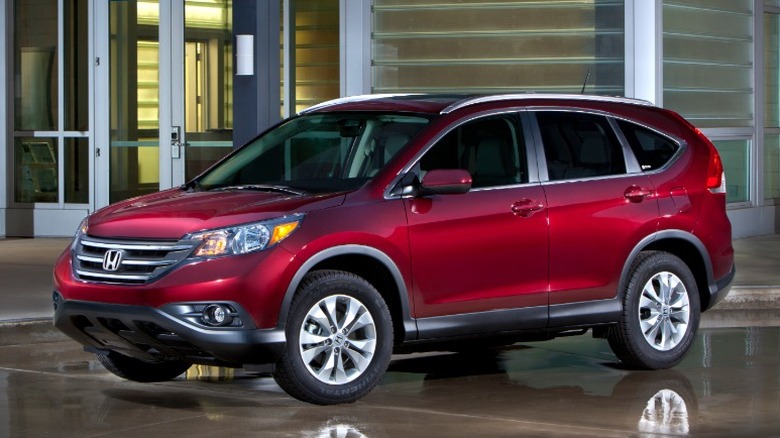
Let's be clear here: The fourth-gen 2012 Honda CR-V is probably not going to be considered one of the best generations of the model in the future. However, while it's not going to get the blood pumping, a used example will do what a cheap SUV should. It'll be comfortable, reasonably frugal, and practical, all for a decent price of $7,500 or so, according to Consumer Reports.
The 2012 CR-V saw the debut of some welcome improvements over the previous generation. These include a very slightly more powerful 2.4-liter inline-4, which makes 185 hp and 163 lb-ft of torque — a whole 5 hp more than the previous four-pot. Bluetooth was also now available as standard, as was a rear-view camera. Buyers were also treated to upgrades such as electric power steering, hill start assist, and an optional, electronically-controlled real-time AWD system for better traction in inclement weather.
Unfortunately, while CR was a fan of the 2012 CR-V when it debuted, the years have not been entirely kind to it: The 2012 model has nearly 400 complaints recorded on the NHTSA website, with one of the most common issues being a grinding or knocking sound from the engine upon startup. The SUV also seems to have battery drain and transmission judder issues, although the latter was addressed with a voluntary update. While none of these make the 2012 CR-V a hard "avoid," especially if you find one at the right price, it's certainly an SUV to check thoroughly before purchasing.
2014 Mazda CX-5
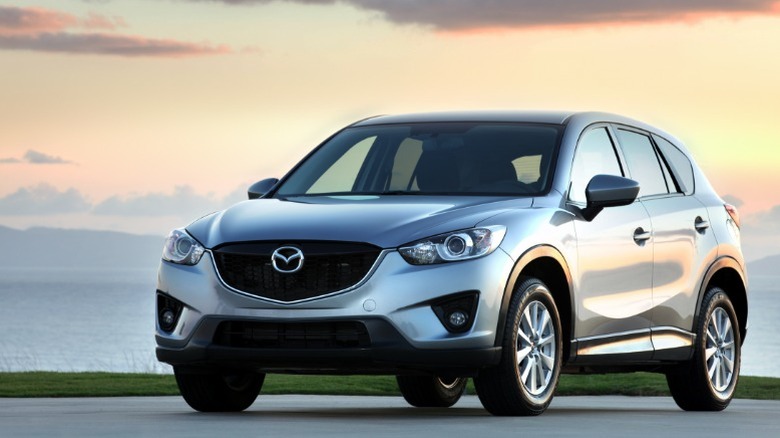
SUVs aren't necessarily known for being fun vehicles to drive, but the Mazda CX-5 has always been something of an exception to that rule. Upon its debut for the 2013 model year, the CX-5 immediately impressed reviewers with its great manual gearbox and sharp handling — two traits that likely helped it outperform its predecessor in terms of sales as well.
If there was one issue with the 2013 CX-5, it's that it was slow, with just 155 hp from its 2.0-liter inline-4. Thankfully, Mazda resolved that issue — in a sense — for the 2014 CX-5 that earned Consumer Reports' recommendation. The entry-level 2014 CX-5 Sport still had the 155-hp inline-4, but Touring and Grand Touring models came with a much beefier 2.5-liter engine that made 184 hp and 185 lb-ft of torque. While increased horsepower didn't make the CX-5 a straight-line demon, it did make the SUV a much more capable vehicle overall, especially when combined with its still-excellent handling characteristics.
As such, if it's at all possible, we recommend seeking out a 2.5-liter 2014 CX-5 if you're going to go down this route. CR expects that 2014 CX-5s to start at $7,600 or so, although it's not clear whether that's for the Sport model or the 2.5-liter-equipped trims. Either way, the larger engine is well worth seeking out and paying extra for. The fact that Mazdas are generally reliable even after 100,000 miles should make it a reasonably stress-free purchase, too, provided you're getting a well-maintained CX-5.
2016 Nissan Murano
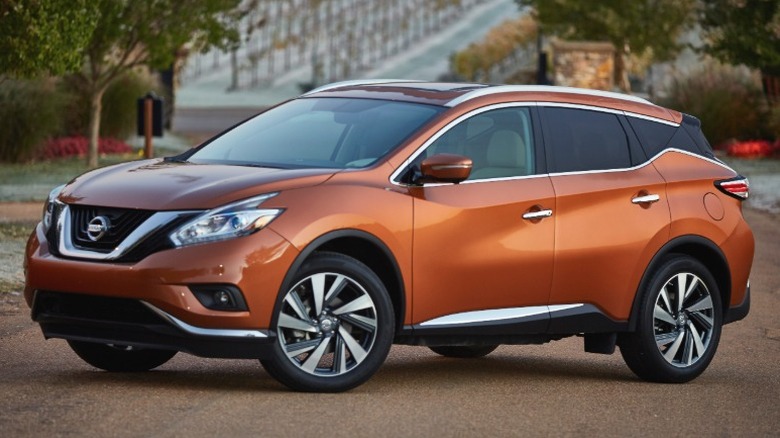
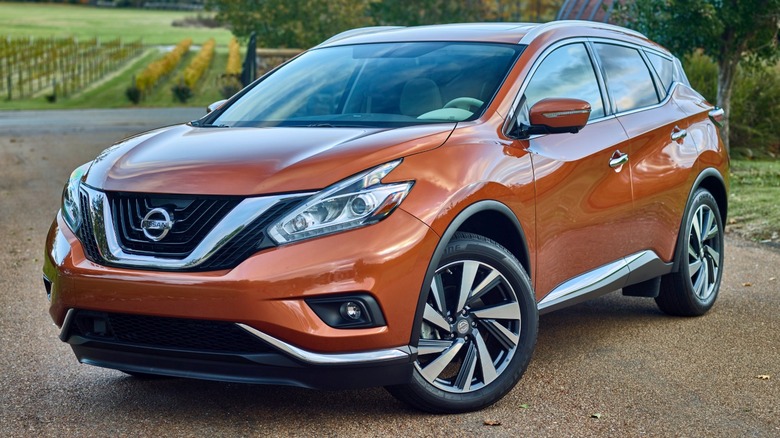
Buying a used SUV for less than $8,000 invariably means having to settle for an older model, which may not be to everyone's taste. Thankfully, you don't necessarily have to go too far back to get a cheap, CR-approved SUV. Enter the 2016 Nissan Murano, which CR expects to be available for around $7,450 or so.
The 2016 Murano is one of the best years for the SUV, with its reliability praised by Consumer Reports and J.D. Power users alike. It was quite a departure from the 2015 Murano, which inaugurated the SUV's third generation in inauspicious form with a jerky, unpleasant transmission that drivers were not particularly keen on. What changed between the two model years to prompt such an upswing isn't clear, but that doesn't matter much — what's important is that the 2016 Murano is a great buy if you're after an affordable SUV that isn't too dated.
Improved reliability — or, well, fewer user complaints — aside, there aren't any differences between the 2015 and 2016 Murano. That means you have a 260-hp, 3.5-liter V6 under the hood mated to Nissan's Xtronic transmission, with a solid selection of safety features available on the higher-end SL and Platinum trims. These include many standard features we're now familiar with, including blind spot warning and rear cross traffic alert, plus optional features like intelligent cruise control and automatic emergency braking. The fact that some of these are optional means that you'll have to hunt for a suitably-equipped Murano, but it's still reassuring that affordability doesn't necessarily entail sacrificing safety tech here.
2008, 2011, and 2012 Toyota RAV4
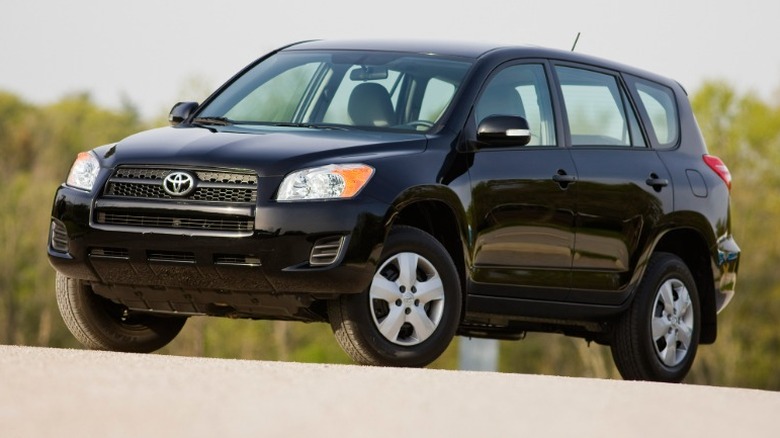
Toyota's RAV4 is the automaker's best-seller in the U.S. and has come a long way since its humble beginnings in the mid-1990s. Over the years, it made a name for itself with its dependability, great fuel economy, and versatility, ensuring that the RAV4 deserves its sales success and then some. Given its popularity, you'd probably expect used RAV4s to be quite easy and affordable to get hold of — and you'd be right, with three members of the SUV's third generation earning the CR Recommended award.
At around $5,700, the oldest and cheapest of the three is the 2008 RAV4. This model is from before the SUV's 2009 refresh, so it has the third-gen model's original front and rear lights and, most importantly, the older 2.4-liter four-pot instead of the larger 2.5-liter engine available in 2009 and onward. This makes 166 hp and 165 lb-ft of torque. That minor issue aside, the 2008 RAV4 offers cheap, compact utility, and is also available in a more powerful 269-hp 3.5-liter V6 version if fuel economy isn't a big concern. It's been recalled 14 times, though, so be on your toes.
Those with larger budgets can opt for the refreshed third-gen 2011 or 2012 Toyota RAV4. These have the 2.5-liter inline-4, which makes 179 hp and 172 lb-ft, with the 269-hp V6 still present for those who want power above all. The 2011 and 2012 RAV4 aren't much different from each other, although we think the 2012 is worth paying extra for — CR estimates that prices will start at $7,600, versus $6,800 for the 2011 model — as it's the first model year with Bluetooth as standard.