

The Best Honda SUVs Available Today, According To The Experts
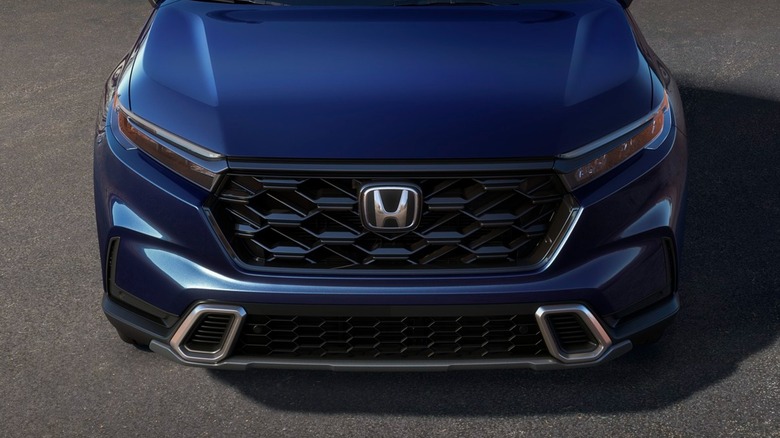
Honda is known for building great vehicles, from cars and trucks to motorcycles and much more. It's no surprise that its SUVs are some of the first things that comes to mind for many when thinking about buying a new car. If you're decided to go with a Honda for your next purchase, the brand offers several models to choose from, ranging from the subcompact Honda HR-V, the battery-electric Prologue, the mid-size Pilot, and several different versions of the CR-V.
With this range of choices, it's natural to be undecided on which Honda SUV to get. That's why we've gathered a list of those on offer, going from the worst to best option, based on expert reviews. Also, note that this "worst" option does not mean that it's a bad car — instead, it's just the model with a relatively low rating when compared to others from Honda's SUV lineup.
These models are all available at the time of writing, with MSRPs starting from around $26,500 and going all the way up to just over $50,000. That way, you know that there's likely to be a Honda SUV for you, no matter what price point you're looking at.
Honda CR-V e:FCEV
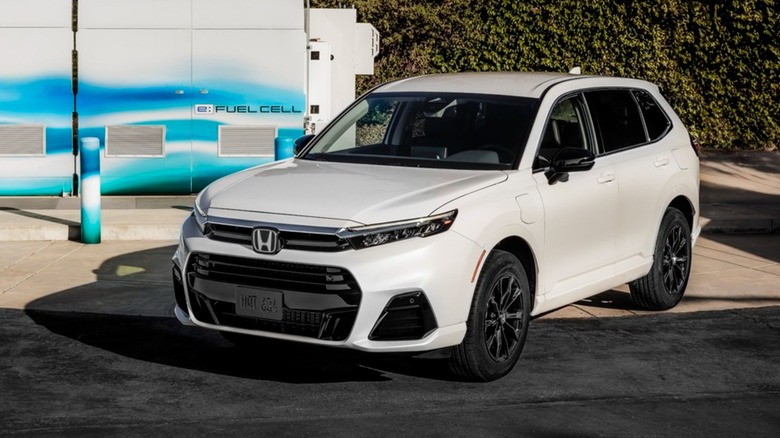
The Honda CR-V e:FCEV has the lowest rating we've seen from all the experts, but that's not because it's a bad car. In fact, this vehicle is just a Honda CR-V (one of the best Honda SUVs around) with a different front grill and powertrain. The CR-V e:FCEV is a plug-in hybrid (PHEV) that replaces the powertrain of the vanilla CR-V with a hydrogen fuel cell engine paired with a modest back-up battery that you can charge from an outlet.
One of the reasons the e:FCEV scored low is because of its limited availability. At the time of writing, you can only get it in California, which has the greatest number of hydrogen fueling stations in the U.S. But even then, there's only a handful of available retail stations in the state, meaning you're going to have difficulty refueling this specialized CR-V trim level unless you live near one of these hydrogen refueling points. This model is also priced relatively high — it has a starting MSRP of more than $50,000, which makes it even more expensive than similar alternative-fuel vehicles like the full-electric Honda Prologue.
It's not all doom and gloom, though. In addition to the novel technology powering this SUV, it's also exclusively offered in the CR-V's top-end Touring trim. That means you're getting a lot of optional features as standard, like the digital gauge and the heated steering wheel. Yet at the end of the day, the e:FCEV is barely any different from the CR-V if you disregard its hydrogen fuel cell. So, if you live in California, have easy access to hydrogen fuel, and want to drive a vehicle that uses cutting edge technology, this is a Honda SUV you should consider for your next ride.
Honda Prologue
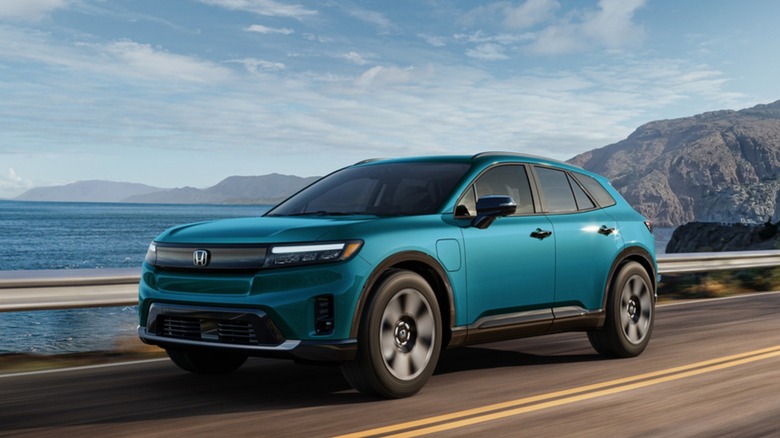
Honda is pretty late to the battery electric game, only launching its first fully electric model in the US with the 2024 Honda Prologue. Furthermore, this model isn't homegrown by the Japanese automaker — instead, the company borrowed General Motor's Ultium platform, allowing it to quickly bring to market its first all-electric SUV. Unfortunately, using this technique makes the Prologue feel more like a GM product, which might make some long-time fans of Honda a bit uncomfortable.
Still, the Prologue is good option if you want to transition from gasoline to fully electric while still sticking to the Japanese carmaker's badge. It has a claimed range of 283 to 308 miles, although SlashGear testing estimates closer to 255 miles on a single full charge. Nevertheless, that should be good enough for most daily drives. Another thing you should consider, though, is that even though the Prologue is larger than the CR-V, it has a considerably smaller cargo capacity, even with the seats folded down.
This mid-size battery electric SUV is available in three different trims: EX, Touring, and Elite. The base EX trim starts at $47,400, while the top-end Elite will set you back at least $57,900. The carmaker also includes an optional home wall mounted charger and a $1,250 installation incentive so you can top it up while parked in your garage — or a $500 sales credit if you choose to not install a home charging station.
Honda Pilot
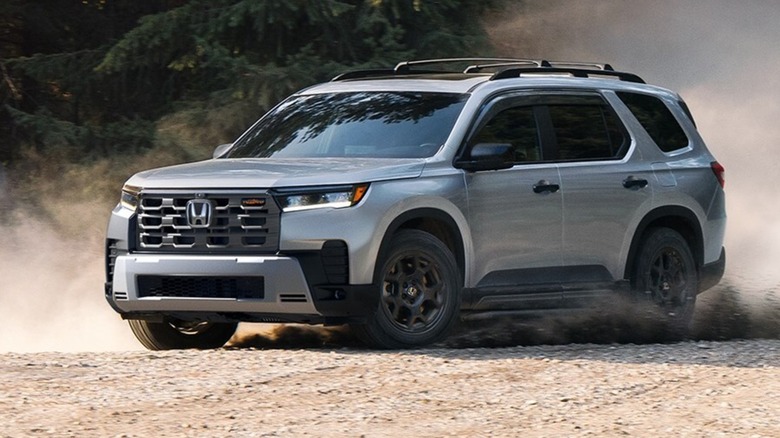
The Honda Pilot is the only three-row SUV you can get from the company, so this is your sole option if you're looking a family hauler from Honda that will fit the kids, the dog, and all your bags in the luggage compartment. It brings a tougher, more rugged look compared to the previous generation Pilot, giving it a front fascia similar to the popular CR-V, and pairs that with a boxy body that delivers a lot of interior space for passengers and cargo.
Apart from that, Honda gave this SUV some off-roading chops, especially with the optional AWD on the offroad-focused Honda Pilot TrailSport trim level, allowing you to confidently take on some light and even moderate difficulty trails. You also won't be short on power, as this vehicle is equipped with a 3.5-liter V6 that puts out 285 hp at 6,100 rpm and 262 ft-lb of torque at 5,000 rpm, all of which is mated to a 10-speed automatic (although don't expect it to be supercar quick).
The Honda Pilot starts at $43,690 for the base Sport trim, but if you want to get all the bells and whistle, the Black Edition will set you back by at least $56,490. Unfortunately, this SUV still lacks a hybrid option, so you'll just have to take its 20 to 22 MPG combined EPA rating if you want a three-row Honda SUV.
Honda HR-V
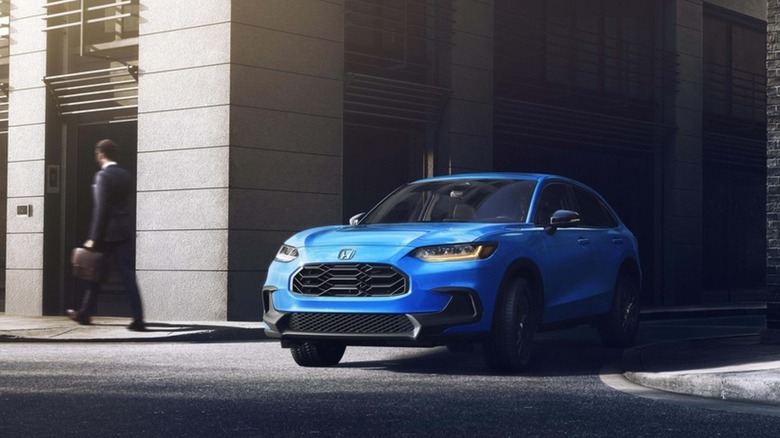
If you're on a budget or don't really need a huge honking SUV, Honda offers the subcompact HR-V. Yet despite being the smallest vehicle in the brand's lineup, the Honda HR-V is an exceedingly safe vehicle, with the National Highway Traffic Safety Administration (NHTSA) giving it a rating of five out of five. Meanwhile, the Insurance Institute for Highway Safety (IIHS) agreed, recognizing the HR-V its Top Safety Pick Plus award recipient in 2025.
This model's benefits also go beyond safety thanks to its appeal to younger buyers. That's because it's both relatively inexpensive and also comes with a lot of features like wireless Apple CarPlay and Android Auto, a wireless charging pad, and the Honda Sensing safety suite as standard. It's also quite roomy given its relatively small size, so you won't feel cramped despite the HR-V being a subcompact SUV.
The HR-V is powered by a 2.0-liter, naturally aspirated inline-four pushing out 158 hp at 6,500 rpm and 138 ft-lb of torque with a continuously variable transmission (CVT). These numbers won't leave you feeling like you're driving a bigger Honda Civic Type-R, but it should be good enough to get you around town. More importantly, it only starts at $26,500 for the base LX trim, while the top-end EX-L will only set you back around $30,350.
Honda Passport
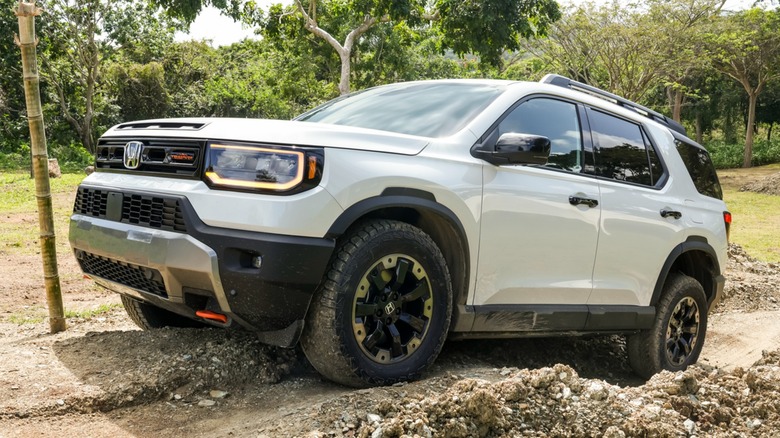
The Passport is the second-best Honda SUV you can get today, with many experts ranking it second only to the CR-V. The carmaker revamped the fourth-generation model of this SUV, turning it from a generic-looking mid-size vehicle meant for city streets into a full-on off-roader capable of taking on moderate trails. And if you pick the Honda Passport TrailSport, you can take on even more challenging routes straight from the dealership.
But even though Honda designed this vehicle for taking on mountain tracks, it didn't forget the basic things that make it a great city car as well. Just like the smaller HR-V, this mid-size SUV received IIHS' Top Safety Pick+ rating, making it one of the safest options in its category. It also comes in several different trims, allowing you to just get the features that you need and not overpay for tech you won't use.
If you love the styling of the Passport, you can get it for a starting MSRP of $44,950 with the base RTL trim. As for the top-of-the-line TrailSport Elite Blackout, it starts at $53,850. This puts it within the same price range as the Honda Pilot, but its off-roading chops make it the better alternative, especially if you don't need the two to three extra seats you get with the Passport's tamer brother.
Honda CR-V
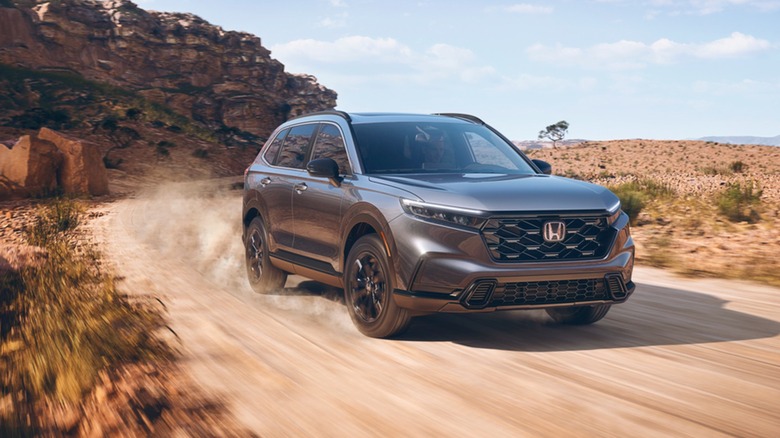
Many experts consider the Honda CR-V as the best of the best when it comes to the Japanese automaker's crop of SUVs, and sales data backs this up. As of the third quarter of 2025, the CR-V is the second-best selling model in the U.S., sitting only second to the Toyota RAV4. This Honda has a lot going for it — it has a quiet and comfortable interior, there's plenty of space for both passengers and cargo, it comes with a lot of tech that many young buyers are looking for, and it's available in a variety of trims that allow for affordability. More importantly, it's the only SUV in Honda's lineup that's available as hybrid, at least at the time of writing.
The gas-powered CR-V comes with a turbocharged 1.5-liter inline-four engine that outputs 190 hp at 6,000 rpm and 179 ft-lb of torque paired to a CVT. But if you prefer the hybrid engine, you're getting a larger, naturally aspirated 2-liter mated to an electric motor, putting out a total of 204 hp. Aside from this, there's also a secondary generator used to start the engine and recharge the batteries.
The most affordable LX trim starts at just $30,920. You'll have to shell out at extra few thousand dollars if you want to get the $35,630 Sport Hybrid trim, the cheapest variant that has both an internal combustion engine and an electric motor. This puts it on par with the traditional gas-engine EX-L trim level, which starts at $35,400. If you want to go all out, the top-of-the-line Sport Touring Hybrid will cost you at least $42,550.
Why did we list these Honda SUVs?
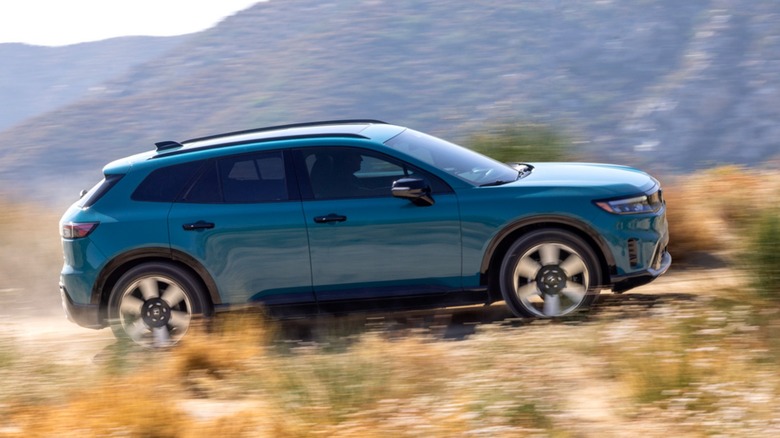
We based our list on expert feedback and reviews from several different outfits, including resources like Car and Driver and JD Power. We then ranked these SUVs accordingly based on the results of those reviews, averaging them to provide a larger and more complete idea of how these models stacked up against each other. Furthermore, we took into account the experiences of our staff and writers here at SlashGear who have reviewed the Honda SUVs listed above to create our final definitive ranking.