

2027 Subaru Forester Wilderness Hybrid Surpasses Rivals, But Not In The Way You Expect
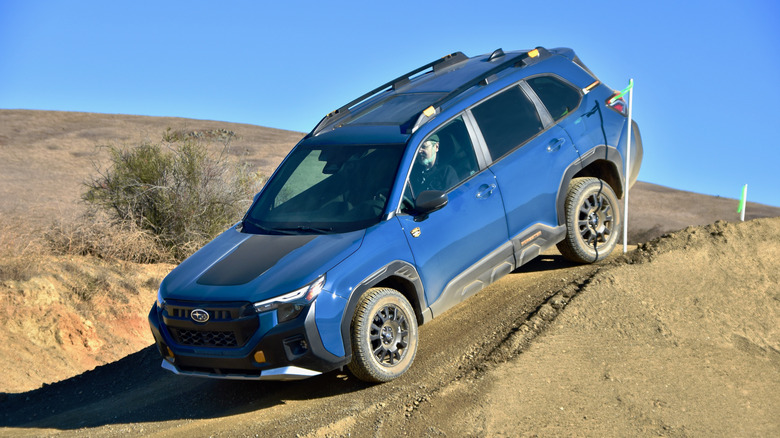
Some new cars are genuinely unexpected, or represent what business schools would call out-of-the-box thinking, but the 2027 Subaru Forester Wilderness Hybrid isn't one of them. Because it doesn't have to be.
Since the first Forester Wilderness launched in 2021, Subaru has sold nearly 300,000 Wilderness-badged models. And after the current-generation Forester arrived for the 2025 model year, the lineup included a hybrid for the first time. With Subaru expecting hybrids to account for 50% of sales in this market segment by 2029, it was logical to combine the hybrid powertrain with the Wilderness off-road kit.
Off-road variants of compact crossover SUVs are also far from a niche subgenre. Nearly every competitor has one now, and while not all are hybrids, the Honda CR-V TrailSport and Toyota RAV4 Woodland are hybrid-only, and Hyundai will offer a hybrid-exclusive XRT Pro version of the redesigned 2027 Tucson when that SUV hits showrooms in the 2027 calendar year.
In other words, Subaru couldn't avoid doing a Forester Wilderness Hybrid. But this extra-rugged crossover does more than check a box.
What makes it a Wilderness?
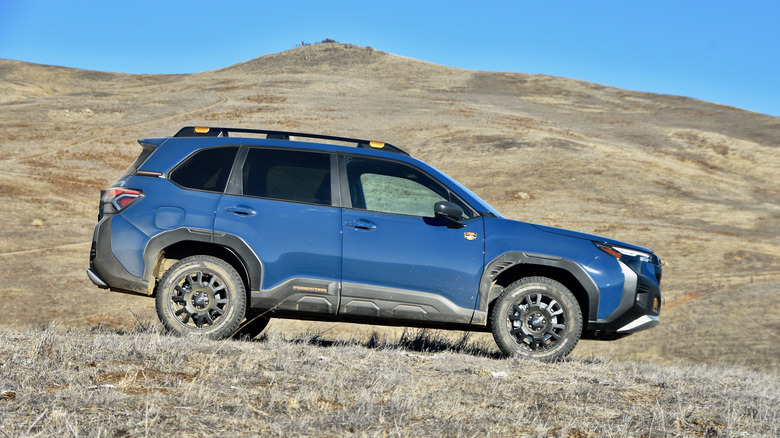
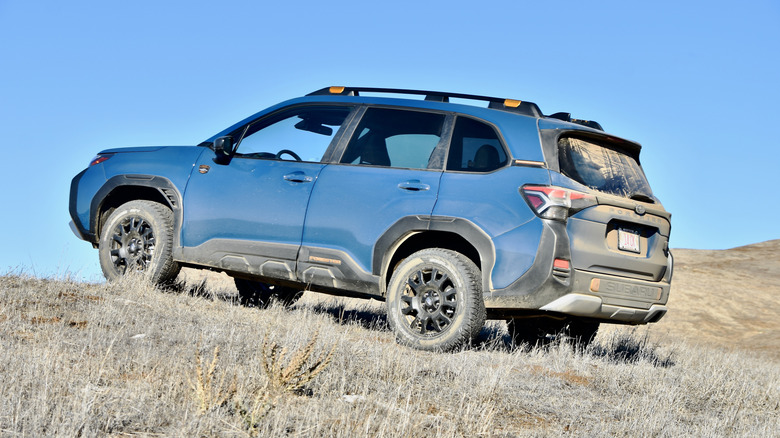
The Wilderness Hybrid gets the same equipment as the current non-hybrid Forester Wilderness that debuted as a 2026 model. Functional elements include 9.3 inches of ground clearance (up from 8.7 inches for the standard Forester Hybrid) thanks to longer coil springs and shocks, "underbody protection" (aka skid plates), standard roof rails with an 800-pound static load capacity, and Yokohama Geolander all-terrain tires (on 17-inch wheels). However, hybrid models don't have a spare tire because the battery pack occupies the space normally reserved for it.
The hybrid model is also visually identical to the non-hybrid Forester Wilderness, with so much body cladding that it looks like half the car is unpainted. The contrast is especially apparent with this test car's Geyser Blue paint, the signature Subaru Wilderness color from the beginning. Bronze accents are sprinkled about as well. You certainly won't confuse a Wilderness for a standard Forester, but I still see a lot of Ford Explorer in the design. Only instead of a regular Explorer, the Wilderness looks like an Explorer Tremor.
In the context of its rivals, though, the Forester Wilderness Hybrid does a much better job of selling that all-important active lifestyle fantasy. Visually, the CR-V TrailSport and RAV4 Woodland don't look that different from their less-rugged counterparts. Subaru did it right; there's little point in having a sleeper off-roader.
Subaru's hybrid powertrain goes unchanged
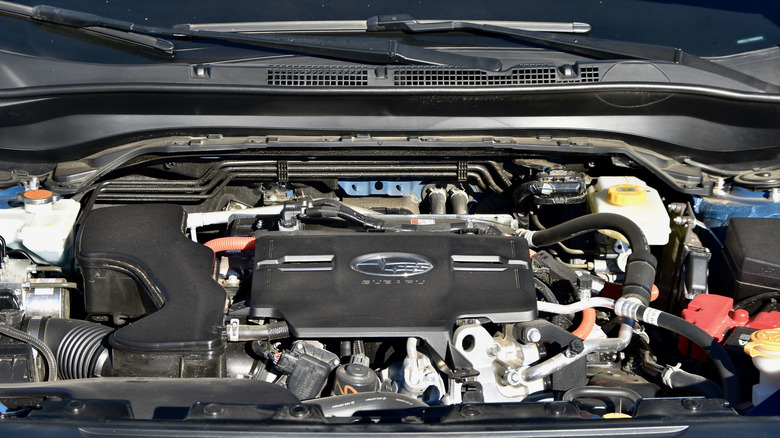
The Wilderness doesn't receive any powertrain changes, so you still get a mix of Subaru and Toyota components. Subaru leveraged its partnership with the larger automaker (which has also birthed a lineup of EVs and the wonderful BRZ/ GR 86 sports cars) to buy into the industry's benchmark hybrid system. Two electric motors—one acting as a generator, the other dedicated to propulsion—and a planetary gearset take the place of a conventional transmission. They're fed by a 1.1-kilowatt-hour lithium-ion battery pack that lives under the cargo area's floor.
But Subaru provides its own 2.5-liter boxer-four engine and all-wheel drive system. The engine is pretty much the same as what you get in a non-hybrid Forester, but can run on the Atkinson or Miller cycles to improve efficiency. Total system output is 194 horsepower, which is 10 hp less than a CR-V TrailSport and 35 hp less than a RAV4 Woodland. It's a noticeable 14-hp increase over the non-hybrid Wilderness, but towing capacity nonetheless decreases from 3,500 pounds to 1,500 pounds.
Subaru retained a fully-mechanical all-wheel drive system (unlike Toyota) with a center differential (unlike Honda) to preserve off-road capability. For 2027, software tweaks improve low-speed traction by boosting electric motor torque and curtailing traction-control intervention.
All-day off-roader
In these days of Hemi-powered Wranglers and twin-turbo V8 Defender Octas, it's easy to dismiss a compact crossover with not quite 200 hp. The Forester Wilderness Hybrid is a throwback to the days when off-roaders didn't have to be fast.
For this first drive, Subaru invited SlashGear out to Rancho Quien Sabe, 48,000 acres of cows, dirt tracks, and stunning scenery in California's Central Coast region. Almost the entire day was spent on dirt, but I didn't feel worn out at the end of it. In contrast to more hardcore rigs, the Forester maintained its car-like composure, transmitting minimal vibration through its suspension and keeping occupants from getting bounced around. Most of the route consisted of minimally-prepared trails, and while we did have to rely on the skid plates for a couple of sharply-angled creek bed crossings, getting stuck or leaving bodywork behind never even seemed like a possibility.
A short obstacle course with more technical stuff was a reminder that the Forester is still a car-like unibody crossover, though. The lack of suspension travel compared to a body-on-frame Wrangler or Land Cruiser came into play on moguls, which had to be negotiated with extra patience. The lack of a spare tire in hybrid models is also a problem (we saw plenty of sharp rocks that could have caused a flat) and using the touchscreen to switch between the X-Mode driving modes is a bit awkward. Still, the Forester shows that you can get pretty far off-road without sacrificing comfort.
Reasonably refined on-road, too
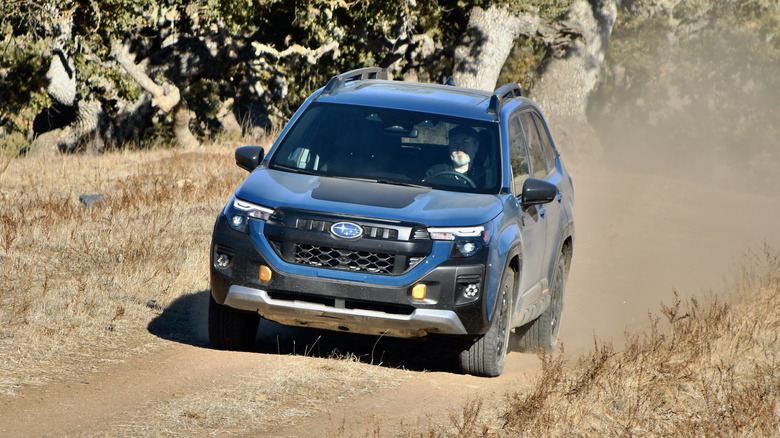
The Forester Wilderness Hybrid is more at home in the Wilderness, but the changes that make it more capable off-road don't impact the on-road driving experience.
Soft suspension that allows lots of body roll is pretty much a Forester trademark, but the Wilderness Hybrid's lifted suspension didn't exacerbate this, at least. The steering doesn't give you any indication that this car is made by the same company as the BRZ and WRX, but it gets the job done. It's accurate enough that smoothly setting up for corner entry and exit without corrections is easy, which helps with managing that body roll. All-terrain tires generally make more noise on pavement, but that wasn't an issue here.
Like the standard Forester Hybrid, the Wilderness' electric assistance adds a layer of refinement that's not apparent in the spec sheet. The powertrain doesn't sound happy when you floor the pedal, but it pulls consistently. The additional 14 hp and electric-motor torque is enough to push the Forester Hybrid over the line from "slow" to "adequate."
Don't expect Toyota-like mpg
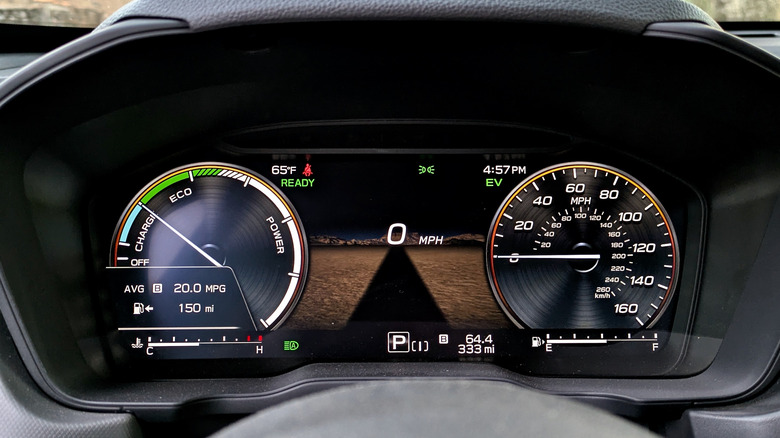
The Forester Wilderness Hybrid's main rivals are also pretty civilized on-road, though, and they do a better job at delivering the increased fuel efficiency that is generally the reason for buying a hybrid.
This more rugged hybrid is EPA-rated at 31 mpg combined (33 mpg city, 29 mpg highway). That's a big step down from the 36 mpg combined (38 mpg city, 34 mpg highway) of the standard Forester Hybrid, and a few mpg shy of those rivals. The CR-V TrailSport is rated at 35 mpg combined (38 mpg city, 33 mpg highway) and the RAV4 Woodland is rated at 38 mpg combined (41 mpg city, 35 mpg highway).
After a day of off-roading, observed real-world fuel economy was also unimpressive, at 20 mpg. It's not surprising that the Forester fell very short of its EPA ratings, as off-road driving isn't factored into the federal testing cycle. But that number isn't making a strong case for choosing the hybrid over the standard Wilderness.
The problem is that, while Subaru uses Toyota's hybrid system, the automaker's own engine and all-wheel drive system aren't the most efficient choices. Instead of achieving maximum efficiency, preserving the Forester's distinctive Subaru-ness was the priority. The engineers certainly did that, with the confidence that most Subaru customers will likely sacrifice some mpg to stay with the brand.
Interior is fit for purpose, but tech lags
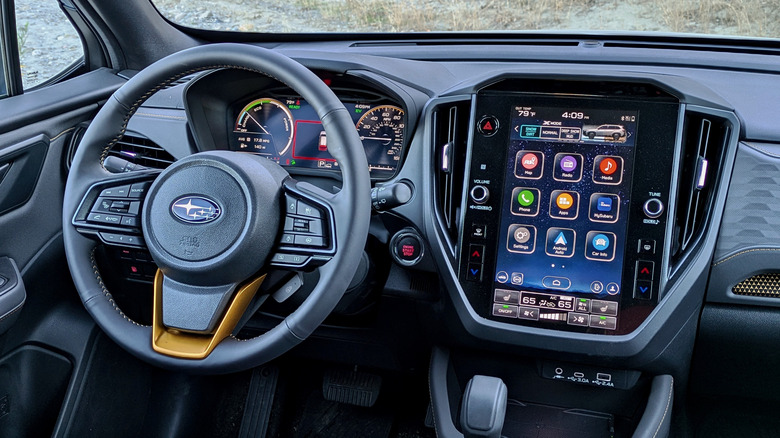
That Subaru-ness also extends to the interior. As with the previous two generations, the Forester has a boxy profile that creates plenty of room for glass, giving the interior a more spacious feeling and providing better sightlines—which definitely comes in handy when off-roading. In terms of objective measurements, the Forester offers similar headroom and legroom to its closest rivals from Honda and Toyota, but less cargo space with the rear seats up (and with the rear seats down, in the case of the Honda).
None of these off-road crossovers offer particularly stylish interiors, but Subaru puts in more effort than Honda and Toyota. The bronze accents (including a star pattern on the dashboard that may invite copyright lawsuits from Mercedes) makes the Forester Wilderness Hybrid's cabin look a lot less austere. The standard StarTex upholstery and copious plastic aren't fancy, but they look durable enough to survive even the most active of lifestyles.
Wilderness Hybrid models have the biggest-available 11.6-inch touchscreen and 12.3-inch digital instrument cluster. But the big touchscreen is easily washed out in sunlight and slow to respond. And while the big icons are easy to find, it does feel like using an oversized children's toy version of an infotainment system. At least you still get wireless Apple CarPlay and Android Auto.
2027 Subaru Forester Wilderness Hybrid verdict
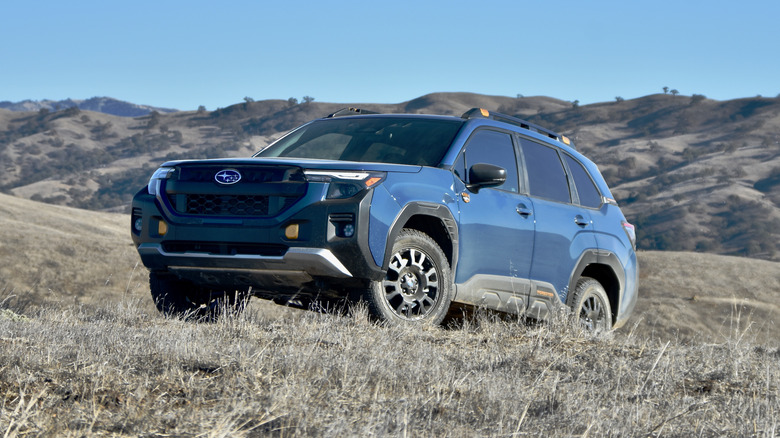
The Wilderness Hybrid costs $41,970, which is a $1,000 upcharge over the non-hybrid Forester Wilderness. It's also the second-priciest Forester Hybrid model, behind only the Touring Hybrid. However, it's well equipped compared to the lower Forester Hybrid grades, and Subaru makes everything standard, with no need to pay extra for options. The Forester is also Subary's only Wilderness model available as a hybrid right now, although the difference in real-world fuel economy might not be great.
Subaru's pricing is also barely separated from that of the Honda CR-V TrailSport ($40,750) and Toyota RAV4 Woodland ($42,250). Both are better hybrids, with higher fuel economy on paper and drivetrains that make it easier to achieve that fuel economy on the road. But as a more rugged version of an ordinary crossover, the Forester Wilderness Hybrid leaves the TrailSport and Woodland choking on trail dust.
It's not just that the Forester is good off-road. It's that it actually looks the part. Inside and out, Subaru gives you more than just badges, different tires, and all-weather floor mats. Instead of asking customers to imagine what it can do to make writing a bigger check less painful, the Forester Wilderness Hybrid feels like an upgrade no matter where you are.