

Hyundai's Redesigned 2027 Tucson Is Better Than It Needs To Be, But It Could Be Even Better
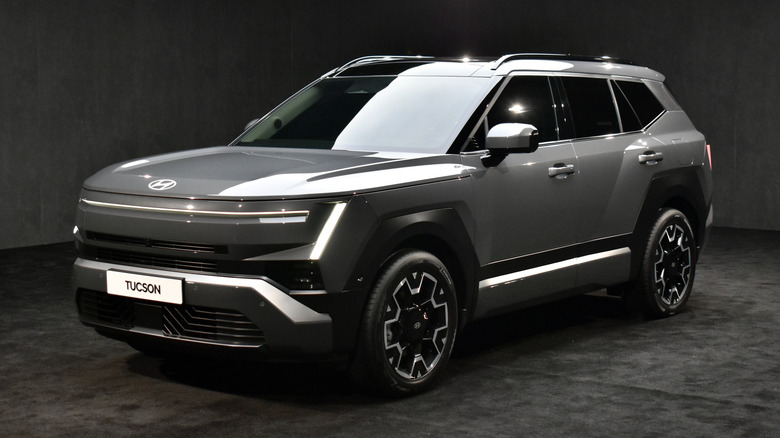
Hyundai Motor Group is the overachiever of the auto industry. Like a fanatically motivated high schooler messing up the grading curve for the rest of the class, Hyundai consistently manages to deliver above and beyond what the assignment demands.
It would be impressive enough if Hyundai consistently delivered cars with daring styling, impressive quality, and good value across one brand. That it also has the bandwidth to do the same with its Kia and Genesis brands is actually kind of obnoxious. Car enthusiasts know that it wasn't always this way, that Hyundai was once a laughingstock known for making chintzy cars that appealed to those who paid attention to the base price and nothing else.
Those days are so far in the past, though, and Hyundai's performance has been so impressive of late, that if anything Korea's main automaker needs to be graded with more scrutiny than its mostly-flailing competition. That's the attitude I brought to a preview of the redesigned 2027 Hyundai Tucson—a very important new model for the automaker and its customers alike.
Somehow, Hyundai found an original take on the classis SUV shape
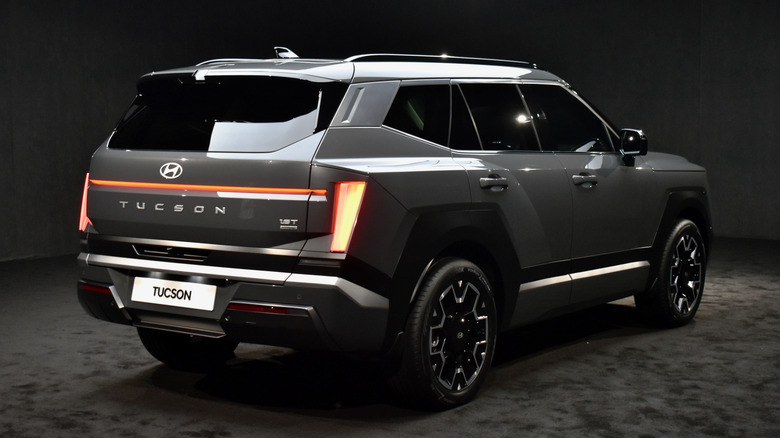
Entering its fifth generation, the Tucson is Hyundai's current bestseller and its entry into the market segment that's replaced midsize sedans as the default car type for most Americans: compact crossover SUVs.
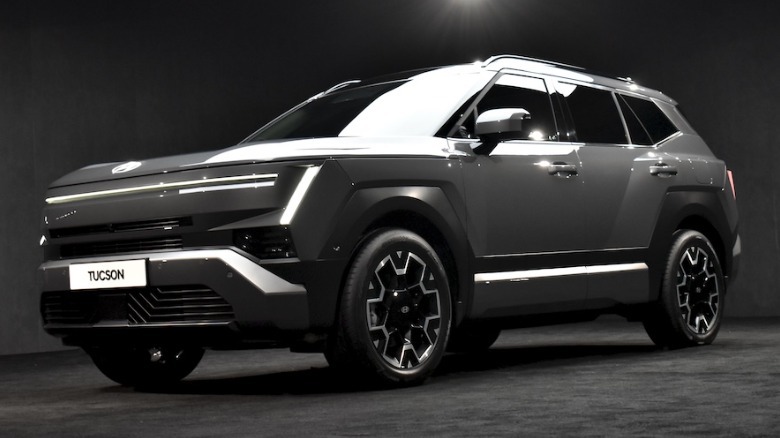
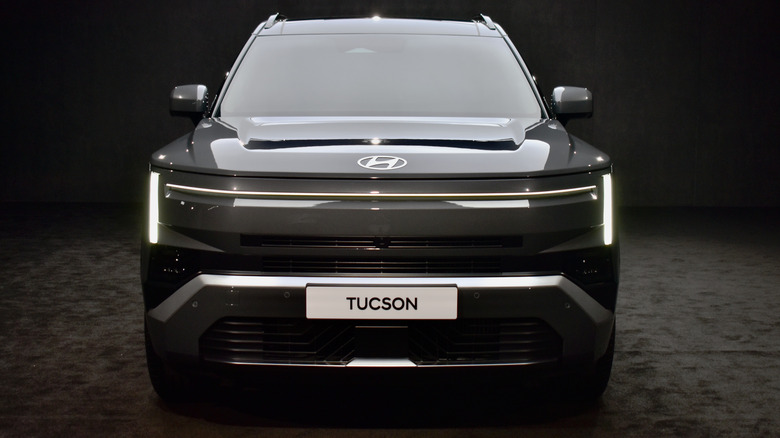
Unlike the competition, which has been gradually bulking up its compact crossovers to look more truck-like, Hyundai isn't doing anything in half-measures. With its angular, creased fender flares and flat roof and hood, the Tucson screams "SUV." But it does so in a futuristic way that I wish more carmakers would attempt. Park this Tucson alongside the original model from 2004, and it really looks like 20+ years separate the two.
 Stephen Edelstein/SlashGear
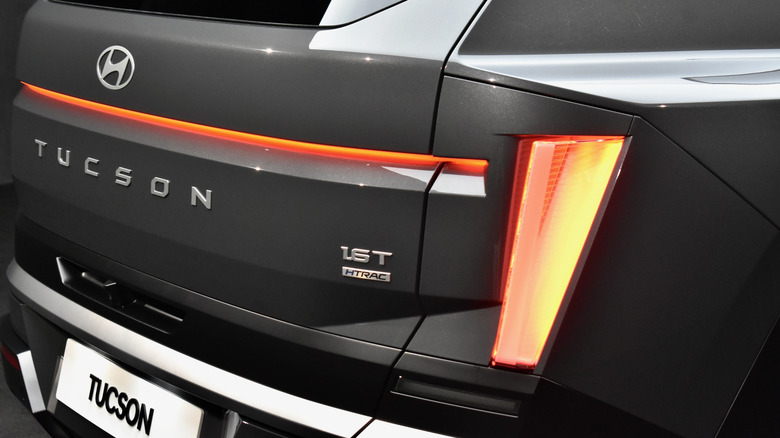
That's largely down to the new Tucson's lighting. At the front, simple vertical lights and a horizontal bar give the Tucson and imposing appearance without resorting to a cliche oversized grille and convoluted stacked lighting arrangements, while also making the shape of an "H" for "Hyundai." The same trick is repeated at the back, but with beautifully detailed taillights that slash out of the bodywork like a Stegosaurus' armor plating.
The precise stamping of every crease in the bodywork is also very ambitious for a non-luxury car. Hyundai makes steel, and wanted to show off what can be done with the material. Mission accomplished.
The XRT Pro off-road model actually looks the part
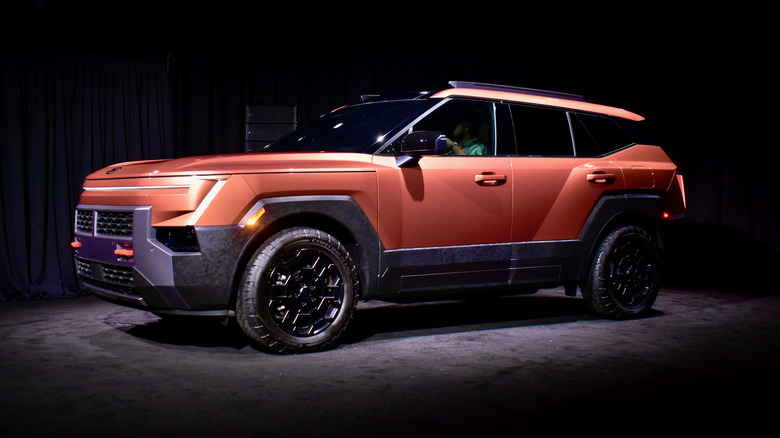
Every compact crossover needs an off-road variant these days to support car buyers' active lifestyles (or fantasies thereof), and again, Hyundai did more than the bare minimum.
The new Tucson XRT Pro replaces the previous generation's XRT model, adding a hybrid powertrain and more distinct styling. The front and rear bumpers are specific to this model, and the lower bodywork is covered in plastic cladding that should help protect the more precious painted metal bodywork from scratches and dents. And instead of just making it look like someone forgot to paint half of the car, Hyundai gave the cladding a neat texture that looks like forged carbon fiber.
This more rugged look is a nice contrast to competitors like the Honda CR-V TrailSport, Kia Sportage X-Pro, and Mazda CX-50 Meridian Edition, which just add some all-terrain tires and call it a day. The Tucson XRT Pro has those too, of course, plus 1.1 inches of additional ground clearance. That gives it 8.3 inches in total, which actually isn't all that impressive. It's about the same as the Honda and Kia, and 0.3 inch less than the Mazda. But most people will probably buy this rig for its looks, and that's where the XRT Pro delivers.
The interior is nice too, but in a completely different way
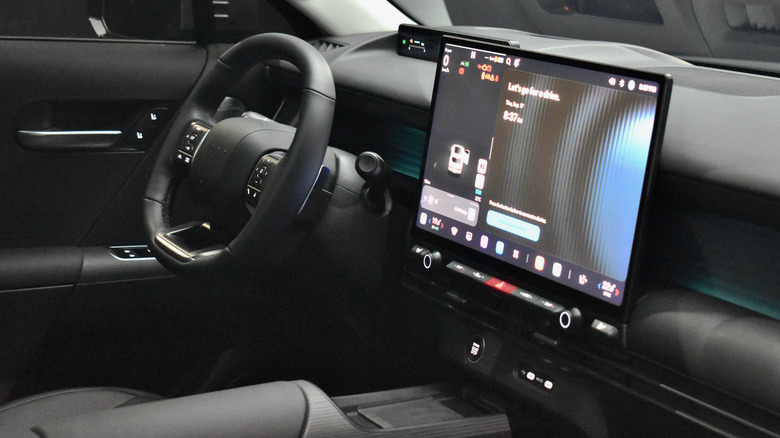
Designers apparently used all of the sharp edges on the exterior. The Tucson's interior is all curves, taking its design cues from other recent Hyundai models. Like the exterior, it feels genuinely fresh and new, but the contrast is a bit jarring. It's like the outside and inside were drawn by artists working on two different sci-fi movies.
It's hard to argue with the interior's functionality, though. The minimalist dashboard and center console create a spacious feel, while accommodating dual wireless device chargers in a space-efficient staggered arrangement. A modest increase in size (2.4 inches in length, 1.5 inches in width, and 0.7 inch in height) also translates into modest increases in cabin space. Rear-seat legroom increases by half an inch, and there's a bit more room for cargo as well. A low tailgate lip and door sills make that space easy to access as well.
Given the size creep of supposedly "compact" vehicles like the Tucson, I was hoping that Hyundai gave it a dose of GLP-1. But that runs counter to a collective narrative that people choose vehicles like this because they're actually making use of that rear-seat and cargo space. Hyundai execs said room in the back was expanded because that would be the most meaningful change for customers, but given how many people buy small SUVs because they're bored with sedans, that space will likely go to waste in many cases.
New interface doesn't move things far enough along
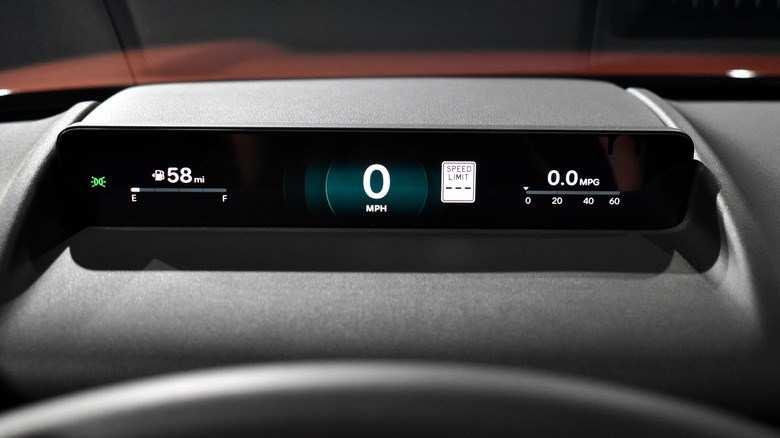
The Tucson also debuts Hyundai's new infotainment system, dubbed Pleos Connect, and accompanying screens. With this new system, Hyundai is attempting to change course away from screen-centric interfaces. However, we're only talking a few degrees, not a full 180.
You still get a 12.9-inch central touchscreen mounted to the dashboard like a flatscreen TV on a wall, but it's accompanied by a row of physical controls for climate and audio and a more reasonably-sized 9.9-inch digital instrument cluster. The thin cluster and awkwardly-integrated touchscreen combination reminds me of what Ford did with the Mustang Mach-E, but Hyundai's inclusion of some physical controls should make this setup easier to use.
Hyundai also placed the instrument cluster very high on the dashboard, about where a head-up display would normally project, to keep it within the driver's line of sight. It seemed okay sitting in a stationary car in a Jersey City studio, but driving is the only way to confirm how well it works (or doesn't).
The same goes for the new AI-enabled voice assistant (named Gleo), and the split-screen main menu layout for the touchscreen. Hyundai reps said the goal was to keep vital information closer to the driver, but it seems to mostly repeat things already shown in the cluster, and assumes that you'll usually have a passenger to reach things on the opposite side of the screen.
Powertrains play it safe
Hyundai made some bold moves with the new Tucson, but none of them are under the hood. The two powertrains available at launch are aggressively average.
The standard powertrain is upgraded from a naturally-aspirated 2.5-liter inline-four to the 1.6-liter turbocharged four-cylinder engine used elsewhere in the Hyundai lineup. The turbo-four makes a reasonable 187 horsepower and 195 pound-feet of torque and is connected to an eight-speed automatic transmission. That should make for a driving experience that is pleasant but unremarkable. A lot like the current Tucson, in other words.
A hybrid powertrain also returns, teaming the 1.6-liter engine with an electric motor sandwiched between the engine and a six-speed automatic transmission, and powered by a 1.5-kilowatt-hour battery pack. This is all the same as the previous-generation Tucson Hybrid, as is the expected output of 231 hp. But Hyundai expects at least some models to get 42 mpg, which is a bit better than the old model and in line with the Toyota RAV4.
The plug-in hybrid is no more because, according to Hyundai Motor North America head of product planning Olabisi Boyle, it didn't sell well enough. If Hyundai were to add another powertrain, it would be the extended-range electric one that's coming first to the Santa Fe in some markets, Boyle said. This would likely mean a bigger battery and smaller combustion engine than a conventional plug-in hybrid for more electric range, but the technical challenges of these powertrains are significant.
It's a great new cover of a familiar song
The Tucson launches in its home market of South Korea later this year and arrives in the U.S. next year. Based on these first impressions, it should be a strong contender. Hyundai did everything it needed to make a good compact crossover for this moment, and went the extra mile on styling and interior functionality. As the kids say, it understood the assignment.
Like an overachieving student, though, Hyundai only thought within the parameters of that assignment. The Tucson is well executed, but doesn't challenge segment norms. Like so many rivals, it focuses on pretend-ruggedness while neglecting sportiness, enabling the escapist fantasies of the suburbanites that make up a big part of its customer base. And while Hyundai is hinting at a less screen-centric future, it's not there yet. I'd love to see Hyundai be as bold with its basic vehicle concepts as it is with styling.