

5 4-Cylinder Cars Most Likely To Last 300,000 Miles
Four-cylinder cars are among the most ubiquitous on the road today. If you name any car off the top of your head, chances are it has at least one four-cylinder engine in its lineup, and that's quite deliberate. The configuration is compact enough to be mounted either front-to-back (longitudinally) or sideways (transverse), it makes good power when turbocharged, it's generally simple because it has relatively few cylinders, and that, combined with its size, makes it easy to work on. Consequently, this is basically the default engine choice for most cars, ranging from family crossovers to sports cars.
Therein lies the problem, though. Sure, it's an enduring and perennial design, but there are some four-cylinders that are undoubtedly more reliable than others. Moreover, these engines are inside of cars with durable platforms that can utilize all that reliability. Like a Lima inline-four out of a Pinto might be one of the most reliable four-cylinder engines, sure, but that doesn't help when the Pinto itself rusts like the Titanic, so barely any of them actually lasted that long.
Therefore, what we'll look at here is more of a complete package deal. Yes, the car needs a bulletproof four-cylinder, that much is obvious. The real question is whether or not the rest of the car can keep up. A good methodology is based on simple observation — if you see a lot of these still floating around in the wild, you'll likely find them on this list because they've proven themselves through the test of time. Otherwise, we'll take a look at statistics, anecdotes, and the overall build quality, focusing on one manufacturer at a time. Let's dive in.
Toyota Hilux (Fourth and fifth generations)
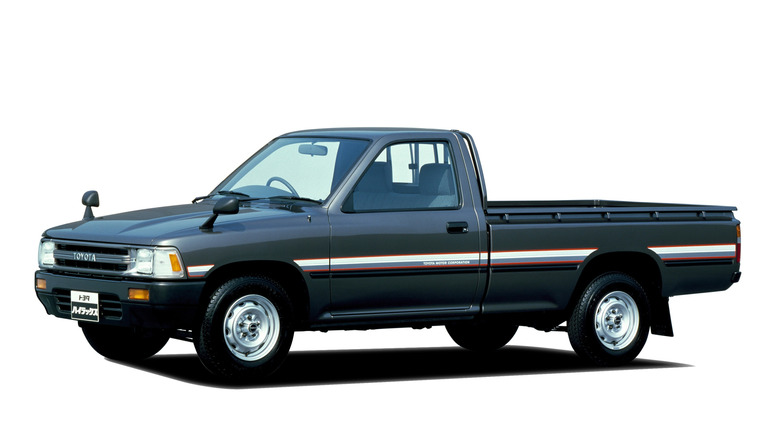
In truth, we could probably fill this entire list with just different Hiluxes — and there were a lot of them — much less Toyotas in general, so we'll keep it relatively brief and focus on just this one era because of its engine. The 22R, specifically, considered to be one of the strongest engines ever built, period. The reasoning behind that is something we'll commonly see throughout this piece as well — it's overbuilt and understressed.
What does that mean in engineering terms? Imagine an engine that has the capability to produce, say, 200 hp, but you limit it to 100 hp. So all of the components are overbuilt for the amount of power they actually make, which means you're understressing them and they last longer. Ultimately, all engines are just lumps of metal with a lot of moving parts in them. The bigger and thicker those parts can be for the amount of power they generate, the more durable the engine will be.
But the Hilux goes further than even that. Its durability is so legendary that it became the centerpiece of Top Gear's studio for many years after the crew deliberately attempted to total it by plummeting it off the side of a building, and it still ran. People have created entire series dedicated to trying to destroy them. Moreover, they remain pretty much universal in just about any major conflict since the 1980s, with Hilux and 70-series Land Cruiser chassis being the unofficial technical platform of choice. They even had a war named after them, the Toyota War. No vehicle earns such a reputation without being legitimately that durable and long-lived, and it's certainly capable of well-surpassing 300,000 miles of regular, non-abusive driving.
Honda Civic (EG)
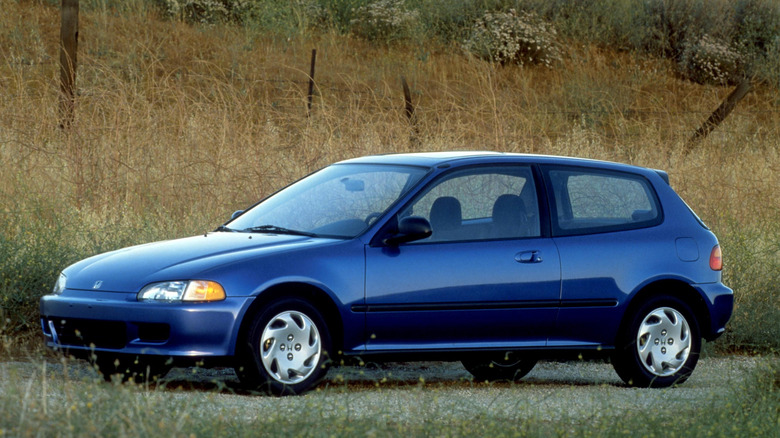
The fifth-generation Civic, also known as the EG, introduced for the 1992 model year, is another one of those cars that's functionally a cockroach. They're everywhere on the road despite being over 30 years old at this point. Granted, they're in various states of deterioration, but they're still around, and still common enough to be found on Facebook Marketplace or any other site without issue, almost invariably with hundreds of thousands of miles. These are known to be some of the most reliable compacts on the planet, comparable with the Toyota Corolla of the same era.
But what makes them so reliable? Again, it goes back to the Hilux thing with the overbuilt and understressed engine. Even more than that, this was the golden age of cars for this type. You had modern metallurgical and build quality standards, coupled with dead-simple electronics. It's tough to be unreliable when the base-model DX didn't come with keyless entry, cruise control, a tachometer, or power mirrors. Even air conditioning and a center armrest were optional. This was the last era of cable-operated throttles, few sensors and electronics, and solid linkages between everything important.
Of course, that doesn't stop people from running these things into the ground. It's an early Internet trope that you hear the rattle of a screaming straight-piped 90s Civic at 3AM; not everyone treated these cars well. Unmodified examples rarely have major mechanical issues, though; D-series engines are known to be reliable as long as the maintenance schedule is adhered to, and the tuner favorite VTEC-equipped B16 and other B-series engines need no introduction to Honda and tuning fans. Coupled with its simplicity and ease of maintenance, and a well-kept Civic will easily go the distance.
Jeep Cherokee (XJ)
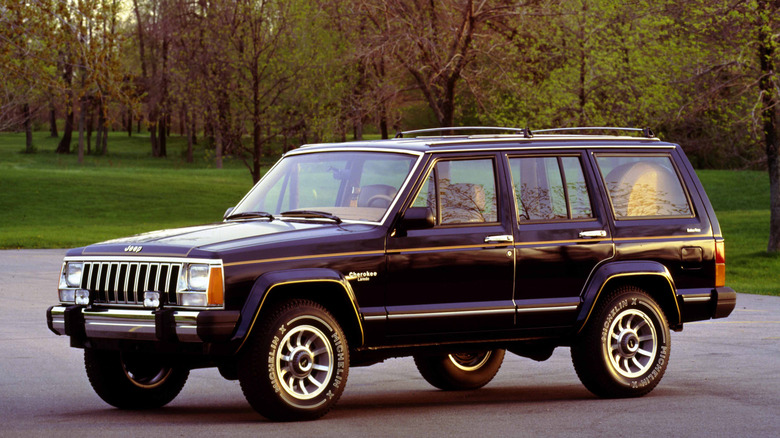
The classic Jeep Cherokee is famed for its reputation as a car able to go deep into six-figure odometer numbers, in-part because of its venerable 4.0L straight six. That engine's reputation is legendary among off-road enthusiasts, easily exceeding 100,000 miles without breaking a sweat in the Cherokee and all related Jeep models. But that's a six-cylinder, not a four-cylinder, right? Well actually, the 2.5-liter inline four found in the Cherokee predates the inline six by a few years, and both share multiple components. Extend the stroke length and tack on two extra cylinders, and you have the 4.0-liter we all know and love.
The origins of this particular engine date back to the Muscle Era, using basic technology such as pushrods and carburetors in early 4.2-liter configurations before switching over to fuel injection. They're essentially truck engines adapted for use in SUVs, designed with truck-like durability in-mind. So then all you have left is the rest of the Cherokee, which easily keeps up with the 2.5-liter four-cylinder.
To begin with, unlike Wranglers, Jeep Cherokees are unibody designs, meaning the body is effectively the frame. This keeps weight down and improves handling, which coupled with the fact that Cherokees and Wranglers share most undercarriage components, means they're still relatively understressed. As long as the body remains solid, the off-road oriented axles and suspension can easily cope with multiple hundreds of thousands of miles of regular road use, much like the early Hilux. Plus, with a plethora of new legacy parts available from places like Quadratec, one can easily maintain a classic Cherokee in OEM condition with relative ease because of its commonality.
Mazda MX-5 (ND)
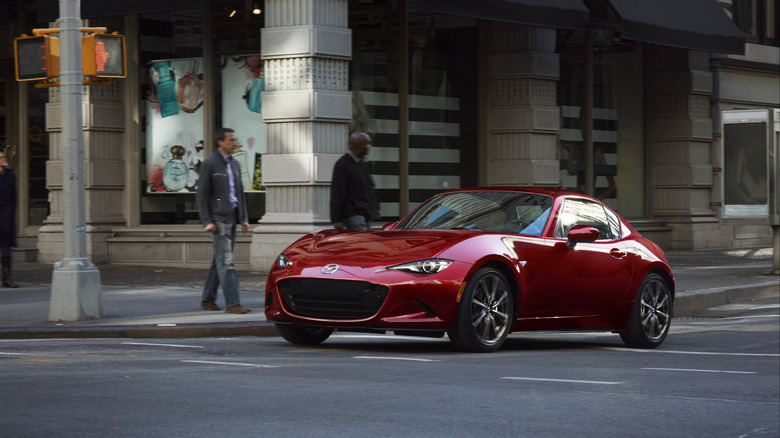
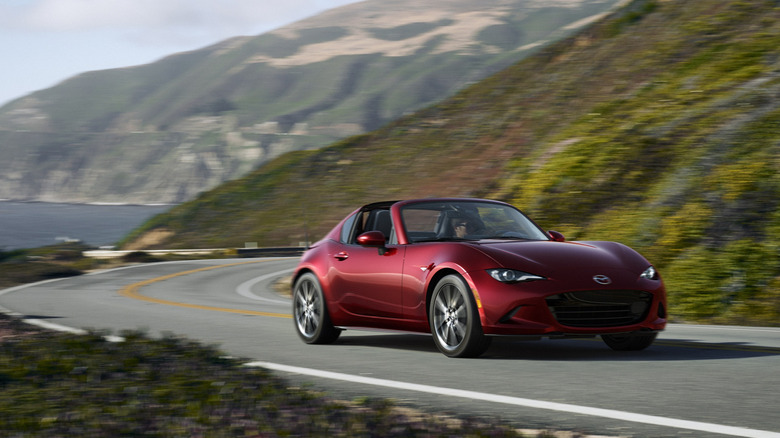
The Mazda MX-5, known as the Miata stateside, used to be categorized as either a hairdresser's car or something you see racing around the highway. Nowadays, however, with a relative lack of simple four-cylinder sports cars on the market, enthusiasts are truly appreciating just how special this little roadster actually is. The MX-5 is the quintessential formula for a fun sports car — entry-level price, rear-wheel drive, six-speed manual, rev-happy four-cylinder, and a lightweight, compact package. That's what most people focus on when buying one. But another lesser-appreciated fact is that these things are absolute tanks.
Take the 2019 model year, for instance, which scored very, very high on Consumer Reports' reliability ranking, with almost no complaints from owners or professional periodicals alike to go along with that. And sure, one might argue that the relative lack of reliability critique is because people buy an MX-5 for its fun-factor, not its reliability, but a car is much less fun when it's on the back of a tow truck.
Ultimately, the secret of these cars likely lies in its performance-oriented yet relatively underpowered design. The MX-5 is designed from the ground up to be a slow car that goes fast, to be driven at a higher level than a family crossover, for instance. It's a lightweight, simple, and nimble vehicle. Combined with the 2.0 Skyactiv-G, an engine known for its reliability, you get a remarkably robust little car. This same principle applies to virtually any MX-5, but the modern ND is particularly reliable because it builds upon the lessons learned from prior generations, combining them with modern manufacturing standards.
Ford Ranger (first generation)
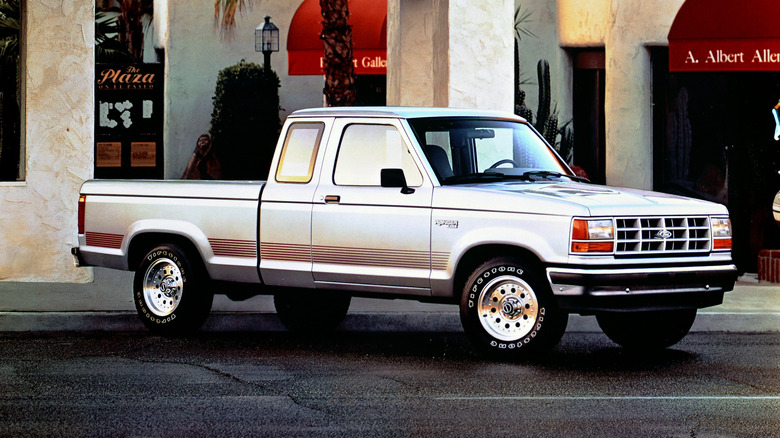
Ah, the good old days when an American pickup truck was considered a power tool and not a giant family hauler with a bed shorter than six feet. If all you've ever experienced is a pickup truck made after 2020, then the first-gen Ranger might as well be a go-kart for all the features it lacks. Let's run down the list. No power windows, tilting steering wheel, floor mats, automatic transmission, engine options, or accents of any kind — even an AM radio was considered "optional" for the base-model trim. And that's in 1992, the final model year for this generation.
In short, these Rangers were the epitome of simplicity itself, and common sense dictates that the simpler and more robust something is, the more reliable it's likely to be because there's less that can go wrong. That base-model engine in particular epitomizes this concept — the perennial 2.3-liter Lima four-cylinder, better known as the Pinto engine. No, it's not the 2.3-liter Tempo engine, which is its own can of fuel-efficient worms. The OHC Lima, on the other hand, is much like the Ranger itself — basic as they come. It's an OHC, no-frills engine. No electrics to go wrong, can be fixed by anyone with simple hand tools, and it's seriously understressed.
All this combines into a perfect storm of reliability, so long as the rust can be controlled. These trucks were meant to be used, after all, and so many of them lived hard lives. But a clean survivor with little rust is likely to run functionally indefinitely, so long as it's not abused and you do the maintenance.