

6 Fighter Jets That Can Pull The Most Gs
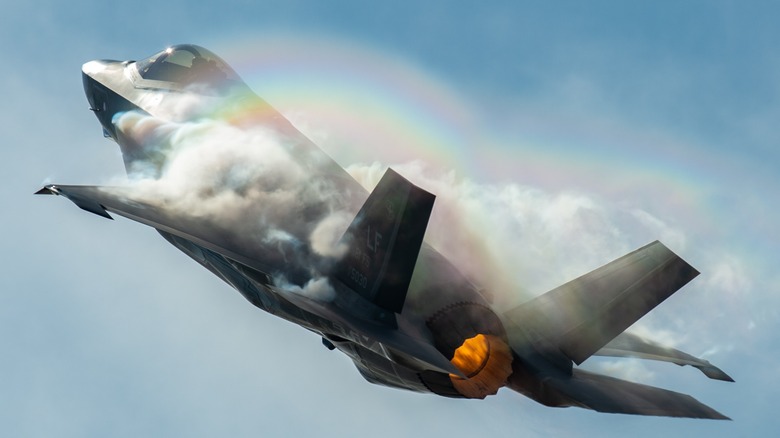
Modern fighter jets are among the most complex and impressive pieces of military machinery ever put into service. They're capable of reaching incredible speeds, and thanks to advancements like thrust vectoring, they're far more maneuverable than ever before. Flying one takes a great deal of training and skill to not only pull off high-speed maneuvers, but also to stay conscious due to the high G-forces a pilot experiences while flying a fighter jet.
G-force is the measure of gravity endured by a pilot during flight. 1G is what everyone experiences on Earth — it's the baseline gravity we're all accustomed to. Fighter jets changing direction quickly increase the number of Gs felt by the pilot, and the higher they get, the more dangerous it becomes. Modern G-suits are pressurized to limit this danger, so while most people could remain conscious at around 5Gs, something you might experience on a roller coaster, fighter pilots typically endure up to 9Gs.
When it comes to measuring the Gs a fighter jet can pull, the concern isn't the pilot's safety, but rather a measurement of the structural capability of the aircraft. Most can pull up to 9Gs, but some are rated higher, despite the risk to the pilot. In rare cases, fighter jets have pushed to around 12Gs in emergency situations, and some pilots have proven that they can endure this for short periods. These aircraft can pull more Gs than other modern fighter jets.
Lockheed Martin F-35A Lightning II
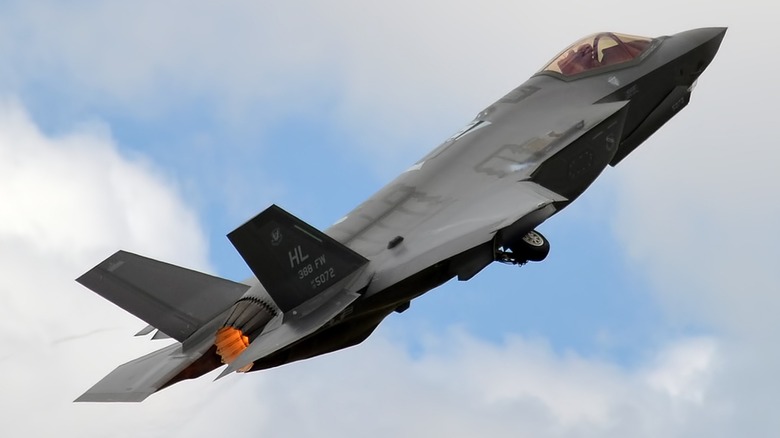
The United States military's second fifth-generation fighter began operating in 2015, and the F-35 Lightning II comes in three variants. The F-35A belongs to the U.S. Air Force (USAF), the F-35B is capable of vertical take-off and landing and is flown by the U.S. Marine Corps, and the F-35C is a carrier-based version used by the U.S. Navy. While the B and C variants are rated at 7G and 7.5G, respectively, the F-35A has a maximum G-limit of +9Gs, making it the strongest F-35 model.
The F-35A runs on an exceptionally powerful engine, the Pratt & Whitney F135-PW-100, which produces 40,000 pounds of thrust. This gives the F-35A the power it needs to reach speeds of Mach 1.6 (1,228 mph), and it's also highly maneuverable, thanks to its impressive flight control software. This helps control the aircraft during different types of flight operations, including high alpha maneuvers, which is when an aircraft like the F-35A uses an incredibly high angle of attack.
While pilots can fly up to 9Gs, which is the limit of the F-35A, there have been instances of pilots experiencing oxygen deprivation (hypoxia) during flights. In 2017, Luke Air Force Base, Arizona, grounded 55 F-35s for 11 days following pilot reports of hypoxia. Steps were taken to limit the problem while the USAF investigated the cause. Eventually, flight operations returned to normal after the USAF addressed the oxygen generation system and other elements, enabling a return to normal flight operations.
Lockheed Martin F-22 Raptor
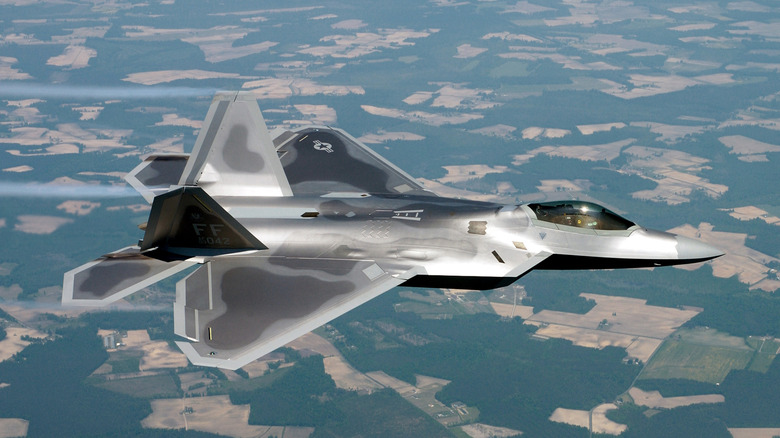
The F-22 Raptor is the world's first fifth-generation fighter jet, and it remains one of the most advanced aircraft operating today. It was so expensive to develop that fewer than 200 aircraft were initially produced. As of this writing, it's unlikely that any additional F-22s will be made and put into service. That makes flying it a rare opportunity for any USAF fighter pilot.
In terms of speed, the F-22 Raptor is fast. Its supercruise ability enables supersonic cruising speeds up to Mach 1.5 (1,151 mph) without the need for its afterburner, and because the F-22 features 2D thrust vectoring, it's exceptionally maneuverable. The F-22 is rated with a +9/-3 G-limit, where +9 refers to upward G-forces, and -3 is for its downward G-force limit. Those figures are the extremes of what a human can endure while operating a fighter jet, even with G-suits and extensive training in centrifuges. Interestingly, several pilots have nearly blacked out while flying the F-22, but not because of the intense G-forces sustained during operation.
In July 2012, the Pentagon reported at least 11 incidents of pilots becoming woozy and nearly blacking out. The subsequent investigation determined the G-forces weren't the cause, but rather the G-suits were. Due to a faulty valve, the suits would inflate their air-filled bladders prematurely. This made it difficult to breathe, resulting in hypoxia, but fortunately the problem was addressed.
Sukhoi Su-57
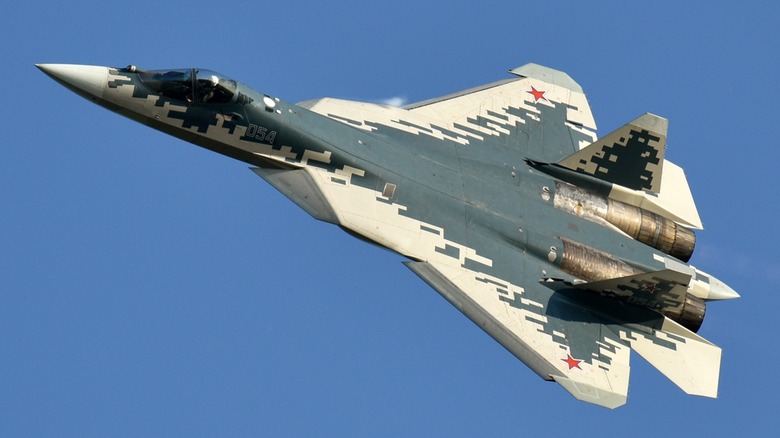
It's not just American aircraft that endure high Gs; the Russian Federation's Sukhoi Su-57 "Felon" is also rated up to 9Gs. Introduced in 2020 as the first Russian-designed fighter jet with stealth capabilities, this multirole fighter boasts plenty of impressive stats and equipment. It's not only stealth capable, it also features supercruise, supermaneuvrability, and more, aligning closely with the F-22 Raptor and F-35 Lightning II's flight capabilities.
Since its introduction, Russia has continuously produced Su-57s to meet its goal of 76 aircraft by 2027. Apparently, it's well on its way to reaching that goal, though the Su-57 has seen only limited combat, as Russia prefers to keep it safe from Ukrainian air defenses during the Russia-Ukraine war. While the Su-57 is undeniably fast, its high G-limit threshold comes into play via its supermaneuvrability, which is achieved via its 3D thrust-vectoring engine nozzles, digital fly-by-wire system, and its aerodynamic design. The Su-57's 3D thrust vectoring exceeds the F-22's capabilities, as it affects not just the pitch, but also the yaw and roll.
While there aren't any public records of pilots blacking out while flying the Su-57, there have been accidents. An Su-57 used for training crashed in July 2026, though Russia claimed this was due to a technical malfunction. Regardless, Russia, like the U.S. and other nations, employs high-tech G-suits to ensure their pilots maintain consciousness while flying advanced fighter jets. Russia began testing a new G-suit specifically designed for the Su-57 in 2019, showing an increased interest in pilot safety.
Dassault Rafale
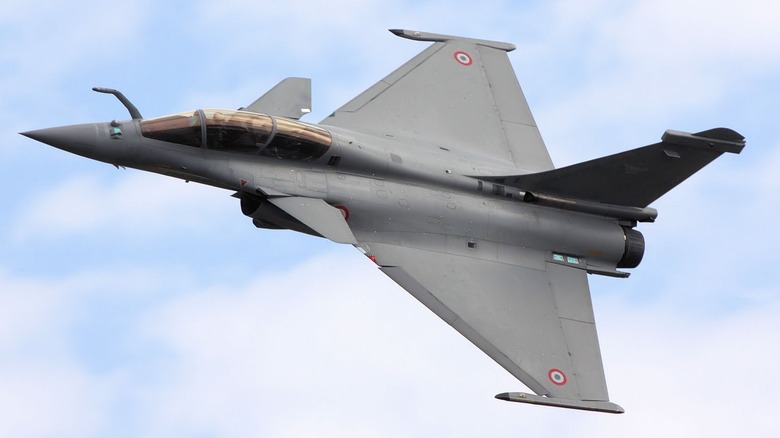
France developed the Dassault Rafale as its primary fourth-generation multirole fighter, which entered service in 2001. The Rafale is one of the most innovative fighters of its generation, thanks to its use of a digital fly-by-wire system. Along with the aircraft's canards, this gives the Rafale improved aerodynamics and maneuverability. It's powered by two Snecma M88 turbofan engines and is capable of reaching Mach 1.8 (1,381 mph), so the Rafale is undoubtedly fast.
In fact, a Rafale successfully "downed" an F-22 Raptor in an exercise in 2009, showing that it had what it takes to go up against a higher-generation fighter. The Rafale is rated up to +9Gs and -3.2Gs, making it one of the strongest European fighter jets in active service. However, in emergency situations, the Rafale has demonstrated a capability of +11Gs. While that wouldn't be survivable for long, pilots have remained conscious at and above 11Gs for short durations.
While the aircraft can handle that many Gs, normal operations are limited to the standard scale, and higher than 9Gs are only reached during emergencies. There aren't any known instances of pilots passing out while flying a Rafale, but there have been accidents. In December 2007, a Rafale crashed in southwestern France. The investigation found that the pilot became disoriented, though it wasn't made public whether that disorientation was the result of hypoxia. France uses its own domestic G-suits designed by Safran, which outfit all French pilots operating the Rafale and similar aircraft.
Saab JAS 39 Gripen
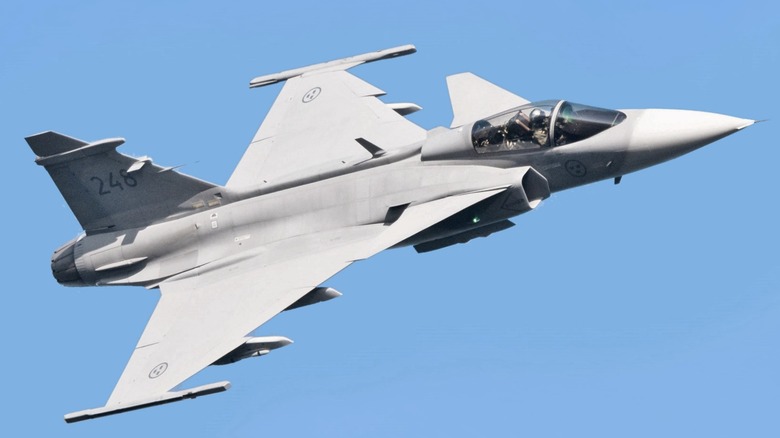
Another European fighter jet from the fourth generation featuring canards, Sweden's greatest fighter jet, the Saab JAS 39 Gripen entered service in 1997, preceding the Dassault Rafale by several years. Despite this, it's an incredibly advanced fourth-generation fighter jet that features improved fly-by-wire flight controls to aid in its maneuverability. The Gripen is also fast, thanks to its single General Electric F414, which is the engine installed on the most recent variants.
It's also the same engine used in the F/A-18 Super Hornet, so it's been in use for some time on several aircraft. The engine provides enough power to give the Gripen a top speed of Mach 2 (1,535 mph), and thanks to its overall design, the aircraft features excellent maneuverability. It is rated for +9Gs and -3Gs, but like the Dassault Rafale, it can exceed this during emergency situations. The maximum possible G-limit of the Gripen is 12Gs, which is incredibly high.
At time of writing, there are no reported incidents of Gripen pilots blacking out during flights, though there have been accidents. These are largely attributed to technical and mechanical failures, so despite the possibility of hitting 12Gs, it appears that pilots have safely flown the Gripen for decades. This is likely due to the use of an advanced Swedish G-suit worn by all pilots during operation. Granted, other nations operate the Gripen, but for Sweden, high Gs and well-made G-suits keep pilots safely flying the impressive fourth-generation fighter.
Boeing F-15EX Eagle II
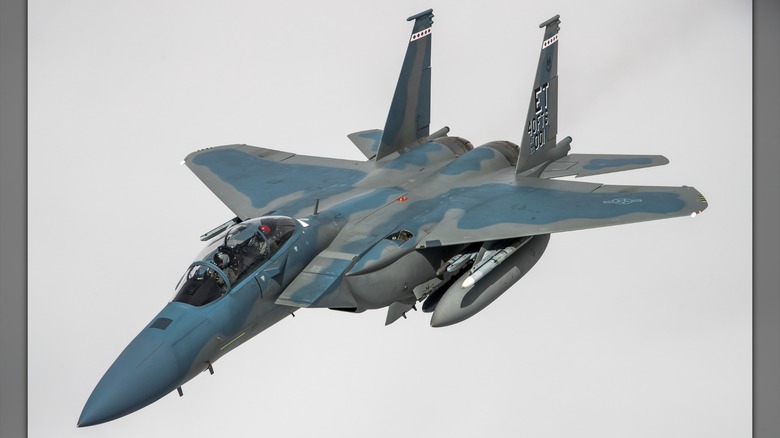
While the U.S. began flying the F-15 Eagle back in 1976, the variant currently flying is a vastly improved, modernized aircraft with 4.5th-generation capabilities. The F-15EX Eagle II is as close to being a fifth-generation jet as any legacy airframe could be. The USAF first revealed the jet in 2021, and it only entered the inventory in 2024, but the F-15EX has nonetheless proven itself an impressive fighter.
The USAF calls the F-15EX its missile truck due to its overwhelming number of loadouts. The aircraft is also fast, with a top speed of Mach 2.5 (1,918 mph), and it boasts two incredibly powerful Pratt & Whitney F100-PW-229 turbofan engines. These provide a combined thrust of 58,000 pounds, enabling the aircraft's incredible speed. While the F-15EX is rated for +9Gs, which is the standard limit for pilots, and not necessarily the aircraft, it can achieve up to 12Gs.
Like other 12G-capable fighter jets, the F-15EX only pushes that limit during emergency situations. Fortunately, no pilots have fully blacked out while flying an F-15EX; some have come close during high-G operations. The flight computer has the capability to limit the Gs regardless of how much the pilot pulls on the stick, ensuring they remain conscious when they might otherwise push themselves beyond their limit. The 4.5th-generation fighter jet is an impressive machine, and it is strengthened for high Gs, but controlled by advanced software, ensuring pilot safety under extreme circumstances.