

9 Vintage Car Parts That Are Worth More Than You Realize
We may receive a commission on purchases made from links.
Locating and purchasing vintage parts is the bane of some auto hobbyists' existence. They comb everything from online marketplaces to ancient junkyards to find the final piece for a restoration or that authentic period touch for a replica racer. Some parts make their name on racing pedigree, others on pure rarity, while still more are part of a thriving aftermarket built around dedicated enthusiasts. Whatever the case, car lovers have been opening their wallets to find the just-right part for their garage queens for as long as cars have existed.
We dug into automotive history to find some vintage car parts (and their re-creations) that are worth more than you might think. They range from specialty performance engines to classic body panels to custom glass windscreens. Woe to the car lover who finds one of these on their to-buy list. Some will be easy to find, but none will be cheap.
Fender – Horch 853 Classic

Some parts are so unusual and specialized that they demand premium prices whenever they surface for sale. Enter the Horch 853. Founded by August Horch, who was later ousted by a hostile board of directors and went on to create Audi, Horch built German automobiles from 1901 to 1940.
The Horch 853 was the halo car of a company with decades of experience under its belt. Produced and sold from 1935 to 1940, it is a sleek and sensuous throwback to another age. It's easy to imagine replacement parts costing a fortune, especially after you learn fewer than 1,000 were made. If you find yourself in the rare position of owning one of the relatively few surviving 853s and need one of those graceful fenders, you can expect to pay a premium. Plan to pony up upward of $25,000 to finally finish that lost 853 you've been waiting to unveil to the world.
Fuchs racing wheels – Porsche 911 RSR
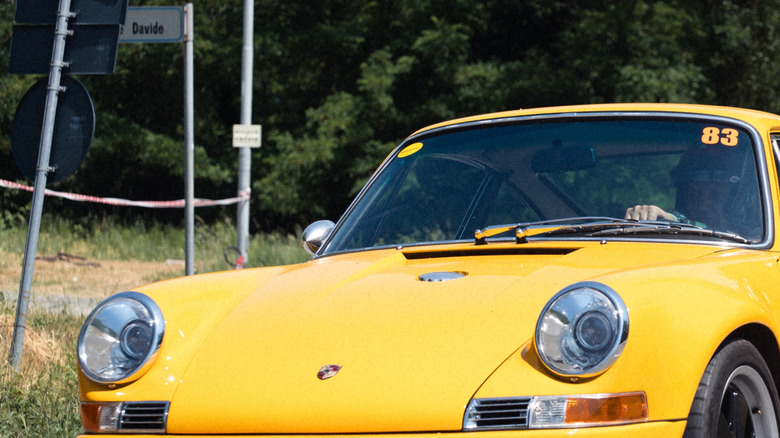
The 911 changed everything for Porsche upon its debut at the 1963 Frankfurt Motor Show. It was clearly a new Porsche; the crossover Volkswagen parts were gone. It was a promising step, but Porsche still had to prove it on the track. The Porsche RSR arrived in 1973 as Stuttgart's best foot forward. And those feet needed special shoes. To step up its performance, Porsche chose a set of Otto Fuchs-made aluminum forged wheels.
The same firm shod the debut 911S in 1966, but historical provenance aside, these wheels look like a million bucks. The RSR had a one-year career as a racer sold mostly to racing teams, and today it is a highly sought-after item in a niche market of deep-pocketed collectors like Jerry Seinfeld. If the RSR is worth around $2 million, what might the wheels fetch? Porsche fanatics can put the finishing touch on their RSR replica with these Fuchs racing wheels for about $1,700 per corner.
Nose cone and wing – Dodge Charger Daytona

There once was no replacement for displacement — and then auto manufacturers discovered aerodynamics. One of the earliest and most impactful adopters of aero design is the ultra-classic Dodge Charger Daytona and its running mate, the Plymouth Superbird.
The ungainly 1969 Dodge Charger Daytona wasn't going to win any beauty contests, but it would win races. The 18-inch steel nose cone sliced through the air, and the 23-inch rear wing provided downforce over the drive wheels. Rudimentary by modern standards, and sinfully ugly, the Daytona upended NASCAR's 1970 season. Driver Buddy Baker broke the 200 mph barrier for the first time on a NASCAR track at Talladega. Chrysler dominated the season, so much so that NASCAR cracked down on the winged cars the following year. The upshot is that those Chargers and Superbirds were built like that for a single model year and have consequently become exceedingly valuable today — to the tune of roughly $200,000 to $3 million.
Part prices for these cars — especially iconic one-year-only aero elements — are through the roof. Say you wanted to turn your Charger into a high-flying winged replica. You can go through aftermarket manufacturers like AAR Quality Fiberglass, which can provide you with a rear wing for $1,100. RPM Productions will build you a nose cone for about $4,700. If nothing less than original will do for your banned baby, expect to pay significantly more, like for this nose cone demanding $8,500 or this rear wing asking nearly $10,000.
Knock-off wheels – Jaguar E-Type
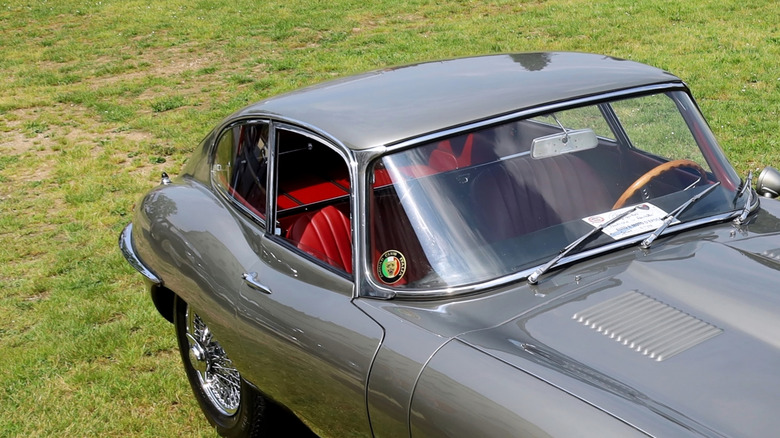
The Jaguar E-Type is commonly heralded as the most beautiful car in automotive history, and everything about it is precious. Perhaps its most charming feature is its distinctive wheels. Wire wheels save weight by creating a spindlework of spokes rather than heavy metal. In the case of the E-Type and many others, the design also used a single knock-off nut that pit crews could change in a hurry. Since the E-Type is recognized as a garage queen classic today, it's hard to believe people raced the heck out of these cars.
Wire wheels weren't all convenience, though. They required extensive maintenance to remain safe, and knock-off nuts were under enormous pressure as single points of failure holding the wheels on. Fortunately, these wheels proved so popular that there is a thriving aftermarket ready to meet the needs of any British racing enthusiast. Wire wheels are priced from $400 to $700 per shoe. For those who want original equipment, eBay has original Jaguar wire wheels priced from about $90 for a single used wheel up to around $1,700 for a set of four.
Rear window – Plymouth Barracuda
Plenty of Ford fans will tell you it kicked off the pony car craze with its 1964 ½ release of the Mustang. But what if we told you there was another contender? The 1964 Plymouth Barracuda was announced on April 1, 1964, a full 16 days before the Mustang's debut at the New York World's Fair, cementing its place in automotive history.
The 'Cuda didn't quite make the same impact as the Mustang. With a design somewhat reminiscent of the Ford, its long hood terminated at a front fascia fit for a previous era, while its curious bubble rear window sloped down to a fastback-ish rear end. And that window costs a surprising amount today.
The 14.4-square-foot wraparound rear window was the biggest piece of auto glass on the market at the time. At one point, a Mopar restorer lamented the inflated cost of obtaining this piece for a restoration, with prices climbing as high as $1,000. The market seems to have calmed down, though, as eBay currently has offerings in the $300 range — without the seals.
Assorted parts – Ferrari 250 GTO and others
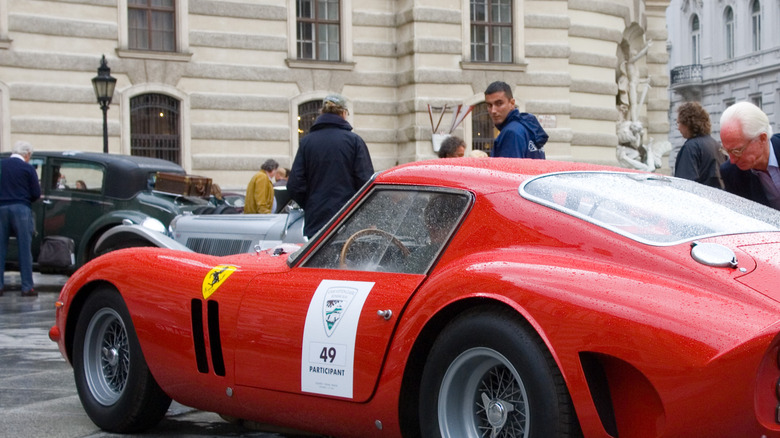
It should be no surprise that one of the most expensive vintage parts finds out there involves the Ferrari 250 GTO. It is one of the most valuable cars in the world, after all. Aside from the Prancing Horse on the fender, many, including us, consider it among the coolest Ferrari designs of all time. Pedigree and rarity make the 250 GTO a premium collector's item. Ferrari built fewer than 40 homologated 250 GTOs (by hand, mind you) between 1962 and 1964. Which brings us to sourcing parts.
The Gioachino Colombo-designed 3.0-liter V12 drove the GTO to racing glory with 300 horsepower. With an exotic powerplant like that, few owners settle for an LS engine swap. And finding any other parts is nigh on impossible. Ferrari built 36 — plus three 4.0-liter prototypes — and all have survived. It's not precisely the kind of car you find in the wrecking yard.
That's why a box of miscellaneous parts discovered in a shipping container in 2018 drew enormous interest. The container included pristine parts for the Ferrari 250 SWB, 275, Competition Daytona, F40, 512 LM, and 250 GTO, many of them still in original packaging. The parts included exhaust pipes, radiator grilles, wheels, and more, valued at $1.3 million.
Engine – BMW F90 M5

The engine is the most complex part of any car, and when it blows, woe to the owner. Especially if it is a 2017 to 2023 BMW M5. The 616-horsepower super sedan used a twin-turbo 4.4-liter V8 that made 553 lb-ft of torque. This monster drove the Autobahn annihilator to a top (limited) speed of 190 mph.
An engine like that is not going to be fun to replace, unless you happen to own a dealership. Notoriously difficult to work on, it's not as forgiving to home wrenching as, say, an LS2 or LS3 V8. Much of that is due to the twin turbos and all the extra heat and hardware that come with them. Should your F90 M5 engine blow up just past the Munich exit, you have two options. If you're an experienced BMW mechanic, eBay could net you a replacement for $15,000 to $20,000. Then there is always the dealership. One shell-shocked owner posted an invoice for a $56,000 F90 engine replacement.
Supercharger – Scion FR-S

Toyota's ill-fated Scion offshoot seldom raises any red flags when it comes to expensive parts. It targeted a younger market with an affordable lineup of sedans, hatchbacks, and even a well-regarded sports car in the FR-S.
The FR-S shared a blueprint with the Subaru BRZ. Hagerty hailed them as a millennial Z-car for the new age. Lithe and light, it was fun, with a plucky 2.0-liter engine good for 200 horsepower. Naturally, pushing that number up was a goal for plenty of owners, but most of them won't have a chance to get their hands on the racing-only supercharger TRD developed for it.
The racing supercharger could be had — without the management software that anyone wanting to mate it to a factory engine would need — for an asking price of $26,000. And there was a minimum order of two.