

iPhone Duo Review: Is Apple's Foldable iPhone Worth Buying Now?
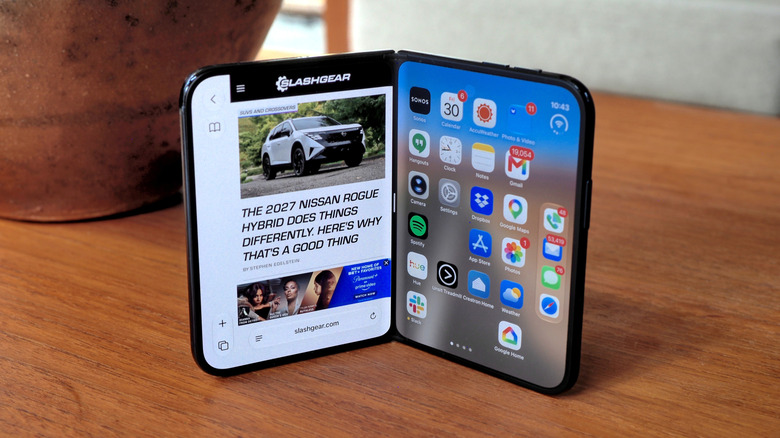
People laughed back in 2019, when I opened up one of the first foldable phones to take a photo. Some of them are still laughing, but at least I can point to the iPhone Duo as evidence that what seemed like a gimmick seven years ago has actually had staying power. After all, Apple may not always be first to a category, but when it finally wades in there's a sizable splash
Since that original Samsung Galaxy Fold, we've seen numerous flexible smartphones — with a variety of screen sizes and form-factors — hit the market. Some of them are borderline affordable, now. Only for a lot of people, the biggest hurdle hasn't been hardware or even price, but operating system. iPhone owners just don't like giving up iOS.
 Chris Davies/SlashGear
That factor alone means the iPhone Duo's main competition probably isn't the Samsung Galaxy Z Fold 8 or the Google Pixel 11 Pro Fold, but Apple's own iPhone 18 Pro Max. Buyers of such a phone are familiar with premium price tags, but the $1,999 starting price of an iPhone Duo 256GB is still enough to make you wince. Especially when you realize Apple's first foldable isn't just its flagship iPhone that you can fold in half.
Small phone gets big
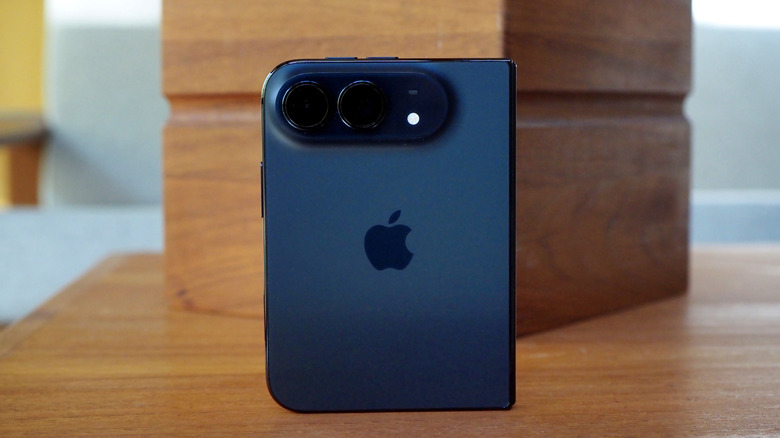
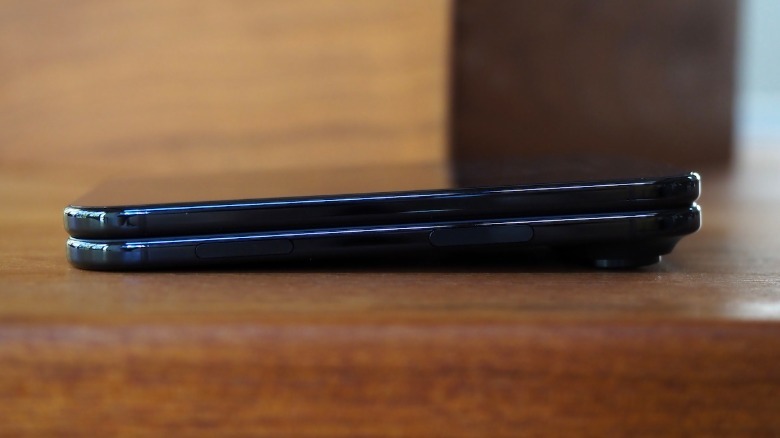
Instead of the big-phone-gets-bigger approach taken with a lot of foldables, the iPhone Duo assumes you'd prefer something smaller. Closed, it's about the size of a wallet. I usually carry my phone in my front pants pocket, and even at 11.3 mm thick the iPhone Duo didn't feel unwieldy there. Apple's cases do add to that bulk, of course, and I can well understand a wariness of going without some sort of extra protection.
 Chris Davies/SlashGear
There's toughened Ceramic Shield glass along with IP68 dust and water resistance, but with all these moving parts, a flexible screen, and a sizable price tag I definitely felt more conscious of how I was holding (and folding) the iPhone Duo than a regular, candy bar iPhone.
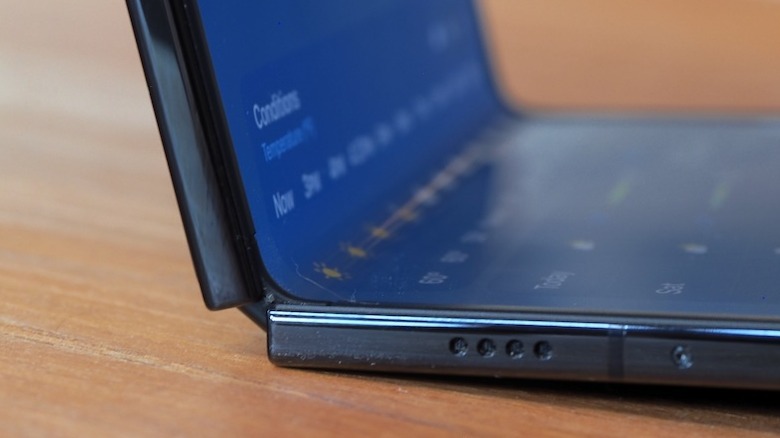
That said, Apple's hinge is firm and feels impressively sturdy. There's a whole bunch of clever gubbins inside to make it not only smoothly open and close, but hold at pretty much any angle, and magnets for that satisfying final 'click' shut. Opening it is definitely a two-handed affair, but after that I found it was no more arduous to hold single-handed than the iPhone 18 Pro Max. Officially the foldable is Apple's heaviest iPhone, but at 254g the delta there is only five grams.
 Chris Davies/SlashGear
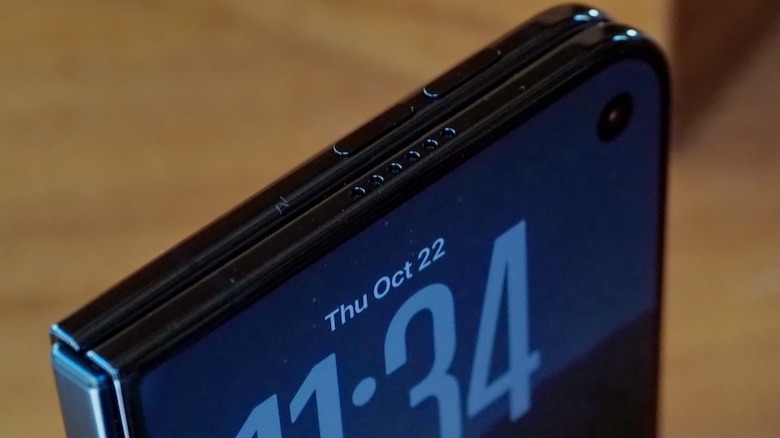
Closed, the volume buttons are on the top edge — odd placement when you're making a call — and the power and camera keys are on the right side. There's no Face ID, the iPhone Duo getting Touch ID built into the power button as on some iPad models, and I was surprised how much I missed facial recognition. I'd recommend teaching iOS as many fingerprints as you have patience for, since you'll find yourself tapping Touch ID frequently and from a variety of directions depending on how you're holding the phone and whether its unfolded or not. It's fast to respond, at least.
Apple nails the internal display
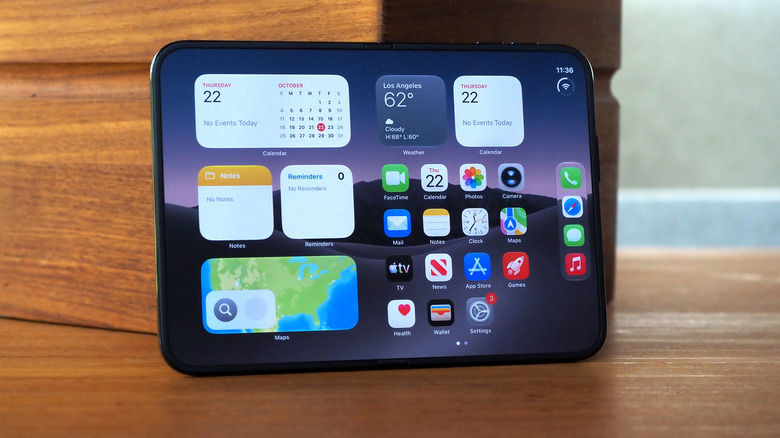
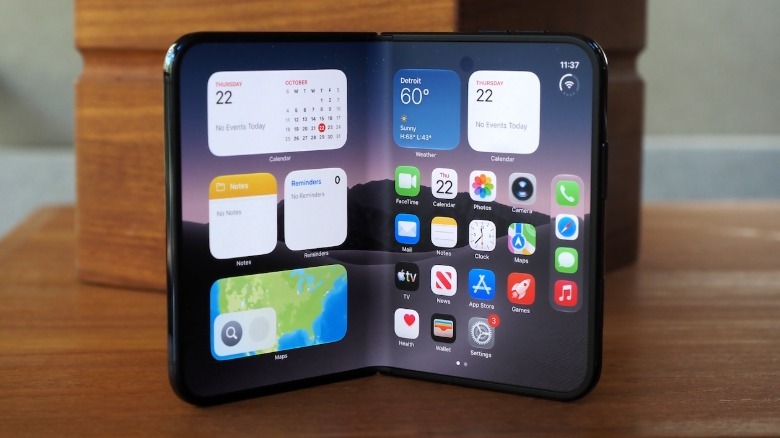
It's well worth opening the iPhone Duo up. Beyond the lingering technical marvelry of flexible OLED, Apple's 7.6-inch inner screen is a thing of visual beauty. The matte texture (sorry, nano-texture polymer) helps hide the crease line but also cuts glare and reflections; reading outside was problem-free, despite being in direct sunlight. It also leaves the screen feeling more akin to paper if you have an Apple Pencil (though only the USB-C flavor); support for annotations and the like was added post-launch in iOS 27.2. You do notice the Pencil's nib as it goes across the crease, though.
Hold it in landscape orientation, and the iOS home screen organizes itself akin to two regular iPhone displays side by side; the layout is even more obvious if you part-fold the iPhone Duo, at which point the two halves of the display bias to each side (avoiding the hinge). In portrait orientation, it's more like a regular iPhone home screen centered: spacious, but with a lot of unused real-estate down either side.
 Chris Davies/SlashGear
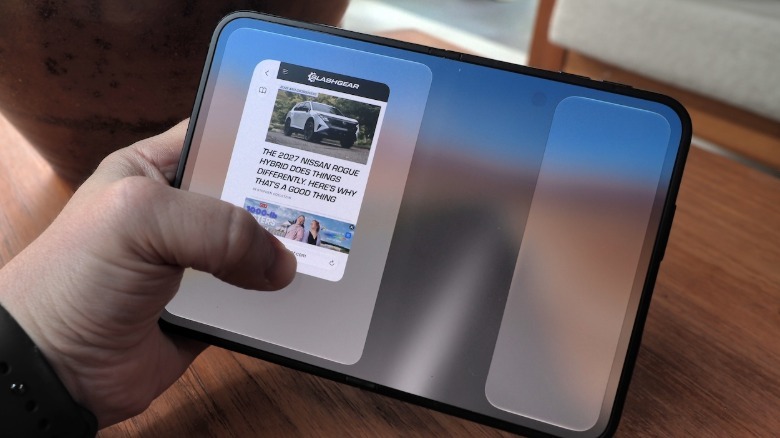
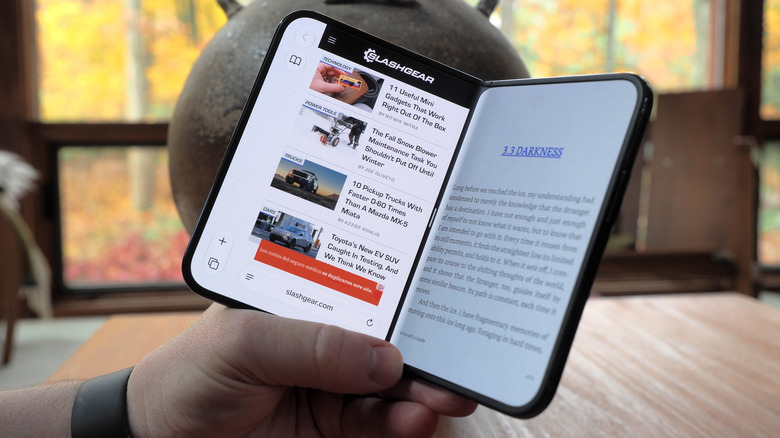
Open an app on the outer screen, then unfold the phone, and it'll maximize to fill the inner display. You can have two apps running simultaneously on the larger screen, by swiping up to trigger the app switcher, then dragging the app to the left or right; if you then close iPhone Duo, whichever of the two you most recently interacted with is carried over to the external display.
 Chris Davies/SlashGear
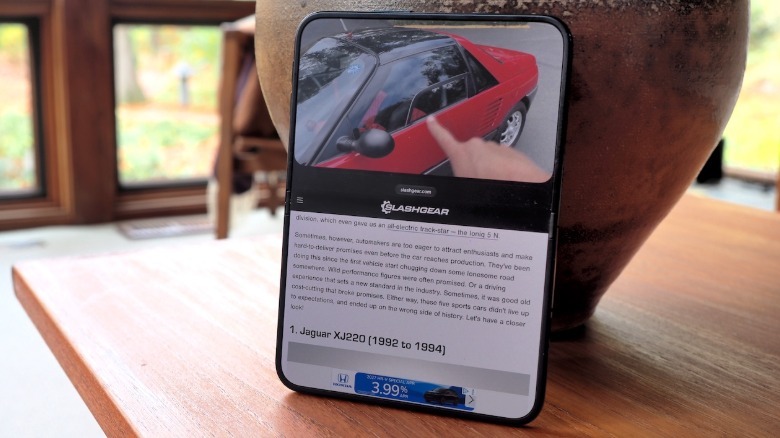
Dual-app support is only offered when you're using the iPhone Duo in landscape orientation, though in video-centric apps — like Netflix or FaceTime — with Picture in Picture support you can dock the video at the top half of the screen, and have a different app open underneath. Unlike on Samsung's Galaxy foldables, Apple doesn't support pinning a pair of apps together to open them both, split-screen, with a single tap.
The iPhone Duo's external display is surprisingly usable
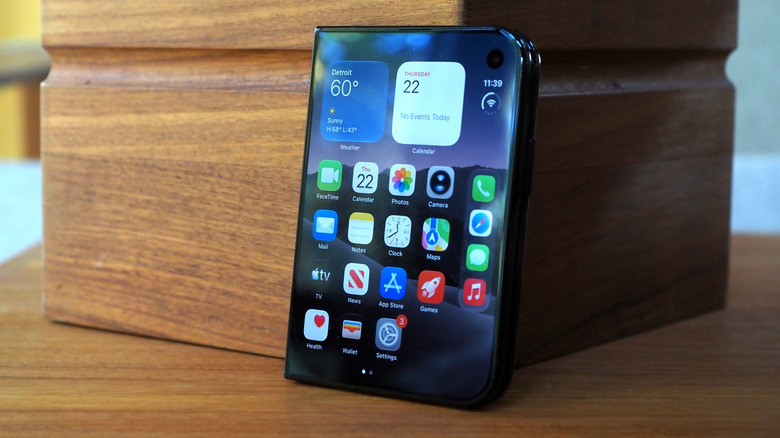
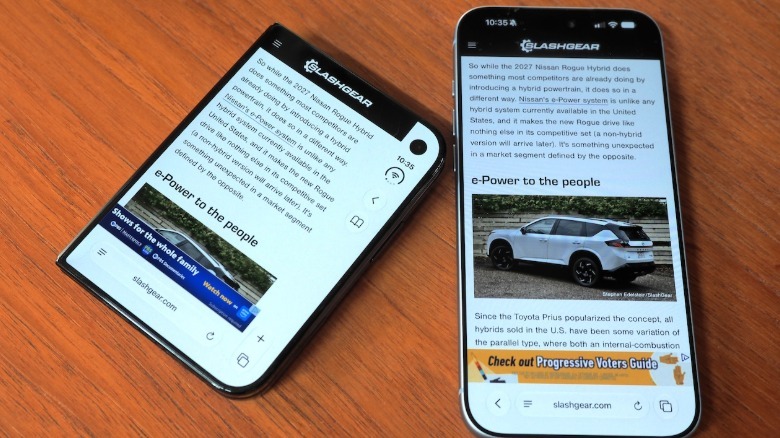
For years, now, my go-to has been the iPhone with the largest screen available. My assumption was that the iPhone Duo's 5.4-inch exterior touchscreen would feel laughably small in comparison; instead, I've been surprised at just how much I've chosen to interact with it, rather than unfold the foldable. The short, wide aspect ratio has proved to be far more usable than the taller, narrower — but also 5.4-inch — panel of the old iPhone 13 mini.
If it works, I suspect that's because I also know there's the option of a much larger display should the exterior screen grow too constraining. And I also expect that my inclination to open the iPhone Duo up will increase in tandem with apps adding Duo-specific features for the internal display.
 Chris Davies/SlashGear
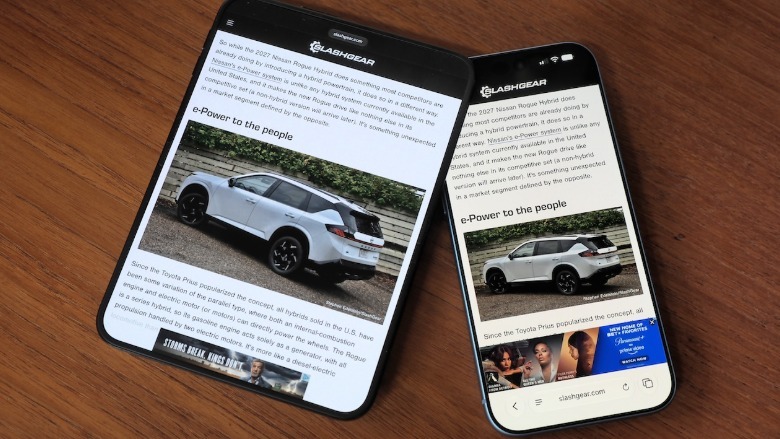
As anyone around for the original iPad launch will recognize, that transition is a work-in-progress. Apple's own software leads the charge, apps like Mail and Messages using the bigger internal screen to show both a message list and a preview, for instance. A pre-release version of Slack I tested offered a desktop-like layout; popular photo and video editor Darkroom similarly takes good advantage of the extra real-estate.
The hardware's there, but apps are playing catch-up
A lot of apps, however, float in a sea of black, unused display. You can magnify them, when holding the iPhone Duo in portrait mode, to better fill the screen, but that's just bigger rather than more functional. I've found myself checking the App Store for updates throughout the day, in the hope of a more Duo-ready version of things like Bluesky, Gmail, and Google Voice.
This will undoubtedly improve in due course. It's the peril of the early-adopter, forced to wait while developers get around to taking advantage of the latest hardware and software features.
 Chris Davies/SlashGear
Even in these early days, though, the allure of a bigger screen is strong. Browsing, reading, and watching videos are simply more pleasant; dealing with work stuff like email and Slack is quicker. I could well see myself picking up a compact Bluetooth keyboard and leaving my laptop behind on short trips. The iPhone Duo's screen is smaller than the 8.5-inch iPad mini but, much as I love Apple's tiny tablet, I've always chafed at carrying both it and an iPhone. Since the iPad won't fit in my pocket, it has to go into a bag, and at that point I'd probably just grab my laptop instead.
Good cameras, but not Apple's greatest
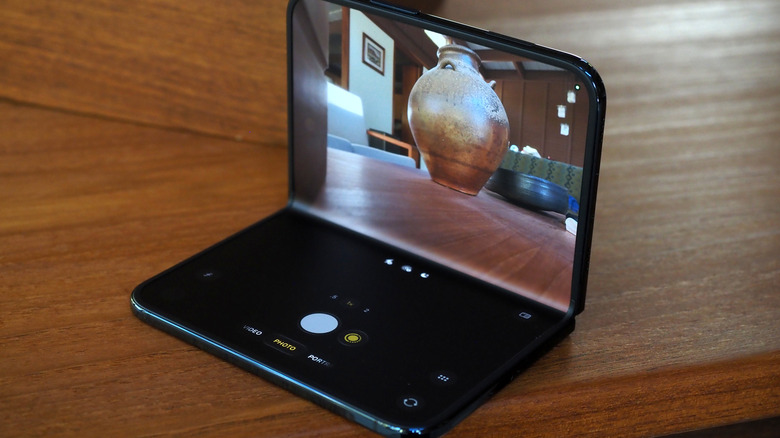
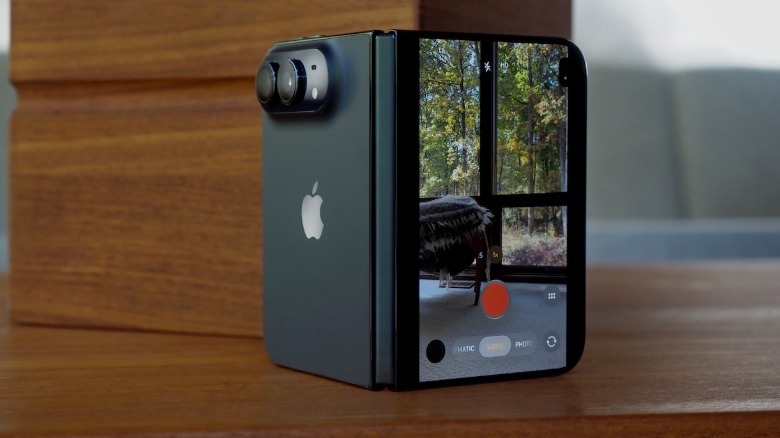
Even in the space of just a few weeks, I've been spoiled by the excellent cameras on the iPhone 18 Pro Max. Sadly, while the iPhone Duo has a pair of Fusion sensors — a 48-megapixel main camera and a 48-megapixel ultra wide — on the outside, there's none of the variable aperture magic. Nor is there the dedicated telephoto which gives the Pro phones their 4x optical zoom. Instead, the Duo promises 2x optical-quality, and then software magnifies all the way to (a fairly crunchy) 10x.
I'm a regular zoomer (optically, not generationally), so I did miss the telephoto option. And Apple's internal FaceTime camera — cleverly peeking through the pixels of the inner display — is perfectly sufficient for video calls, but for actual selfies I'd use the far-better camera cut into the external screen. It produces shots that are sharper and clearer.
 Chris Davies/SlashGear
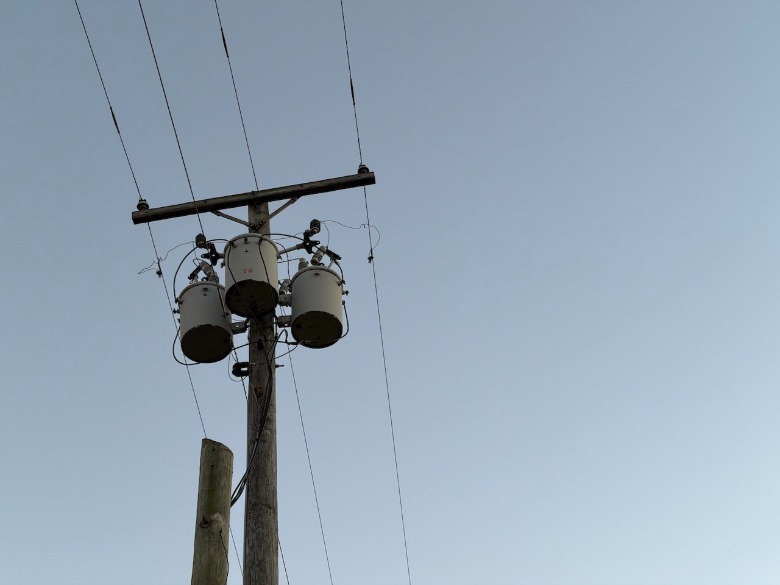
Overall, the main cameras on the iPhone Duo produce images much akin to those from last year's iPhone 17 Pro, telephoto sensor aside. I prefer how Apple's night photography doesn't wildly brighten the scene: you can still tell it's nighttime, unlike the technically impressive but over-the-top processing some rivals skew toward by default.
 Chris Davies/SlashGear
In this sunset shot, for instance, the descending sandhill cranes are still crisp (though the impact of that is lost, somewhat, because of the page compression here) despite a sufficiently long exposure to capture the texture of the much darker fields.
 Chris Davies/SlashGear
Big battery life, big repair costs
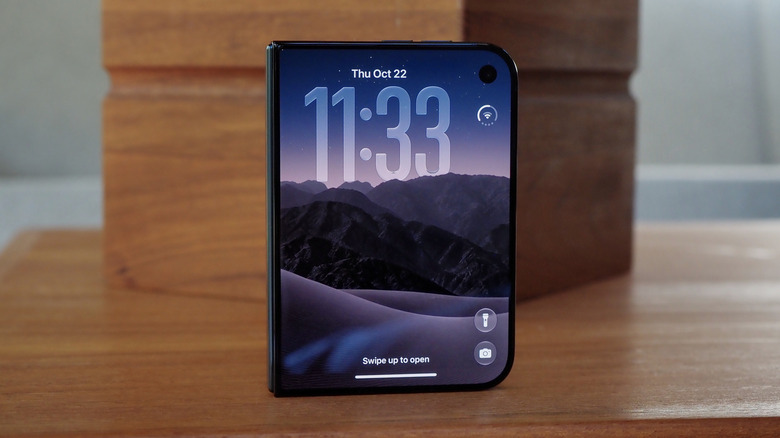
Apple claims up to 24 hours of "typical use" from the dual batteries, a figure based on its collated owner metrics. I was initially skeptical, then ended the day with about half the battery left despite my showing no restraint. The iPhone Duo stuck just fine — when folded — to my MagSafe desk stand, though drooped when unfolded.
Otherwise, much here is in line with the latest iPhone 18 Pro models. That means the A20 Pro chipset, speed and heat management improvements over last year's phones, the latest Siri AI, and the reassurance of Messages via Satellite. 5G, eSIM, Bluetooth 6, and WiFi 7 are also standard.
 Chris Davies/SlashGear
One notable distinction is the cost of repairs. Having Apple replace the iPhone Duo's outer display is the same $379 as for the screen on an iPhone 18 Pro Max, but the inner display is a whopping $999. The price for ominously nebulous "other damage" — which you have to assume includes the hinge — is a blanket $1,499. At least having Apple swap the matte inner screen protector is just $49.
Apple iPhone Duo verdict
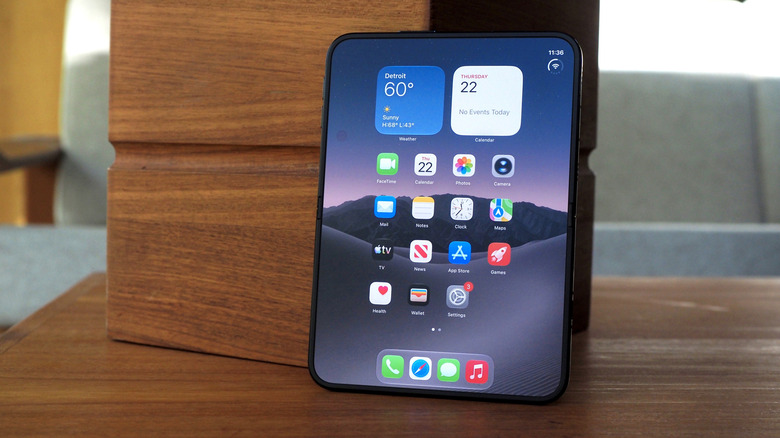
The iPhone Duo may have Apple's fanciest smartphone display right now, but it doesn't necessarily feel like Apple's fanciest smartphone, period. You sacrifice — in ways beyond just the price tag — to get the folding form-factor. An iPhone 18 Pro Max has better cameras, more streamlined security with Face ID, and the vast majority of apps in the App Store look just swell on its hardly-small display. I'm a lot more confident about dropping it, case-less, into my pocket, too.
It'd also be negligent not to discuss pricing. The iPhone Duo starts at $1,999; you'll spend a heady $3,199 for the maxed-out 2TB version. That's MacBook Pro territory. Suddenly, the $1,299 of an iPhone 18 Pro Max starts to look, not exactly cheap, but attainable in comparison.
 Chris Davies/SlashGear
For every person I've shown the iPhone Duo to that has loved the form-factor, there's been another who has questioned its point. And honestly, there's a part of me that's relieved: we're overdue something fun (and controversial) in a tech world that has been dominated the past few years by over-promising AI. The hardware-fan in me is delighted.
As for whether you should actually buy an iPhone Duo today, right now Apple's first foldable feels more flagship adjacent not flagship replacement. It's tough to make an argument that most iPhone users should stretch beyond the iPhone 18 Pro (in Max form or otherwise): it's the all-rounder in the lineup. Those with the budget and the patience to join the iPad Duo early-adopter ranks will find great hardware, a beautiful screen, and plenty of software promise. Just how long it takes for reality to catch up with that potential will largely come down to developers.