

5 Cars You Might Not Know Have 12-Cylinder Engines
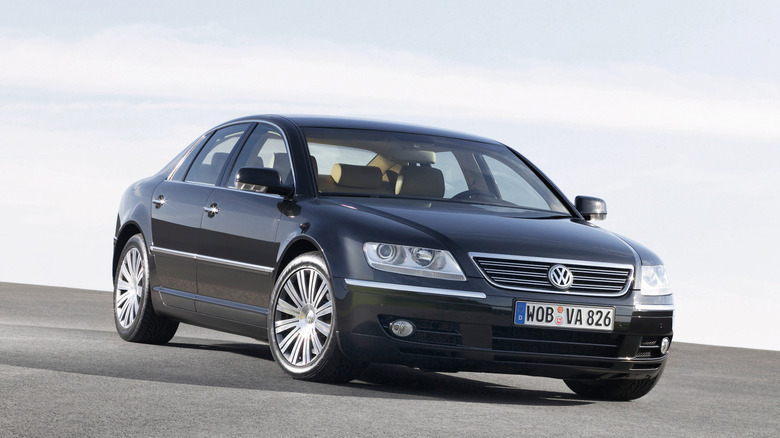
A lot of people associate the 12-cylinder engine with power, prestige, opulence, luxury, and many other buzzwords, something that's no accident. Through both design and clever marketing, the 12-cylinder engine, especially in V12 form, is among the smoothest engine designs. That's because the engine is inherently just two straight sixes stuck together on a single crankshaft, with the straight six in particular being an incredibly balanced platform. It's one of the straight six's main advantages – with perfect engine balance comes no need for balance shafts. The V12 inherits this trait, making it exceptional for luxury and high-performance cars.
Of course, there are still plenty of downsides to the V12 engine. They're physically massive, complex, and drink fuel, to name a few, but who cares? You have a 12-cylinder engine under the hood? There's something inherently interesting and, frankly, cool about these powerplants. Not the least of which because they're quite rare today, likely because they're so complex and take up so much space. You can't satisfy EPA requirements or make an aerodynamic car nearly as easily with a V12 as you could with a turbo V6, after all.
That said, there are still a surprising amount of cars with 12-cylinder engines under the hood, including the elusive W12, and some of them even use alternative fuels. We've come to expect to see a V12 under your typical Ferrari supercar or 1990s to 2000s hypercar, granted, but what about the weirder stuff? Regular cars, SUVs, vehicles from more "pedestrian" manufacturers, and so on? That's our focus here. Let's discuss some of the oddest cars to feature an already odd engine by modern standards.
Lamborghini LM002
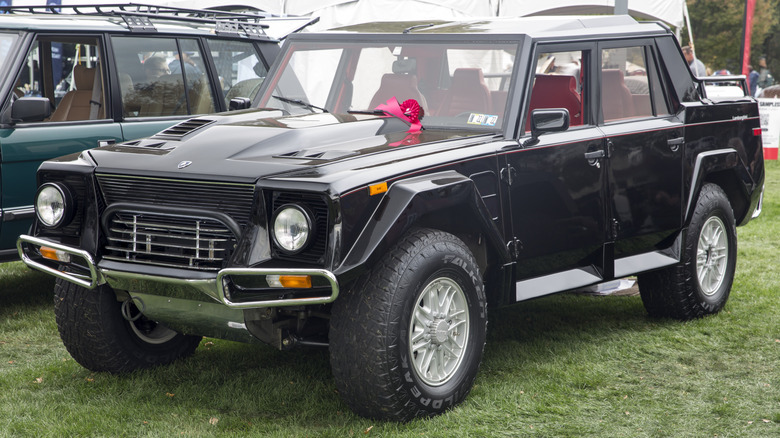
Let's start with the easy one, because at the end of the day, you expect to find a V12 under the hood of anything with a Lamborghini badge on it. But, well, just look at it — this isn't exactly an ordinary Lamborghini, which is a bold statement considering some of the stuff the company's developed. And bear in mind that the layperson would see this monstrosity on the road and think it's powered by some sort of massive diesel or V8 or something, not the V12 out of a Countach. Yet that's exactly what the LM002 is.
Nicknamed the "Rambo Lambo" for fairly obvious reasons, the LM002 is practically the definition of excess. Its development history can be summed up thusly: Lamborghini answered a contract to build a desert-hopping troop transport. However, the company's first prototype featured a paltry rear-mounted 180-hp AMC V8, making it hopelessly underpowered. So in a move that could only ever see the light of day in early-1980s Italy, Lamborghini swapped the V8 for a 455 hp 5.2-liter V12 out of the Countach LP 5000 QV.
Lord knows what substances compelled designers to think this would make a good military truck, but it certainly made a lasting impact on anyone who witnessed this monstrosity in traffic. Though by today's standards, seeing an LM002 in-person is somewhat less overwhelming than one might expect. It's basically the same size as the Urus, in fact. It just looks monstrous because of its ground clearance and being surrounded by much smaller 1980s hatchbacks in its heyday. It also helps that the LM002 has some of the widest tires fitted to any production car.
Toyota Century
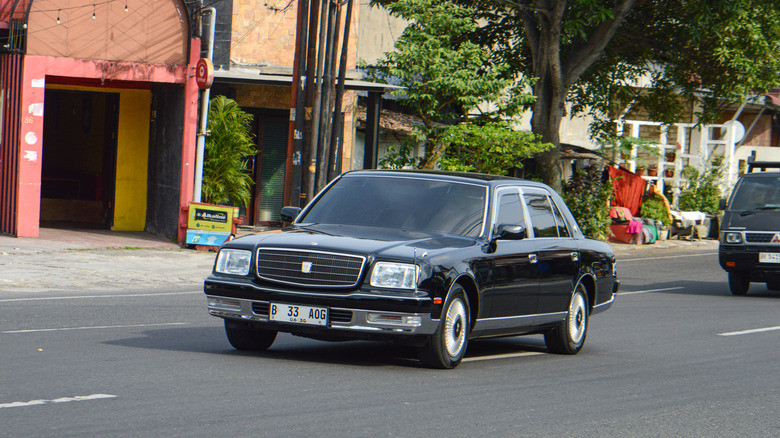
The Toyota Century is easily one of the poshest, most classically-Japanese luxury cars one can buy. And by that, we mean that you'd never know the utter comfort the occupants are lavishing in by looking at the exterior. In traditional Japanese fashion, the Century is the purest essence of "quiet luxury," where the luxury comes from a subtle yet commanding presence, accented by its black paintjob, chrome trim, and boxy aesthetic. It's such a timeless design that Toyota barely changed it; the first generation alone lasted some three decades, from 1967 to 1997.
It's the second generation where things get really interesting, though, because Toyota upgraded the powerplant from the more basic V8 to a brand-new V12, the 1GZ-FE. Codenamed the BEAMS, or Breakthrough Engine with Advanced Mechanism System (even the codename is an aesthetic), this engine used various technologies like VVT-I and slant-squish combustion chambers to make it not just incredibly smooth, but also more economical and powerful. Befitting a car of the Century's status, this was an incredibly well-built and innovative engine of its day, easily earning the title of one of the best V12s in history.
But let's be real — at least in the United States, the layperson doesn't typically associate Toyota with Maybach-rivaling luxury. Granted, the Century predates Lexus by over two decades. But still, a non-car person would never think of a Toyota sedan, of all things, to house a V12. Yet the Century easily out-luxuries even top-tier Lexus cars of its day, though sadly the V12 was only ever sold in Japan. So if you want one in North America, you have to find one already here or import it yourself.
BMW E32 750i
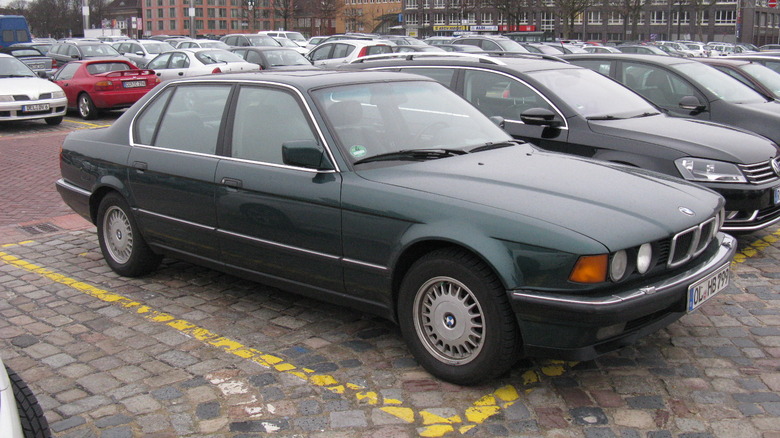
Speaking of ultra-luxury advanced sedans, we now rewind back to the 1980s with something notably more down-to-Earth than the ridiculous LM002 or downright intimidatingly presidential Century. This BMW looks positively tame by comparison, certainly by modern standards. It is, after all, just another German luxury sedan, not unlike the sea of other late-80s luxury barges flowing out of Europe at the time. However, as the company's new flagship, it was the 7-Series' job to be as ultra-smooth and luxurious as possible, an what better engine for the job than a stout 300-hp V12?
That V12, the M70 to be specific, was built to counter the V12s churned out by longtime rival Mercedes-Benz, along with opposition from British marque Jaguar. These were arguably the pinnacle days of the V12 engine, combining the excess of the 1980s with the thrill of more advanced and modern cars finally appearing in the wake of the Oil Crisis. The E32 7 Series marked a noticeable shift in BMW's design language befitting this trend, presenting a sleek, understated silhouette with the classic BMW grille now standing near-vertically instead of slanting forwards like most 1970s models.
Of course, that doesn't stop it from being unassuming and something of a sleeper by modern standards. Most people would look at this and assume it's probably a straight six or V8, as most BMWs are. And yes, BMWs are famous for their straight sixes the company stubbornly refuses to give up, but remember — a V12 is just two straight sixes. What better engine configuration for the car built to represent BMW's most luxurious offering in the 1980s?
Volkswagen Phaeton
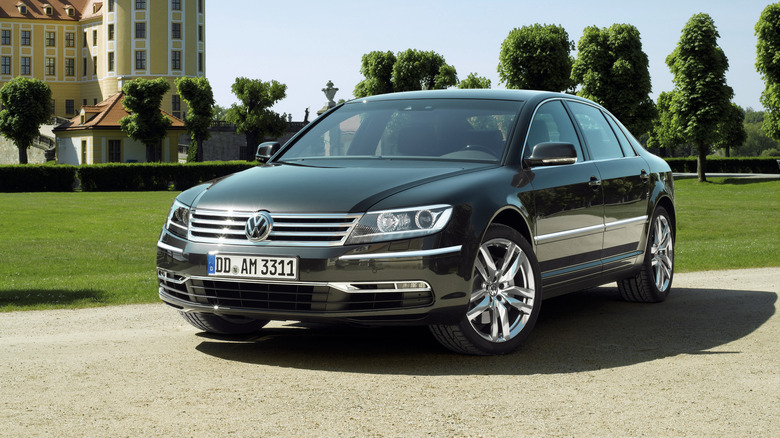
V12s are what most people automatically think of when they picture a 12-cylinder engine, but it's not the only configuration. You also have flat-12s, for instance. Or in this case, a W12.
First of all, what on Earth is a W12? In this context, not actually what you'd think, because the Volkswagen W12 isn't a true W12. An actual W12 would have three engine heads, basically three four-cylinder engines mated to one crankshaft. Volkswagen's idea was to take two VR6 engines and stick those together. The VR6 is a staggered design, meaning the cylinders are staggered across two rows like cans of soda laying on top of each other. The Volkswagen W12 just takes two of these and mates them together, so it's more accurately a V12 with extra steps.
That said, this is still the only engine to bear a W12 name and see mass production. One would assume that it'd be fitted to the absolute halo car of Volkswagen Auto Group, like a Lamborghini or Audi or something. And yes, it was fitted to cars like the Audi A8 and Bentley Continental Supersports. Oh, and a Volkswagen, like an actual Volkswagen.
The Phaeton, named after the phaeton body style of horseless-carriage days, is the "budget" version of a Bentley Flying Spur. It was as unassuming as any other Volkswagen on the road, lacking the opulence (or inflated price) of the Bentley badge and aesthetic, yet it retained the luxury features and unique powertrain in top trim. It even held over 100 patents to its name; this was an insanely advanced car in the 2000s. Sadly, it was simply too understated to catch on in status-driven 2000s America and was ultimately discontinued, relegating the Phaeton to relative obscurity.
Audi Q7
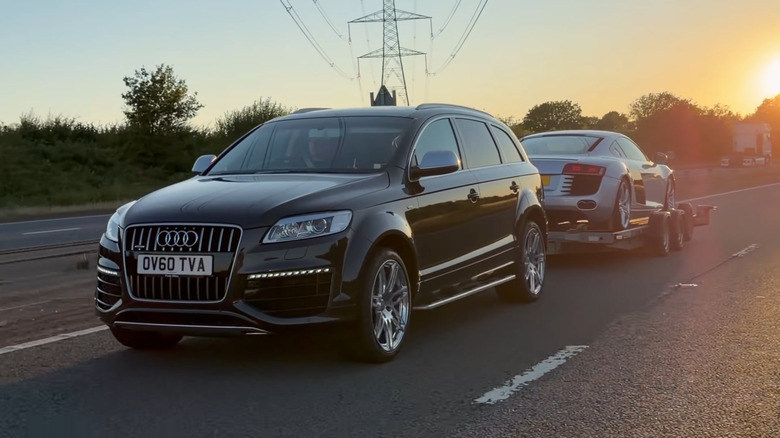
Volkswagen didn't just produce the W12 as its sole V12 offering, though. It also produced a V12, though even this was far from traditional. It was fitted to exactly one vehicle: Audi's first-generation Q7. If one looks at the back of this car, what would they see? Okay, yes, it's a Touareg with a business suit on. But then it's got a TDI badge on it. Oh, so it's just a diesel, right?
Not at all — this isn't any ordinary diesel. It's a 6.0-liter V12 diesel with a frankly ridiculous 737 lb-ft torque, shoving what is ostensibly a full-size crossover alarmingly quickly. But you'd never know it by looking at it; much like the Toyota Century, the Audi Q7's party-piece is its luxury. Exuberance is an understatement — on some versions, even the rear floor is made of finely-crafted and finished walnut. This elevates the price-point to heights not even managed by the Audi R8 of its day, making the Q7 arguably the true halo car for people with bloated bank accounts.
As is appropriate for such a generously appointed car, the Q7 commands presence through sheer prestige, perhaps most evident in that insane engine. The engine is quiet and refined, though unquestionably oversized for such a vehicle. This adds up to a firm push on the throttle pedal rocketing the speedometer up without actually feeling the visceral sensations of going fast. Cars like these were built to get to (and remain at) high speeds in the utmost comfort, and the Q7 is no exception. It's also probably the last car one would expect to find housing the world's sole production diesel V12, but that's why it's so cool and why we wish it was still around.