

10 Mini Camera Drones That Can Easily Fit In Your Pocket Or Backpack
Those of us who are old enough remember when drones were exclusively a military thing, never a technology we imagined finding its way into civilian hands. Now, drones are everywhere. One could say they've replaced costly helicopter film crews with something anyone can buy for a couple hundred dollars. They're excellent for creating professional-looking bird's-eye and flyby footage of your vacation spots or group events. And nowadays they don't need to be those huge albatross-sized drones capable of shooting footage for television. Some capable drones are small enough to quite literally drop into your pocket and shoot in 4K.
Today we look at some of the smallest drones on the market. Pocket-sized is ideal, though we'll take a drone that could easily go in your backpack without being the only thing in it. All of the drones on this list have a camera. Since the drone market is huge and options abound, here are just 10 that fit the bill.
DJI Neo
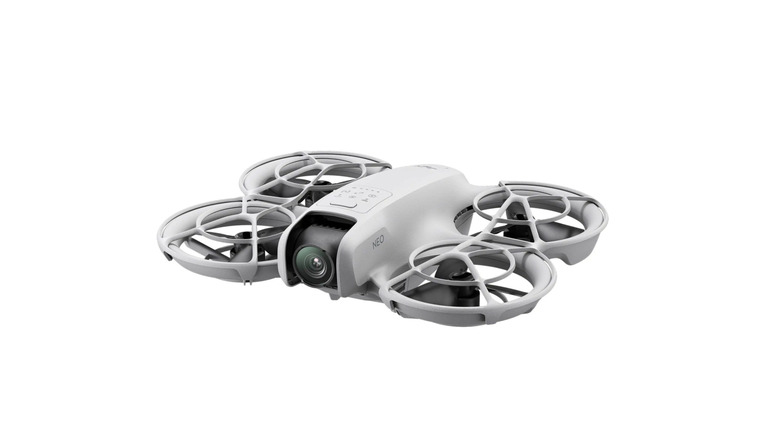
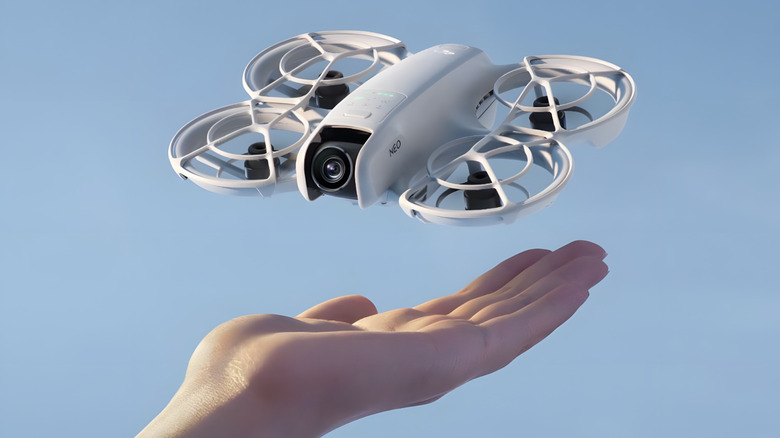
No drone list would be complete without DJI, the king of the consumer drone market. One of DJI's most affordable and approachable drones is the DJI Neo. It retails for $169 and is on sale at the time of writing for $139. Our own Andy Zahn reviewed it in 2024 and gave it a laudable 9/10. Even though it's been superseded by the DJI Neo 2, we still think it's an impressive drone by today's standards. The Neo weighs an almost impossible 135 grams, requires no controller (if you just want some simple footage) and comes with propeller guards for a bit of tumbling. It knows how to return home on its own, and DJI rates it as having Level 4 wind resistance, ensuring you don't lose it forever when a gust hits it over some water.
Despite its size, it supports 12MP photos and stabilized 4K 30 FPS video, with enough internal storage for up to 40 minutes of footage, which you can transfer to your phone with the DJI Fly app. All you have to do is choose which filming mode it's going to use, and then let it launch out of your palm and do the rest for you — or you can fly it with the DJI Fly app or a remote controller. Bear in mind, this is not an RC-equipped drone; you'll need to add that functionality afterward if you want to do some long-distance flying and recording. Flying time is estimated to be about 18 minutes.
It may be pocketable for some, but for most, we'd say this is suited to a backpack. It cannot fold down to be smaller as many drones in this category can. It measures 130mm by 157mm, or 5.12 by 6.18 inches. It also sells on Amazon for $199, with sales bringing it much lower.
DJI Neo 2
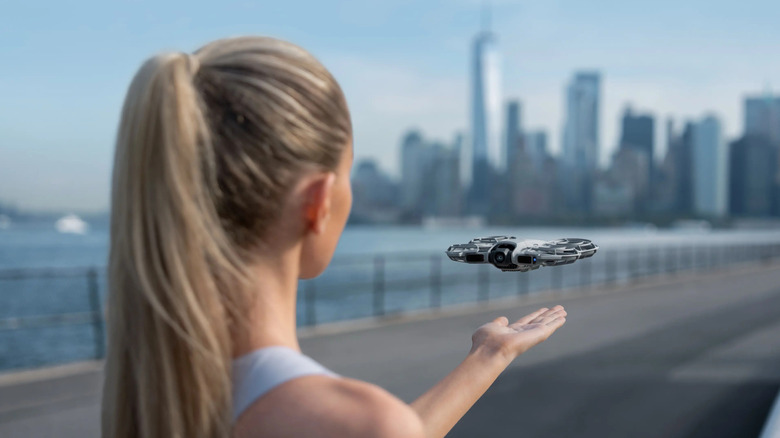
The DJI Neo 2 is a subtle upgrade over the first-gen Neo, boasting many of the same selling points: stabilized 12MP photos and 4K video, a no-controller drone, propeller cages, and multiple intelligent shooting modes after launching from your palm. Only this time, it can shoot 4K at 60 FPS or 4K at 100 FPS for slow-motion shots, plus upgraded 2.7K vertical video (the previous was 1080p). It can handle more complex, varied shots and gives you more control over it via devices like your Apple Watch. It's also smarter about its surroundings, preventing crashes both indoors and outdoors in all sorts of challenging environments. Battery gives you an extra minute of flight time, for 19 minutes total.
Other upgrades are less subtle, such as an extra axis for the gimbal, support for gesture controls and automatic return to palm, longer video transmission range, faster tracking speed, and more than double the internal storage space. At its retail price of $259, it might be more sensible to skip the Neo and spend extra on future-proofed hardware, if you intend to use this a lot. Amazon also sells it for $259, and the DJI USA Authorized Reseller sells it for the same.
Measurement-wise, it weighs a bit more than its predecessor at 151 grams. It's slightly larger, too, measuring 147mm by 171mm, or 5.79 by 6.73 inches. Still well within our pocketable/backpackable ballpark.
DJI Mini 4K
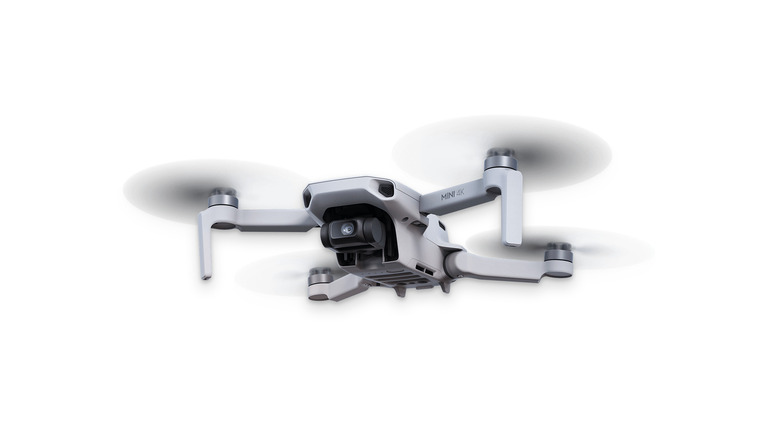
Tired of DJI drones yet? Well, buckle in because there is an absolutely huge list of them, and several fit our pocketability criteria. Next up is the DJI Mini 4K, a larger, more capable, and more expensive drone. The quadcopter is small enough folded that it is perhaps even more pocketable than the DJI Neo, and is still light at under 249 grams. The three-axis gimbal camera takes 12MP shots and shoots 4K 30 FPS video, supporting up to 4x zoom in HD.
Although this drone is intended to be piloted manually (via controller and the app), it comes with intelligent shooting modes (i.e., it'll automatically handle a perfect boomerang shot for you so you don't have to crash your drone trying) and a whole bunch of automated flight features, like automatic takeoff and landing, midair hovering, and return to home. Aside from that, it boasts about 31 minutes of flight time, long-range 10-km video transmission, and Level 5 wind resistance.
When folded up, the DJI Mini 4K squeezes down to 138mm by 81mm, or 5.43 by 3.19 inches. Unfolded, it expands to 245mm by 289mm, or 9.65 by 11.38 inches. It sells for $299 on the DJI USA reseller, and the same on DJI's official store on Amazon. That price includes DJI's controller.
DJI Mini 5 Pro
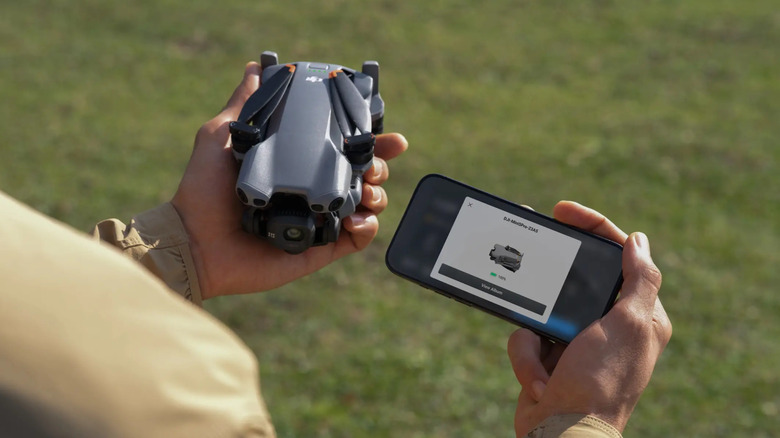
The DJI Mini 5 Pro is the most powerful drone in the Mini lineup, meant to get you close to the specs and capabilities of the bigger, professional drones. It sports a 50MP camera with a 1-inch CMOS sensor capable of shooting at night, 2x zoom, and video up to 4K 120 FPS. Its 3-axis camera gimbal can rotate a wide 225 degrees. Similar to other DJI drones we've shown, the Mini 5 Pro comes with a whole bunch of intelligent shooting modes to automate complex, yet professional-looking, shots. It's also packed with a LiDAR sensor, enabling it to steer around typical obstacles like tree branches and lampposts even at night, and global positioning support for better navigation.
Overall, the Mini 5 Pro boasts about 36 minutes of flight, or 52 minutes with its Intelligent Flight Battery Plus. It enjoys a maximum 20-kilometer video transmission and an impressively high 6,000-meter max takeoff altitude. All of this in a package that weighs 249.9 grams. It's a huge upgrade over the Mini 3.
So how pocketable is this thing? Completely folded up, it measures 157mm by 95mm, or 6.18 by 3.74 inches; it's only a pinch larger than the Mini 4K, so absolutely pocketable. Expanding out, it measures 304mm by 380mm, or 11.97 by 14.96 inches. It sells for $759 on the DJI USA store and the DJI official Amazon store.
HOVERAir X1
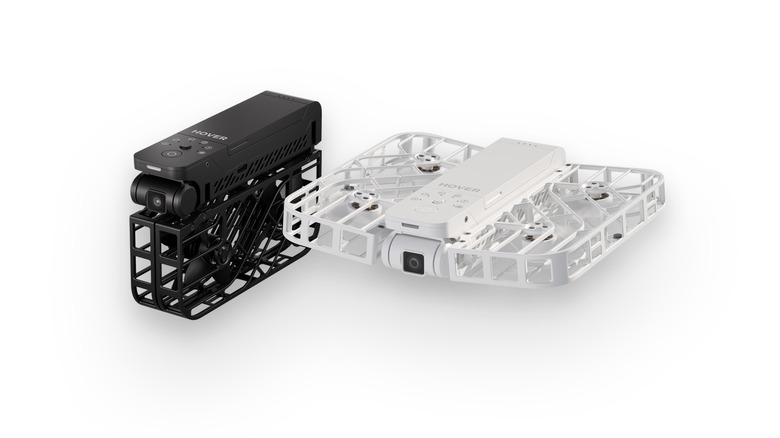
Moving on from DJI drones, there is a lot of competition in this space worth mentioning. The HOVERAir X1 is a potential competitor to the DJI Neo series, a self-flying drone anyone can use which automatically handles beautiful shots for you. It does many of the things the DJI Neo can, such as palm takeoff, automatic tracking at up to 15.7 mph, and video stabilization via a single-axis gimbal. It includes propeller guards so crashes don't necessitate a propeller swap-out. The video resolution isn't 4K, instead 2.7K, though for the size and weight that's a compromise many would probably be willing to make. Similar to DJI's Neos, you can change settings via the app, or control it with optional accessories like the Joysticks.
The HOVERAir X1 will give you about 11.5 minutes of flight, and the 32GB storage holds 100 minutes of footage. What's most impressive about the HOVERAir X1, though, is how small in size it can be when folded: 5 inches by 3.39 inches, expanding to 5 inches by 5.7 inches at full extension. This thing is crazy small and should fit in many pockets without issue.
You can purchase the HOVERAir X1 directly from its website for $299. It sells on Amazon for the same price. That includes an extra battery, a charging hub, and a cable. It's on the pricey side compared to what you get from DJI, but then again, DJI has become an increasingly tricky brand to buy in the U.S.
HOVERAir X1 PRO
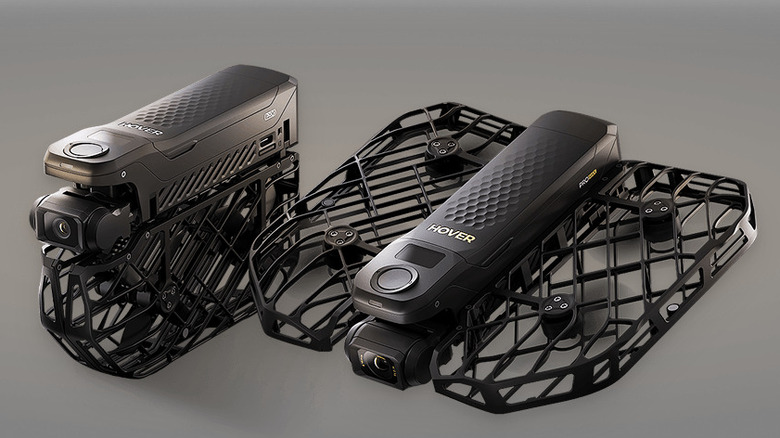
The HOVERAir X1 Pro and ProMax are a sizable upgrade over the baseline X1. It's the same lightweight, easy-to-use form factor, except this time with significantly better hardware specs. Namely, support for up to 8K footage and 4K 120 FPS, including 4K 30 FPS for vertical shots, and 2x zoom. The gimbal is now two-axis, and it adds rear collision detection. Level 5 wind resistance helps it endure blustery days, and it has a higher top speed (26 mph) for object tracking and better tight-space navigation. You'll find more flight modes, a wider FOV, and voice control. You can control it manually with the accessories or the app. Flight time is about 16 minutes.
Despite such a massive upgrade in hardware, the X1 Pro series is still compact and light. It measures 105mm by 149mm when folded, or 4.13 by 5.87 inches. Expanded, it measures 173mm by 149mm, or 6.81 by 5.87 inches. It weighs only 192 grams.
The X1 Pro sells for $499 on the official website, with the X1 ProMax starting at $699. It's the same price on Amazon. Make sure you check the spec sheets before you buy, though, as the X1 Pro (sans Max) has inferior specs: only up to 4K video, 1080p slow motion, and a narrower FOV, for example. Full disclosure, our review of the HOVERAir X1 ProMax was not so favorable, so definitely see what others are saying before you buy.
Potensic ATOM SE
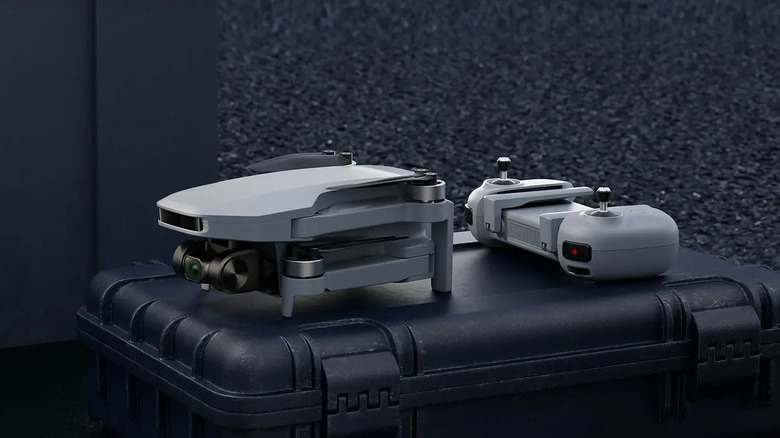
The Potensic ATOM SE is a relatively affordable drone boasting impressive specs. It can take 12MP stills and shoot in stabilized 4K 30 FPS on a single-axis gimbal with a wide 118-degree FOV. Range goes up to 4 kilometers. Battery life should run you about 31 minutes. It's a drone you pilot yourself, though it does have different flight modes and a downward vision sensor to aid flight, plus Level 5 wind resistance. At max speed it attains 16 m/s (57.6 km/h or 35.79 mph). It's all controlled via your phone strapped into the controller.
Potensic boasts that this is a palm-sized drone, measuring 88mm by 143mm (3.46 by 5.63 inches) in its folded form, or 300mm by 242mm (11.81 by 9.53 inches) with the propeller blades installed. It also weighs under 249 grams when all kitted out to fly. You'll need pockets on the larger side, but this is definitely a drone we can say is pocketable.
The price is also quite impressive. For $289.99 on the official website, you get the drone, plus a controller, two batteries, spare propellers, and a bag. You can also buy it from Amazon for $279.99. Considering the prices of drones offering similar specs, this is a quite competitive option at the price point.
Potensic ATOM 2
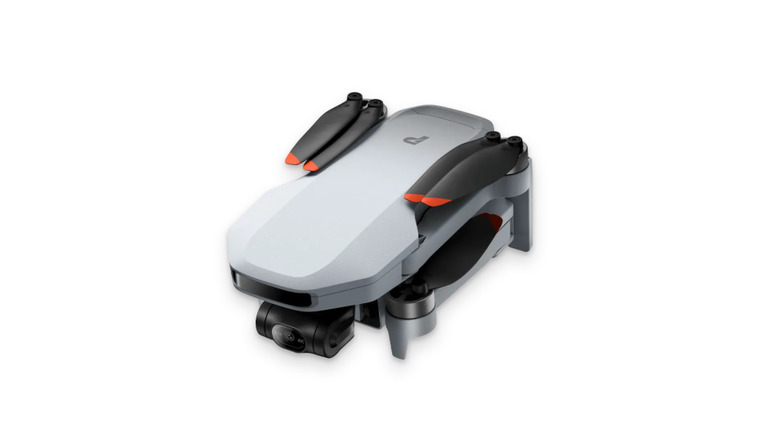
The Potensic ATOM 2 is a sizable upgrade over the ATOM SE, asking only a modest price bump for better specs in most areas. First, it can shoot 8K photos and 4K video with HDR, 4x zoom, and better night content, including vertical content; its range is more than doubled at 10 kilometers; you can now track and follow subjects using AI, and access a whole bunch of automatic aerial shots; flight time is also a minute longer at 32 minutes total. All in all, these are decent upgrades over the more affordable SE version.
What's impressive is that it retains the exact same measurements as the ATOM SE despite better hardware: 3.46 by 5.63 inches in storage mode, and 11.81 by 9.53 inches fully extended with its propellers on. All at under 249 grams. And that's with better battery life, mind.
The Potensic ATOM 2 sells on the official manufacturer's website for $359.99. This time, it's a single-battery kit with a standard controller, no bag. You can purchase it on Amazon starting at the same price. Based on our previous experience with Potensic, it is a solid brand that doesn't get as much recognition as it might deserve.
Ruko U11MINI 4K (RC3)
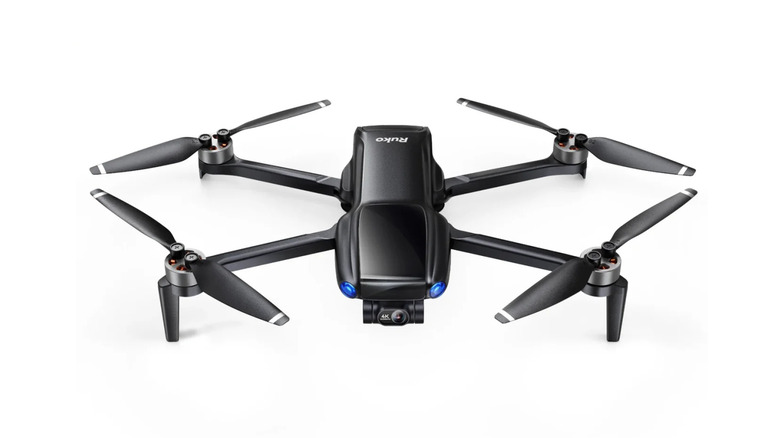
Ruko is a perhaps lesser-known brand in drones, but it makes an excellent pocket-sized option to add to this list: the Ruko U11MINI 4K (RC3). It can shoot in up to 4K 30 FPS video and 8K photos using a stabilized 48MP camera on a three-axis gimbal. Like most drones on the market these days, it comes with automatic filming modes, plus one-button takeoff and auto-return. You can control it from up to 20,000 feet away or just over 6 kilometers. Flight time lasts for 32 minutes.
Ruko markets this as a pocket-worthy drone, though frustratingly it does not include any measurements on its website or product manual — odd, considering this drone sits in the mid-range to premium range as far as price is concerned. Only a photoshopped image showing the drone being placed in a loose jacket pocket gives us a clue. Eyeballing it visually in comparison to reviewer hands, it definitely is pocketable. Big pockets, sure, but pockets nonetheless.
The Ruko U11MINI 4K (RC3) retails for $599.99 on the manufacturer's website, and that price includes a dedicated controller with a 5.5-inch 1080p screen, an extra battery, and free shipping. You might be able to get it for less on Amazon, where at the time of writing it's on sale for $499.99. The Amazon version frequently goes on sale and can sell for as low as $424.98.
RELIDOL 1080P Camera Drone
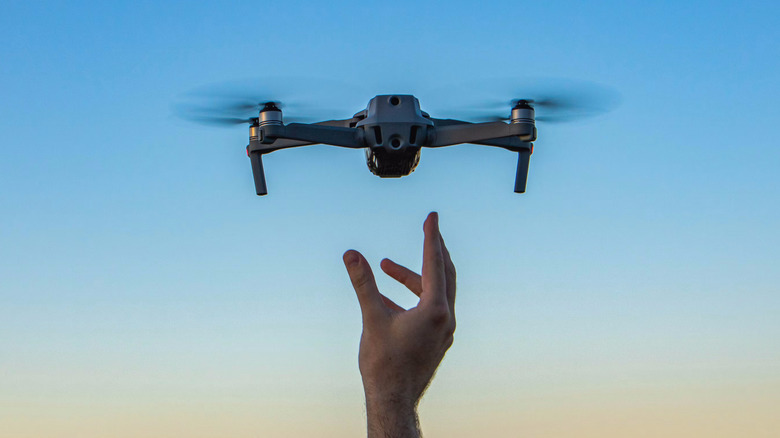
Every drone we've mentioned on this list has cost at least a couple hundred dollars, which may be far above what someone is willing to pay if they just want to dip their toes in camera aerial photography. So we wanted to include an option that is approachable budget-wise: the Relidol 1080p foldable camera drone. It costs only $56 on Amazon, with sales frequently bringing it down into the $37 range. However, it boasts over 1,600 reviews averaging 4.3 stars, so we'd say it's a solid choice.
The 1080p, 80-degree camera can also take pictures and be triggered with gestures and voice commands. It flies for about 25 minutes across its two included batteries via its included controller and has some simple propeller guards. Despite its low price, it still has some of the automatic filming modes we've shown in other drones. It has no dimensions that we can reference from its website or on its Amazon page. Looking at customer hands in comparison to the drone, it is definitely well within pocketable range.
Just be aware that you are getting what you pay for. Camera quality will not be amazing, nor will build quality. Having said that, users who have purchased this drone seem to be content with it for what it is.
Our decision-making process for these options

The drone market is huge, with countless options of all sizes. Our focus here was simple: small camera drones that could fit in your pockets, and if not, your backpack. Nothing more complicated than that, and all other considerations were secondary.
Of course, what constitutes a "pocket" is highly variable — some women's pants have fake pockets, for crying out loud — so we're leaning more toward the big pockets like those on cargo shorts or a jacket. We included backpack here because these are drones you could easily carry alongside all your other gear, without the drone consuming all the space.
Aside from all that, the drones on this list are all purchasable in the US and seem to have decent customer ratings. However, we admit that we did not factor in how well they perform and fly, and how good their camera quality is. We aimed for size above all else.