

5 New Diesel Engines Coming Out In 2027
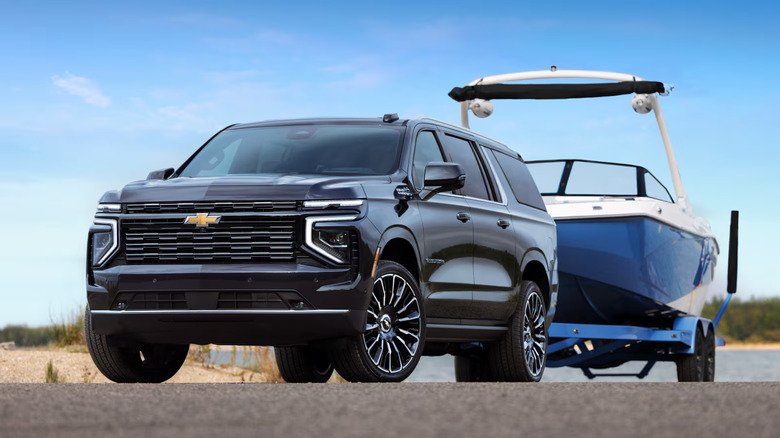
New engines are a hot topic for automakers in the coming year, thanks in no small part to the dramatic increase in fuel prices. It's all supply and demand, after all, and arguably no one is feeling the pinch at the pump quite like diesels. Moreover, with more modernization programs and clean-energy initiatives than ever before, it's imperative for engine builders to stay relevant in today's economy. Welcome to the rush of the decade's latter half, filled with innovation and reimagining alike, as companies update old diesels and create new ones from scratch.
You'll see a lot of common threads across every one of these engines, apart from their application in commercial and private cargo hauling. For the uninitiated, diesel engines prioritize torque, with their lower RPM bands and relatively longer piston strokes naturally producing more torque than gasoline engines. That's because diesels run on compression rather than spark — diesel fuel is less volatile than gasoline, so you can compress it a lot more without pre-ignition, known as knocking. A typical diesel engine packs over 14:1 compression, versus gas engines that have around 50 percent less. So you get more force and leverage to push the piston down, hence the additional torque.
Another point you'll notice here is how overbuilt these engines are. It's a well-known pro of diesel engines that they're relatively understressed designs, meaning they can theoretically accept far more power than they're producing from the factory. This means the parts don't have to work hard, which makes these engines last extremely long — generally-speaking, anyway. That said, here's what's on the horizon for 2027.
Cummins X15 (2027)
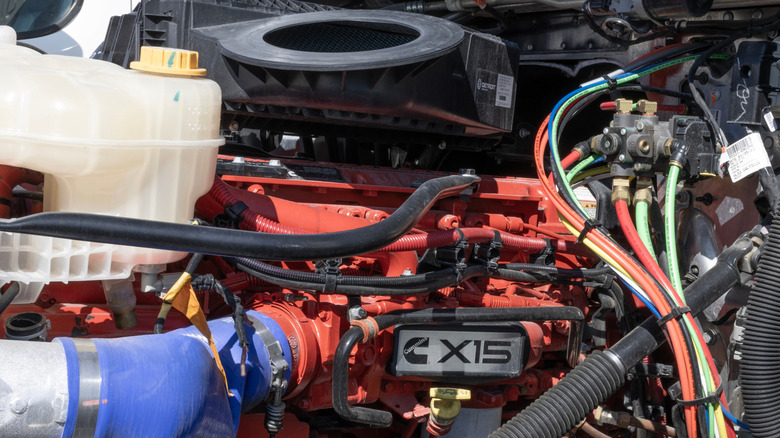
The Cummins X15 is arguably one of the best-known and robust heavy-duty truck diesel engines of all time. The engine has been on American roads in one form or another since 1998, boasting a 15-liter straight six design. The types of vehicles that most commonly use this engine under the hoods of just about anything requiring good low-end torque, of which it has plenty — 1,600 to 2,050 lb-ft depending on trim. The applications rangе from agriculture and trucking to rail transport, construction, and power generation, among others. Cummins bills it as a universal Swiss Army knife of diesels.
Originally, the engine was a more complicated double overhead-cam design, but Cummins swapped it out for a simpler single overhead-cam layout, among other efforts to maximize its longevity and ease of repair. This trend continues with the 2027 iteration, designed under Cummins' Destination Zero strategy that aims to improve the company's fuel economy across a broad range of its products.
To this end, Cummins is developing the new X15 and its sister platforms by utilizing its new HELM initiative, designed to make use of alternative fuel sources to help offset carbon emissions. In the X15's case, that means introducing not just one but three individual models: the standard diesel X15, the hydrogen-powered X15H, and the X15N powered by natural gas. The hydrogen engine in particular may help spur the otherwise relatively stagnant development of so-equipped fuel stations, considering how niche hydrogen engines otherwise are in land transport applications throughout the United States.
Cummins X10
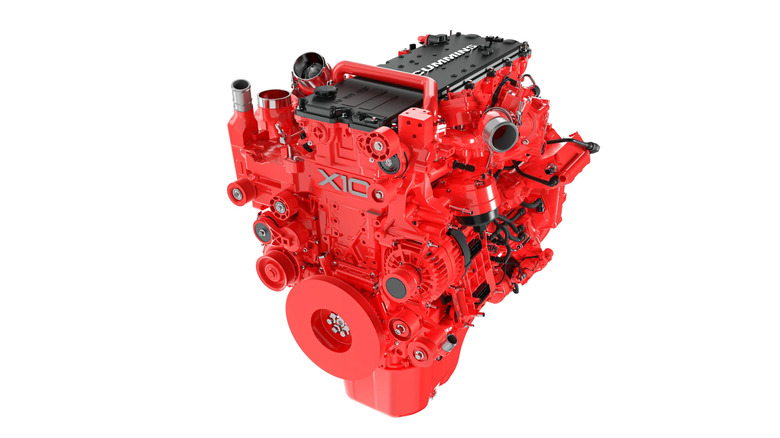
At first glance, this engine looks quite similar to the X15, a deliberate choice on the part of Cummins. As the saying goes, if it ain't broke, don't fix it. That said, this downsized engine actually has its own unique history and applications which set it apart from the X15. First announced in 2025, the X10 is specialized for use with stuff like public transit and buses, vocational work, regional trucking, and emergency vehicles like fire engines. Basically anything coachbuilt on a bus chassis, like a Pierce ladder truck or a New Flyer transit bus, that's what this engine is for.
Cummins developed this engine using the philosophies of the outgoing L9 and X12, using common parts with the X15 to make it easier to produce and install spares, as well as iteratively upgrading it over time. The basic X10's power ranges between 320 and 450 hp, about 200 hp less than an X15; and between 1,000 to 1,650 lb-ft torque. Moreover, just like the X15, this engine represents a marked improvement in fuel economy, with Cummins estimating a 4% improvement against the L9 and 2% over the X12, while also being about 100 pounds lighter than the X12.
The key here is this engine's versatility. A lighter, more compact design allows the X10 to comfortably fit in anything from motor homes to vocational equipment, alongside having enough torque to match the X15 in heavy-duty trim. Moreover, Cummins promises less downtime, with priority given to over-the-air updates, extended service intervals, and the ability to service your own engine.
GM Mongoose Duramax
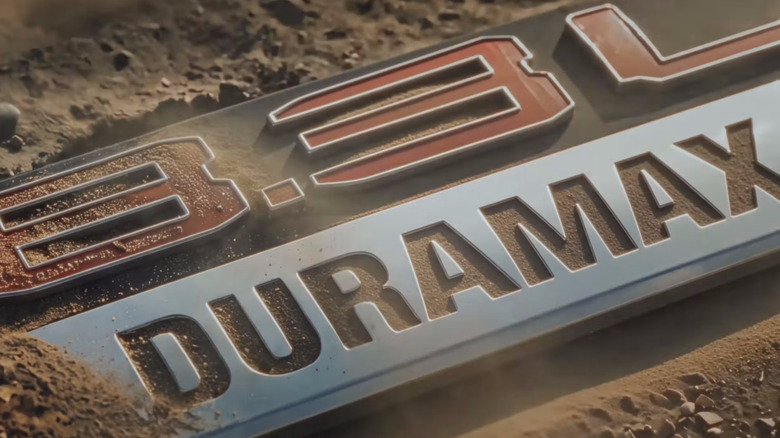
GM's newest iteration of the Duramax, an 8.3-liter monstrosity codenamed Mongoose, represents the latest in a long and storied tale of a three-way arms race. It's been ongoing since time immemorial, leading the Big Three to produce some of the greatest American cars of all time, from the Muscle Era of the 1960s to the super-duty trucks of the 2000s and beyond. Diesels have long been at the forefront of the latter, competing amongst each other for bragging rights on who has the biggest numbers — the most torque, most displacement, biggest tuning potential, and so on.
The Mongoose marks GM's answer to Ford's Scorpion diesel engine, a point the company actually targets in its press release: "A certain cross-town rival's HD V8 diesel engine may be referred to as the 'scorpion.' But nature, or GM in this case, always engineers a better predator –- the Mongoose." This is, of course, accompanied by its video showing the titular mongoose hunting said scorpion, advertising about as subtle as the engine itself.
Ford's 6.7-liter Scorpion Power Stroke boasts 500 hp and 1,200 lb-ft torque, but the Mongoose is rated at 555 hp and 1,230 lb-ft of torque. By comparison, GM's current top-tier Duramax, a 6.6-liter V8, produces "just" 470 hp and 975 lb-ft torque, which is already on-par with heavy duty truck engines of the 1970s. Basically, this engine is the equivalent of taking an early Kenworth W900 diesel and shoving it into a medium-duty pickup truck, which is hardly surprising, considering the Mongoose is essentially the same as bolting two extra cylinders' worth of displacement onto the existing Duramax.
Detroit Diesel generation-six engine family
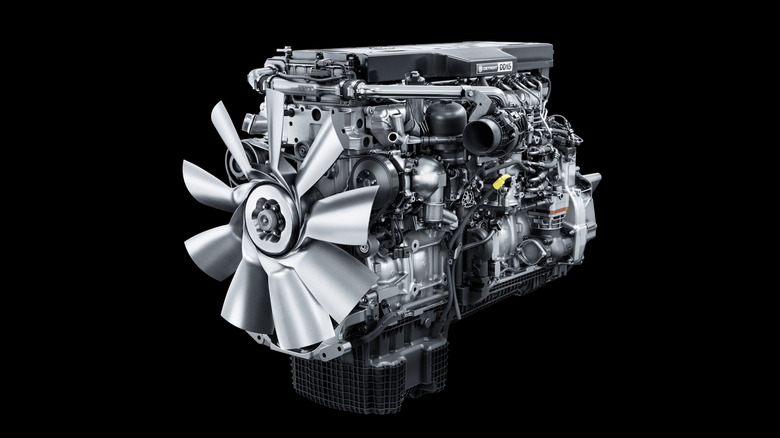
Much like the passenger truck arms race, there also exists one between heavy-duty haulers and agricultural engine makers, namely brands like Caterpillar, the aforementioned Cummins, and Detroit. The latter's latest iterations, as the name implies, marks the sixth overall generation of the brand's mainstay diesel lineup, including the DD13, DD15, and DD16 — the latter being Detroit's most powerful production diesel, in fact. Much like the Cummins, the numbers represent the engines' displacements, with the 13 being a 12.8-liter, the 15 being a 14.8-liter, and the 16 being a 15.6-liter.
As part of the overall modernization of commercial diesel engines, these companies all have their own individual programs to make the engines as reliable and efficient as possible, the two factors which matter most to the end-user; fleet-wide fuel isn't cheap, and an engine that's down for maintenance isn't making money. To this end, the DD-series isn't trying to reinvent the wheel, but rather iterating on the previous generation while incorporating some modernized tech.
At the intake side, Detroit has revised the timing cycle and changed around the turbocharger, adding in a wastegate valve to help manage boost levels for more consistent and clean operation. The company is also implementing a new aftertreatment system to further reduce harmful emissions, promising that the components do not impact the engine's performance figures — anywhere from 1450 to 2050 lb/ft torque, depending on displacement and application. These improvements are scheduled to roll out with the smaller DD13 and DD15 in 2027, with the DD16 variant releasing in 2028. As per usual, Detroit plans to fit them in Western Star and Freightliner truck chassis from the factory.
GM 3.0L Duramax
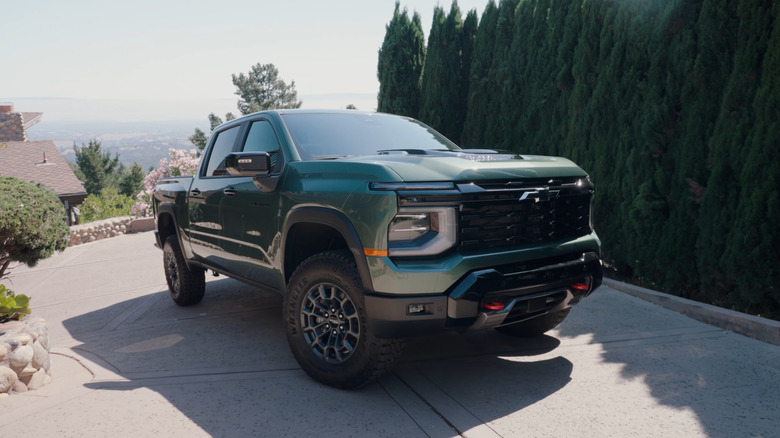
This is a familiar face to anyone who knows GM products; the LM2, as its previous iteration was called, first debuted in model year 2019 for the light-duty Silverado and Sierra 1500, putting out a respectable 277 hp and 460 lb-ft torque. It was perfectly adequate as far as most light-duty towing was concerned, but what was more impressive was the fuel efficiency — 27 MPG combined and 33 MPG highway in a truck with the frontal profile of an office building — hence why it's considered such a good engine.
That trend continues with this latest iteration, which GM promises will travel a cool 900-plus miles on a single 34-gallon tank of diesel. Forget about the sheer numbers of the 8.3-liter Duramax and its displacement equaling that of a Viper engine; this humble straight six is an absolute lifesaver for people looking to maximize profits in smaller trucks.
To put that into context, a far more aerodynamic Porsche Panamera hybrid can stretch its range out to around 750 miles in ideal highway driving conditions. By contrast, you could feasibly cross the entire continental United States filling up in Colorado, Illinois, and Pennsylvania and make it up to Maine with a comfortable reserve.
Of course, these numbers are no doubt influenced from the recent surges in fuel prices, with the trend not slowing for a second thanks to the numerous conflicts in oil-refining nations. So expect more efficiency-first engines like this one from competing manufacturers in the coming years to meet the ever-increasing demand.