

15 Military Helicopters That Are Faster Than The Black Hawk
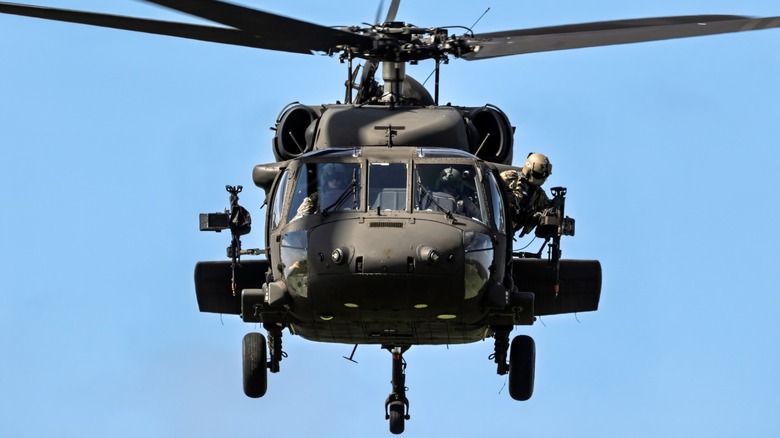
The UH-60 Black Hawk is special because it has been part of the backbone of U.S. Army aviation since 1979, and with more than 5,000 airframes built, it remains one of the most widely flown military helicopters on the planet. The aircraft is also flown by the armed forces of Australia, South Korea, Japan, and Colombia, among others, and it exists in a range of variants — the UH-60A, UH-60L, UH-60M, and the S-70A — that have similar Sikorsky airframes, engines, and rotor systems.
Because the Black Hawk was built as a medium-lift utility and air-assault helicopter rather than a speed demon, its top speed is 159 knots (183 mph). This is a respectable clip for a rotorcraft hauling troops and cargo into a landing zone, but the Hawk is not one of the fastest military helicopters. Attack helicopters, compound designs, and even a few heavy-lift workhorses may leave the Black Hawk in the dust — or in the wind, in this case. That said, here are 14 military helicopters faster than the Black Hawk.
Sikorsky-Boeing SB>1 Defiant
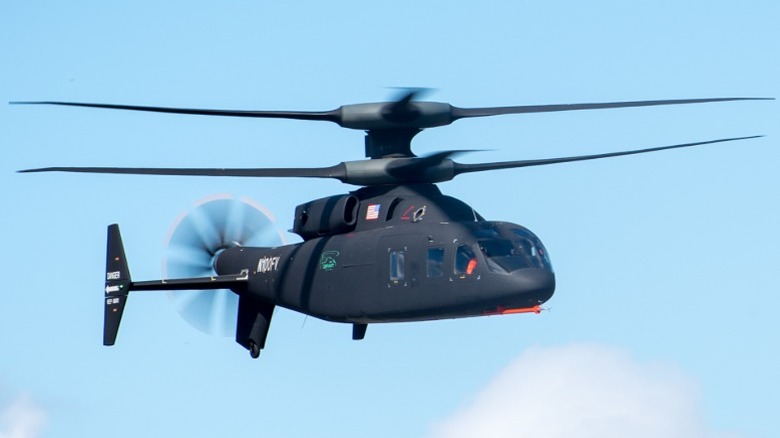
The SB>1 Defiant was Sikorsky and Boeing's joint entry in the U.S. Army's Future Long-Range Assault Aircraft competition, and it was built from the ground up to exceed conventional helicopter speed limits. The experimental aircraft has flown up to 247 knots, or about 284 mph — that's nearly 90 knots faster than a Black Hawk at full tilt, and it comes from an entirely different configuration: rigid coaxial rotors paired with a rear pusher propeller.
The Defiant's rivals at Bell, flying the tiltrotor V-280 Valor, ultimately won the FLRAA contract. Still, the Defiant proved the coaxial-pusher concept could deliver high speed without sacrificing low-speed agility (Sikorsky and Boeing also demonstrated tight, low-altitude maneuvering and a 700-nautical-mile cross-country flight during testing). This rotorcraft hasn't entered production, but as a technology demonstrator, it showed just how much faster next-generation Army helicopters could fly compared to the Black Hawk it may eventually help replace.
Sikorsky S-97 Raider
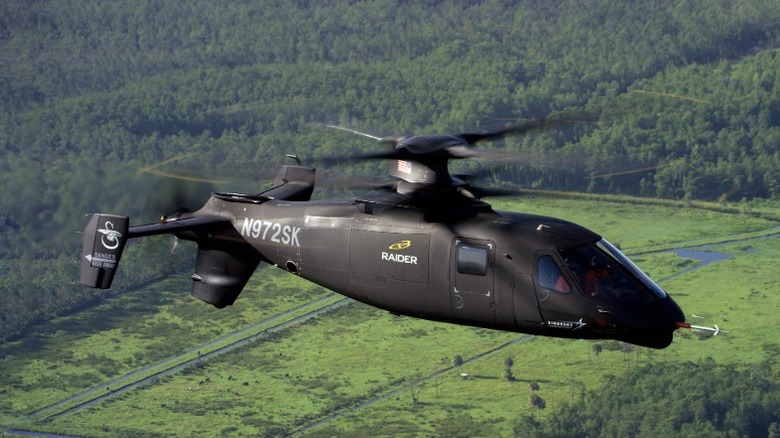
Sikorsky's S-97 Raider is a smaller sibling of the Defiant, built to compete for the Army's Future Attack Reconnaissance Aircraft program. Like the Defiant, it uses Sikorsky's X2 compound design: rigid coaxial rotors and a pusher propeller in the tail for speed and lift. That combination pushes the Raider's top speed a bit past 220 knots (253 mph).
That speed comes with a clever trick. At high velocity, the Raider's flight-control software shifts most of the engine's power to the pusher prop, letting the rotors spin just fast enough to keep the aircraft aloft while the propeller does the work of pushing it forward. When stealth matters more than speed, the pilot can disengage the prop entirely and cruise on rotor power alone at a quieter 130 knots. And the rigid-rotor design, which tamps down vibration at speed, also sharpens the Raider's handling. This gives Sikorsky's compound helicopter both a straight-line speed advantage and sports-car-like agility that a conventional single-rotor Black Hawk simply can't match.
Bell AH-1Z Viper
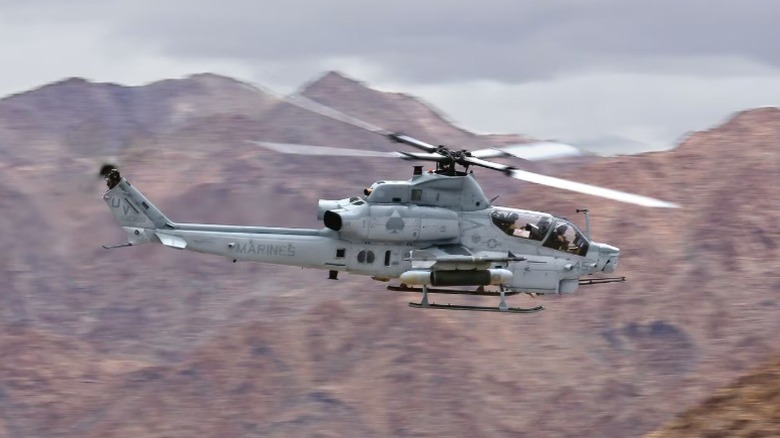
The Bell AH-1Z Viper is the U.S. Marine Corps' primary attack helicopter, and it descends from a Cobra lineage that stretches back to the Vietnam War. Bell's own performance figures list the Viper's maximum speed at 200 knots, or about 230 mph, putting it more than 40 knots ahead of the Black Hawk. That speed comes from a four-blade, all-composite main rotor and an uprated transmission; these changes also gave the Viper sharper handling than the two-blade Cobras it replaced.
Where the Black Hawk is built to move troops and cargo, the Viper is built to find and destroy targets. To get the job done, it carries the AIM-9 Sidewinder air-to-air missile, along with a full load of Hellfires and guided rockets. The AH-1Z shares roughly 85% of its components with the utility-focused Bell UH-1Y Venom, a commonality that simplifies logistics and maintenance for Marine aviation units running both types side by side. Fully combat-ready since 2011, the Viper has since entirely replaced the older AH-1W Super Cobra in Marine Corps service.
Bell AH-1W Super Cobra
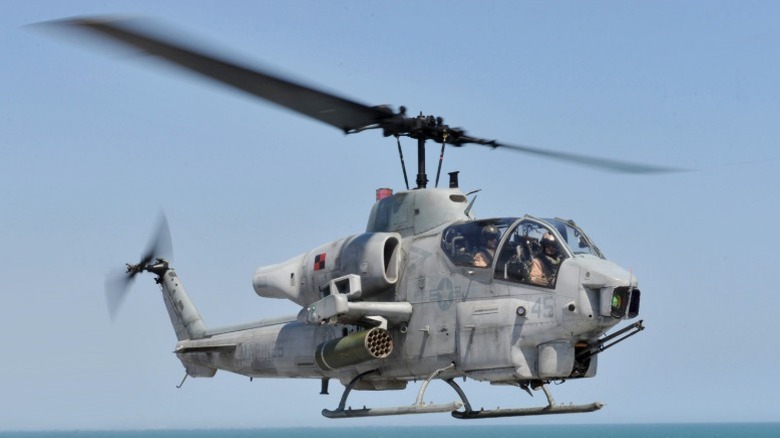
Before the Viper took over, the twin-engine AH-1W Super Cobra was the Marine Corps' attack helicopter of choice for more than three decades, and it could reach a maximum speed of 190 knots, or roughly 219 mph — a 30-knot edge over the Black Hawk. That performance came from two General Electric T700 turboshaft engines. Each of these engines produced around 1,690 shaft horsepower (SHP), replacing the single engine of the earlier AH-1 Cobra and giving Marine aviators a welcome safety margin over water and in combat.
The Super Cobra earned its reputation during the 1991 Gulf War, when Marine Corps AH-1Ws were credited with destroying about 104 armored vehicles and 97 tanks. The Cobra went on to see action in multiple conflicts, including Operation Iraqi Freedom during the Iraq War and Operation Enduring Freedom during the American occupation of Afghanistan, before the Marine Corps finally retired the type in October 2020, handing its mission entirely to the AH-1Z Viper. A number of Super Cobras remain in service abroad in Turkey, Taiwan, and Iran.
Mil Mi-24 Hind
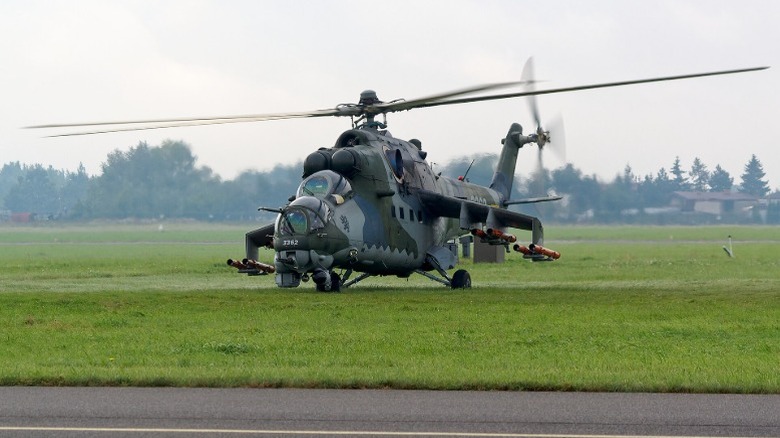
NATO calls it the Hind, but Soviet crews knew the Mi-24 as the "flying tank," and Afghan fighters who faced it called it "Satan's chariot." What makes the Hind unlike any Western attack helicopter is that it can also carry up to eight fully equipped troops in a rear cabin, letting a single aircraft suppress a landing zone and then land its own assault squad. Its maximum speed of 208 mph, or about 181 knots, is more than 20 knots faster than the Black Hawk; this figure is aided by stub wings that generate lift in fast forward flight, taking some of the load off the five-blade main rotor.
The Hind's power comes from two Klimov (originally Izotov) TV3-117 turboshaft engines, which together produce about 4,400 SHP. This craft first flew in 1969 and became infamous during the Soviet-Afghan War. It was not until American Stinger missiles gave mujahideen fighters a way to strike back that they stood a chance against "Satan's Chariot." Over fifty countries have flown the Mi-25 and Mi-35 exported versions of the aircraft since then, and Mi-35M rotorcraft are still being produced today.
Airbus H225M Caracal
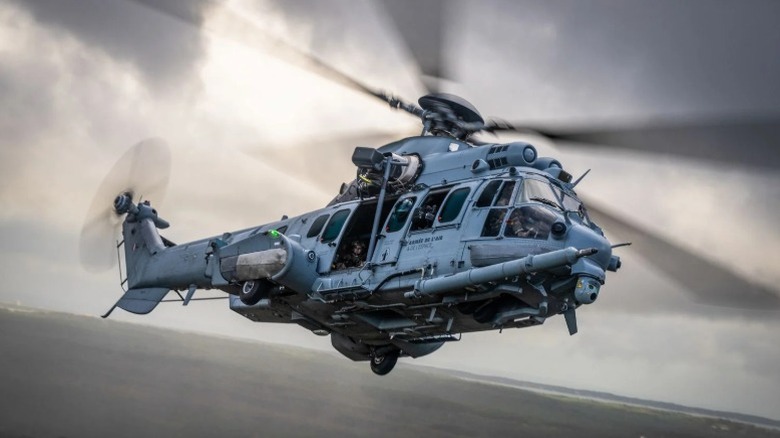
The Airbus H225M Caracal is an 11-tonne, twin-engine military helicopter built for exactly the kind of long-endurance, fast-cruise missions its name implies. Airbus markets it as a "force multiplier" for exactly that reason. Its maximum speed is listed at 175 knots (201 mph), about 16 knots faster than the Black Hawk, while its recommended cruise speed of 262 km/h (about 163 mph) still gives crews a comfortable margin for covering ground quickly.
Two Safran Makila 2A1 turboshaft engines, producing around 1,567 kW at takeoff, power the Caracal's 16.2-meter rotor, and the airframe can carry up to 28 troops or be configured for combat search and rescue, special operations infiltration, and tactical transport. With standard tanks, the Caracal can cover roughly 920 km (approximately 572 miles), or about 1,253 km (approximately 779 miles) with extended fuel tanks, and has an endurance of up to 4.5 hours. These numbers make it a favorite for long-range special-operations missions where speed and range matter just as much as raw lift capacity.
Sikorsky CH-53E Super Stallion
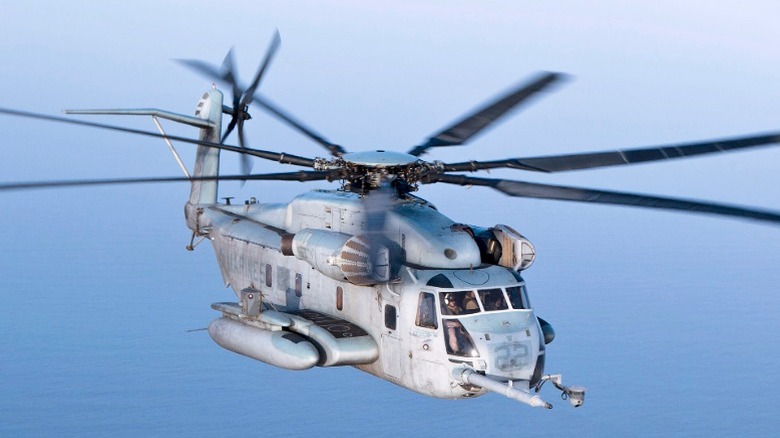
Heavy-lift helicopters aren't supposed to be fast, but the Sikorsky CH-53E Super Stallion manages a top speed of 196 mph — about 170 knots — which is enough to edge out the Black Hawk despite carrying vastly more weight. First flown in 1974 and in Marine Corps service since 1981, the Super Stallion is powered by three General Electric T64 turboshaft engines producing more than 14,250 SHP combined. While there were CH-53 variants before it, the CH-53E Super Stallion was special not only because it featured a new third engine but also because it featured a larger, seven-blade main rotor with composite rotor blades.
That extra power lets the CH-53E move serious loads: an internal payload of around 7,000 kg, an external sling load of about 14,000 kg, and up to 55 troops in a stretched configuration. The Marine Corps used the Super Stallion for amphibious assault and heavy-equipment transport for decades, while the Navy relied on it to recover damaged aircraft from carrier decks. A specialized mine-countermeasures variant, the MH-53E Sea Dragon, remains in Navy service today, even as the newer CH-53K takes over the Marine Corps' heavy-lift mission.
Sikorsky CH-53K King Stallion
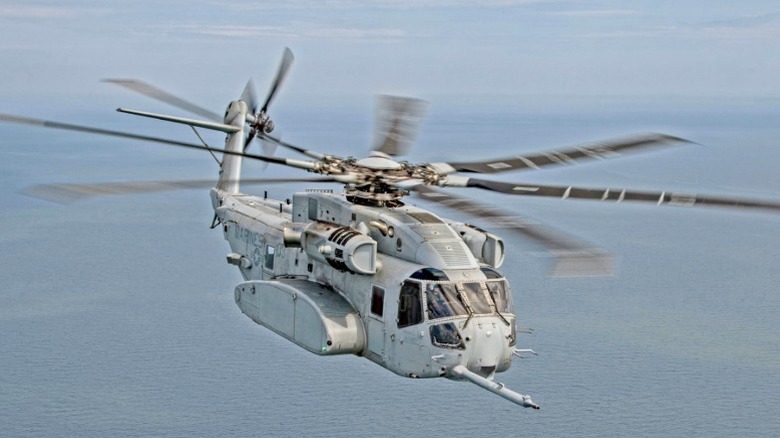
Tagged "the most powerful helicopter in the Department of Defense," the CH-53K King Stallion is the U.S. military's newest heavy-lift helicopter and has one of the most powerful engines ever used in a rotorcraft. Remarkably, it cruises at around 170 knots — the maximum speed of the CH-53E it's replacing — despite having almost triple its baseline strength. Three General Electric T408 turboshaft engines, each rated around 7,500 SHP, give the King Stallion enough muscle to lift 27,000 pounds at a 110-nautical-mile radius even in hot, high-altitude conditions — a benchmark the older Super Stallion couldn't even begin to approach.
First flown in October 2015 and supplied to the Marine Corps starting in 2018, the King Stallion is built almost entirely new, with fourth-generation composite rotor blades, fly-by-wire flight controls, and a cabin 12 inches wider than its predecessor's — wide enough to load a Humvee internally. In September 2025, the Navy awarded Sikorsky an almost $11 billion contract for up to 99 more King Stallions, cementing the CH-53K as one of the most important aircraft in the future of American warfare.
Boeing CH-47F Chinook
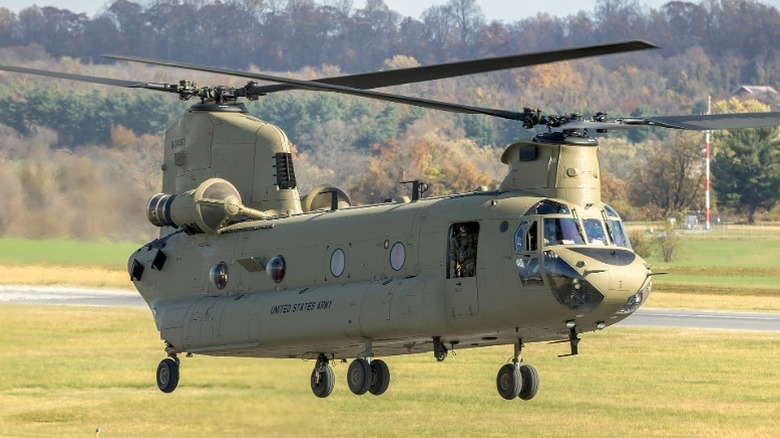
The tandem-rotor CH-47 Chinook goes back to Vertol, which began developing it before Boeing entered the picture; the aircraft first flew in September 1961 and entered Army service the following year. Boeing's current Block II variant has a maximum speed of about 170 knots (196 mph) and a cruise speed of about 157 knots (183 mph); the Australian Army notes that this makes the rotorcraft particularly fast compared with most other contemporary helicopters that combine utility and attack capabilities. Two Honeywell T55-GA-714A engines, each one rated at 4,777 SHP (3,562 kW), power the aircraft, and because the tandem rotors handle lift and control without a tail rotor, the design gives the Chinook stability in high winds and unrestricted rear-ramp access for loading.
The CH-47F remains the Army's main heavy-lift cargo helicopter; it supports disaster relief, homeland defense, and overseas contingency operations. Even more impressive is that the Block II upgrade adds 4,000 pounds to the aircraft's maximum gross weight, along with fuel-system changes that extend its combat radius. Not only the U.S. Army, but also the U.S. Special Operations Command and 20 international countries, according to Boeing, use this rotorcraft. It is worth noting that even now, the CH-47F holds the Guinness World Record for the fastest military helicopter. This record, however, is from 1961, and helicopters have since flown faster than 315 km/h (170 knots).
Bell UH-1Y Venom
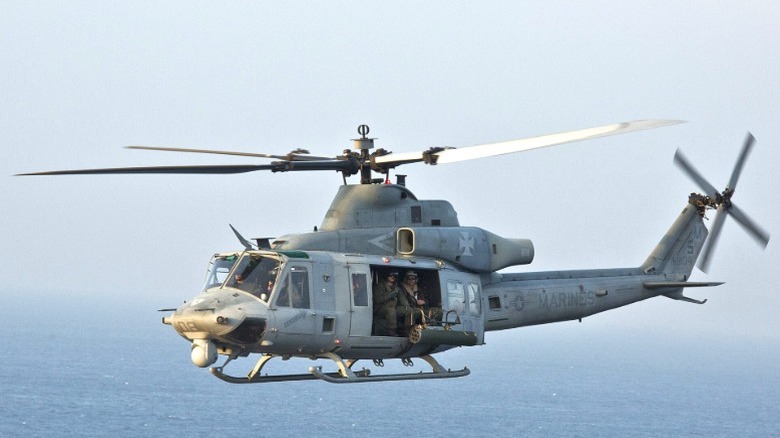
The Bell UH-1Y Venom is the modern successor to the Vietnam-era "Huey," and Bell's specifications put its maximum speed at 170 knots — around 196 mph — enough to beat the Black Hawk by more than 10 knots. Twin T700-GE-401C engines, the same engines used in the AH-1Z Viper, give the Venom the power to serve as a true multi-role utility helicopter, handling everything from troop transport and command-and-control to armed escort and search-and-rescue.
The shared engine and component set is deliberate. As mentioned earlier, the UH-1Y and AH-1Z share about 85% of their parts, allowing the Marine Corps to operate both aircraft side by side through a single logistics and training pipeline. This utility is why the U.S. Marines use this aircraft rather than the Black Hawk or Apache.
The Venom carries forward-looking infrared sensors for target identification, a helmet-mounted sight display for its pilots, and a versatile weapons fit of rockets and crew-served guns, all wrapped in a marinized airframe built to withstand shipboard saltwater exposure; this makes the craft as comfortable escorting a convoy as it is ferrying Marines ashore.
Kamov Ka-50 Black Shark
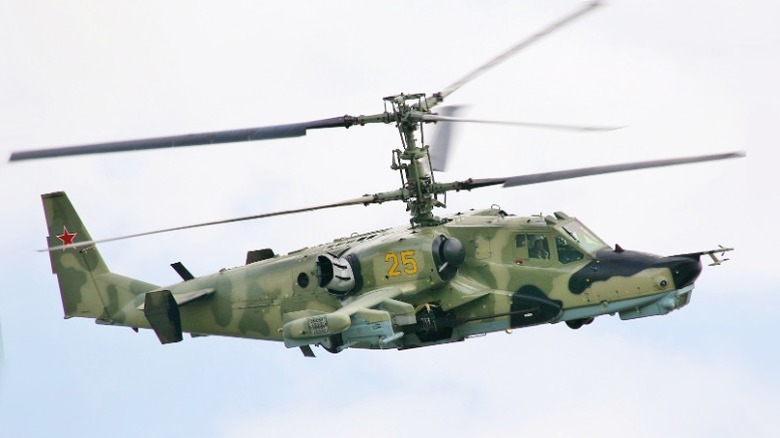
Russia's Kamov Ka-50 "Black Shark" took a completely different approach to helicopter design, and its top speed of about 170 knots proves the formula worked. Rather than a single main rotor and a tail rotor, the Ka-50 uses Kamov's signature coaxial rotor system — two contra-rotating rotors stacked on the same mast and along the same axis. This design approach eliminates the power losses and complexity of a tail rotor entirely, freeing up more engine output for speed and lift.
Powered by two Klimov TV3-117VMA turboshaft engines producing around 2,200 SHP each, the single-seat Ka-50 was designed in the 1980s as a dedicated tank-killer, armed with a 30mm gun and up to 12 laser-guided Vikhr anti-tank missiles. It's also one of the few attack helicopters ever fitted with an ejection seat for its pilot, a feature made possible by the coaxial rotors, which could be explosively jettisoned before ejection. Only a small number were built before Russia shifted its attention to the two-seat Ka-52 derivative; however, the Black Shark's coaxial-rotor speed advantage over the Black Hawk remains obvious on paper.
Kamov Ka-52 Alligator
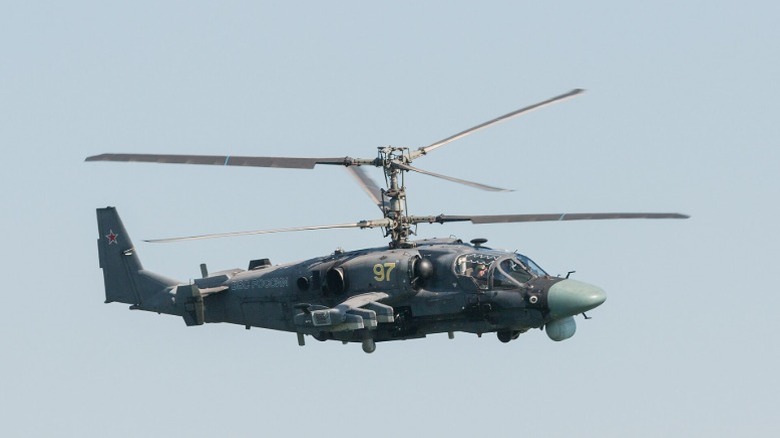
The Kamov Ka-52 Alligator is a twin-seat, all-weather development of the single-seat Ka-50, sharing roughly 85% parts commonality with its predecessor while swapping in a side-by-side cockpit fitted with K-37-800M ejection seats for both crew members. The helicopter first flew in June 1997, entered serial production in 2008, and was fielded by the Russian Air Force starting in 2011 — the same year that Russia's defense ministry ordered 140 of the type. Two Klimov VK-2500 turboshaft engines, each producing up to 2,400 hp at takeoff, drive the tail-rotor-free coaxial rotor system, and give the Ka-52 a top speed of about 162 knots (approximately 186 mph) and a cruise speed of about 140 knots (approximately 161 mph).
Fitted with Vikhr-1 and Ataka anti-tank missiles, a 30 mm 2A42 cannon, S-8 rockets, and the newer TV-guided LMUR missile, the Ka-52 has become one of Russia's most relied-upon strike platforms in its war against Ukraine. The UK Ministry of Defense has called it "one of the single most influential Russian weapon systems," and Ukrainian media reportedly nicknamed it "Putin's vulture" after it began inflicting heavy losses on their advancing armor. That reputation has come at a cost, however; open-source trackers estimate Ukraine has shot down as many as 50 Ka-52s since the invasion.
Mil Mi-28N Havoc
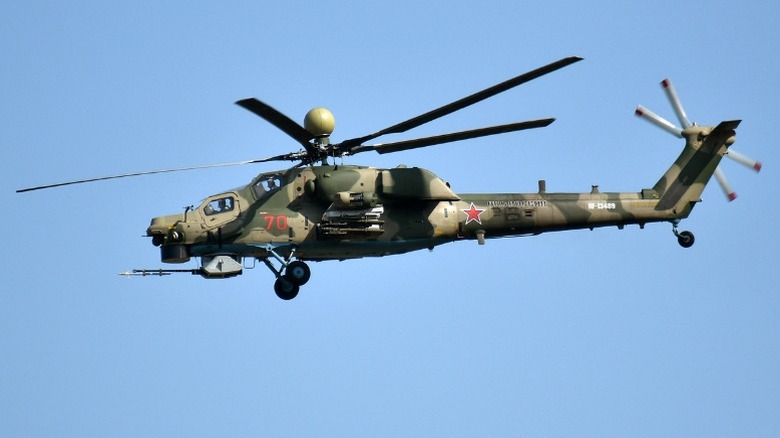
The Mi-28, NATO's "Havoc," was developed by the Mil Moscow Helicopter Plant as Russia's dedicated attack helicopter. The company rolled out a day/night-capable prototype, the Mi-28N "Night Havoc," in August 1996. The first production of this variant finally flew in April 2004, and by June of the next year, the Russian Air Force was already flight-testing it. With a maximum speed of about 162 knots, the Havoc is another helicopter that is more than capable of competing with the Black Hawk in terms of speed. The newest variant, the Mi-28NM "Night Superhunter," has flown over Syria and adds the N025E radar (previously fitted only to export models) mounted above the rotor in a distinctive ball-shaped fairing, giving the crew an all-round view of the battlefield while staying hidden behind terrain.
The Night Superhunter's VK-2500P-series engines are built to maintain performance in extreme climates, and its networked avionics also allow it to receive targeting data from other aircraft and intelligence units, improving how quickly crews can react to threats. Its armament carries over from earlier Havocs: a turreted 2A42 30 mm cannon and up to 16 Shturm and Ataka anti-tank missiles, the latter with an 8 km (4.3 miles) range and a tandem warhead capable of penetrating up to 1,000 mm of armor.
Airbus NH90
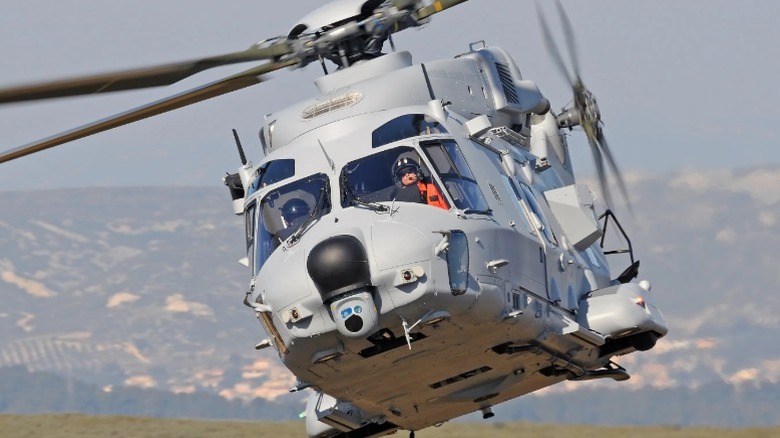
Developed by the multinational NHIndustries consortium — Airbus Helicopters, Leonardo, and Fokker — the NH90 traces back to a late-1980s NATO initiative, with France, Germany, the Netherlands, and Italy joining forces to build it. Airbus lists the craft's maximum cruise speed at 300 km/h, or about 162 knots, a feat supported by twin RTM 322-01/9 or GE T700/6E1 engines, producing up to 2,388 SHP or 2,269 SHP, respectively, at takeoff.
The NH90 comes in two main variants: the ship-based NFH for anti-submarine and anti-surface warfare, which can carry an anti-ship missile and a torpedo simultaneously and has automatically folding blades and tail for shipboard storage; and the TTH tactical transport, combat-tested since 2010 in Afghanistan, Mali, Iraq, and Gabon. A new TTH variant for special forces, the NH90 Standard 2, was delivered to France's Armament General Directorate in July 2026. The first of 18 aircraft were for the French Army's special forces squadron in Pau, with Spain joining the program in December 2025 for 31 more.