

Why US Marines Don't Fly Apache Or Black Hawk Helicopters
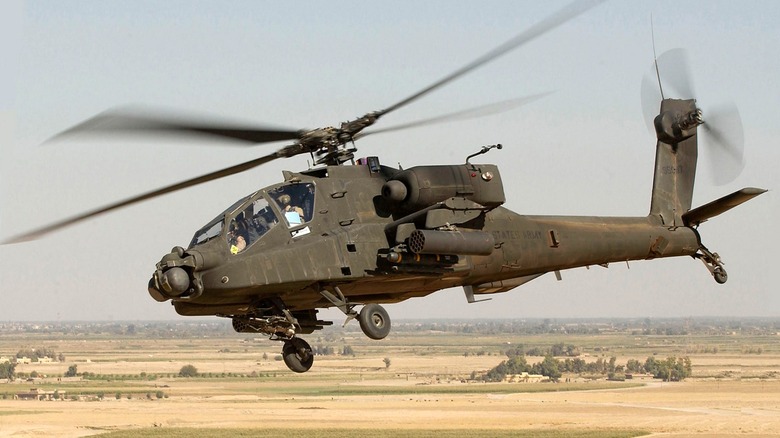
The United States military employs many different helicopters across its branches, and many are well known to the public. Perhaps two of the best-known choppers in the military inventory are the AH-64 Apache and the UH-60 Black Hawk. These vehicles are ubiquitous wherever the Army operates, get a lot of press coverage, and have featured in movies like "Black Hawk Down." Variants are in use by every service save one: the U.S. Marine Corps (USMC).
That may seem like a bit of a mystery. After all, they're highly capable helicopters that would likely benefit the Corps, which flies plenty of choppers. While the USMC could use other helicopters, it doesn't, and the primary reason is the different environments in which the Corps operates. The AH-64 is fine for the U.S. Army, but it doesn't meet the needs of the USMC.
The same is true of the UH-60, which isn't ideal in a saltwater environment. Both helicopters were designed for ground operations, but the Marine Corps requires robust systems and vehicles that work well in littoral combat zones, out on the open ocean, and along coastal regions. Instead of the aforementioned, the USMC flies the AH-1Z Viper as its primary attack chopper and the UH-1Y Venom for utility purposes. The Corps operates other helicopters for various reasons, including the MV-22 Osprey tiltrotor aircraft, but the AH-1Z and UH-1Y fill the same roles as the AH-64 and UH-60, respectively.
The Marines have their own fleet of helicopters
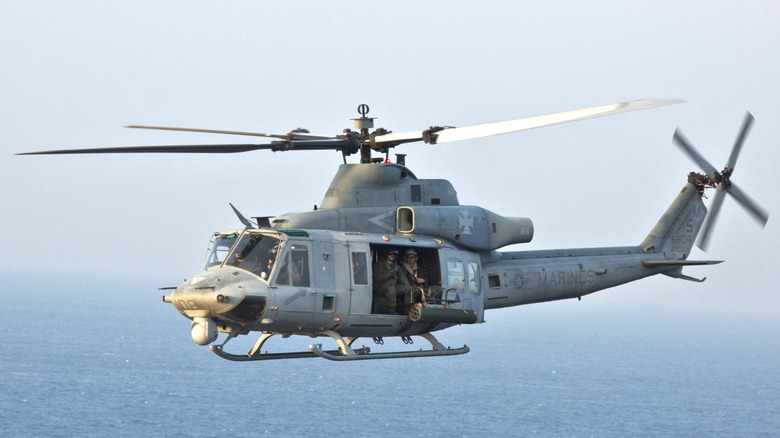
Using the UH-60 or AH-64 would require the USMC to heavily modify the aircraft to make them suitable for its needs, and the service already has choppers filling those roles. The UH-1Y Venom is an upgraded version of the UH-1, first introduced in 1962. The UH-1Y entered service in 2008 after a 12-year development phase, so it's a far newer platform with robust capabilities. The Venom can land on flattops, is designed to operate in the same environments as the USMC, and has a proven track record.
There's simply no reason to fly the UH-60 when the UH-1Y exists. The latter was designed specifically for the USMC, whereas the UH-60 wasn't. There are Black Hawk variants that operate for the Navy, but the Corps is sticking with its UH-1Y for the foreseeable future. The same is true of the AH-1Z Viper, another aircraft that has a long history.
The platform is the U.S. military's oldest attack helicopter, but like the UH-1Y, the AH-1Z is vastly upgraded over its initial model, which entered service in 1962. Like the Venom, the Viper was built specifically for USMC operation, and it entered service in 2010. The Corps received its final AH-1Z in 2018 and plans to fly the AH-1Z for decades, so it's not looking to replace the Viper with another aircraft for some time.