

Every Class Of Battleship The U.S. Navy Operated In WWI And WWII
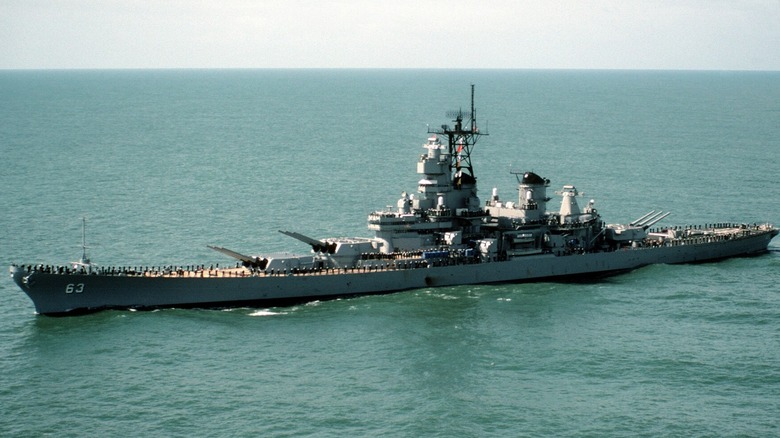
Throughout much of the early 20th century, the United States Navy centered its combat around battleships. The massive vessels packed a punch, delivering steel in numerous conflicts throughout the century. The first U.S. Navy battleships arrived in the late 19th century with the USS Indiana (BB-1), entering the fleet in 1895. While powerful, the USS Indiana doesn't fit the modern description of a battleship.
20th-century battleships were significantly larger, with more weapons systems and better propulsion; these were identified as dreadnoughts. A dreadnought was the pride of any blue-water navy, and while they've all since been decommissioned, there's no denying that an American battleship that served during WWI and/or WWII was an impressive ship, and the U.S. fielded a lot.
Every battleship is designated with a "BB," and by the time the U.S. stopped using them, 59 battleships had served the fleet. While President Donald Trump ordered the creation of a new Trump-class battleship, it's unlikely to come to fruition for various reasons, leaving the USS Missouri (BB-63), "Mighty Mo," the last battleship operated by the U.S. Navy. Each of these battleship classes was designed and built in the 20th century, and their ships played a part in numerous conflicts, most notably WWI and WWII.
South Carolina
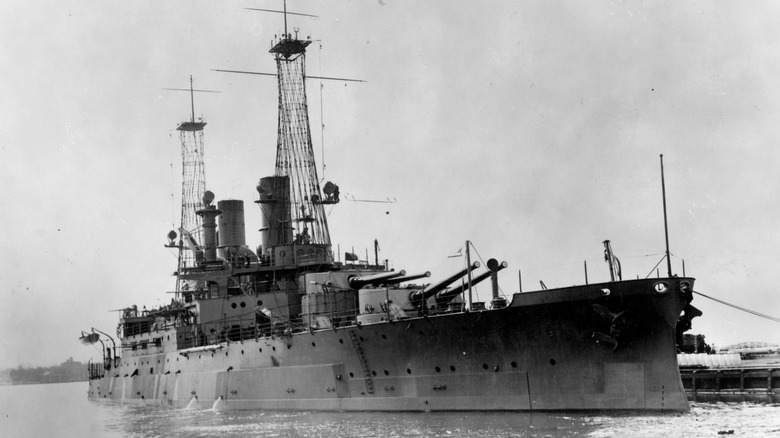
The 20th century saw a redesign of naval vessels, including battleships. This resulted in the introduction of the U.S. Navy's first dreadnoughts, the USS South Carolina (BB-26) and the USS Michigan (BB-27). The idea was to change battleship design to favor larger guns, additional armor, and improved speeds. To that end, the two ships of the South Carolina-class were built in the image of the United Kingdom's HMS Dreadnought.
Previous battleships favored guns of varying caliber, some of which could be fired more rapidly than others. Innovations in gun and targeting technology led designers to close the gap by using large batteries of the same caliber, ushering in a new era of battleships that could better engage multiple targets. Both vessels were outfitted with four 12-inch gun turrets mounted in pairs.
The ships weighed in at 16,000 tons and were both commissioned in 1910. The USS South Carolina spent much of WWI operating in the Western Hemisphere, though the vessel escorted a convoy across part of the Atlantic Ocean in 1918. The USS Michigan suffered several accidents, but it entered the war primarily as a convoy escort and troop transport. Both battleships survived the war and were later scrapped following the Washington Naval Treaty of 1922.
Delaware
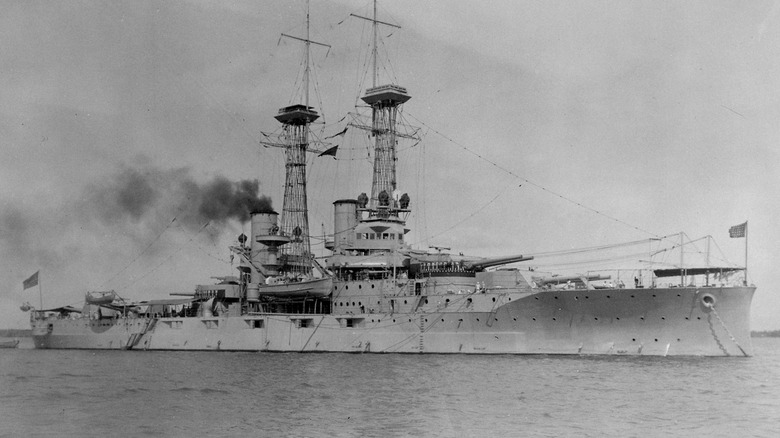
For its next class of battleships, the U.S. Navy broke away from the 16,000-ton limit, producing the USS Delaware (BB-28) and the USS North Dakota (BB-29) at 20,000 tons. This overcame several notable flaws, which had to be addressed to maintain the congressionally mandated limit on capital ship construction. Both vessels were outfitted with 10 12-inch guns in five turrets, increasing their lethality over their predecessors.
They were also faster than the South Carolina class battleships, managing speeds of 24 mph over the previous ships' top speed of 20.7 mph. The new speed set the Delaware-class ships apart from other dreadnoughts of the era, and they both participated in WWI. The USS Delaware initially operated in a training capacity along the U.S. East Coast, but in 1917, the ship joined the British Grand Fleet in the U.S. Sixth Battle Squadron.
By July 1918, the USS Delaware returned home. It was decommissioned and sold for scrap in 1924. The USS North Carolina served as a gunnery and engineering training ship, participating only in bombing tests and seeing no combat. The North Carolina was decommissioned and demilitarized before it was sold for scrap in 1931.
Florida
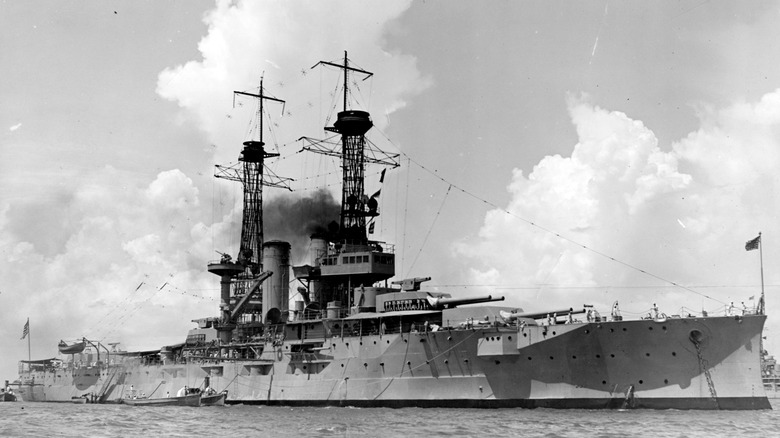
The USS Florida (BB-30) and the USS Utah (BB-31) joined the fleet in 1911 as slightly larger versions of the preceding class. Each ship weighed 21,825 tons and was packed with firepower. The two battleships were outfitted with 10 12-inch guns and 16 5-inch guns alongside two 21-inch torpedo tubes. Both vessels featured steam turbine engines, whereas previous battleships utilized a mixture of propulsion technology.
The USS Florida and USS Utah deployed to Europe during WWI, where the Florida served in the North Sea until escorting President Woodrow Wilson to France in December 1918. After the war, the Florida was modernized, but by 1931, it was decommissioned and scrapped in accordance with the 1930 London Naval Limitations Treaty. The USS Utah served in the Atlantic Ocean as a covering force for convoys.
After the war, the USS Utah received a modernization update and served in various capacities before being converted into a radio-controlled target vessel in 1931. It continued operating for training purposes until the 1941 attack on Pearl Harbor. The Utah was one of the vessels moored in the harbor on December 7th. It sank after being struck by two torpedoes. The wreck was partially righted and moved out of the area, and remains in its final resting place near Ford Island.
Wyoming
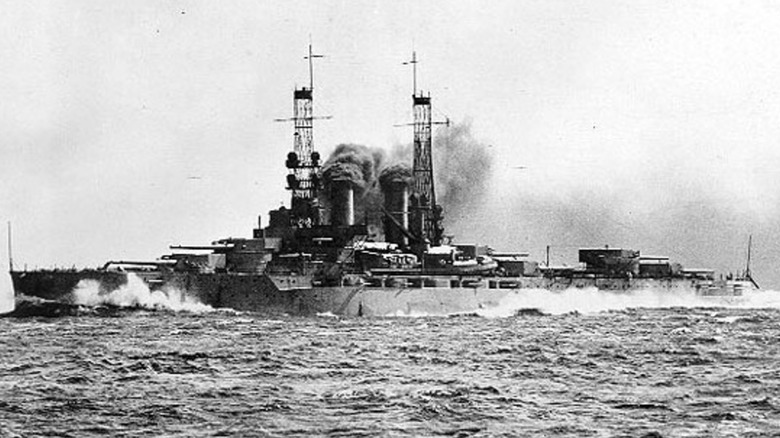
In 1912, the U.S. Navy commissioned the USS Wyoming (BB-32) and the USS Arkansas (BB-33). One of the ships' biggest improvements was the adoption of a new 12-inch/50 caliber Mk. 7 gun, increasing the battleships' firepower over the previous 12-inch/45 caliber Mk. 5 guns. They also featured an additional turret, more armor, and a torpedo bulkhead, which was a type of armor designed to keep the ship afloat after a strike.
In 1917, the USS Wyoming joined the British Grand Fleet in the North Sea and remained in operation with the Sixth Battle Squadron until the 1918 Armistice. The ship was demilitarized in 1931 and used for training purposes, which continued into WWII. Throughout that conflict, the Wyoming remained in Chesapeake Bay, training sailors on its reinstalled guns. In 1947, the Wyoming was sold for scrap, ending decades of service.
The USS Arkansas also served in the Grand Fleet and remained attached to the Pacific Fleet following the war. In June 1944, the Arkansas fired its guns in support of Operation Overlord as U.S. troops and allied personnel stormed the beaches of Normandy, France. It later supported the U.S. Marine Corps' operations at Iwo Jima and Okinawa, Japan. In 1946, the Arkansas served as a target ship off Bikini Island for nuclear testing, resulting in its sinking.
New York
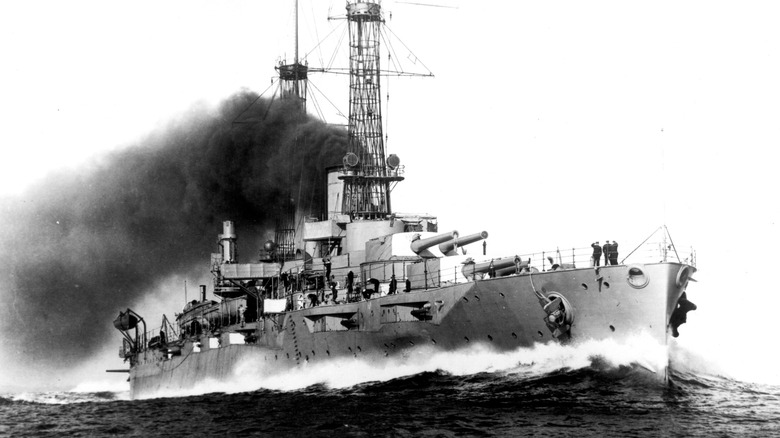
Both ships of the New York-class served in WWI and WWII, with extensive combat action seen by each vessel. The USS New York (BB-34) and USS Texas (BB-35) carried additional armor over earlier ships and received an upgraded weapon system. They were the first U.S. battleships to use 14-inch/45 caliber guns. Because they served extensively in WWI and WWII, each ship was overhauled numerous times.
This was done primarily to include or increase anti-aircraft defenses, as the ships weren't built with that in mind when they were commissioned in 1914. The vessels also weighed significantly more than their predecessors, displacing 27,000 tons of seawater. The USS New York served as the flagship of American battleships throughout WWI. In WWII, it served convoy escort duties and engaged in several campaigns at Iwo Jima and Okinawa before becoming a nuclear bomb target ship in 1946.
Due to its radioactivity, the New York was used as a target ship off the coast of Pearl Harbor in 1948. The USS Texas served in the Grand Fleet in WWI and saw action throughout WWII. It served in the Atlantic and Pacific, engaging in numerous island-hopping campaigns. After the war, the ship was given to Texas, which transformed the USS Texas into a museum ship.
Nevada
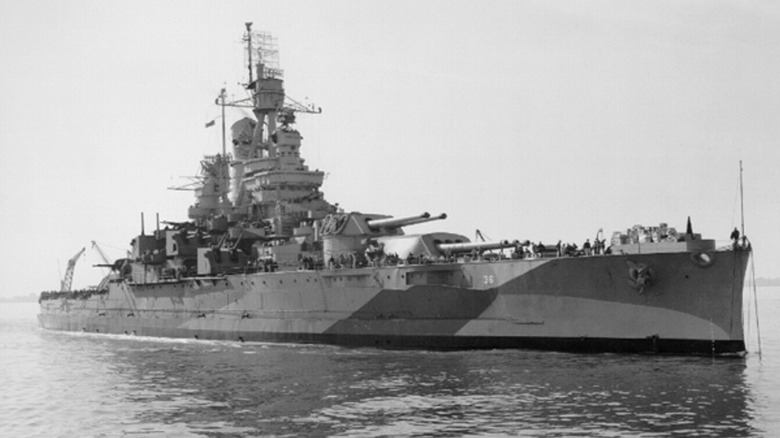
While the upgrades made to the New York-class battleships approached the super-dreadnought classification, it was the USS Nevada (BB-36) and the USS Oklahoma (BB-37)that fit the description. They got there by using an "all or nothing" armor design that favored protection during long-range combat.
The Nevada-class battleships weighed 27,500 tons and carried 10 14-inch guns, 21 5-inch guns, and four 21-inch torpedo tubes. They served in an escort capacity during WWI, but didn't engage the enemy before the 1918 armistice ended the conflict. That wasn't the case for WWII, as both were moored in Battleship Row in Pearl Harbor on December 7, 1941. The Japanese sneak attack successfully sank the USS Oklahoma, while the USS Nevada purposefully grounded itself to avoid sinking.
The Nevada was salvaged, repaired, and modernized to return to the fight. The battleship served during numerous operations, including Operation Overlord, at Iwo Jima, and at Okinawa. After the war, the USS Nevada served as a target ship for nuclear testing, which it survived. The Nevada was purposefully sunk off the coast of Hawaii, where it remains to this day, though the wreck wasn't discovered until 2020.
Pennsylvania
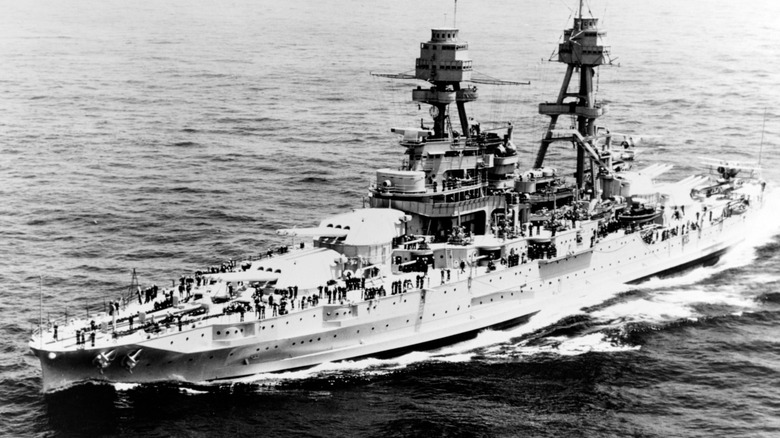
When the U.S. entered WWI in 1917, it had two brand new, shiny battleships: the USS Pennsylvania (BB-38) and the USS Arizona (BB-39). Both ships were designed with "all or nothing" armor; they featured two more 14-inch/45 caliber guns and thicker armor designed to keep the ships in the fight for as long as possible. These were "standard-type" battleships with their layout of 12 14-inch guns in four triple-barreled turrets.
The Pennsylvania-class battleships displaced 31,400 tons of seawater and utilized oil fuel over previous coal-powered ships. This innovation kept the battleships out of combat during WWI due to fuel shortages, though they were in operation at the time. During WWII, the USS Pennsylvania served as the flagship of the U.S. Fleet. The ship was lightly damaged during the Pearl Harbor attack and went on to participate in multiple combat operations.
After the war, the Pennsylvania served as a target ship for nuclear testing and was scuttled at sea in 1948. Unlike the Pennsylvania, the USS Arizona was completely destroyed and sunk during the Pearl Harbor attack, resulting in the loss of 1,100 sailors entombed where the Arizona sank. Some of its guns were salvaged and transferred to the U.S. Army for coastal defenses.
New Mexico
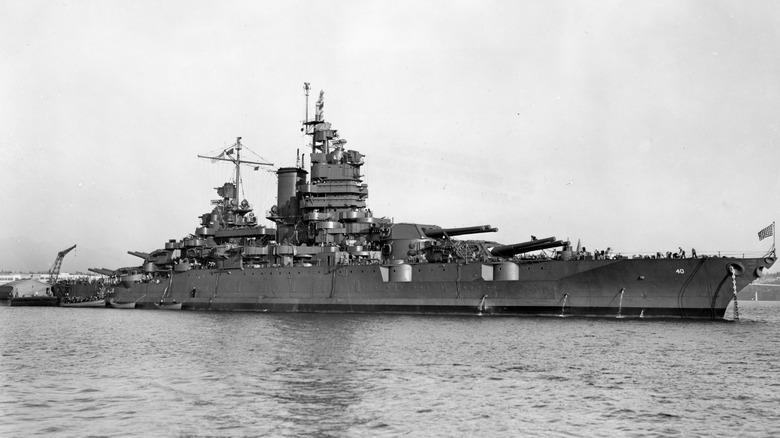
When the New Mexico-class came into being, it resulted in the commissioning of three ships, not two, like earlier dreadnoughts. These were the USS New Mexico (BB-40), USS Mississippi (BB-41), and USS Idaho (BB-42), all standard-type battleships. They featured the same 14-inch gun as the preceding class, but upgraded from 45 to 50 caliber. They also displaced 32,000 tons of seawater and maintained the standardized speed of 24 mph.
While the USS Mississippi and Idaho featured traditional propulsion tech, the USS New Mexico was outfitted with a new General Electric turbo-electric drive. The ships didn't serve in combat in WWI, but they did in WWII. The USS New Mexico operated first in the Atlantic and then the Pacific in 1942. It served during numerous operations before being sold for scrap in 1947.
The USS Mississippi served in the Pacific Fleet and became a gunnery training ship in 1946. The Mississippi served until 1956, when it was sold for scrap after nearly 40 years of service. The USS Idaho served in the Atlantic Fleet, operating against Germany until making its way to the Pacific in 1942. After the war, the Idaho was decommissioned in 1946 and sold for scrap the following year.
Tennessee
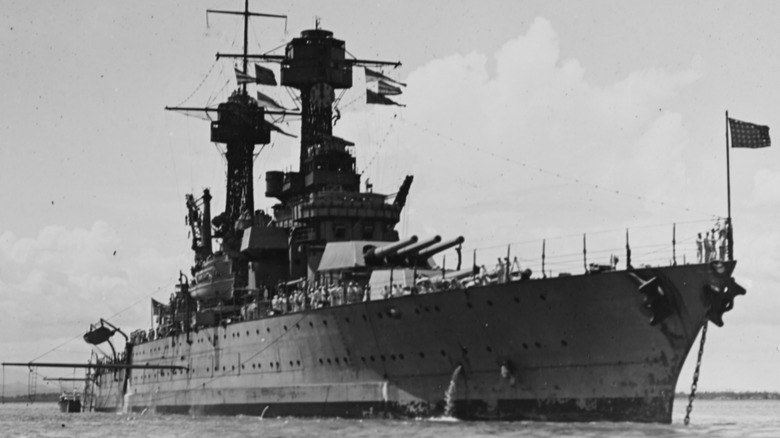
The Tennessee-class battleships, of which there were two, were similar to the New Mexico-class, though they featured some enhancements to their armor and range. The USS Tennessee (BB-43) and USS California (BB-44) were the first battleships commissioned after WWI, so they didn't have the chance to serve during the conflict. During the interwar period, both 32,300-ton battleships were used primarily for training, but that changed in 1941.
Both the USS Tennessee and USS California transferred to the Pacific Fleet as tensions with Japan rose. They were moored in Battleship Row during the attack on Pearl Harbor. The Tennessee was hit by two bombs, damaging its gun turrets. The ship survived, was overhauled, and modernized. Throughout the rest of the war, the Tennessee fought numerous operations in the Pacific, firing nearly 1,400 14-inch and 6,000 5-inch rounds during the Battle of Okinawa.
After the war, the Tennessee was decommissioned and placed in the Atlantic Reserve Fleet before it was sold for scrap in 1959. The USS California was hit by bombs and torpedoes, which sank it. It took two and a half years to fully salvage and repair the California, which reentered the fight in 1944. It was also decommissioned to the Atlantic Reserve Fleet for a dozen years before it was sold for scrap in '59.
Colorado
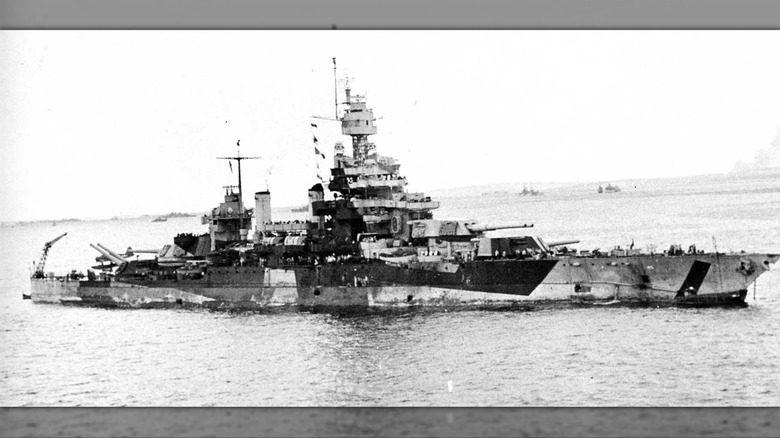
While the Colorado-class was designed during WWI, none of the three ships entered the fleet until 1921. Initially, four were planned, but the Navy only produced the USS Colorado (BB-45), USS Maryland (BB-46), and the USS West Virginia (BB-48); there is no BB-47, as the USS Washington was never completed. The class's ships displaced 32,600 tons of seawater and were the last of the standard-type battleships. They were similar to the Tennessee-class battleships, but featured eight 16-inch guns.
The USS Colorado was being overhauled during the attack on Pearl Harbor, and it remained in the Pacific throughout the war, participating in numerous operations. It was decommissioned in 1947 and placed in the reserve fleet before it was sold for scrap in 1959. The USS Maryland was moored at Pearl Harbor during the attack, but wasn't heavily damaged.
It served in the Pacific and survived the war. The Maryland entered the reserve fleet and was sold for scrap in '59. The USS West Virginia was also at Pearl Harbor on December 7, 1941, where it was struck by two bombs and seven torpedoes. The ship sank and was later salvaged, but remained out of action until July 1944. It served in the Pacific and was also decommissioned in 1947, placed in reserve, and ultimately scrapped in 1959.
North Carolina
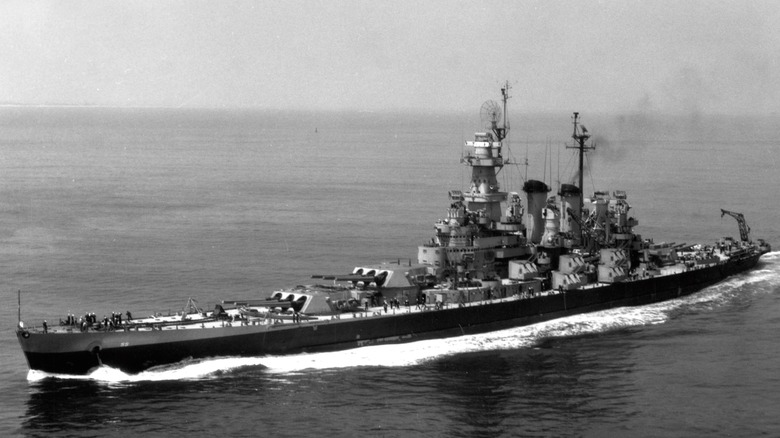
The Navy scrapped its planned South Dakota-class battleships and skipped to the North Carolina-class, which included the USS North Carolina (BB-55) and the USS Washington (BB-56). The 35,000-ton battleships joined the fleet in 1941, making them the newest battleships the U.S. Navy commissioned in nearly two decades. Primary armament consisted of nine 16-inch/45 caliber Mk. 6 guns, which packed a serious punch, placing firepower over protection and speed in the ships' design.
The USS North Carolina participated in numerous campaigns, including the one at Guadalcanal as well as the Battle of the Eastern Solomons. The battleship returned home and was decommissioned in 1947. In 1960, it was transferred to the state of North Carolina, which converted it into a museum ship. The USS Washington also fought at Guadalcanal and participated in various Pacific operations, including the Battle of the Philippine Sea and the Marianas invasion.
While operating in the Marshalls, the Washington's bow was crushed when it collided with the USS Indiana (BB-58), taking it out of the fight for several months before rejoining the fleet in June 1944. After the conflict ended, the Washington transferred troops home and was decommissioned in 1947. In 1961, the Navy pulled the ship out of its reserve fleet and sold the Washington for scrap.
South Dakota
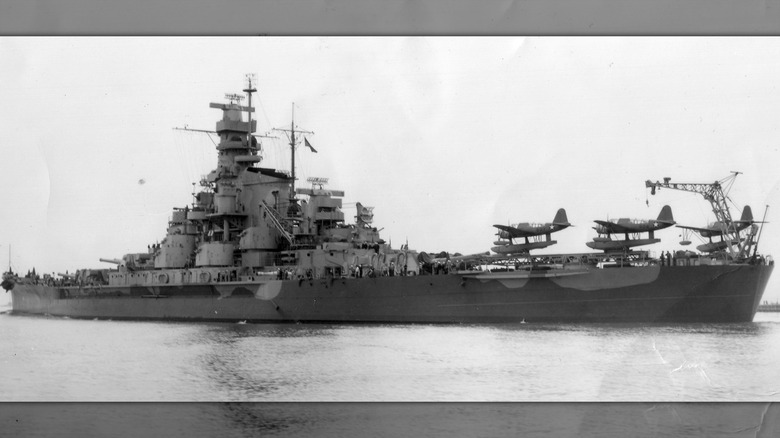
After canceling the original South Dakota-class battleships, the Navy used the name once more for its newest class commissioned in 1942. These included the USS South Dakota (BB-57), USS Indiana (BB-58), USS Massachusetts (BB-59), and the USS Alabama (BB-60), each of which displaced 35,000 tons of seawater. The class' ships featured many of the same upgrades and improvements as the North Carolina-class battleships, but with better protection.
They boasted additional anti-aircraft protection, which defended the USS South Dakota and its damaged forward turret after a bomb strike during the Battle of the Santa Cruz Islands. It continued to serve throughout the Pacific theater before returning home for deactivation in 1947. The South Dakota remained inactive until it was sold for scrap in 1962. The USS Indiana fought against Japan in the Pacific across numerous operations. It also returned home to deactivation in 1946 and was sold for scrap in '63.
The USS Massachusetts participated in the invasion of North Africa before heading to the Pacific, where it served until the conflict's conclusion. It was decommissioned and later transformed into a museum ship at Fall River, Massachusetts. The USS Alabama protected the Eastern coast of the U.S. before making its way to the Pacific, where it served throughout the war. It was decommissioned in 1947 and became a museum ship in 1964 at Mobile, Alabama.
Iowa
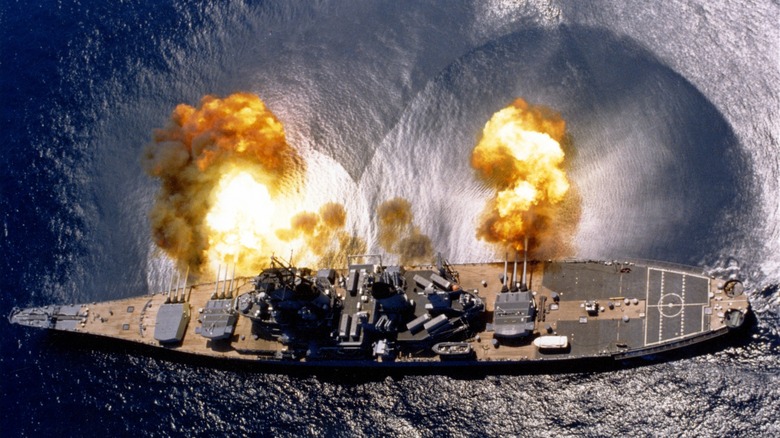
These days, when people think of battleships, they likely picture one of the four Iowa-class battleships. These were the last class of battleships the U.S. Navy used, and they all played an important role during WWII. The 45,000-ton vessels were fast, cruising up to 40.5 mph, which was considerably faster than preceding battleships. The four that served were the USS Iowa (BB-61), USS New Jersey (BB-62), USS Missouri (BB-63), and the USS Wisconsin (BB-64).
The USS Iowa first served in the Atlantic before making its way to the Pacific, where it participated in numerous campaigns. After the war, it was mothballed, but returned to service with a significant modernization that kept it active until 1990. The USS New Jersey also started in the Atlantic before moving to the Pacific as the flagship of the Third Fleet. After WWII, the New Jersey served in the Korean and Vietnam Wars and was modernized, enabling its service until 1991.
The USS Missouri, best known as "Mighty Mo," fought at Iwo Jima and Okinawa. It was the site of the Japanese surrender on September 2, 1945. After WWII, the Mighty Mo served in the Korean War and Operation Desert Storm, after which it was decommissioned. The USS Wisconsin served in the Pacific at the Philippines, Iwo Jima, and Okinawa. It served during the Korean War and Operation Desert Storm before being decommissioned in 1991. All four Iowa-class battleships continue to operate as museum ships.