

5 Cars You Might Not Expect To Have Manual Transmissions
You're not exactly spoiled for choice when it comes to cars sporting a third pedal, at least in the United States. A lot of places in Europe have a generous population of cars with manual transmissions, but America generally preferred the automatics for decades at this point. This led to most of the more desirable everyday cars either having hardly any available with a manual, or the transmission type simply not existing at all in the model line. Luxury cars, crossovers, tech-packed SUVs and pickups, and so on are all generally the worst-off.
Throughout history, there have been a wide variety of car types we've long-associated with automatic transmissions, and that's for a variety of reasons depending on who you ask. But generally it's just an expectation at this point that most regular cars have automatics unless it's an enthusiast car or some older, extremely basic model. So it might come as a surprise to learn that there's actually a wide variety of cars that fall outside that bell curve — cars that you wouldn't look twice at in a grocery store parking lot, but you happen to catch a glimpse of a manual shifter and go, "Huh. That's weird."
Due to the nature of manuals being more popular in Europe, we'll discount foreign-market specific stuff and focus only on cars sold in the United States. Moreover, we'll also discount enthusiast cars specifically marketed as having manual transmission options, like the now-deceased Cadillac Blackwing — these are cars where you'd never think they have a stick shift, they just do for whatever reason. Let's get into it.
Ford Taurus 5MT wagon
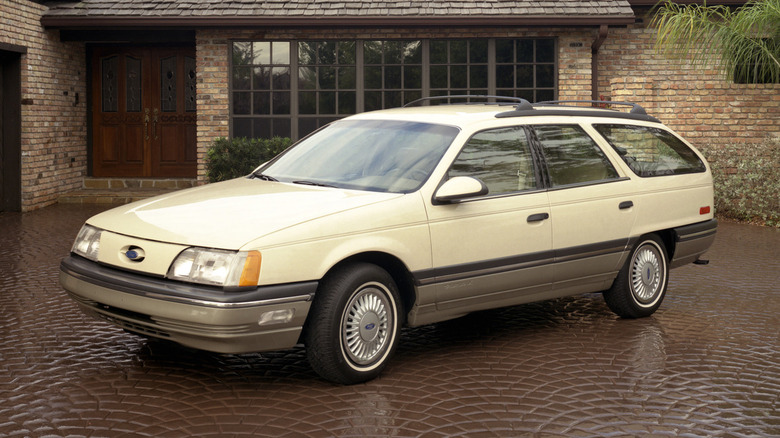
The Ford Taurus is a car that needs no introduction, whether you're an enthusiast or not. It's one of the most famous and aggressively regular Ford cars ever built, and all the better for it. This was in the mid-1980s, right at the tail end of the Malaise Era. Automakers were entering into a transitional period, going from the big, underpowered boats of the late-1970s to sleeker, handsome sedans of the 1990s. That transition occurred, in no small part, because of this car.
It's tough to understate the significance of the Taurus. It proved insanely popular and iconic, becoming a poster child for the middle-class luxury car for the best part of 40 years. Every single Taurus model year, it's featured only automatics — unless you got the SHO super-sedan, of course. But a regular Taurus, not a chance, and certainly not a wagon. That is, unless you go way back to 1986 when it was first released. That and the 1987 model years were the only times you could order a Taurus wagon with a third pedal; the mythical MT-5 trim.
While the MT-5 continued in sedan format until 1988, making it three model years total, the wagon was even more scant. There's no official sales figure reliably describing each trim level, but it's fairly safe to assume that these things barely sold with manuals at all, much less in wagon form despite the brochure officially listing it as an option. That's likely why finding a factory manual Taurus wagon today is like finding a $100 bill lying in the middle of a busy New York sidewalk.
Subaru Forester
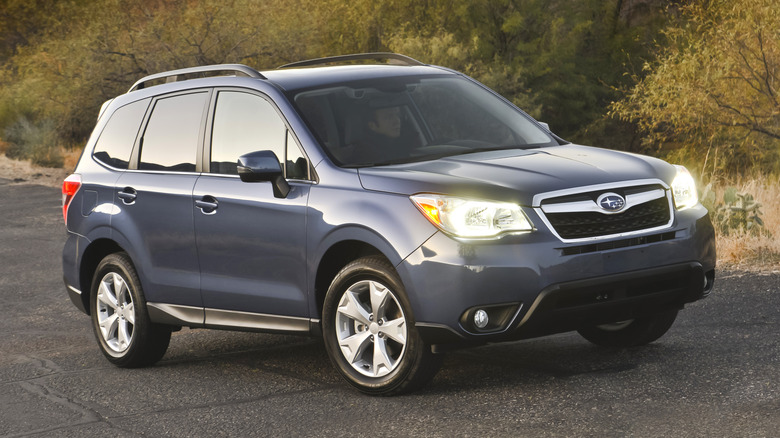
Alright, let's forget the early hatchback Foresters from the 1990s; we all know those things came with manual transmissions more often than not. We're talking about the modern Forester crossover, the one which blends into traffic so hard it might as well be the auto-generated NPC of the car world, with its only major distinction being that it has that boxer engine Subarus are known for.
Its fourth generation is the realization of this vision, produced from model years 2014 to 2018 during the height of the modern crossover era. Most cars you encounter here unsurprisingly come with CVTs — obviously the Forester did with its Lineartronic CVT, as did the Nissan Rogue, Toyota RAV4, and all the other normal crossovers for the most part. But with the Forester, if you ordered an absolute base-model example with the naturally-aspirated 2.5 boxer engine, it actually came with a manual transmission as standard all the way until its expiration in 2018. To repeat, this is a normal, family crossover with a 170 hp boxer four, boasting a six-speed for some reason.
For one, not many crossovers offered manual transmissions in the first place. Sure, you had cars like the Jeep Renegade, but these were more specialized to a sportier market. All the closest analogues to the Forester, be it American or Asian, all had CVTs or automatics. Even the basest base-model Honda CR-V came standard with a five-speed automatic in 2014. The Forester, then, represents the end of an era for the average family car, being effectively the last popular vehicle of its class where you could feasibly find one with a manual transmission on the used market.
Chrysler minivans until 1994
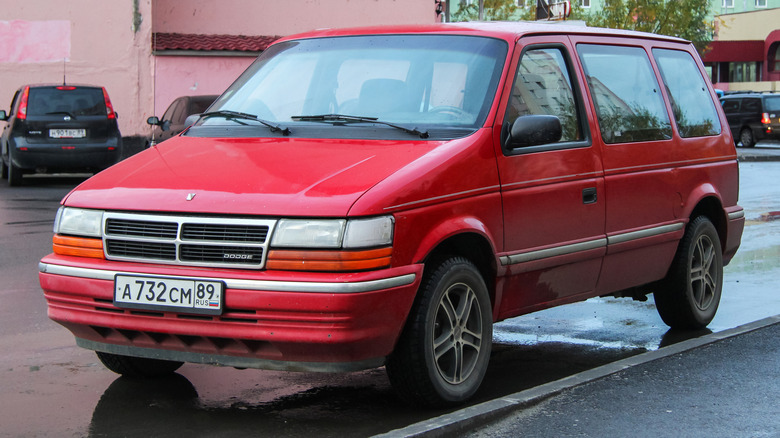
The Chrysler K-platform minivan was basically the Ford Model T of MPVs and minivans. Sure, minivans existed before Lee Iacocca's magnum opus of 1984, but the automotive climate would be incredibly different today without their influence. These vans signaled the beginning of the end for the station wagon, ushering in a new era of family transportation for the masses. And sure, it might not come as a surprise that some of these early ones had manuals; that wasn't uncommon for any car of that era. But by 1994? And in a minivan sold in America, no less?
These weren't spartan or archaic like a Ford Aerostar, either. This was the second-gen Plymouth Voyager, Dodge Caravan, etc. You had a whole host of extras in them — supple captain's chairs up front with a tape deck between them, electronic warning light displays, available dual-zone climate control, speakers in the trunk, and a huge number of cubbies and ashtrays in the back so your kids had places to put their cigarettes. Meanwhile, what's funny is that Chrysler advertised all of this, but didn't bother to list the manual transmission or 2.5-liter engine it was paired with in the 1994 brochure despite apparently building them.
In hindsight, it makes sense as to why these likely didn't sell well. For one, having your kid come up and bonk their head on a prominent shift knob while you're driving isn't ideal, and the manual transmission was falling out of fashion by this point anyway. But rowing gears did serve as a nice distraction from being forced to listen to a mail-in Kidz Bop tape for the 147th consecutive time.
Second-generation Porsche Cayenne
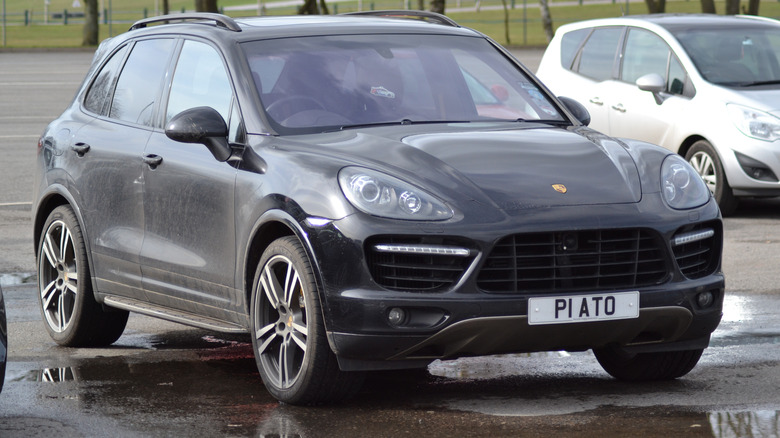
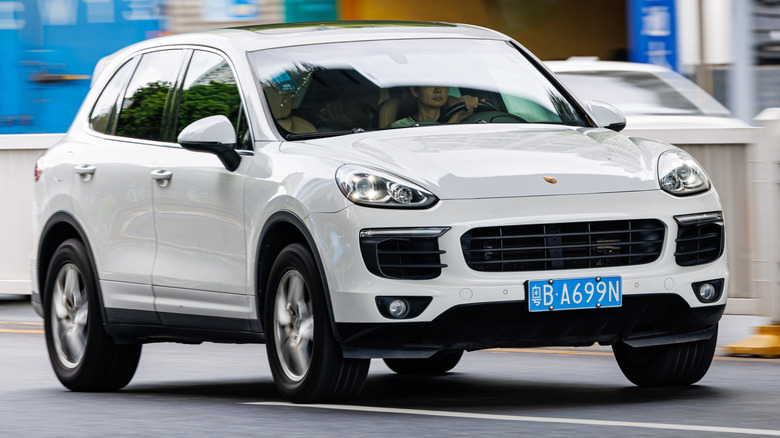
As far as crossovers go, the Porsche Cayenne is definitely on the higher end of the expense scale. It's a positively upper-middle class automobile and has been since its introduction, which is appropriate, considering how famously expensive Porsches tend to be, especially higher-end models like the 911 GT3 RS. It's generally safe to assume that these sportier vehicles come with manuals; Porsche's 911 lineup is famous for its analogue, driver-centric experience, making it the perfect car to boast a pure manual gearbox. But then you have the luxury crossover entry in the German marque's lineup, which apparently came with a six-speed all the way until 2014.
Granted, the manual was only available in the base-model Cayenne, not even the diesel or Cayenne S. Even so, that's like going to a fresh, artisan burger place and ordering a juicy burger with nothing but ketchup. Yeah, it doesn't have all the bells and whistles, but it's still a Porsche. It's inherently a step above a lot of other vehicles in its class as far as the weight that badge carries, at least when it comes to luxury. It's also about the furthest thing one would expect to find a manual transmission in, but there you go.
Oddly, this is a case of reverse downgrading — the Cayenne is based on the Volkswagen Touareg, but the 2014 Touareg didn't actually come with a manual transmission in the United States, whereas the more upscale Cayenne did, like a vestigial organ from its performance-oriented heritage. Granted, it's a welcome one, because a modern luxury crossover with a factory manual is an awesome novelty.
Toyota Tacoma
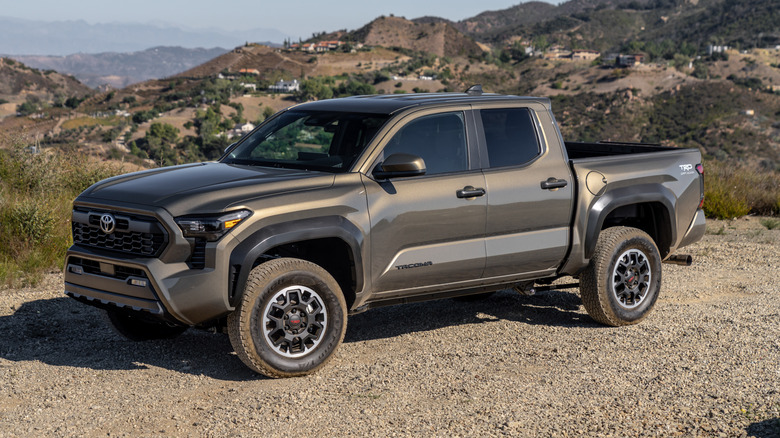
Apart from luxury vehicles, if there's one other class of car we would never associate with manual transmissions these days, it's pickup trucks. Certainly in America, where we kissed goodbye to the Big Three's contribution to manual transmission trucks with the heavy duty Ram 2500 in 2019. As we all know, most trucks used to have basic manual transmissions and little else, but those days are long gone. It's just one part an ever-growing trend among trucks in general to include every piece of technology under the sun, with automatic transmissions being virtually a given.
There is one truck that defies that trend, however — well, in the transmission department, anyway; it's still just as crammed with tech as everything else, at least in the TRD Off-Road or TRD Sport options. However, you could also get a manual Tacoma in an absolute base-model SR trim with the same engine, a 2.4-liter turbo four-cylinder producing 270 hp. It's a positively middle-of-the-road vehicle as far as the power and specs are concerned, with all the usual refinements one would expect of a 2026 midsize truck, just with a six-speed as standard equipment.
Being the last midsize truck in North America with a six-speed works well for the Tacoma because, let's face it — having a monopoly over a market has its perks. That's certainly true these days, considering there's a resurgence of manual transmissions in the enthusiast sector, which is likely one of the reasons why Toyota's still offering its TRD lineup with the six-speed. Moreover, like many other modern manuals, the Tacoma's transmission has various user-friendly options like automatic rev-matching, being marketed as an iMT or intelligent manual transmission.